How to Adjust ISO on DJI Drone
Peter Leslie
22 May 2026

If the footage from a DJI drone is coming back blown out, muddy in the shadows, or hunting around in brightness from one clip to the next, the control to lock it down is the ISO row inside DJI Fly. ISO sets how sensitive the sensor is to the light hitting it, and on every current DJI drone the slider only becomes adjustable once the camera mode is switched out of Auto.
Quick guide
To adjust ISO on DJI Drone, go to DJI Fly → Camera View → camera mode icon set to Pro → tap the live preview → ISO row → Auto off → drag the slider. Pro mode is the gate — the ISO row stays locked while the camera is in Auto.
Drones this applies to
The same Pro-mode path covers every current DJI drone that ships through DJI Fly:
- DJI Neo 2
- DJI Mini 5 Pro
- DJI Avata 2
- DJI Air 3 Pro
- DJI Mavic 4 Pro
Step-by-step: How to Adjust ISO on DJI Drone
Follow these top to bottom the first time, and you will know the path off by heart the second time.
Open DJI Fly and drop into the DJI drone camera view
With the DJI drone powered on and the remote controller connected, launch DJI Fly and tap Go Fly to enter the camera view. The live feed from the drone fills the screen with the shooting controls stacked in a column down the right-hand edge.
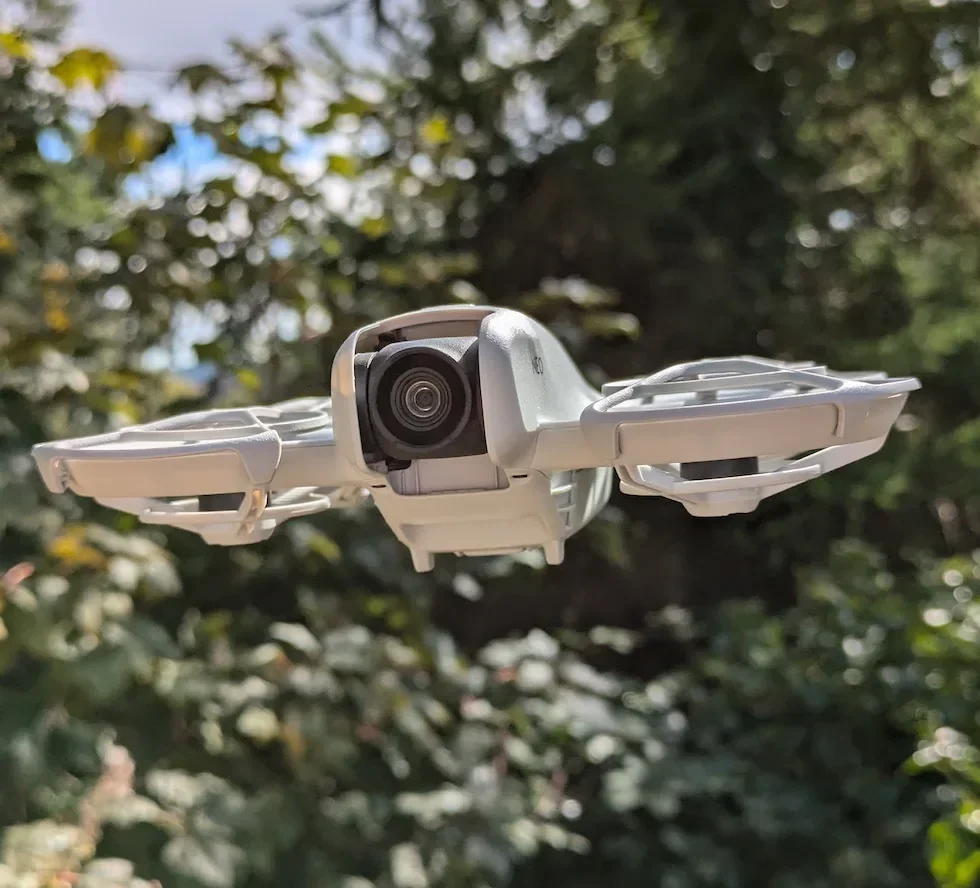
Tap the camera mode icon on the right-hand column to switch into Pro
Look at the camera mode icon near the foot of the right-hand control column — it reads Auto or Pro depending on which mode the camera is in. Tap it once to flip the camera into Pro. The label on the icon now reads Pro, and three new rows appear higher up the column for shutter speed, exposure value, and ISO.
Tap the live preview to open the shooting parameters panel
With Pro mode showing on the icon, tap anywhere on the live preview area of the camera view. A shooting parameters panel slides in over the live feed and groups the exposure controls into named sections. The exposure rows you came here for sit inside the camera shutter section.
Scroll to the camera shutter section and find the ISO row
Inside the parameters panel, scroll until the camera shutter section is in view. ISO sits as one row inside that section alongside shutter speed and exposure value. The current ISO setting is printed on the right of the row — it reads Auto if the camera is metering for you, or a fixed number if you have already set one.
Tap the ISO row and switch the Auto toggle off
Tap the ISO row to expand it. The first control inside the expanded row is an Auto toggle — flip it off so the camera stops metering ISO on your behalf. With Auto off, the row collapses into a horizontal slider showing the manual ISO values you can choose between.
Drag the slider to the ISO value you want for the shot
Drag the slider left for a lower ISO and a cleaner image, right for a higher ISO and a brighter exposure when the light is failing. The live preview behind the panel reacts as you scrub, so you can read the exposure on the feed rather than guessing at numbers.
Tap off the parameters panel to lock the value and return to the camera view
Tap anywhere outside the parameters panel to close it. The ISO value you set sticks until you change it again or toggle the row back into Auto. Power-cycling the DJI drone does not reset the value mid-session — the camera holds it across short breaks.
Check the ISO readout on the right-hand column before you fly
Back on the camera view, the ISO row in the right-hand column now shows the fixed value rather than Auto. That readout is your sanity check before launch — if it still reads Auto, the toggle did not take and the camera is still metering on its own.
Peter's tip
I set ISO last, not first. Shutter speed gets locked to twice the frame rate, exposure value gets nudged to taste, and only then do I touch the ISO slider — pulling it down to the lowest value the live preview lets me get away with. That order keeps the footage cinematic and the grain in the shadows under control across every DJI drone I fly, instead of letting a high ISO eat the detail before the other two controls have done any work.
ISO range by DJI drone
The procedure does not change between models, but the values inside the slider do. The native ISO band is set by the sensor, so a small-sensor drone tops out lower than a larger-sensor drone. The numbers below are the manual ISO range shown on the slider in Pro mode.
| DJI drone | Pro mode ISO range |
|---|---|
| DJI Neo 2 | 100 to 12800 |
| DJI Mini 5 Pro | 100 to 25600 |
| DJI Avata 2 | 100 to 25600 |
| DJI Air 3 Pro | 100 to 25600 |
| DJI Mavic 4 Pro | 100 to 25600 |
Frequently asked questions
What ISO range does each DJI drone cover in Pro mode?
The slider draws from the native ISO range of the sensor inside each DJI drone, so the bottom of the range stays at one hundred across the current line-up but the top differs. The DJI Neo 2 caps at twelve thousand eight hundred, while the DJI Mini 5 Pro, DJI Avata 2, DJI Air 3 Pro, and DJI Mavic 4 Pro all extend to twenty-five thousand six hundred. The per-drone table further down the article lists the exact ranges side by side.
Why is the ISO row greyed out on my DJI drone?
The camera is still in Auto mode. ISO can only be set by hand once the camera mode icon on the right-hand control column of DJI Fly is showing Pro. Tap that icon to flip the mode across, then come back to the shooting parameters panel — the ISO row is now active and the Auto toggle inside it is what you turn off.
What ISO should I shoot at on DJI Drone during the day?
Keep the ISO at one hundred — the lowest value any current DJI drone slider lets you pick — for daylight flights. The bright outdoor light gives the sensor plenty to work with, and the low ISO keeps the footage clean. If the exposure is still too bright at ISO one hundred with a frame-rate-friendly shutter, that is the cue to fit an ND filter rather than to raise ISO.
What ISO should I shoot at on DJI Drone at dusk or low light?
Raise ISO only after you have already opened the shutter as far as your frame rate allows. The order is shutter first, ISO second — pushing ISO too early introduces sensor noise that no grade in post will recover. Step the slider up one stop at a time, watching the live preview, until the exposure on the feed matches what you want to record.
Will a high ISO make my DJI drone footage noisy?
Yes — small drone sensors get noisy fast once ISO climbs above the cleanest band. Every current DJI drone is the same in that respect, although the larger sensors on the DJI Air 3 Pro and the DJI Mavic 4 Pro hold cleaner detail higher up the slider than the smaller sensors on the DJI Neo 2 or the DJI Avata 2. Treat the upper third of the ISO slider as an exposure rescue rather than a creative choice.
Can I change ISO mid-flight on a DJI drone?
Yes. The Pro mode parameters panel is one tap away from the live camera view, and the slider responds immediately, so you can re-set ISO while the drone is hovering or moving. Just stop recording before you scrub the slider — the value change is visible on screen and will land in the middle of the clip if you do not pause first.
Does ISO change differ between photo and video on DJI drones?
The path to the ISO row is the same on every current DJI drone — Pro mode, parameters panel, ISO row, Auto off, drag the slider. The exact values shown on the slider can differ between photo and video because the available stops are tied to the shooting format. The procedure to find the row and pick a value does not change.
Does Auto ISO on DJI drones work well enough to leave on?
For grab-and-fly footage where the light is even, yes — Auto ISO meters scene by scene and the exposure stays watchable. For locked shots, matched footage across multiple clips, or anything in mixed lighting where you have already set shutter manually, switch Auto off. Auto ISO will keep hunting between values and the brightness across the timeline will drift in a way you cannot fix in post.
Manual ISO on a DJI drone is the single biggest lever for moving footage from snapshot to cinematic. Pair it with a locked shutter and the right ND filter, and the drone starts producing clips that will cut into a sequence shot on a bigger camera without sticking out.
If you are not sure which ISO suits the kind of flying you are doing, drop the details to peter@hiredronepilot.uk and I will come back to you directly. The video version of this walkthrough is on YouTube and the comments are open.
References
Primary source material for this article is the official DJI product documentation and DJI Fly. External links open in a new tab.
- DJI UK product line-up · Current DJI drones shipping with DJI Fly: Neo 2, Mini 5 Pro, Avata 2, Air 3 Pro, and Mavic 4 Pro.
- DJI Fly — App download and release notes · The app where the camera view, the Auto / Pro toggle, and the ISO slider all live. Release notes record any layout changes between app versions.
- DJI Support — product specifications and downloads · Per-drone ISO range, sensor size, and shooting mode notes used to fill the comparison table.
Peter Leslie
Founder & GVC Drone Pilot
Peter is the founder of HireDronePilot. With thousands of logged commercial flight hours, he writes about drone technology, commercial surveying tactics, and UK aviation compliance.
Connect on LinkedIn