How to Change the Transmission Frequency on DJI Drone
Peter Leslie
22 May 2026
If the live feed on your DJI drone keeps stuttering, breaking up, or dropping at short range, the setting you are looking for is the Frequency Band selector inside DJI Fly. Most drone pilots flying in town are sitting on a saturated 2.4 GHz band without realising the remote can swap to 5.8 GHz with one tap.
Drones this applies to
DJI Neo 2, DJI Mini 5 Pro, DJI Avata 2, DJI Air 3 Pro, DJI Mavic 4 Pro. The same procedure works on any drone running DJI Fly v1.21.2 or later — only the bands actually offered in the selector vary by region and by which remote controller is paired.
Quick guide
To change the transmission frequency on DJI Drone, go to DJI Fly → Settings → Transmission → Frequency Band, then tap Auto, 2.4 GHz, or 5.8 GHz. Auto lets the app hop between bands, 2.4 GHz favours range, and 5.8 GHz favours a clean signal in busy environments.
Step-by-step: How to Change the Transmission Frequency on DJI Drone
Follow these top to bottom the first time, and the path is muscle memory the second time. The labels and order are identical on every drone in the callout above — the screenshots are taken on a DJI Neo 2.
Open the DJI Fly Settings menu from the camera view
With the drone connected and DJI Fly on the live camera view, tap the Settings icon in the top right of the screen. The settings panel slides in from the right with the category tabs running down the left edge.
Tap the Transmission category in the Settings panel
Transmission sits down the left of the Settings panel underneath Safety and Control. Tap it and the right-hand pane updates to show the live signal-strength readout, the channel-quality graph, and the Frequency Band selector at the top of the list.
Find the Frequency Band row at the top of Transmission
The Frequency Band row is the first item inside the Transmission pane. It renders as a segmented control with three pill-shaped options laid out side by side, and the band you are currently using is filled in with the brand colour while the other two sit greyed out.
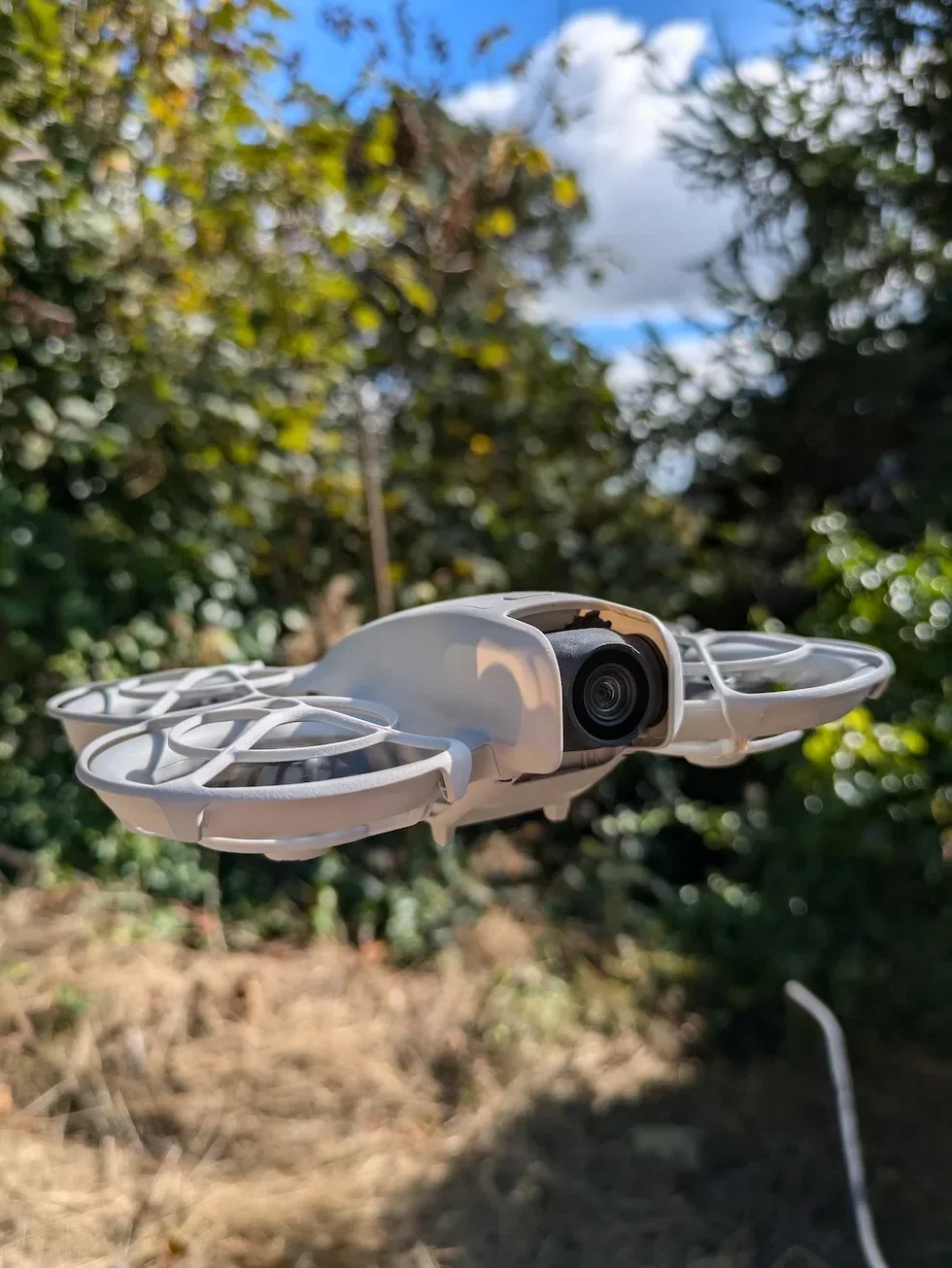
Tap Auto to let DJI Fly pick the cleaner band on the fly
Auto is the default selection and the right pick for almost every flight. DJI Fly monitors both bands continuously and switches the active one to whichever is cleaner in the moment. The handover is seamless and the live feed does not visibly drop during the switch.
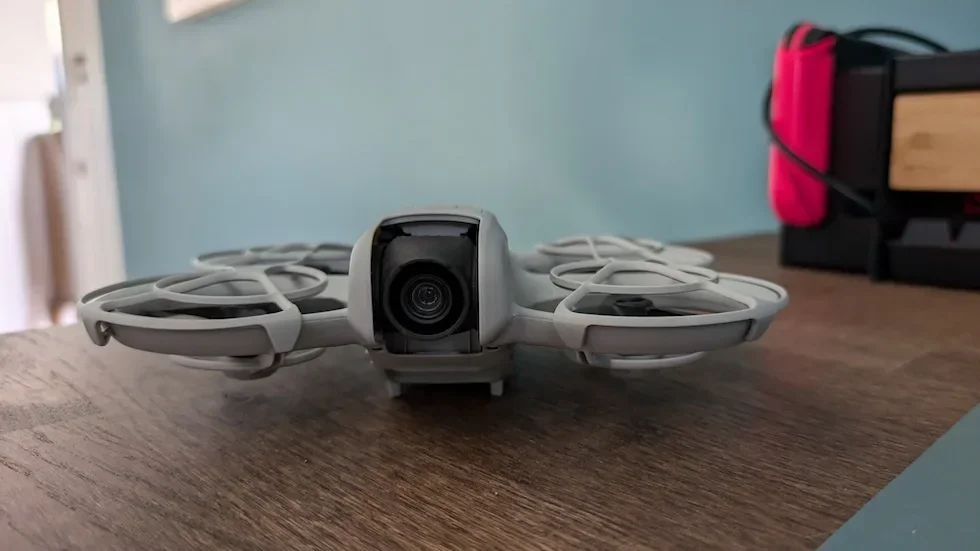
Tap 2.4 GHz to lock the link to the longer-range band
2.4 GHz penetrates light obstacles and holds the link further out in open countryside. Tap the 2.4 GHz pill if you are flying far from the home point with a clear horizon and you want the band that physics favours for distance. The signal bars in the top status bar update within a second.
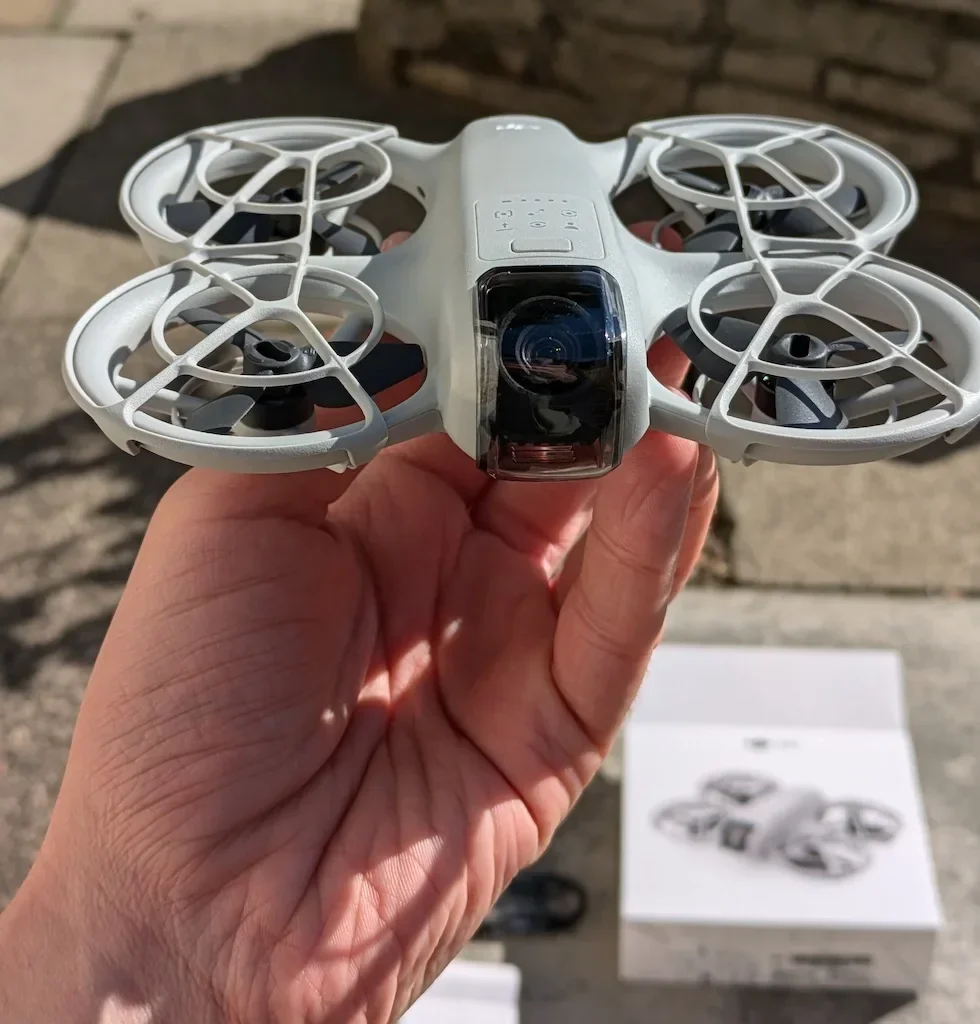
Tap 5.8 GHz to lock the link to the cleaner urban band
5.8 GHz is the band to pick when 2.4 GHz is saturated by Wi-Fi and Bluetooth — town centres, busy parks, rooftops with dozens of nearby networks. The range is shorter in open air, but the band is much cleaner where consumer devices have crowded 2.4 GHz to a standstill.
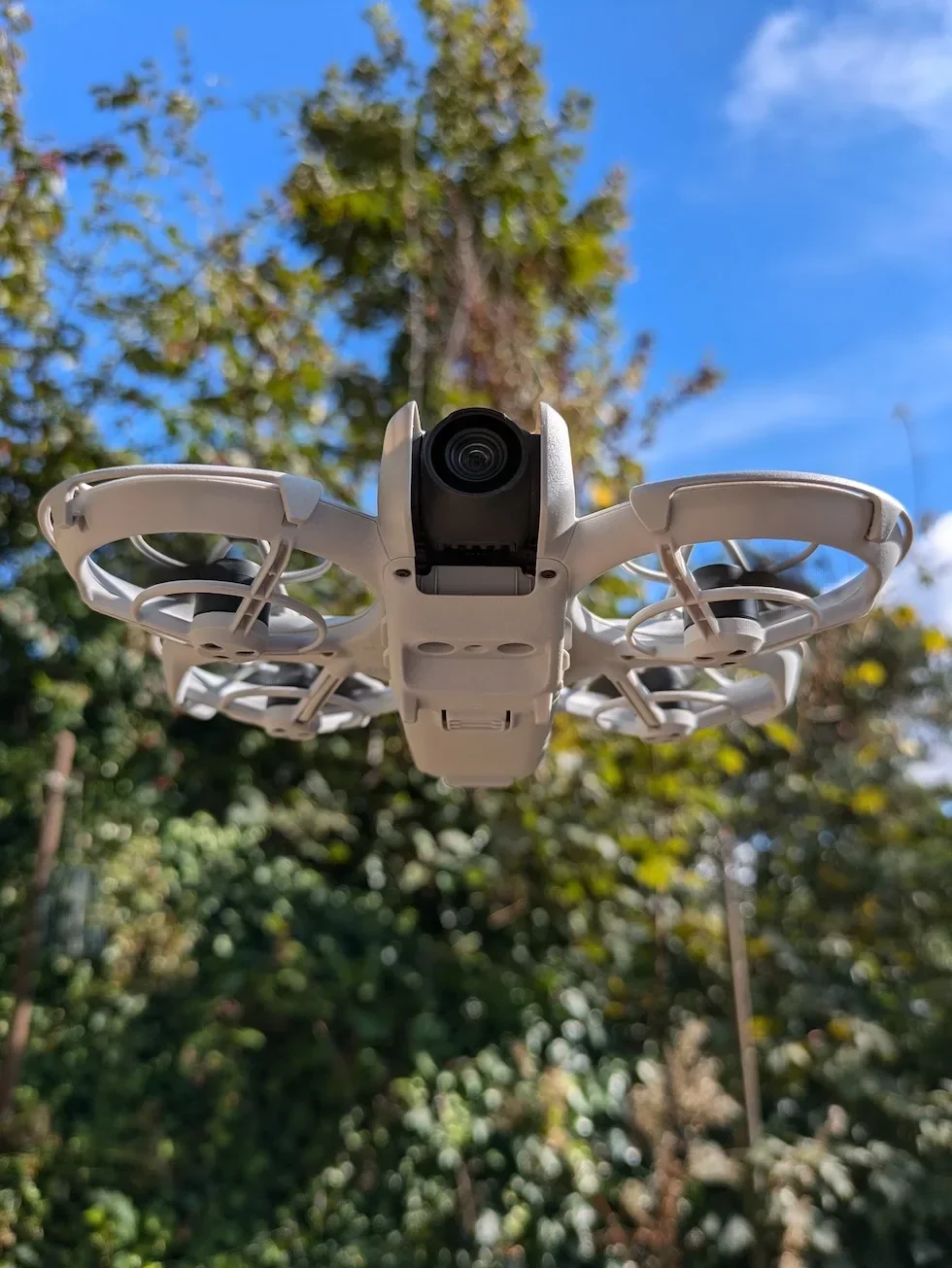
Watch the signal indicator settle on the new band
After the tap, the signal bars in the top status bar drop briefly and then settle on the new band. The channel-quality graph in the Transmission pane redraws with the new readings so you can see immediately whether the band you just picked is actually cleaner than the previous one.

Close the Settings panel and return to the camera view
Tap the X in the top right of the Settings panel, or tap anywhere on the camera view behind it, to close out. The Frequency Band selection persists across power cycles, battery swaps, and app restarts until you tap a different option.
Peter's tip
I leave the band on Auto for the vast majority of flights. The only time I lock it manually is when the channel-quality graph in Transmission shows one band is obviously clean and the other is hammered — and even then, I switch it back to Auto before the next session, because the right answer in the next location is almost always different.
Auto vs 2.4 GHz vs 5.8 GHz
Three options, three very different outcomes. Use this table to pick before the flight, not during one.
| Frequency Band | What it does | When to pick it |
|---|---|---|
| Auto | DJI Fly switches between 2.4 GHz and 5.8 GHz on the fly based on real-time interference readings. Handover is seamless and the live feed stays connected through the switch. | The default and the right answer for almost every flight. Leave this selected unless you have a specific reason to lock the band. |
| 2.4 GHz | Locks the link to the lower band. Longer range in open air, better at penetrating light obstacles, noisier in built-up areas where Wi-Fi and Bluetooth crowd the same spectrum. | Long-range flights with a clear horizon and a quiet 2.4 GHz environment — fields, coastline, hills. |
| 5.8 GHz | Locks the link to the higher band. Shorter range in open air but much cleaner in cities where the 2.4 GHz band is saturated by consumer devices. | Urban flights, busy parks, rooftops, anywhere the channel-quality graph shows 2.4 GHz hammered with interference. |
Frequently asked questions
Which transmission frequency should I leave a DJI drone on by default?
Auto. It lets DJI Fly hop between 2.4 GHz and 5.8 GHz as interference moves around, and that is the band you want for almost every flight. Lock the band manually only when you have already identified which frequency the local environment is clean on.
When should I lock a DJI drone to 2.4 GHz instead of Auto?
When you are flying at longer range with a clean horizon and the 5.8 GHz band is congested. 2.4 GHz penetrates obstacles a little better and tends to hold the link further out, at the cost of being noisier in urban areas where everyone is on Wi-Fi and Bluetooth.
When does 5.8 GHz make sense on a DJI drone?
In a busy 2.4 GHz environment — a town centre, a rooftop with dozens of nearby Wi-Fi networks, or any indoor flight where 2.4 GHz is saturated. 5.8 GHz is cleaner there because fewer consumer devices use it, even though the band has less range in open air.
Is 5.8 GHz legal to use in the UK on a DJI drone?
Yes for most of the band. Ofcom allows the 5.8 GHz licence-exempt SRD band for drone video links, and DJI ships the UK firmware configured to comply. DJI Fly gates the band selector by region, so if 5.8 GHz appears in your Transmission menu it is permitted where the drone is currently flagged.
What if the 5.8 GHz option is missing from the Transmission menu?
The regional flag on the drone or the remote does not allow 5.8 GHz. This happens when the firmware locale is set to a country where the band is restricted. Update the firmware on both the drone and the remote, confirm the DJI account country matches where you are flying, and the option should reappear.
Will changing the frequency band affect video quality?
Indirectly. The recorded footage on the microSD card is unchanged, but the live feed bitrate depends on signal strength. A cleaner band gives a sharper live view in DJI Fly, which makes flying easier even though the file on the card is identical.
Does the frequency band reset to Auto after a flight or a battery swap?
No. The selection persists across power cycles, battery swaps, and app restarts. The only way the band changes is if you tap a different option in the Transmission menu, or if you reset the drone to factory defaults.
Does the DJI RC 2 have the same Transmission menu as the DJI RC-N3?
Yes — the menu path is the same on any current DJI remote. Settings then Transmission then the Frequency Band selector. The DJI RC 2 renders the menu on its built-in screen, while the DJI RC-N3 surfaces it on the connected phone.
The frequency band on any current DJI drone is one of those settings that earns its keep the day the live feed starts breaking up for no obvious reason. A two-tap switch to the cleaner band is often the difference between a calm flight and a scramble back to the home point.
Got a DJI Fly Transmission menu that does not look the way I have described, or a band that refuses to switch despite a clean tap? Drop a note to peter@hiredronepilot.uk with the firmware version DJI Fly is reporting and I will come back to you directly. The video version of this walkthrough is on YouTube with comments open.
References
Primary source material for this article is the official DJI user documentation for each drone in the callout and DJI Fly. External links open in a new tab.
- DJI Fly — App download and release notes · The app where the Transmission menu and Frequency Band selector live across every current DJI drone. Release notes record any menu reshuffles between versions.
- DJI — UK consumer drone product line-up · Per-drone user documentation carries the Optimal Transmission Zone diagram, 2.4 GHz and 5.8 GHz band coverage notes, and the DJI Fly Settings menu reference.
- Ofcom — Licence-exempt radio use (2.4 GHz and 5.8 GHz SRD bands) · The UK regulatory frame that makes both bands available for consumer drone video links without an individual licence.
Peter Leslie
Founder & GVC Drone Pilot
Peter is the founder of HireDronePilot. With thousands of logged commercial flight hours, he writes about drone technology, commercial surveying tactics, and UK aviation compliance.
Connect on LinkedIn