Best Drone for Roof Inspections: What I’d Fly Over My Own House

Peter Leslie
31 July 2026 · 19 min read
There is a wet patch on a ceiling, or a tile in the garden after a gale, and somebody has quoted you an uncomfortable amount of money simply to put a tower up and go and look. That is how most people end up reading a page like this one.
Almost every guide will now hand you a list sorted by camera. That is the wrong sort first. A roof inspection is decided by two numbers, and neither of them is megapixels: how small a thing you have to be able to see, and how close you are prepared to fly to a chimney to see it. Those two numbers fight each other, and everything else on the spec sheet is a footnote to the fight.
Worked out that way, the best drone for roof inspections in 2026 is not the one with the biggest sensor. It is the one that resolves a cracked slate from a distance at which hitting the house is not really on the table.
I have flown every DJI drone in the list below, and the thing that surprised me when I put the arithmetic on paper is how little the expensive sensors help. Four of these drones land within two per cent of each other on the only measurement that matters for spotting damage. What separates them is what they can see coming, and how far back you can stand.
So this guide asks four questions about the roof you are actually looking at, narrows ten drones to the one that suits it, and then does the resolution maths properly — including the part where the answer is that you should not be buying a drone at all.
How I get paid: the Amazon links below are affiliate links, so if you buy through one I earn a small commission at no extra cost to you. It does not change what I recommend — two of the ten drones here have no buy link at all, and the last section of this article is an argument for not buying anything.
The Best Drone for Roof Inspections in 2026 Is the DJI Mini 5 Pro
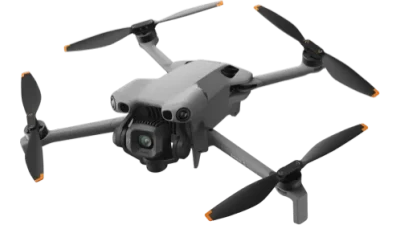
It sees a roof in enough detail to argue with a roofer, and it sees the chimney coming from every direction while it does it.
- About 1.8 mm of roof per pixel from ten metres away — a slipped tile, a gap in the pointing and a lifted ridge are all obvious.
- Obstacle sensing in every direction, plus a forward laser rangefinder, and it works down to 1 lux — dim enough for a north-facing pitch in winter.
- 249.9 grams, so you may legally fly it over a residential street with no test, no licence and no certificate — just the £12.34 registration you do online.
- Around 30 minutes of real flying per battery. DJI advertises 52, but only on the bigger battery that takes it over 250 grams.
Affiliate link · costs you nothing extra · full disclosure
PART ONE
Here are the five that win their categories — and the honest problem with each, because there is one every time.
Best Drone for a Look After a Gale: DJI Neo 2
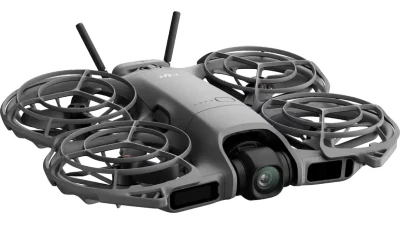
When the only question is whether a tile has gone, this answers it — and it is the cheapest drone here that watches every direction while it does.
- No test and no licence — just a £12.34 registration you do online.
- Sees obstacles in every direction — the cheapest drone here that does, and the reason it is on this page at all.
- 5.2 mm per pixel from ten metres: a slipped or missing tile is obvious, a failed mortar joint is not.
- Nineteen minutes a battery, which is one roof and not two.
Best Budget Drone for Roof Inspections: DJI Flip
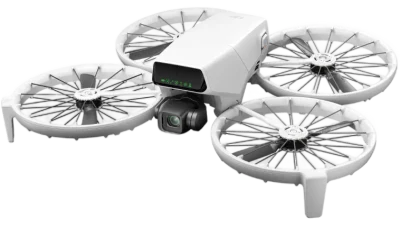
Exactly as many pixels across your roof as the drones costing three times as much. The saving is in what it cannot see.
- No test and no licence — just a £12.34 registration you do online.
- 48 megapixels on a 24 mm lens: the same 1.8 mm per pixel as the drones at three times the money.
- It watches forwards and downwards, and nothing else. Sideways and above are on you.
Best Value Drone for Roof Inspections: DJI Mini 4 Pro
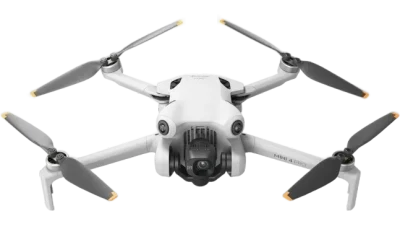
The cheapest way to get obstacle sensing in every direction with a proper 48-megapixel file behind it, and the cheapest drone here I would put on a paying job.
- No test and no licence — just a £12.34 registration you do online.
- Sees obstacles in every direction, out to 18 metres in front — but only above 15 lux.
- 48 megapixels and full raw files, so you can lift the shadow under an eave afterwards.
Best Drone for Paid Roof Surveys: DJI Air 3S
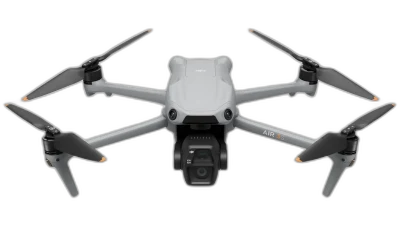
The 70 mm second camera lets you shoot detail from three times further back. On someone else’s property that is worth more than any sensor.
- A second 70 mm camera reaching 0.6 mm per pixel from ten metres — the standoff you actually want.
- No test needed today, but from January 2028 it will need the A2 test to fly near people. You are buying about eighteen months of that freedom.
- 724 grams, so you may not fly it over anybody. Over your own empty garden, fine; over a street, no.
Best Drone for Hairline Cracks: DJI Mavic 4 Pro
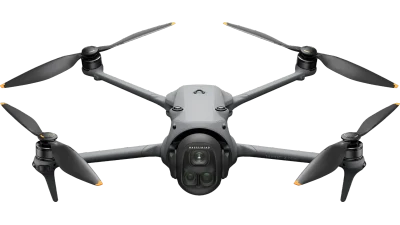
The only drone in this guide that identifies a one-millimetre crack from a distance at which nothing can go wrong.
- Needs the A2 test before you may fly it near people or houses.
- A 168 mm telephoto reaching 0.25 mm per pixel from ten metres — hairline-crack territory.
- Obstacle sensing that works down to 0.1 lux, which is effectively dusk.
Affiliate links · costs you nothing extra · full disclosure
Take the quiz: which drone suits your roof?
Four questions about the building, not about you. Then one drone.
- Matched to what you are trying to see, and what is standing next to it.
- Scored on resolution and obstacle sensing, not on marketing.
- Tells you when the honest answer is to hire somebody instead.
- About 20 seconds, and no email needed.
STEP 1 OF 4
10 of 10 still fit
All ten, and why each one might not suit your roof
-
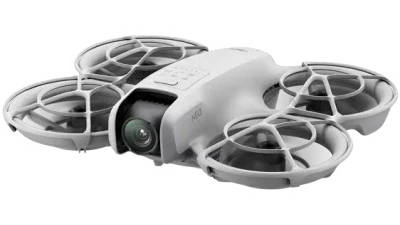
DJI Neo not enough resolution for this job
135 g · C0 · 1/2″ 12MP · 6.2 mm/px at 10 m · downward sensing only · 18 min
A lovely little thing that takes off from your palm, and the wrong tool for this by a wide margin. Its 14 mm lens spreads twelve megapixels over half the street.
- No test and no licence — just a £12.34 registration you do online.
- Twelve megapixels behind a very wide 14 mm lens. That is a holiday camera, not an inspection camera.
- It only senses the ground beneath it. Nothing watches the wall in front of it.
-
DJI Neo 2
151 g · C0 · 1/2″ 12MP · 5.2 mm/px at 10 m · omnidirectional sensing · 19 min
The cheapest drone here that watches all the way round itself, which genuinely matters near a building. The camera is still the camera off a cheap phone.
- No test and no licence — just a £12.34 registration you do online.
- Sees obstacles in every direction, which is unusual at this money and the reason it is here.
- Twelve megapixels on a wide lens. Fine for “is a tile missing”, useless for “is that slate cracked”.
-
DJI Flip
<249 g · C0 · 1/1.3″ 48MP · 1.8 mm/px at 10 m · forward + downward sensing · 31 min
The bargain of this list. It puts the same number of pixels across a roof as drones costing twice as much, and the propeller cages take the fear out of the first flight.
- No test and no licence — just a £12.34 registration you do online.
- 48 megapixels on a 24 mm lens: the same 1.8 mm per pixel as the drones at three times the money.
- It watches forwards and downwards, and nothing else. Sideways and above are on you.
-
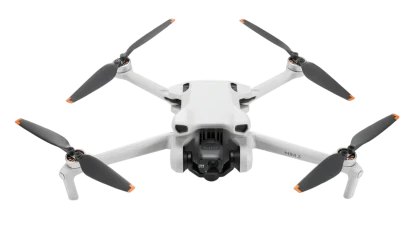
DJI Mini 3 DJI UK no longer lists it
248 g · C0 · 1/1.3″ 48MP · 1.8 mm/px at 10 m · downward sensing only · 38 min
The same camera as the Mini 4 Pro with none of the eyes. It is the clearest illustration on this page that resolution and safety are bought separately.
- No test and no licence — just a £12.34 registration you do online.
- The same 48-megapixel picture as the Mini 4 Pro, so the same 1.8 mm per pixel.
- Only the downward sensor. Near a wall, a chimney or a cable, nothing is watching for you.
-
DJI Mini 4 Pro
<249 g · C0 · 1/1.3″ 48MP · 1.8 mm/px at 10 m · omnidirectional sensing · 34 min
For two years this was the sensible answer, and for a hundred pounds less than the Mini 5 Pro it still nearly is. Its eyes want more light than the newer ones do.
- No test and no licence — just a £12.34 registration you do online.
- Sees obstacles in every direction, out to 18 metres in front — but only above 15 lux.
- 48 megapixels and full raw files, so you can lift the shadow under an eave afterwards.
-
DJI Mini 5 Pro
249.9 g · C0 · 1″ 50MP · 1.8 mm/px at 10 m · omnidirectional + laser · 36 min
A one-inch sensor and a laser rangefinder under the 250-gram line. The pixel count is ordinary; what you are buying is a picture that holds together in the shade and eyes that work in it.
- No test and no licence — just a £12.34 registration you do online.
- Obstacle sensing all the way round plus a forward laser, working down to 1 lux.
- Around 30 minutes of real flying per battery. DJI advertises 52, but only on the bigger battery that takes it over 250 grams.
-
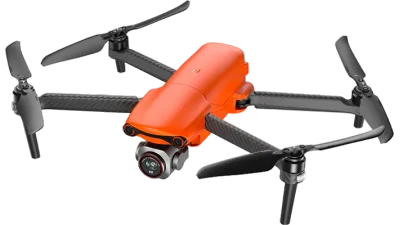
Autel EVO Lite+ no affiliate link — no UK stock I could confirm
835 g · no class mark · 1″ 20MP · forward, backward and downward sensing · 40 min
Here so this is not purely a DJI catalogue, and it makes the legal point better than any DJI drone can. Unclassed and 835 grams is a bad combination over a house.
no link- Needs the A2 test before you may fly it anywhere near a house.
- A one-inch, 20-megapixel camera — fewer pixels across the roof than the cheapest DJI here.
- I could not find UK stock, so there is no buy link for it.
-
DJI Air 3S loses privileges in 2028
724 g · C1 · 1″ 50MP + 70 mm tele · 0.6 mm/px at 10 m · omnidirectional + laser · 45 min
The second camera is the point. A 70 mm lens triples your detail at the same distance, which means you can stand three times further from the building for the same picture.
- A second 70 mm camera reaching 0.6 mm per pixel from ten metres — the standoff you actually want.
- No test needed today, but from January 2028 it will need the A2 test to fly near people. You are buying about eighteen months of that freedom.
- 724 grams, so you may not fly it over anybody. Over your own empty garden, fine; over a street, no.
-
DJI Mavic 4 Pro
1,063 g · C2 · 100MP 4/3 + 168 mm tele · 0.25 mm/px at 10 m · omnidirectional + laser · 51 min
The only drone here that can identify a hairline crack from a genuinely safe distance. It is also a kilogram of drone that needs a certificate before it may go near the house.
- Needs the A2 test before you may fly it near people or houses.
- A 168 mm telephoto reaching 0.25 mm per pixel from ten metres — hairline-crack territory.
- Obstacle sensing that works down to 0.1 lux, which is effectively dusk.
-
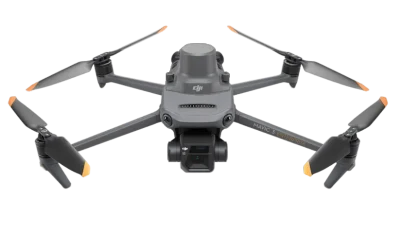
DJI Mavic 3T enterprise only — not sold to consumers
920 g · C2 · 48MP wide + 162 mm zoom + 640×512 thermal · 0.5 mm/px at 10 m · 45 min
In this list to show you what you are not buying. The thermal camera is the one instrument that finds trapped water rather than the damage it eventually causes.
no link- A 640×512 thermal camera, accurate to about ±2 °C, that sees damp behind an intact-looking roof.
- A 162 mm zoom reaching 0.5 mm per pixel from ten metres.
- Not sold in shops. If you want this data, you are hiring a pilot who owns one.
The list runs cheapest first, so the ordering is the price ordering — but the figures themselves live on Amazon, where they change weekly, so check each one on the page its link opens. Specifications checked 31 July 2026. Millimetres per pixel are computed from each manufacturer’s published 35 mm-equivalent focal length and maximum image size — the working is in Part Two. Weights, sensor sizes and flight times for the Autel are from DroneCompare, CC BY 4.0.
PART TWO
The resolution maths: what it actually takes to see a cracked slate
Every drone listing shouts a megapixel number at you, and the number is nearly useless on its own. A hundred megapixels spread over an entire terrace is a worse picture of one slate than twelve megapixels aimed at one slate. What you need instead is a single figure that surveyors have used for decades: ground sample distance, or GSD.
GSD is how much real roof one pixel covers. If your GSD is 2 mm, then every pixel in the photograph is a 2 mm square of tile, and nothing narrower than 2 mm can exist in the picture as anything but a smudge. It is the honest ceiling on what the flight can tell you, and you can work it out before you leave the house.
The sum, in full
You need three numbers, and manufacturers publish all three. The 35 mm-equivalent focal length of the lens, the width of the photograph in pixels, and how far you intend to be from the roof.
GSD (mm) = distance (mm) × 34.6 ÷ ( equivalent focal length (mm) × image width (px) )
The 34.6 is the only part that needs explaining. A “24 mm equivalent” lens is defined against a full-frame camera whose diagonal is 43.3 mm; on the 4:3 shape that nearly every drone shoots, that diagonal corresponds to a frame 34.6 mm wide. Drones that shoot 3:2 — the Mavic 4 Pro is the one here — use 36.0 instead.
Put the DJI Mini 5 Pro in: ten metres is 10,000 mm, the lens is a 24 mm equivalent, and the file is 8,192 pixels wide. That gives 10,000 × 34.6 ÷ (24 × 8,192) = 1.76 mm per pixel.
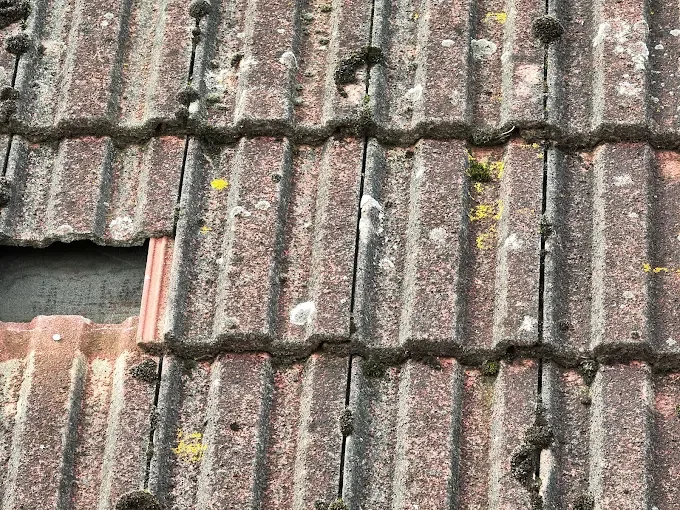
How many pixels does a defect need?
One pixel is not enough. A feature one pixel wide might be a crack, might be a dark lichen streak, might be sensor noise. My working rule — and it is a rule of thumb rather than a standard — is three pixels across the narrowest thing you have to identify. One pixel tells you something is there. Three tells you what it is.
So the question becomes: how wide is the thing you are hunting?
WHAT YOU ARE LOOKING FOR, AND THE GSD IT NEEDS
| DEFECT | ROUGH WIDTH | GSD NEEDED |
|---|---|---|
| Slipped or missing tile | 20 mm+ | ~6.5 mm |
| Lifted or displaced ridge tile | 10 mm | ~3.3 mm |
| Failed pointing or a gap in mortar | 5 mm | ~1.7 mm |
| Split in a lead flashing | 2 mm | ~0.7 mm |
| Hairline crack in a slate | 1 mm | ~0.33 mm |
Widths are my own field estimates for common British pitched roofs, not published figures — treat them as the right order of magnitude rather than gospel. The GSD column is simply the width divided by three.
Now run every drone in the guide through the sum, at a sensible ten-metre standoff, and the picture that emerges is not the one the price list suggests.
Ground sample distance, all ten
| DRONE / CAMERA | EQUIV | WIDTH | GSD @ 10 M | STANDOFF FOR 1.7 MM |
|---|---|---|---|---|
| Mavic 4 Pro — 168 mm tele | 168 mm | 8,192 | 0.25 mm | 68 m |
| Mavic 3T — 162 mm zoom | 162 mm | 4,000 | 0.53 mm | 32 m |
| Air 3S — 70 mm tele | 70 mm | 8,064 | 0.61 mm | 28 m |
| Mavic 4 Pro — main camera | 28 mm | 12,288 | 1.05 mm | 16 m |
| Mini 5 Pro | 24 mm | 8,192 | 1.76 mm | 9.7 m |
| Air 3S — main camera | 24 mm | 8,192 | 1.76 mm | 9.7 m |
| Mini 4 Pro | 24 mm | 8,064 | 1.79 mm | 9.5 m |
| Mini 3 | 24 mm | 8,064 | 1.79 mm | 9.5 m |
| Flip | 24 mm | 8,064 | 1.79 mm | 9.5 m |
| Mavic 3T — wide camera | 24 mm | 8,000 | 1.80 mm | 9.4 m |
| Neo 2 | 16.5 mm | 4,000 | 5.24 mm | 3.2 m |
| Neo | 14 mm | 4,000 | 6.18 mm | 2.8 m |
| Autel EVO Lite+ | — | — | — | — |
Computed from each manufacturer’s published equivalent focal length and maximum image size, checked 31 July 2026. Dashes on the Autel because its specification page would not render for me on the day — I would rather leave a gap than compute a number from a focal length I have not read. GSD is an optical ceiling: haze, motion blur and a soft corner of the lens all make the real picture worse, never better.
Three things fall out of that table, and the first one cost me an assumption.
One. The sensor size barely matters here. The Flip and the Mini 5 Pro land 1.79 mm and 1.76 mm apart — a difference of under two per cent, which is nothing, and the Mini 5 Pro costs well over twice as much. Resolution is decided by how many pixels you spread across the frame and how wide the frame is, and both of those drones spread roughly eight thousand pixels across a 24 mm view. The one-inch sensor buys you a picture that holds together in the shadow under a north-facing eave on a grey December afternoon. It does not buy you finer detail.
Two. A long lens is worth more than any sensor. The Air 3S has a second camera at 70 mm, and that single fact takes it from 1.76 mm per pixel to 0.61 mm at the same distance. Read that the other way round, because it is the point of this whole article: to get the same picture, you can be three times further away from the building. The Mavic 4 Pro’s 168 mm lens takes it to seven times further. A telephoto is not a luxury on an inspection drone. It is a safety feature that happens to also be a lens.
Three. Nothing under 250 grams identifies a hairline crack. To reach 0.33 mm per pixel, a Mini 5 Pro would have to be 1.9 metres from the slate. I have flown that drone a great deal and I would not fly it at 1.9 metres from a building on purpose, on a still day, with nothing to hit. On a real roof, with a gust rolling over the ridge and a television aerial in the frame, it is simply not a thing to do.
That is the honest ceiling on a sub-250-gram roof inspection. You will see missing tiles, slipped tiles, lifted ridges, moss, blocked valleys, failed pointing, daylight through a hole, debris in a gutter and a slate that has gone. You will not reliably see a hairline crack, and any guide telling you otherwise has not done the arithmetic.
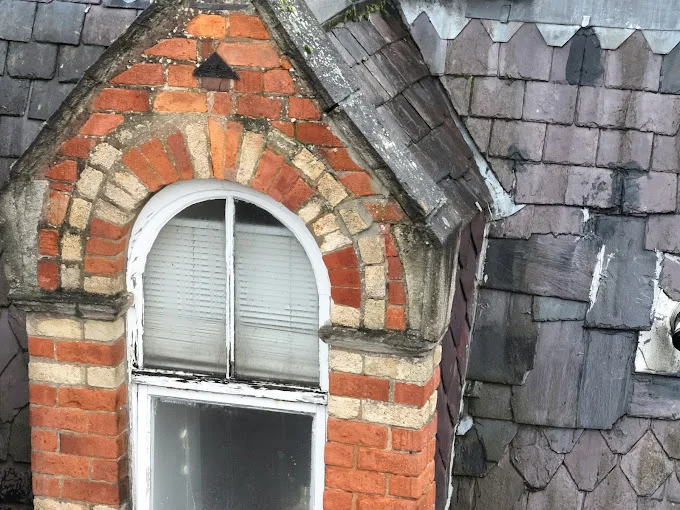
One more thing the maths hands you free: the crop is real. If your GSD at ten metres is 1.76 mm, then cropping into a quarter of the frame does not change it. People assume zooming in afterwards costs them detail; it does not, as long as you are looking at actual pixels. What costs you detail is digital zoom in the air, which throws pixels away before they reach the card. Shoot the widest, biggest file the drone offers and crop at your desk.
The UK rules that decide whether you can point a drone at a roof at all
This is the part that blindsides people, because it has nothing to do with cameras and everything to do with weight. Assume you have never owned a drone; none of the following is obvious, and all of it applies from the first flight.
Two registrations, and neither is a licence
Every drone with a camera needs the same two things. A Flyer ID is a free online multiple-choice theory test from the Civil Aviation Authority, valid five years — it proves you have read the rules. An Operator ID costs £12.34 a year, goes on a label stuck to the outside of the drone, and you must be 18 to hold one. One Operator ID covers every drone you own.
Neither is a licence in the sense you are imagining. There is no practical test, no examiner, and nothing that stops you buying the drone this afternoon.
Then weight decides where you may fly
After registration, the rules split by weight and by a European or UK “class mark” printed on the drone. There are three sub-categories, and for a roof inspection only the first one is comfortable.
WHERE EACH SUB-CATEGORY LETS YOU FLY
| SUB-CATEGORY | WHAT QUALIFIES | NEAR A HOUSE? |
|---|---|---|
| Over People (A1) | Under 250 g, or UK0/UK1, or C0/C1 | Yes — residential streets included. Never over a crowd. |
| Near People (A2) | UK2 or C2, or an unclassed drone under 2 kg — A2 CofC required | Yes, but 30 m from anyone not involved (50 m if unclassed) |
| Far from People (A3) | Everything heavier, with no A2 CofC | No — 150 m from anything residential |
A 120-metre height ceiling applies to all three, you must keep the drone in sight with your own eyes throughout, and you need the landowner’s permission for wherever you take off and land.
Look at the bottom row again, because it is the sentence that eliminates half the drone market from this job. Far from People means 150 metres from any residential, recreational, commercial or industrial area. Your roof is in one. So is your neighbour’s. A heavy unclassed drone is not merely inconvenient for a roof inspection — it is a drone you may not legally fly at the building at all, from any distance, unless you hold the A2 Certificate of Competence.
That certificate is a theory test of at least thirty multiple-choice questions with a CAA-approved assessment provider, valid five years, and providers set their own fees. It is not hard. But if you buy under 250 grams, it buys you nothing you do not already have — which is the single strongest argument for the Mini 5 Pro on this page.
There is also a deadline worth knowing before you buy anything heavier than 250 grams. Until 31 December 2027, a European C class mark can be flown as its UK equivalent. From 1 January 2028, that stops: a C-marked drone becomes legacy and falls back to plain weight rules. The Air 3S is the drone in this guide that this catches. It is C1 and 724 grams, so today it flies in Over People with no qualification; from January 2028 it will need an A2 CofC to go near anyone. If part of the appeal is that it needs no test, you are buying about eighteen months of that.
Doing it for money changes everything
Inspecting your own roof is a hobby flight. Inspecting somebody else’s for payment is commercial work, and the CAA is unambiguous about what that means: third-party insurance stops being optional and becomes mandatory. The CAA lists “get paid to carry out surveys” as one of its examples, alongside using a drone for work on a farm, park or estate. Cover must comply with Assimilated Regulation (EU) 785/2004, and the responsibility sits with the operator — the person or company registered on the Operator ID — rather than with whoever happens to be holding the controller.
Two practical consequences people miss. The name on the insurance policy should match the name on the Operator ID, so if you are trading as a company, register the Operator ID in the company’s name and not your own. And commercial cover is not the twenty pounds a hobby flying club charges: expect low-to-mid hundreds of pounds a year for a compliant annual policy at the million-pound liability limit most clients ask for.
Photographing somebody else’s roof also drags in data protection. Images in which people can be identified fall under the UK GDPR and the Data Protection Act 2018 whether you meant to catch them or not, and pointing a camera where people reasonably expect privacy — through a bedroom window, into a neighbour’s garden — is the fastest way to turn a helpful favour into a complaint. Tell the neighbours before you fly. It costs nothing and it prevents almost every argument.
PART THREE
Flying close to a building without hitting it
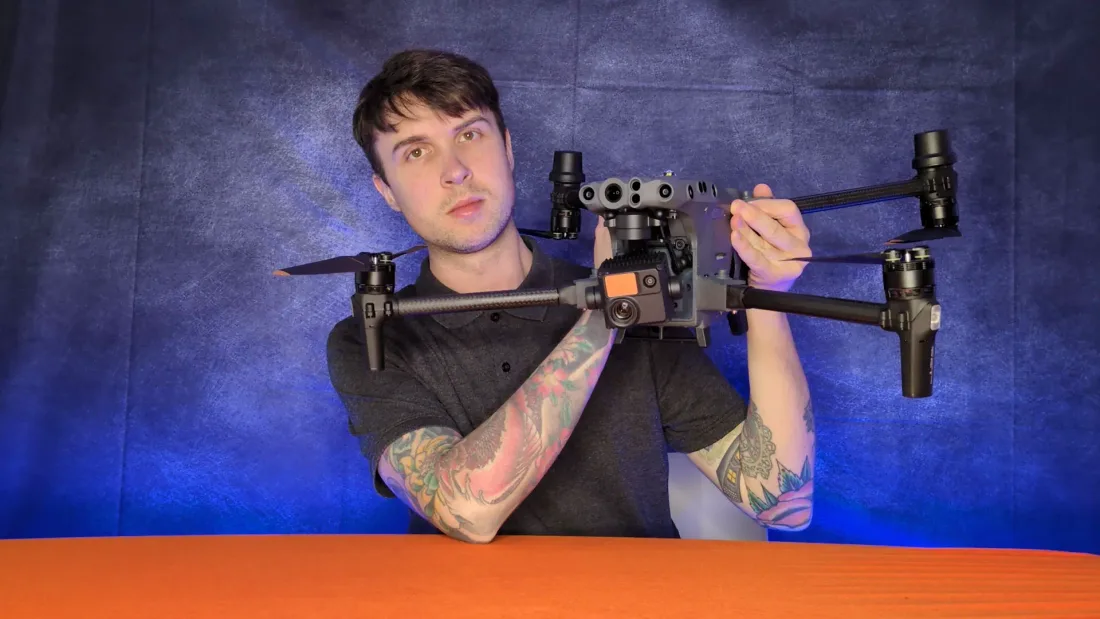
Part Two told you how far back you can afford to stand. This part is about the fact that a roof is the single most hostile thing a small drone can be asked to fly near, and about what obstacle sensing does and does not do about it.
A roof gives you turbulence rolling over the ridge, a wind gradient that changes between gutter height and chimney height, GPS that goes unreliable in the lee of the building, a compass that dislikes flashing and satellite brackets, and a collection of thin objects — aerials, dishes, wires, washing lines — that are essentially invisible to every sensor on board. All of that within one rotor-span of something solid.
WHAT EACH DRONE ACTUALLY SEES
| DRONE | SENSING | FORWARD RANGE | MIN LIGHT |
|---|---|---|---|
| DJI Neo | Downward only | none | — |
| DJI Mini 3 | Downward only | none | — |
| DJI Flip | Forward infrared + downward | short | — |
| DJI Neo 2 | Omnidirectional, single-lens | 0.5–10 m | — |
| DJI Mini 4 Pro | Omnidirectional, twin-lens | 0.5–18 m | 15 lux |
| DJI Mini 5 Pro | Omnidirectional + forward laser | 0.5–18 m | 1 lux |
| DJI Air 3S | Omnidirectional + forward laser | 0.5–18 m | 1 lux |
| DJI Mavic 3T | Omnidirectional, twin-lens | 0.5–20 m | — |
| DJI Mavic 4 Pro | Omnidirectional + forward laser | 180° coverage | 0.1 lux |
| Autel EVO Lite+ | Forward, backward and downward | — | — |
From each manufacturer’s published specification, checked 31 July 2026. Dashes are figures the maker does not publish. Autel sensing directions are from DroneCompare, CC BY 4.0.
The light column is the one nobody mentions in a shop. DJI states that its vision systems need surfaces with discernible patterns and adequate lighting, and it puts a number on “adequate”: more than 15 lux for the Mini 4 Pro, more than 1 lux for the Mini 5 Pro and Air 3S, more than 0.1 lux for the Mavic 4 Pro. Fifteen lux is roughly deep twilight. The north-facing pitch you are inspecting in February, in the shadow of the house next door, is exactly the situation where the cheaper drone quietly stops watching.
And none of it sees a television aerial. Binocular vision needs texture to lock on to; a thin dark pole against a bright sky gives it none. Neither does a satellite-dish arm, an overhead phone line, a washing line or a length of strimmer cord across a yard. Obstacle sensing is the thing that catches your mistake with the big flat wall. It is not the thing that keeps you out of the wires.
How I would actually fly it
Not as a hover-and-poke. As a sequence, from far to near, so that every close pass is one you have already looked at from a distance.
- 1. Walk it first. On the ground, find every wire, aerial, dish, tree and flagpole. Look up. Then decide where you will take off from and get the landowner’s permission for that spot.
- 2. One top-down at 40 metres. Camera straight down, whole roof in one frame. This is your map, and it is where you spot the blocked valley and the slipped tile you did not know about.
- 3. Four obliques from the corners, at about ridge height, camera at 45 degrees, ten metres back. Every pitch, every gable, every chimney gets one.
- 4. Only now, the detail passes. Ten metres out, camera level, one photo per feature you flagged in step two or three. At ten metres a Mini 5 Pro is giving you 1.76 mm per pixel, and you already know that is enough for a mortar joint.
- 5. Shoot the gutters last, flying along the eaves rather than towards them, so a drift takes you away from the building instead of into it.
- 6. Never fly backwards towards anything. On most of these drones the backward sensor is the weakest, and on three of them there is not one.
Two rules I hold to regardless of what the drone claims it can see: never closer than five metres to any part of the structure, and nothing above about 15 mph of wind at ridge height, which is usually a good deal more than the wind you feel standing in the garden. If the maths says you need to be closer than five metres, you need a longer lens, not more courage.
PART FOUR
What year one costs, and when you should just hire somebody
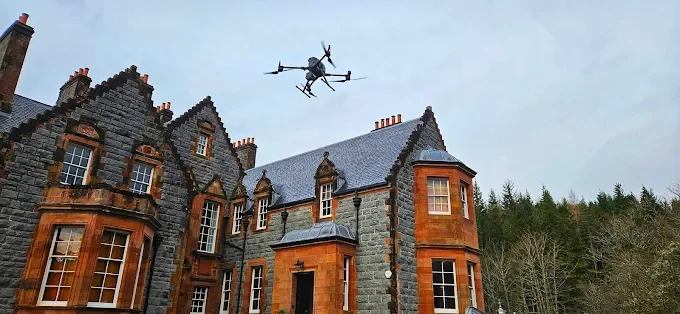
Suppose the quiz left you with the Mini 5 Pro, as it does for most people who answer honestly about a house in a street. The number in your head is the one on the shop page. Here is everything else that leaves the account before you have taken one useful photograph — and it is not a short list.
YEAR ONE — INSPECTING YOUR OWN ROOF
The paperwork first, because it is the cheap part. The Flyer ID is free. The Operator ID is £12.34 a year — a fixed CAA fee, and the only figure in this whole section that will still be true next month. There is no A2 Certificate of Competence to pay for, because under 250 grams you do not need one, which is a line every heavier drone on this page has to add back in.
Then the kit nobody puts on the shop page. A second standard battery, because half an hour is one roof and not two — and it must be the standard pack, not the Plus, which pushes the drone over 250 grams and costs you the exact freedom you bought it for. A 256 GB V30 card, because 50-megapixel stills fill a small one in an afternoon. A landing pad, because grit lifted off a driveway is the cheapest way there is to wreck a gimbal. And an honest allowance for the crash you have not had yet — a set of propellers, possibly a gimbal, possibly an insurance excess.
None of those is expensive on its own. Together they add roughly a quarter again on top of whatever the drone itself costs, and I have been conservative — no bag, no spare propellers, no DJI Care. Note what is not on the list: insurance, because for your own house it is genuinely optional. You remain liable for anything you break, but nobody requires a policy.
Doing it for money adds three items to that list, and none of them is optional. Third-party insurance compliant with Assimilated Regulation (EU) 785/2004, at low-to-mid hundreds a year for the million-pound cover clients ask for. An Operator ID registered in the trading name rather than yours. And the data-controller duties that come with holding photographs of other people’s property. None of that is difficult; all of it is the difference between a hobby and a business, and skipping it is not a grey area.
The case for not buying anything
Here is the arithmetic nobody selling drones will do for you. If you have one roof and one question, you are about to spend the better part of a thousand pounds and a fortnight of learning to fly in order to answer it — and at the end you will have a sub-250-gram drone that, as Part Two showed, cannot resolve a hairline crack and has no thermal camera at all.
Thermal is the part that stings. Trapped moisture changes how a roof gives up heat, which is why a survey with a thermal camera can show you where water is getting in before anything visible has failed. The camera that does it — the 640×512 sensor on a Mavic 3T — is not sold in shops at any price you would consider. A drone roof inspection booked from a pilot who already owns one arrives with the drone, the qualifications, the insurance and that sensor, on a day when the weather suits it.
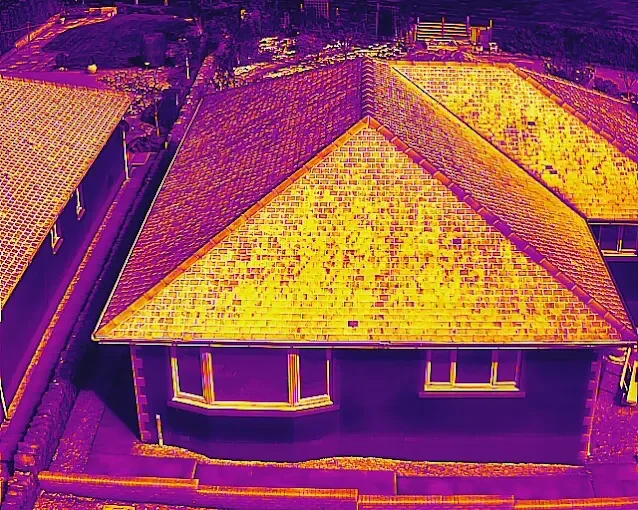
I am not going to quote you a price for that, because it moves with access, airspace, the size of the building and whether you need a thermal pass or a full three-dimensional model. What I will say plainly is this: for one roof, once, hiring is almost always the cheaper answer, and it is the answer I would give a friend. Buying starts to make sense at the point where you will be doing this repeatedly — a landlord with a portfolio, a roofer who quotes twenty jobs a year, a surveyor tired of ladders.
So: what I’d fly over my own house
The DJI Mini 5 Pro, and I would not agonise over it.
Not because of the one-inch sensor — Part Two demolished that as a resolution argument. I would buy it because it is the only drone here that combines three things a roof demands at once: obstacle sensing in every direction with a laser to back it up, eyes that keep working down to 1 lux in the shade where the damage hides, and a take-off weight of 249.9 grams, which means I may fly it over a residential street with nothing but the £12.34 registration. On a terrace or a semi, that last point is not a convenience. It is the difference between a legal flight and an illegal one.
Spend less if the roof is detached. The DJI Flip puts the same 1.8 mm per pixel on your tiles for well under half the money, and comes in propeller cages, which makes it the drone I would hand somebody who has never flown. What the saving costs you is eyes: it watches forwards and downwards and nothing else. Give it open air on three sides and it will do the same job the Mini 5 Pro does, for a great deal less.
Spend more only for the second lens. The DJI Air 3S is the one I would buy if I were inspecting roofs for other people, and it is the most expensive thing on this page I would tell an ordinary householder to consider. Its 70 mm camera means the same detail from three times the distance, and that is the single best safety-and-quality trade on this page. Go in knowing it is 724 grams, so you may not fly it over anybody, and that its no-qualification status expires in January 2028.
The one I’d actively tell you not to buy for this
The DJI Neo, which is the cheapest thing here by a distance — and I say that as someone who genuinely enjoys flying it. It is a delightful object, and it is the one drone on this page you would not be furious about crashing. It is also, for this specific job, a trap dressed as a bargain.
Its 14 mm lens spreads twelve megapixels across an enormous field of view, which puts it at 6.18 mm per pixel from ten metres. To get to the 1.7 mm you need for a mortar joint, you would have to fly it 2.8 metres from the roof — and it has no forward obstacle sensing whatsoever. The cheapest drone on the page asks you to fly closest to the building with the least protection. That is precisely backwards, and it is how people put a drone through a conservatory roof.
If none of this appeals — and for one leak, once, it should not — that is what the rest of this site is for. You can hire a qualified drone pilot who already owns the drone, the certificate and the insurance, and who will hand you a report rather than a memory card.
Roof inspection drones: the questions I get asked most
What is the best drone for roof inspections in the UK in 2026?
The DJI Mini 5 Pro. It resolves about 1.8 mm per pixel from ten metres away, which is enough to see a slipped tile, a gap in the pointing or a lifted ridge; it senses obstacles in every direction, which is what keeps it off the chimney; and at 249.9 grams it is light enough to fly over a street with no test and no certificate. Spend less and the DJI Flip, for well under half the money, gives you the same pixel count on the same sort of lens. Spend more only if you need a long lens: the DJI Air 3S gets to 0.6 mm per pixel from ten metres because it has a 70 mm camera on board.
What resolution do I need to see a cracked slate?
Work in ground sample distance — millimetres of roof per pixel. My working rule is three pixels across the smallest thing you have to identify. A slipped or missing tile is a 20 mm feature, so about 6 mm per pixel will do, and every drone here manages that. A failed mortar joint is nearer 5 mm, so you want about 1.7 mm per pixel. A hairline crack in a slate is around 1 mm, which needs roughly 0.33 mm per pixel — and no sub-250-gram drone reaches that without being flown closer to the roof than I would ever fly one.
Do I need a licence to fly a drone over my own roof?
Not a licence, but two registrations. A Flyer ID is a free online theory test valid five years, and an Operator ID costs £12.34 a year and goes on a label stuck to the drone. After that it is weight that decides things. Under 250 grams you are in Over People (A1) and may fly in a residential street. Heavier drones without a class mark are stuck in Far from People (A3), which means 150 metres from anything residential — so you could not legally reach your own roof at all unless you hold an A2 Certificate of Competence.
Do I need insurance to inspect a roof with a drone?
For your own house, no — third-party insurance is optional for recreation, sport and hobby flying, though you are still liable for anything you break. The moment somebody pays you, it becomes mandatory. The CAA lists getting paid to carry out surveys as commercial use, and commercial cover must comply with Assimilated Regulation (EU) 785/2004. The operator, not the pilot, is responsible for having it, and the policy name should match the name on the Operator ID.
Is obstacle sensing enough to stop a drone hitting a house?
No. It is a backstop, not a force field. DJI states that its vision systems need surfaces with discernible patterns and adequate lighting, and the light thresholds differ sharply between models — the Mini 4 Pro needs more than 15 lux, the Mini 5 Pro more than 1 lux, the Mavic 4 Pro more than 0.1 lux. None of them reliably see a TV aerial, a satellite dish bracket, a washing line or an overhead cable. Fly the standoff distance the maths gives you and treat the sensors as the thing that catches your mistake.
Is it cheaper to buy a drone or hire a pilot for one roof inspection?
For a single roof, hiring. Year one on a DJI Mini 5 Pro runs about a quarter again above the drone’s own ticket price once the registration, a second battery, a card, a landing pad and a modest crash allowance are in — and that is before you have taken a usable photograph or learned to fly. A pilot who already owns the drone, the qualifications and the insurance turns up with all of it, and can bring a thermal camera you cannot buy at consumer prices. Buying makes sense when you will be doing this repeatedly.
The short version
If you read all of that and still want me to just say it: buy the DJI Mini 5 Pro. It is the only drone here that resolves a mortar joint from ten metres, watches every direction while it does it, and stays light enough to fly over a street legally. Budget for the registration, a spare battery and a card on top of the drone — what year one really adds up to is in Part Four — and if it is one roof, once, hire somebody instead.
Affiliate links · costs you nothing extra · full disclosure
This guide deliberately quotes no prices. Drone prices move week to week, and the only figure worth trusting is the one on the page the link actually opens — so check there before you buy. Where the article compares cost, it does it in relative terms, which stay true for longer. Specifications checked 31 July 2026; camera and sensing figures are from manufacturer specification pages. Regulatory detail from the UK Civil Aviation Authority. Comparison specifications from DroneCompare, licensed under CC BY 4.0. Amazon links are affiliate links.