DJI Mini 4 Pro vs DJI Mini 3: which one should you buy?
These two use exactly the same camera sensor behind exactly the same lens, which makes this an unusually clean comparison. Everything that differs is the drone built around it.
 Written by Peter Leslie, GVC-qualified commercial drone pilot | Every figure checked against both DJI manuals | 3 Aug 2026
My short answer
I recommend the DJI Mini 4 Pro
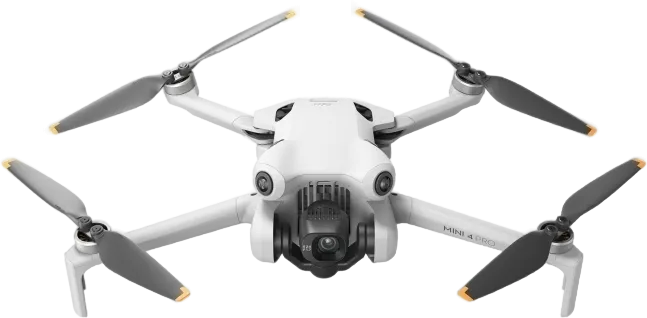
DJI Mini 4 Pro
The 2023 camera drone
The same camera hardware, and a completely different drone around it. Sensing on every side, slow motion, and a transmission system two generations newer.
- Omnidirectional sensing against downward only
- 4K at 100fps against 4K at 30
- O4 against O2 transmission
- ISO to 12800 at night against 3200
- 2 GB inside against no storage at all
- 34 minutes against the Mini 3’s 38
I recommend this if…
- You will fly near obstacles on more than one side
- You want slow motion at full 4K
- You shoot in genuinely poor light
- You want a modern transmission link
If flight time and price come first
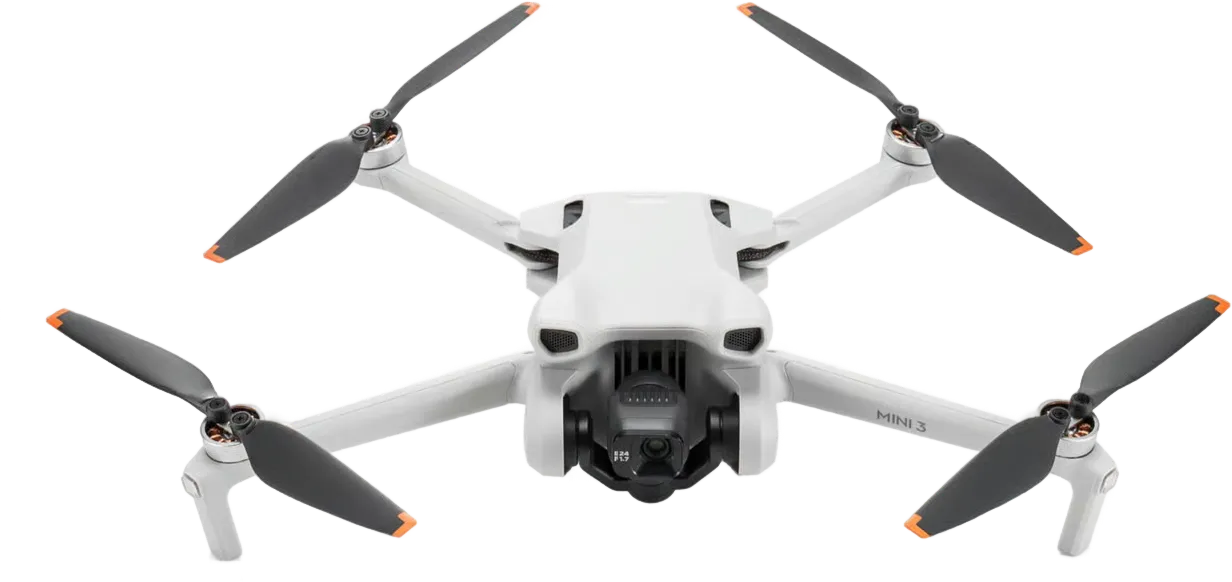
DJI Mini 3
The 2022 camera mini
Same sensor, longest flight time in the class, and eyes only for the ground. The cheaper way to the same picture quality, with none of the safety net.
- Downward vision only — nothing forwards or sideways
- 4K capped at 30fps, no slow motion
- O2 transmission, a generation behind
- ISO stops at 3200
- No internal storage at all
- 38 minutes, the longest in the class
I recommend this if…
- You want the longest flights of any mini
- You fly in open space with little to hit
- The same sensor for less money appeals
- You want two grams more margin than the C0 Mini 4 Pro
Both links are Amazon affiliate links. As an Amazon Associate I earn from qualifying purchases, at no extra cost to you — full disclosure.
The camera argument is a draw, so ignore it
Both drones use a 1/1.3-inch sensor at 48 megapixels behind an f/1.7 lens with an 82.1 degree field of view. Both have three-axis gimbals. Both produce 8064 by 6048 stills.
That is unusual. Normally a two-generation gap changes the sensor, and here it does not.
So anybody comparing these two on sensor size or megapixels is comparing identical numbers, and the marketing on both will happily let them.
What changed between them is everything wrapped around that sensor: what the drone can see, how fast it can record, how it talks to the controller, and whether it can store anything itself.
Both appear in my best drones under 250g guide.
Five things that are genuinely identical
A long list, and it includes the camera, which is why this comparison is cleaner than most.
-
Same camera sensor
1/1.3-inch, 48 MP, f/1.7 on both.
-
Same stills resolution
8064 by 6048 on both.
-
Same three-axis gimbal
Tilt, roll and pan on both.
-
Same C0 class mark
And the same Flyer ID and Operator ID.
-
Same cold limit
Both rated down to minus ten degrees.
-
So ignore all 5
None of it can tell you which to buy. The next four things can.
Both are also rated to 10.7 metres per second of wind and reach 4000 metres, and both need a controller with your phone clamped in.
The four differences that actually matter
1. The Mini 4 Pro sees in every direction. The Mini 3 only sees the ground
With the cameras matched, this is the difference the whole purchase turns on.
The Mini 3 has a downward vision system. It helps the drone hover and land, and it does nothing about what is in front of it.
The Mini 4 Pro uses omnidirectional binocular vision, which is paired cameras judging depth in every direction, with a 3D infrared sensor underneath.
Mini 4 Pro
Omnidirectional binocular vision
- Paired cameras judging depth all round
- 3D infrared underneath
- Works while flying up to 12 m/s
- Brakes or steers round what it sees
Mini 3
Downward vision only
- Knows its height above the ground
- Nothing facing forwards
- Nothing watching sideways
- You are the collision avoidance
Both fly on bare propellers, so on the Mini 3 a misjudged branch is a repair rather than a bump.
That is the practical shape of it. Identical footage, and only one of the two will try to avoid the tree it is filming.
Winner — DJI Mini 4 Pro
Identical cameras, and one drone can be trusted to fly itself past an obstacle while the other cannot. For the same picture quality, that is the whole value of the upgrade.
Fly in open space and the Mini 3’s missing sensors genuinely never come up, and you keep four extra minutes.
Check the Mini 4 Pro on Amazon2. The Mini 4 Pro shoots 4K slow motion. The Mini 3 caps at 30 frames
Same sensor, and a very different set of things you can do with it.
The Mini 4 Pro records 4K at up to 100 frames a second, so a clip can be slowed right down and stay smooth. The Mini 3 records 4K at 30 and nothing faster.
Mini 4 Pro
100fps
smooth 4K slow motion
Mini 3
30fps
normal speed only
Light sensitivity follows. Both start from the same sensor, but the Mini 4 Pro reaches ISO 6400 normally and 12800 in night mode where the Mini 3 stops at 3200.
Mini 4 Pro
12800
ISO ceiling in night mode
Mini 3
3200
ISO ceiling
Four times the ISO headroom from an identical sensor is a processing and firmware difference rather than a hardware one, which makes it slightly galling but no less real.
For overcast afternoons and late evenings, which is most of the British year, that headroom is the difference between usable and grainy.
Winner — DJI Mini 4 Pro
Slow motion the Mini 3 cannot produce at all, and four times the light sensitivity from the same sensor. If you are keeping the footage, this is the section that justifies the newer drone.
In bright, still conditions at 30 frames a second, the two produce very similar results, because the sensor is the same.
Check the Mini 4 Pro on Amazon3. The Mini 3 flies 38 minutes. The Mini 4 Pro manages 34
The Mini 3’s one clear win, and it is a genuine one.
DJI rates the Mini 3 at 38 minutes in forward flight against the Mini 4 Pro’s 34. Hovering, that is 33 against 30.
Mini 4 Pro
34min
about 25 in reality
Mini 3
38min
about 28 in reality
Four minutes is not dramatic, but the Mini 3 holds the longest standard flight time of any sub-250 gram DJI drone, which is a fact worth knowing.
Both offer Plus batteries with longer figures, and on both those batteries take the drone over 249 grams and out of the friendly bracket.
So the honest comparison is 38 against 34, and neither of the bigger numbers belongs to a sub-250 gram drone.
Winner — DJI Mini 3
Four extra minutes per battery, from the longest-flying drone in the class. If you are walking all day with one battery, that is the one thing the older drone does better.
A spare battery costs less than the difference between these two drones and removes the argument entirely.
Check the Mini 3 on Amazon4. The Mini 4 Pro uses O4 and has storage. The Mini 3 uses O2 and has none
Two practical differences that decide what you have to buy alongside the drone.
The Mini 4 Pro uses O4 transmission with a quoted 20 km range. The Mini 3 uses O2, quoted at 10 km.
Neither figure matters directly in the UK, where visual line of sight ends the flight long before either. What matters is link robustness and the sharpness of the picture you frame on.
Mini 4 Pro
O4, and 2 GB of storage
- O4 transmission
- 2 GB internal storage as a fallback
- More robust in interference
- Sharper live view to compose on
Mini 3
O2, and no storage at all
- Adequate in open ground
- A microSD card is compulsory
- A generation behind on transmission
- Nothing onboard if you forget the card
The storage difference is small in absolute terms. Two gigabytes is seconds of 4K, so both really want a memory card.
But two gigabytes will rescue a flight where you left the card at home, and nothing will rescue the Mini 3 in the same position.
Winner — DJI Mini 4 Pro
A newer transmission system and a small onboard fallback. Neither is dramatic, and both point the same way as everything else on this page.
Buy a card and fit it, and this difference largely disappears. O2 is perfectly stable in open ground.
Check the Mini 4 Pro on AmazonFour questions that will tell you which one to buy
Work down them and stop at the first one you can answer firmly. That is your drone.
Will you fly near obstacles on more than one side?
Mini 4 ProDo you want slow motion, or headroom in poor light?
Mini 4 ProIs the longest possible flight time the priority?
Mini 3Is the same sensor for less money the appeal?
Mini 3Because the cameras are identical, this is really a question about sensing against endurance. If you want the newest of this line instead, the Mini 5 Pro comparison is the next step up.
Two catches worth knowing before you order either one
Neither is a reason to avoid either drone. Both are things I would want to have been told before paying.
Both have Plus batteries that break the 250 gram limit
This catches people out on both drones, and the manuals are clear about it.
The Mini 3 manual notes on page 7 that the maximum takeoff weight exceeds 249 grams with the Plus battery fitted. The Mini 4 Pro manual says the same on page 10.
So the 51-minute and 45-minute figures you will see quoted belong to configurations that are not sub-250 gram drones.
Compare 38 against 34 instead, and treat the longer numbers as belonging to a different weight class with different rules.
The Mini 4 Pro comes in two class-marked versions
DJI sells the Mini 4 Pro as a C0 model at 249 grams and a C1 model at 342 grams, and they are hard to tell apart in listings.
Only the first is in the friendly weight bracket. Check the class label on the drone rather than the product title.
The Mini 3 avoids this by existing in one C0 configuration at 248 grams, which is two grams more margin than the C0 Mini 4 Pro.
Weight, size and what neither of them does
Three things worth having straight.
The Mini 3 is 248 grams and the C0 Mini 4 Pro is 249, so the Mini 3 has two grams of margin against one. Neither is comfortable.
At these weights a sticker or a heavier third-party propeller genuinely matters, and both manuals warn against adding payload or unapproved parts.
Folded, the Mini 3 is slightly the smaller package at 148 by 90 by 62 millimetres against 148 by 94 by 64.
Neither has propeller guards fitted as standard and neither can be launched from your palm, so both are conventional drones you pilot with a controller.
Mini 4 Pro vs Mini 3: every specification side by side
| DJI Mini 4 Pro | DJI Mini 3 | |
|---|---|---|
| Released | September 2023 | December 2022 |
| Weight | Under 249 g (C0); 342 g as the C1 model | 248 g |
| Class mark | C0 (249 g) or C1 (342 g) — two models (manual p120) | C0 (manual p71, model MT3PD) |
| Folds? | Yes, to 148 × 94 × 64 mm | Yes, to 148 × 90 × 62 mm |
| Propeller guards | No | No |
| Palm takeoff | No, controller required | No, controller required |
| Obstacle sensing | Omnidirectional binocular vision plus 3D infrared underneath | Downward vision system only |
| Rated flight time | 34 min standard, 45 with the Plus battery | 38 min standard, 51 with the Plus battery |
| Operating temperature | −10° to 40° C | −10° to 40° C |
| Gimbal | Three-axis (tilt, roll, pan) | Three-axis (tilt, roll, pan) |
| Camera sensor | 1/1.3-inch, 48 MP | 1/1.3-inch, 48 MP |
| Lens | f/1.7, 82.1° | f/1.7, 82.1° |
| ISO range | 100–6400 (12800 in night mode) | 100–3200 |
| Max video | 4K at 100fps | 4K at 30fps |
| Max stills | 8064 × 6048 (48 MP) | 8064 × 6048 (48 MP) |
| Internal storage | 2 GB | None — microSD required |
| Transmission | O4, 20 km | O2, 10 km |
| Battery | 2590 mAh standard, 3850 Plus | 2453 mAh standard, 3850 Plus |
| Max speed | 16 m/s Sport, 12 Normal | 16 m/s |
| Wind resistance | 10.7 m/s | 10.7 m/s (Level 5) |
| Ceiling | 4000 m standard, 3000 m on Plus | 4000 m standard, 3000 m on Plus |
| On Amazon | Check price | Check price |
Figures from the official DJI specification pages and both user manuals. Amazon affiliate links — disclosure.
Both drones need a Flyer ID and an Operator ID. Neither is exempt
You will read all over the internet that drones under 250 grams need no licence. For a camera drone in the UK that is simply wrong, and both of these are camera drones.
Any camera drone between 100 g and 250 g needs both of these before you fly it outdoors. At just under 249 g and 248 g, both sit in that bracket narrowly.
Flyer ID
Proves you know the rules. A free online theory test, valid five years.
Operator ID
Registers you as responsible for the drone. £12.34 a year, and the number must be labelled on the drone.
Neither needs a GVC or an A2 Certificate of Competence for ordinary recreational flying. Both are C0 class marked in standard form, though the Mini 4 Pro is also sold as a heavier C1 model. There is more in do I need a licence for a sub-250g drone and UK class marking explained.
Why I pick the DJI Mini 4 Pro over the DJI Mini 3
Because the sensors are identical, this comparison is unusually clean: you are buying sensing and video modes, not a better picture in good light.
The Mini 4 Pro sees in every direction, shoots slow motion, reaches four times further into the dark and has a modern link.
The Mini 3 answers with four extra minutes and a lower price, and if you fly in open space that is a perfectly sensible trade.
My recommendation — DJI Mini 4 Pro
DJI Mini 4 Pro
2023 — under 249 g in C0 form
I recommend the DJI Mini 4 Pro over the DJI Mini 3 because they share the same sensor and the Mini 4 Pro is a far more capable drone around it. It sees in every direction where the Mini 3 sees only the ground, and it adds slow motion, a modern link and four times the ISO headroom. The Mini 3 flies four minutes longer, which is its one genuine win. Everything else here goes the other way.
- Omnidirectional binocular vision plus 3D infrared
- 4K at 100fps for slow motion
- O4 transmission, 20 km quoted
- ISO to 12800 in night mode
- 2 GB internal storage
- Same 1/1.3-inch 48 MP sensor, f/1.7
- 34 minutes against the Mini 3’s 38
- Only 1 g under the limit in C0 form
Amazon affiliate link — no extra cost to you.
The endurance option
DJI Mini 3
Buy this instead if flight time and price matter more to you than obstacle sensing, and you will be flying somewhere open enough that the missing sensors never come up.
Amazon affiliate links — disclosure.
Written by Peter Leslie — GVC-qualified commercial drone pilot
I fly compact DJI drones alongside enterprise survey kit, and I judge them on the footage and the safety margin they give me in real UK conditions.
Every figure here came out of the official DJI manuals or the CAA, not a press release. Where the manuals contradicted the marketing I went with the manuals.
Comparison you want covered next? peter@hiredronepilot.uk.
Sources