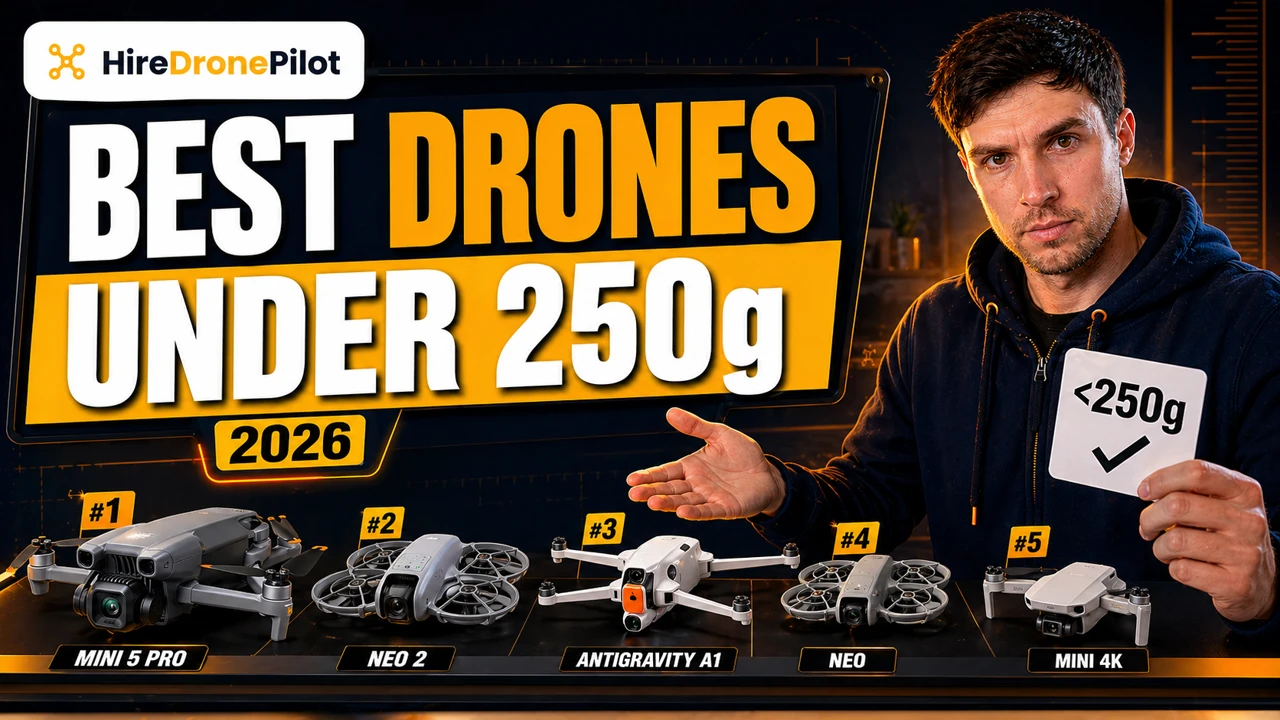
Best Drones Under 250g UK 2026 — Five Ranked Picks

Peter Leslie
21 Apr 2026
This guide contains affiliate links. As an Amazon Associate I earn from qualifying purchases. Buying through these links does not cost you extra — full affiliate disclosure here.
Key Takeaways
- The DJI Mini 5 Pro is the best sub-250g drone I can recommend in 2026, thanks to a one-inch camera sensor, a full obstacle-sensing stack, and up to 52 minutes of flight time on the extended battery
- The DJI Neo 2 is the friendliest first drone under 250 grams, with palm takeoff, palm landing, and on-drone flight-mode buttons
- The Antigravity A1 is the only non-DJI pick on this list and ships with a genuinely different feature set — goggles-first FPV flying and an 8K 360 panoramic camera
- The original DJI Neo is the cheapest palm-launch drone DJI sells, and the DJI Mini 4K is the cheapest way to get a folding 4K drone into the air
- Every drone on this list needs a free Flyer ID and a £12.34 Operator ID — but none of them need an A2 Certificate of Competence, and none of them need a full drone licence
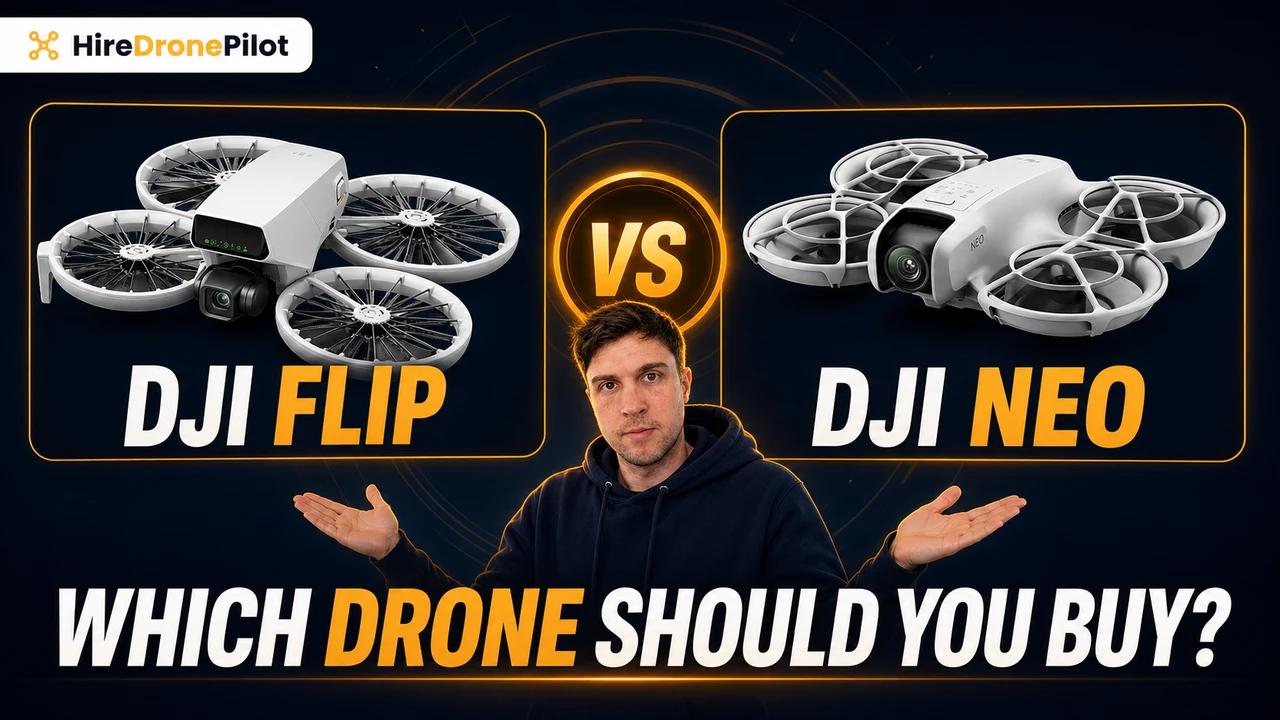
If you want a drone that keeps you well clear of the A2 Certificate of Competence route and lets you fly under the friendliest bracket of UK drone laws, you need to stay under 250 grams. That single number is what separates a drone you can fly near people from one that needs extra paperwork, extra distance, and an afternoon’s worth of theory exam. My top pick for 2026 is the DJI Mini 5 Pro. Head to head, I have compared the Neo 2 against the Flip in detail.
Best sub-250g drone UK 2026
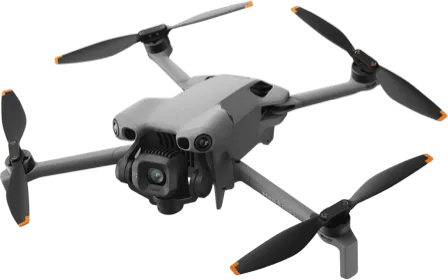
DJI Mini 5 Pro
The DJI Mini 5 Pro is the most capable sub-250g drone I have ever flown. A one-inch camera sensor, a forward LiDAR sensor, omnidirectional vision, 3D infrared sensing, and up to 52 minutes in the air on the extended battery — all packaged into a drone that weighs 249.9 grams at takeoff. If you want a drone you will not grow out of in a year, this is the one.
I recommend this if you…
- Want the best sub-250g camera on the market right now
- Care about obstacle sensing in every direction, not just downward
- Need a drone that works for casual flying and occasional paid work
- Want the extended-battery option to push flight time near an hour
I do not recommend this if you…
- Have never flown a drone before and want palm takeoff and palm landing
- Want the cheapest possible way into the hobby
- Plan to fly mostly indoors or in tight spaces around soft furniture
- Want a goggles-first immersive flying experience
Amazon Affiliate link — see the disclosure.
The four drones that follow cover the rest of the sub-250g market. Some are cheaper. One ditches the camera drone template entirely for a goggles-first FPV setup. Another is the lightest on the list at 135 grams. I have flown all five, and the write-up for each one names exactly who it is for and who should skip it.
Four of these five drones are DJI, and the one that is not is here for a specific reason
Everyone writing about drones in the UK in 2026 runs into the same problem: DJI wins on the things a hobbyist buyer actually cares about. The DJI Fly app is the most polished, spare batteries and props are easy to find from UK drone retailers, every UK flight school teaches on DJI hardware, and firmware updates roll through without drama. That is why four of the five drones on this list come from DJI.
The exception is the Antigravity A1. I have included it because it is the only sub-250g drone I know of that ships a genuinely different feature set — a goggles-first immersive flying experience with an 8K 360 panoramic camera. If you already know you want FPV-style flying, the A1 is the only sub-250g option that gets you there out of the box. Experienced drone pilots may well reach for it. A complete beginner should almost certainly not, for reasons I cover in the A1 section below.
Quick comparison — the five sub-250g drones at a glance
If you are scanning, read this table first. The ranked write-ups sit underneath in order.
| Drone | Weight | Flight time | Camera | Obstacle sensing | Best for | Amazon |
|---|---|---|---|---|---|---|
| DJI Mini 5 Pro | 249.9 g | Up to 52 min | 1” 50 MP | Forward LiDAR + omnidirectional + 3D infrared | Best all-round pick | Check price |
| DJI Neo 2 | 151 g | 19 min | 1/2” 12 MP | Forward LiDAR + omnidirectional + downward infrared | Easiest first drone | Check price |
| Antigravity A1 | 249 g | 24–39 min | 8K 360 panoramic | Forward and downward vision | Goggles-first FPV | Check price |
| DJI Neo | 135 g | 18 min | 1/2” 12 MP | None on route (downward only for landing) | Cheapest palm-launch | Check price |
| DJI Mini 4K | 246 g | 31 min | 1/2.3” 12 MP | None on route (downward only for landing) | Cheapest folding 4K | Check price |
Amazon Affiliate links — see the disclosure.
The DJI Mini 5 Pro is the best sub-250g drone because it does not compromise on the camera
The headline number on the DJI Mini 5 Pro is 249.9 grams. DJI built a drone that sits 0.1 grams under the UK threshold and still fitted a one-inch camera sensor inside it. That is the same size sensor you would find on a proper pocket camera, and it gives the Mini 5 Pro a photo quality that no other sub-250g drone can touch. 50 megapixel stills, True Vertical Shooting (the gimbal rotates a full 90 degrees so you can shoot portrait for social without cropping), and a camera that holds up in dim light.
The obstacle sensing stack is the other headline. Forward LiDAR (a little laser that shoots invisible light forward and stops the drone before it hits anything), an omnidirectional vision system (cameras that look out in every direction while it flies), and a 3D infrared sensing system on the underside (infrared beams that measure the ground when it lands). No other sub-250g drone on the market carries all three. The Mini 5 Pro will try to stop itself before you can.
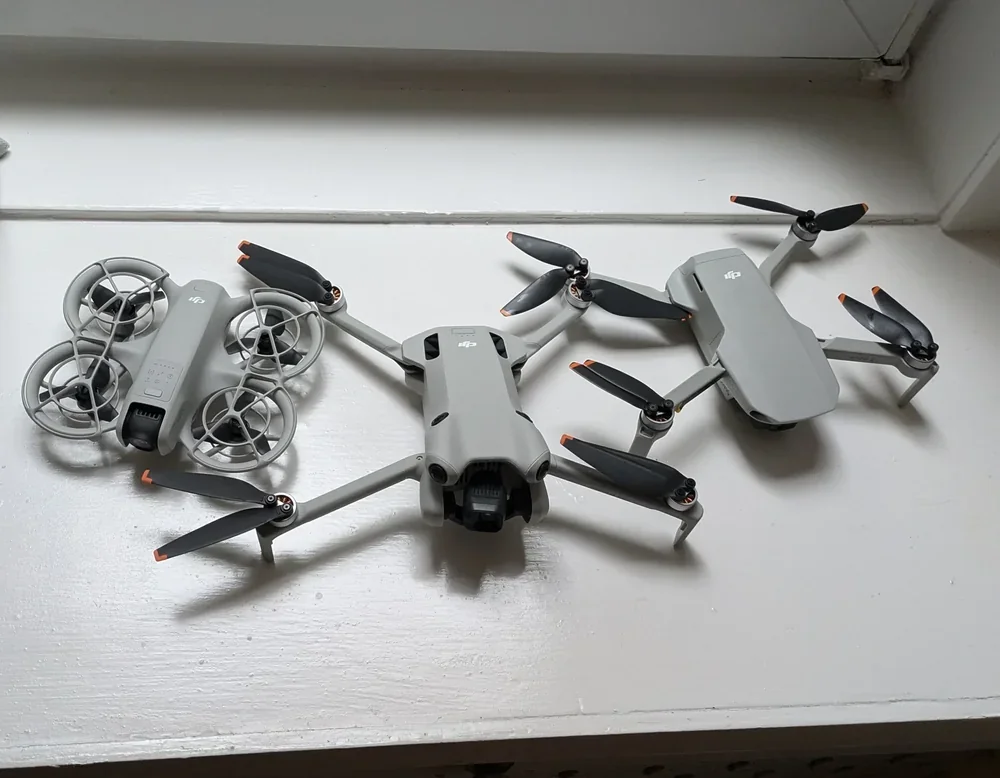
Flight time is the sneaky big win. The standard battery gives a respectable 36 minutes, and the optional Intelligent Flight Battery Plus stretches that to 52 minutes. In the sub-250g weight class, 52 minutes is extraordinary. It means you can drive to a location, do a site survey, shoot your sequence, and come back to the car on one battery. You will still want a spare, but the Mini 5 Pro is the only drone on this list where the stock flight time is enough for most sessions.
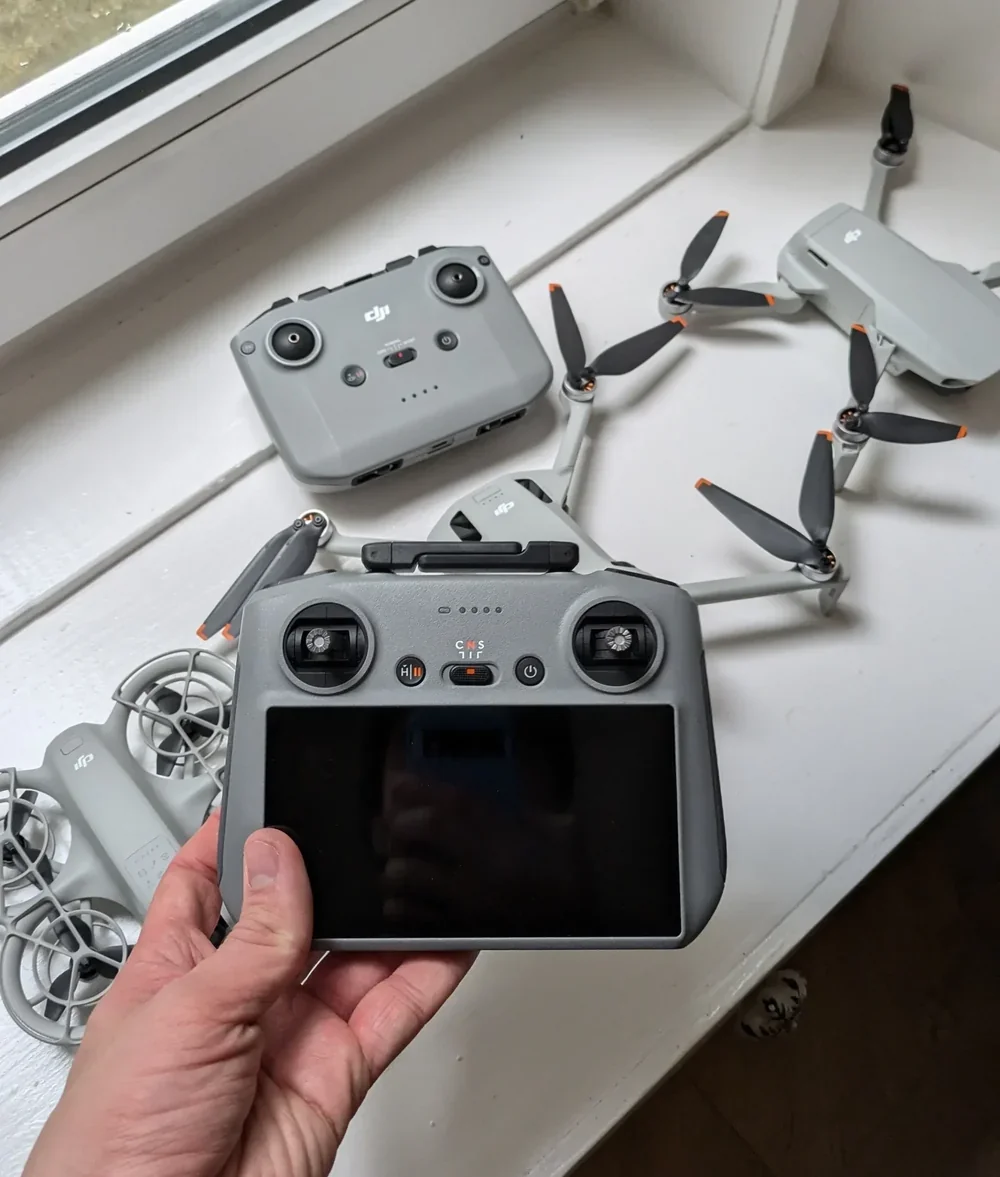
Two controller options ship with it. The DJI RC 2 has a built-in 5.5-inch screen and no phone required, and the DJI RC-N3 clips to your phone. The RC 2 is worth the upgrade if you fly in sunlight a lot — phone screens wash out on bright days. It also does Dynamic Home Point, which means the drone returns to where you are standing now, not where you took off, which matters if you are walking with the drone in the air.
A note on the class mark. The Mini 5 Pro ships in two variants: a C0 version at 249.9 grams and a C1 version at 355 grams. The UK buyer who wants the sub-250g A1 bracket needs to buy the C0 version specifically. The retailer listing should call out which one you are ordering — pay attention to it.
I recommend the Mini 5 Pro if you…
- Want the best camera you can fly under 250 grams in 2026
- Value a full obstacle-sensing stack for peace of mind
- Want a drone capable of occasional paid work as well as hobby flying
- Are happy to learn stick control rather than palm takeoff
I do not recommend it if you…
- Have never touched a drone before and want the gentlest learning curve
- Are on a tight budget — this is the most expensive pick on the list
- Want a goggles-first FPV experience
- Only plan to fly indoors around soft furniture
Amazon Affiliate link — see the disclosure.
The DJI Neo 2 is the friendliest first drone anyone under 250 grams can buy in 2026
The DJI Neo 2 is the drone I would put in front of anyone who has never flown. At 151 grams with a fully enclosed prop cage, it is the kind of drone you can lift off your palm, let it fly a preselected shot around you, and catch it back into your hand. No phone in your pocket, no sticks to learn, no panic.
The select button on the top of the drone cycles through the QuickShots suite — Follow, Dronie, Circle, and more — so you can set up the next shot without opening the app. On the original Neo the mode button is more limited, and anything beyond the basic shots pulled you back to the phone. On the Neo 2 the workflow stays on the drone itself.
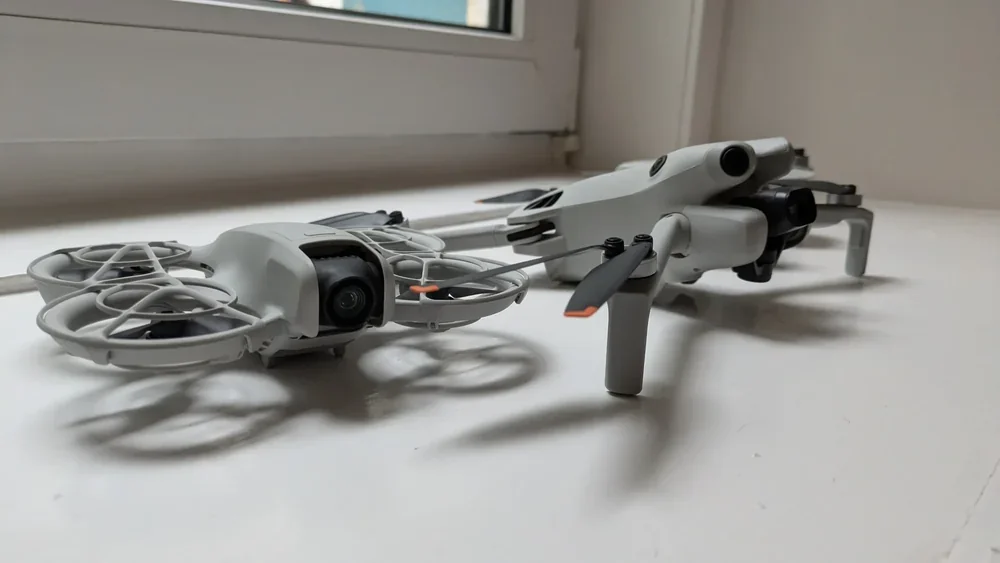
The Neo 2 is the only drone on this list outside the Mini 5 Pro that ships with a real obstacle-sensing stack. Forward-facing LiDAR, omnidirectional monocular vision, and a downward infrared sensor for landing. The prop cage still forgives small mistakes, but the sensing stack means the Neo 2 will try to stop itself before the cage has to take a hit.
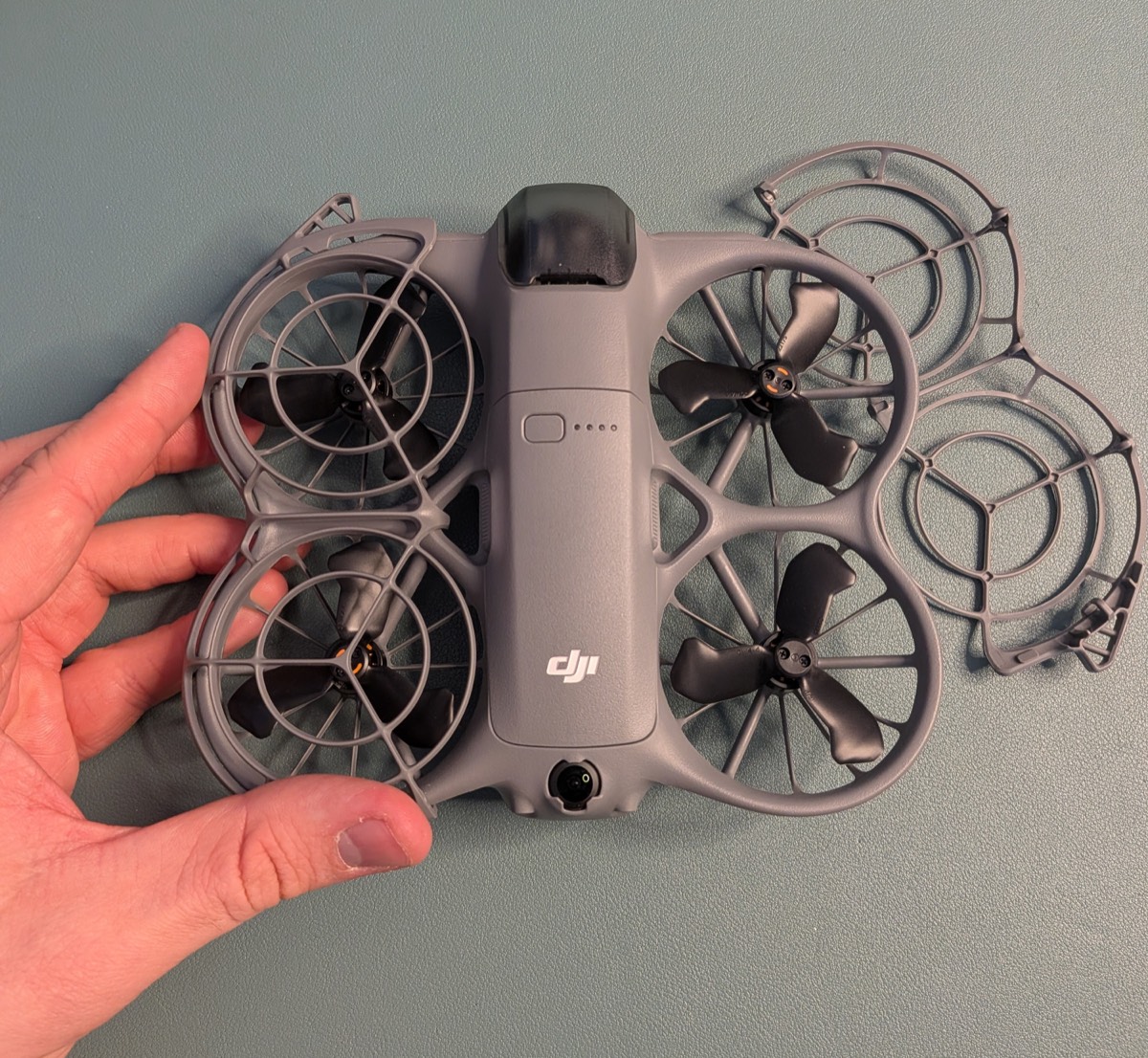
Two more features worth flagging. It supports gesture control — hold your palm up two to five metres from the drone and move it to steer. The Minis and the Mini 5 Pro will not do that. And it will fly without a controller at all, either from the controller you already own or from the DJI Fly app on your phone.
What you give up is flight time and camera. 19 minutes per battery is short, and the 1/2-inch 12 MP camera will not stand up to the Mini 5 Pro on detail or low-light performance. The Neo 2 is a drone you buy because you want the gentlest possible first flight, not because you want a drone that does everything.
I recommend the Neo 2 if you…
- Have never flown a drone before and want the gentlest possible first flight
- Want a drone that flies the shot for you while you are in front of the camera
- Plan to fly around people and want the safety of an enclosed prop cage
- Are on a tighter budget than the Mini 5 Pro but still want real obstacle sensing
I do not recommend it if you…
- Want a serious camera sensor for photos or paid work
- Need long flight times — 19 minutes disappears quickly
- Plan to fly in strong wind or at long range from the drone pilot
- Already know how to fly and want full manual stick control from day one
Amazon Affiliate link — see the disclosure.
The Antigravity A1 is the only sub-250g drone that ships as a goggles-first FPV system
The Antigravity A1 is the most different drone on this list. At 249 grams with the standard battery, it slots into the same A1 bracket as every DJI pick above it. Everything else about it is different. The camera is an 8K 360 panoramic sensor — the same kind of camera you find on an action cam, mounted on a flying drone. You can shoot full 8K 360 video and reframe any angle in post, which is a feature no other sub-250g drone offers.
The catch is that the A1 is a goggles-first system. It does not ship with a normal remote-and-phone workflow. It ships with DJI-style Vision Goggles and a Grip Motion Controller that you steer by moving your hand. Put the goggles on, grip the controller, lift your hand, and the drone responds. There is no phone-screen flying mode to fall back on. That decision makes the A1 a specialist tool rather than a general-purpose camera drone.
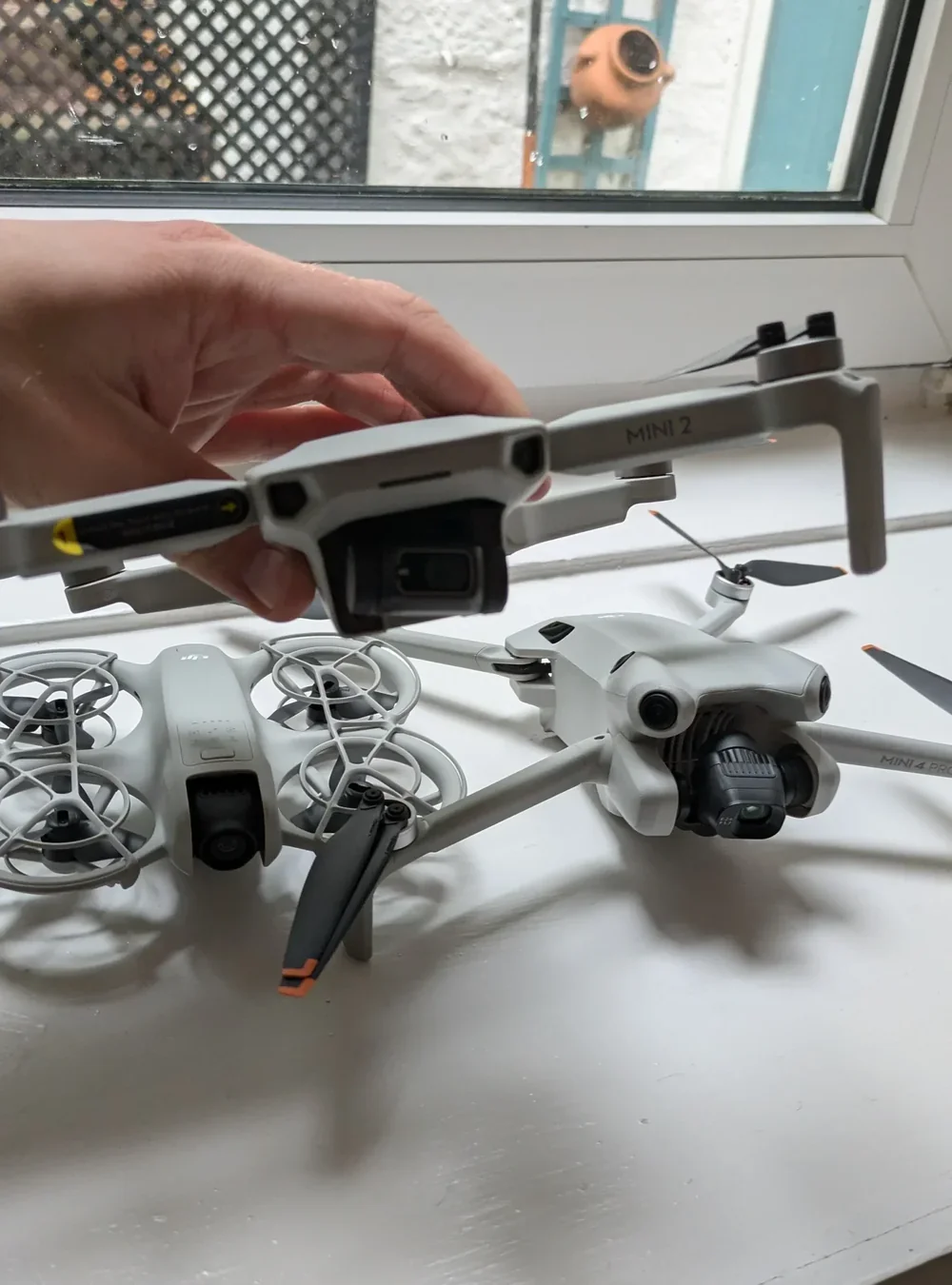
Flight time needs a caveat. The standard battery gives 24 minutes. The 39-minute figure you see quoted on marketing material requires the optional high-capacity battery, which also tips the total system weight over 250 grams into the C1 class — which means Remote ID becomes required and you leave the A1 bracket behind. If you want the sub-250g advantage, stick to the standard battery and accept 24 minutes.
Obstacle sensing is forward and downward vision only, not omnidirectional. No LiDAR. That is fine for deliberate low-and-slow FPV flying but a step down from the Mini 5 Pro and Neo 2.
Before I would put this drone in a beginner's hands, I would want them to have flown something else first. Goggles-first flying reduces your situational awareness by design — you are looking through the drone's camera, not at the drone itself. UK Drone Code still requires you to maintain visual line of sight on the drone itself, which in practice means you need a visual observer standing beside you to watch the drone while you are in the goggles. For a specialist buyer who already knows that trade-off, the A1 is a remarkable sub-250g option. For a general-purpose first drone, it is not the right answer.
I recommend the Antigravity A1 if you…
- Already know you want an immersive goggles-first flying experience
- Want 8K 360 panoramic footage you can reframe in post
- Have a visual observer to fly with you at all times
- Want a non-DJI sub-250g drone with a genuinely different approach
I do not recommend it if you…
- Have never flown a drone before and want a conventional camera drone
- Are flying on your own without a visual observer
- Want the longest possible flight time within the 249-gram limit
- Prefer the familiar DJI ecosystem of apps and accessories
Amazon Affiliate link — see the disclosure.
The original DJI Neo is the cheapest palm-launch drone on the market now that the Neo 2 is out
The original DJI Neo was the first palm-launch drone DJI sold, and now that the Neo 2 is on sale, the original has quietly become the cheapest way into the DJI ecosystem. At 135 grams it is the lightest drone on this list, and the sub-250g math is decisive: 135 grams gives you a lot of head-room before you bump the threshold.
The on-drone mode button cycles through five QuickShots — Dronie, Circle, Rocket, Spotlight, and a Custom preset — that you can fly with no phone in your pocket. Hold the drone in your palm, press the button until the mode you want lights up, and the drone lifts off, flies the shot, and comes back. It is the single easiest flight a beginner can have.
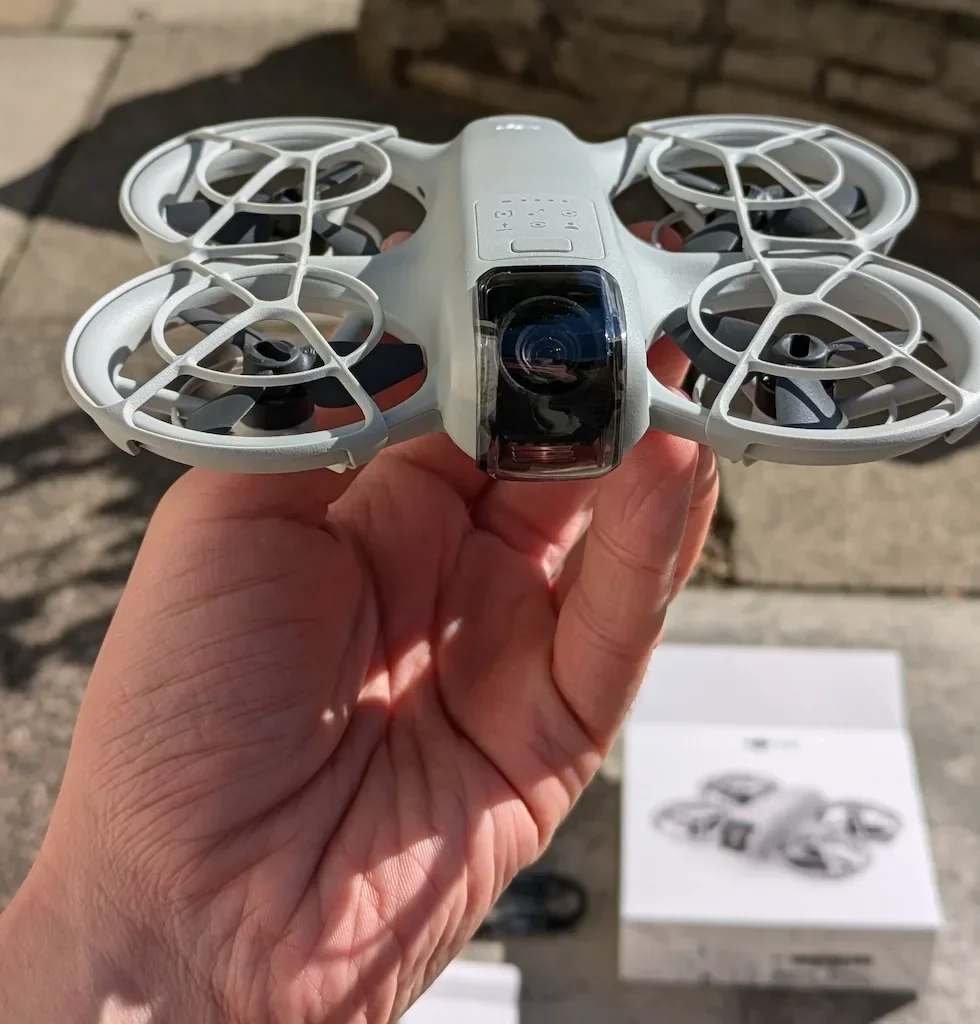
The honest caveat on the Neo is the one the manual is explicit about. The Neo has no obstacle sensing on its flight path. There is a downward vision system and a small infrared sensor for landing, but the drone will happily fly forward into a tree branch if you do not steer it away. The enclosed prop cage protects the drone from a minor bump, but it does not stop the drone from hitting something in the first place. That is the main reason I do not recommend it ahead of the Neo 2 for most buyers — on the Neo 2, forward LiDAR will stop the drone before contact.
Wind resistance is also softer than the Neo 2’s. The Neo is rated for winds up to 8 m/s, which on an average UK day is plenty but in coastal or hill conditions will have you watching the warning icons. If you live somewhere windy, the Neo 2 earns its price difference.
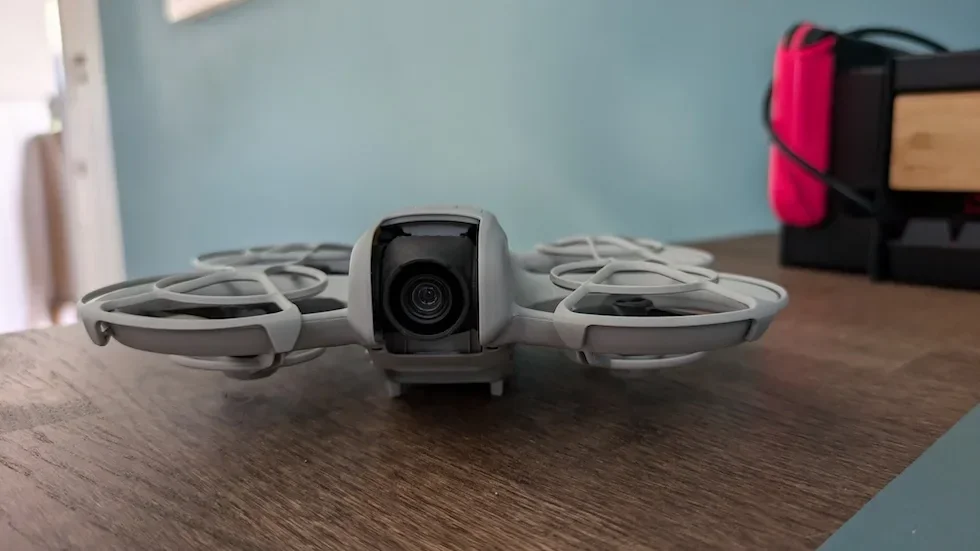
Buy the original Neo if you want palm launch on the tightest budget and you are comfortable keeping eyes on the drone at all times. Buy the Neo 2 instead if you want the same workflow with a proper safety net.
I recommend the Neo if you…
- Want palm launch at the lowest possible price
- Are buying a drone for a child or a family member to share
- Are flying in open fields with plenty of space and no obstacles
- Care more about total drone weight than camera quality
I do not recommend it if you…
- Want any kind of forward obstacle sensing
- Fly in gusty conditions above 8 m/s
- Are willing to pay a bit more for the Neo 2 and its LiDAR stack
- Want to shoot serious photography
Amazon Affiliate link — see the disclosure.
The DJI Mini 4K is the cheapest way to get a folding 4K drone into the air
The Mini 4K is the entry-level Mini, and it is here because it solves exactly one job: the cheapest way to get a real DJI folding drone and 4K video for under the 250-gram threshold. At 246 grams it folds into a pocketable shape, gives you 31 minutes of flight, and runs on OcuSync 2.0 (DJI’s older but rock-solid phone-to-drone signal). Everything else is stripped back.
The camera is a 1/2.3-inch 12 MP sensor, which is the smallest on this list. 4K video is supported at 24, 25 or 30 frames per second — there is no 4K 60 on this drone. If you want slow-motion 4K, you will bump up to 2.7K or Full HD. The image quality is fine for holiday footage and learning shots; it is not fine for paid client work.
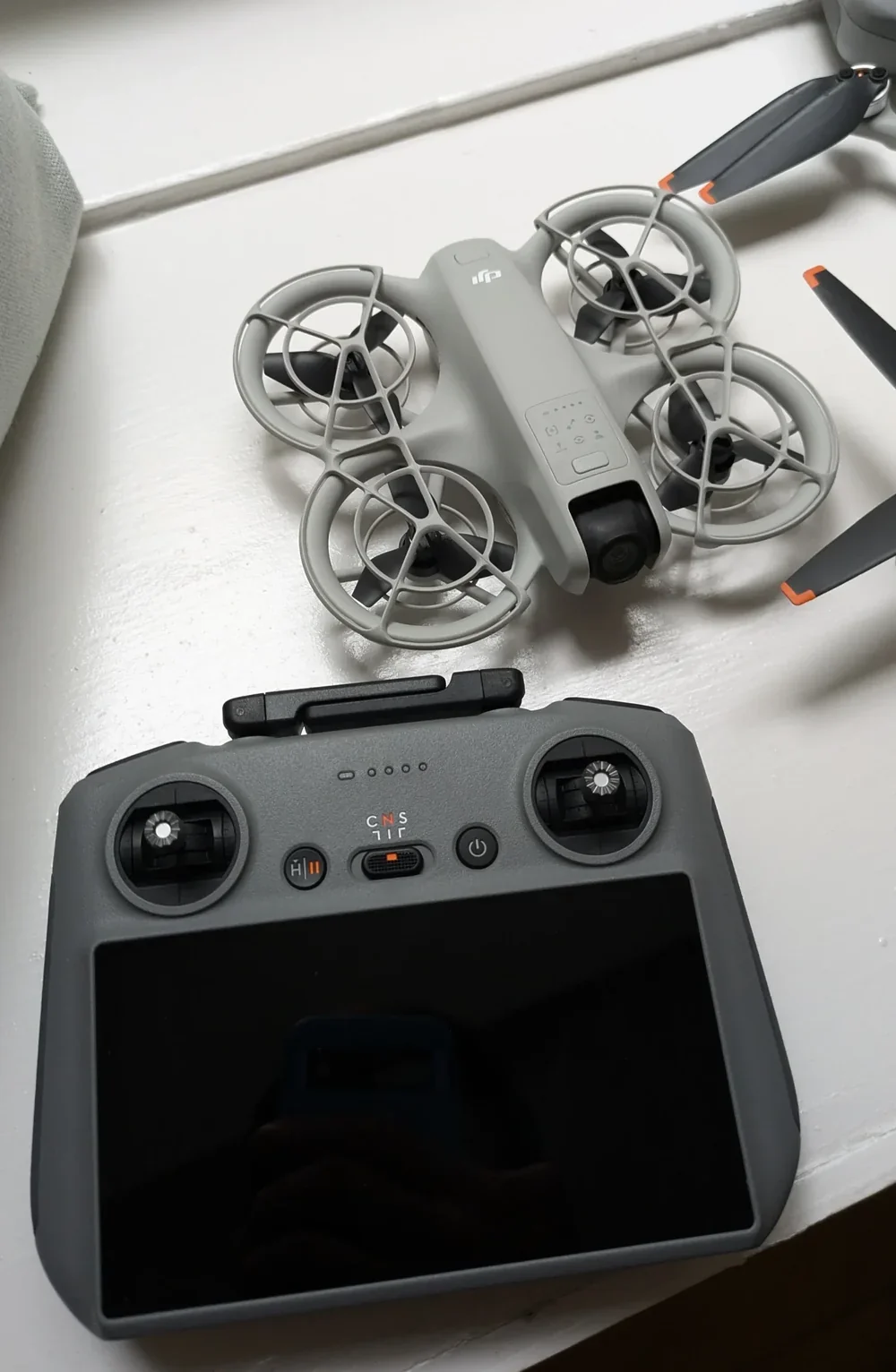
Obstacle sensing is downward only for landing — the manual is explicit that the drone cannot sense obstacles on its route automatically. Like the original Neo, you fly the Mini 4K with your eyes on it at all times. For a confident beginner who wants to learn twin-stick flying on the cheapest real DJI, that trade is fair. For anyone who wants the drone to stop itself from hitting something, the Neo 2 or the Mini 5 Pro are the better buys.
You get the standard Mini QuickShots suite — Dronie, Circle, Helix, Rocket, and Boomerang — plus a Panorama mode the app stitches for you. No ActiveTrack subject following, no MasterShots, no Hyperlapse. The flight modes are deliberately lean because this is DJI’s entry-level product.
I recommend the Mini 4K if you…
- Want the cheapest real DJI drone that folds and shoots 4K
- Are happy to learn stick control with eyes on the drone
- Just want casual holiday footage, not paid client work
- Want 31 minutes per battery at the lowest DJI price point
I do not recommend it if you…
- Want 4K 60 slow-motion video
- Want any obstacle sensing on the flight path
- Want ActiveTrack, MasterShots or Hyperlapse
- Prefer palm takeoff to a traditional remote controller
Amazon Affiliate link — see the disclosure.
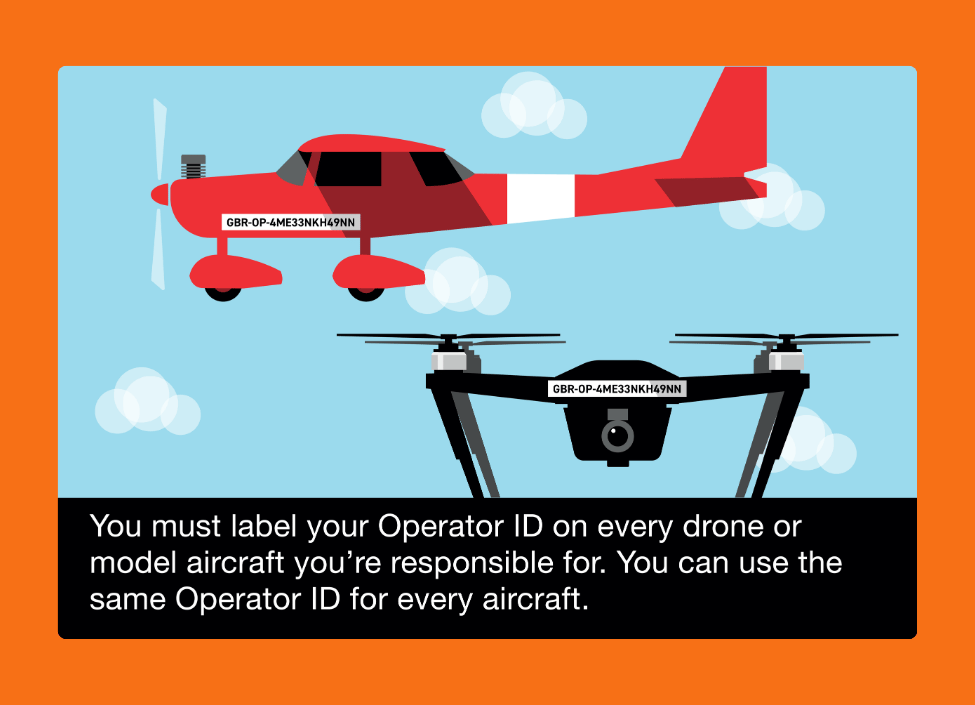
None of these five drones need a full drone licence, but every one of them needs two registrations
This is the part nobody tells you in the unboxing videos. Staying under 250 grams keeps you out of the A2 Certificate of Competence route, but it does not make you paperwork-free. Every drone on this list has a camera and weighs a hundred grams or more, which means before you fly any of them you need exactly two things: a Flyer ID and an Operator ID. Both take an afternoon, both are tied to you personally, not to the drone.
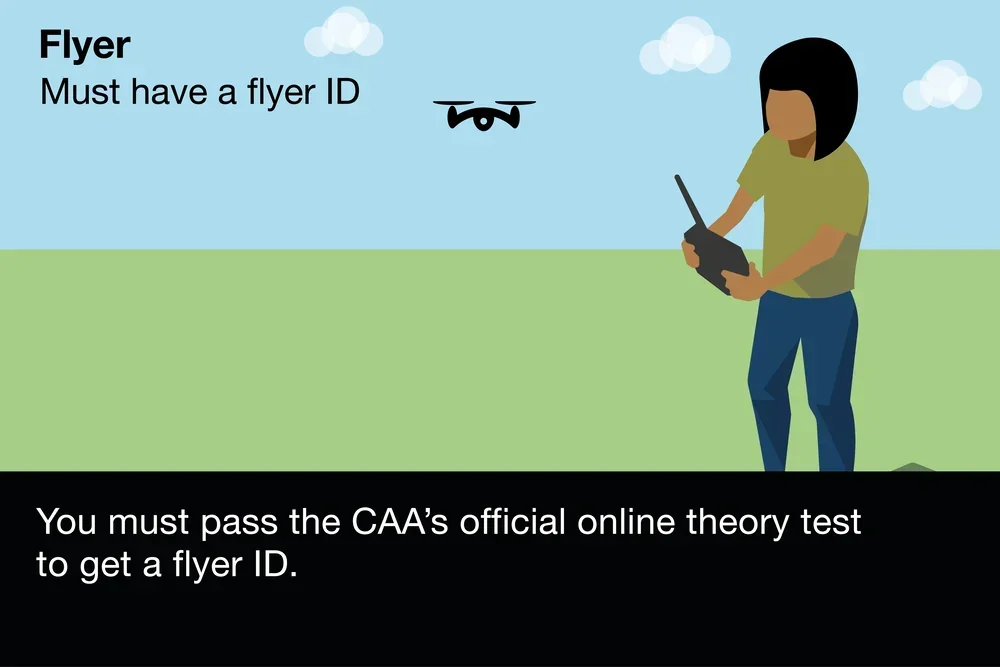
Flyer ID — free, valid five years
The Flyer ID is a free online test set by the UK Civil Aviation Authority. It covers basic airspace rules, weight thresholds, and common-sense scenarios. You can sit it on your phone from your sofa in about an hour. Pass it once and it is valid for five years. Anyone flying a drone heavier than one hundred grams needs one, so every drone on this list qualifies.
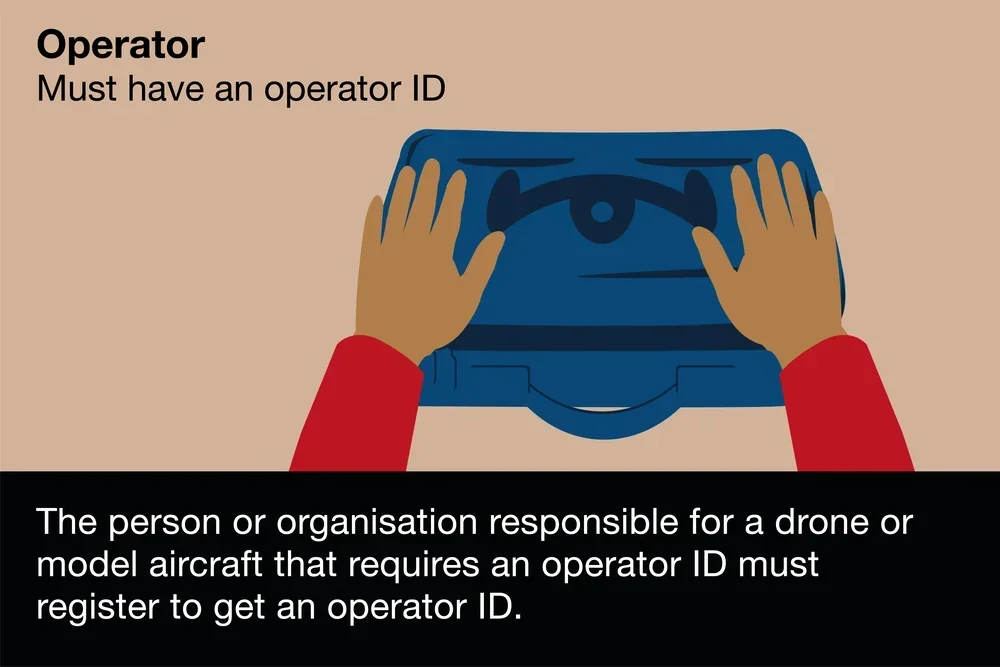
Operator ID — £12.34 a year
The Operator ID costs £12.34 per year and identifies the person responsible for the drone. One Operator ID covers every drone you own — it is registered against you, not the machine — so if you buy a second drone later the same number carries across. Any drone with a camera that weighs one hundred grams or more needs an Operator ID, which is every drone on this list. Write the number on the outside of the drone before you fly it.
What changes at 250 grams
UK drone flying breaks down into three practical “zones” of strictness under the Open Category (the bracket hobby drone pilots fly in). A1 Over People is the friendliest — you can fly near or even over uninvolved people (still never over crowds or assemblies), with almost no distance-from-people requirement. A2 Near People is the middle zone — thirty metres from uninvolved people (five metres in low-speed mode), and you need an A2 Certificate of Competence (an online theory test, about £60–100 with a training provider, roughly an afternoon’s work). A3 Far from People is the strictest — fifty metres from uninvolved people and one hundred and fifty metres from residential, commercial, industrial or recreational areas, no certificate needed.
Every drone on this list sits in A1 Over People. Under 250 grams you get that bracket automatically — no A2 CofC required, no thirty-metre buffer to respect. You still cannot fly over crowds or assemblies, and the 120-metre altitude ceiling still applies to every drone regardless of weight.
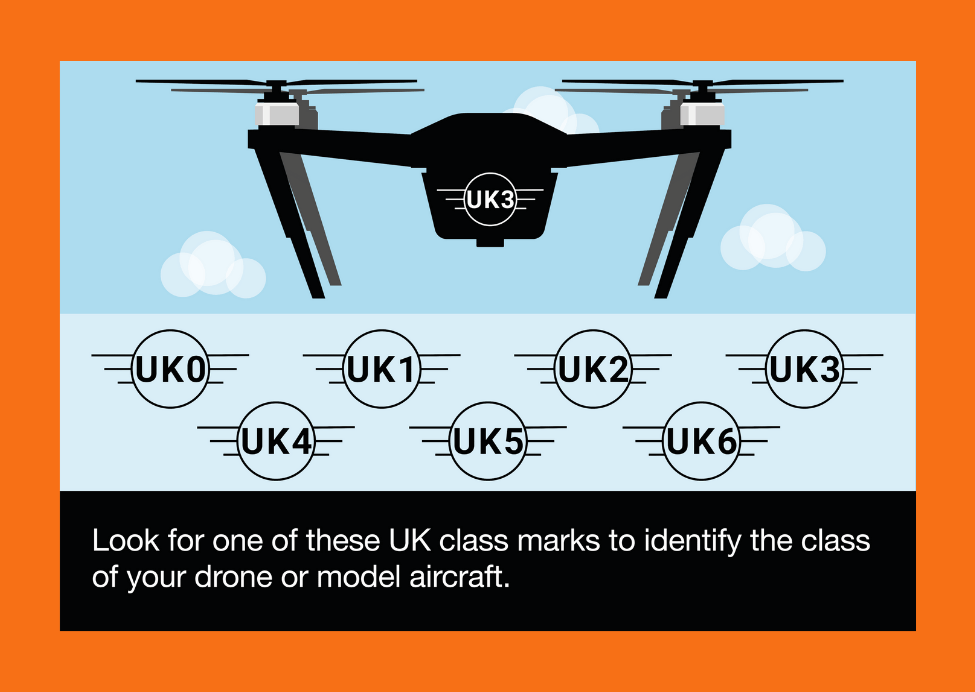
The January 2026 class-mark rule
A class mark is a sticker on the drone’s spec plate (UK0, UK1, up to UK6, or the retained EU equivalents C0 to C6) that tells you which flying bracket the drone is allowed to sit in — smaller number, friendlier rules. From January 2026, new drone models placed on the UK market must carry a UK class mark. Pre-2026 drones with the retained EU C-marks continue to fly as their UK equivalents until the end of 2027. The sub-250g drones on this list all carry C0 or will ship with the equivalent UK0 badge — that is the sticker that keeps them inside A1.
One thing worth knowing for 2026 buyers: Remote ID is not required for sub-250g drones (UK0 class). It only kicks in on UK1, UK2, and UK3 class drones, which start at 900 grams. Every drone on this list is far under that line, so you can skip the Remote ID question entirely.
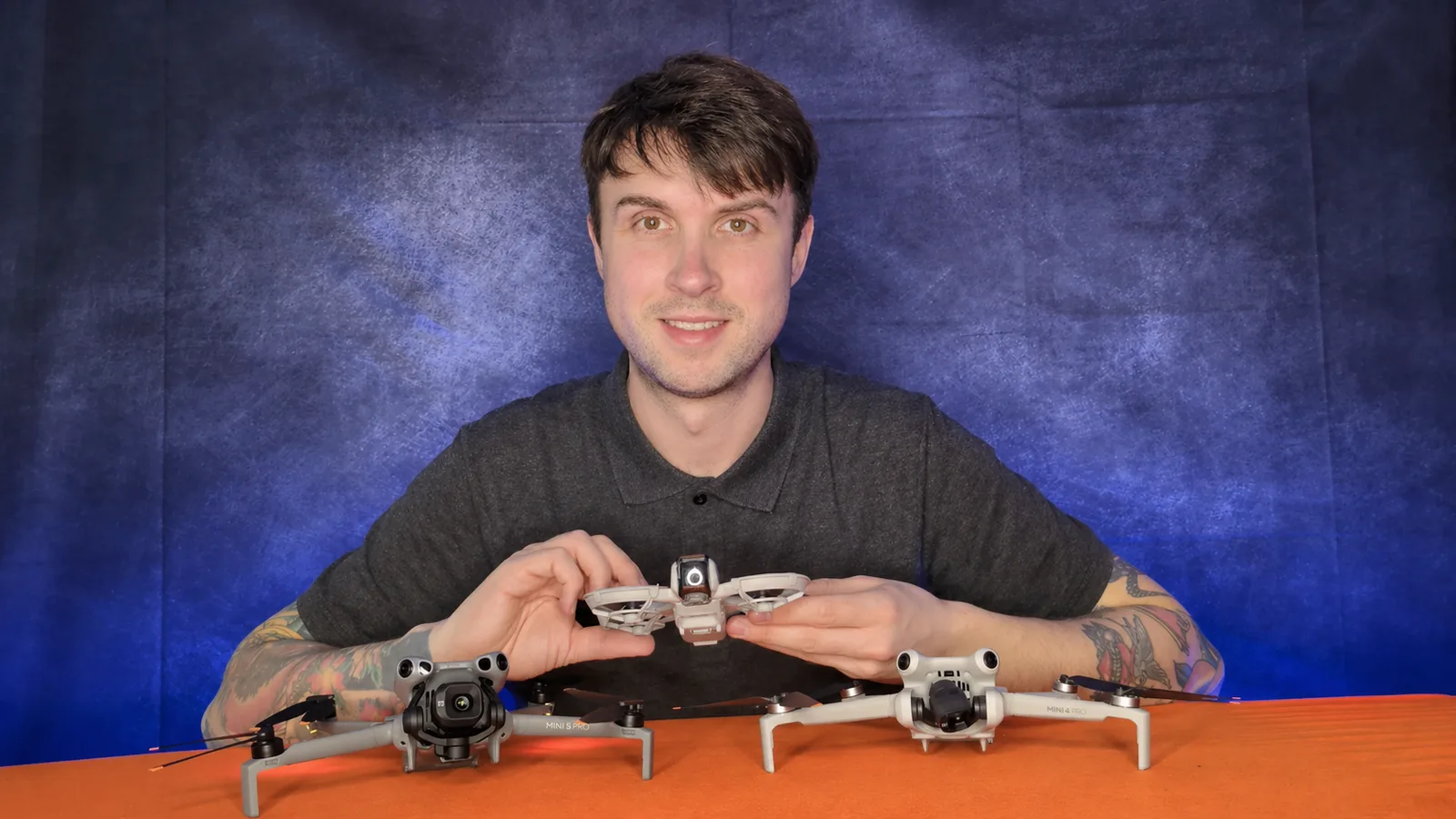
A handful of things every sub-250g drone pilot should spend money on before flying
The drone itself is only part of the kit. A few small extras make the difference between a first flight that goes well and one that ends with you walking home with a dead battery and a lesson learned.
Buy at least one spare battery on day one. UK weather is rarely ideal, and flight times drop hard below fifteen degrees Celsius — the manufacturer numbers on this page are warm-weather figures. A spare battery turns a twenty-minute session into forty. Buy a decent microSD card at the same time; a slow card will drop video frames on the Mini 5 Pro and the Antigravity A1 before you notice.
A small padded case is worth the ten pounds it costs — foam for the Minis and the Mini 5 Pro, a hard shell for the Neo and Neo 2 so the prop cage does not pick up knocks in a rucksack. For the Mini 5 Pro, a set of ND filters (little dark lenses that screw onto the camera) keeps your shutter speed in the cinematic range on sunny days. They are almost essential if you care about video quality.
If any of your flying crosses into paid work — even an occasional drone photography gig for a friend’s business — you need third-party drone insurance that covers commercial use. The hobbyist cover that comes with some memberships is not enough once money changes hands. That one is non-negotiable and has nothing to do with which drone you buy.
The short version one more time: the Mini 5 Pro if you want the best camera and sensor stack, the Neo 2 for the friendliest first flight, the Antigravity A1 if you already know you want goggles-first FPV, the Neo 1 for the cheapest palm-launch drone on the market, and the Mini 4K for the cheapest folding 4K drone DJI sells.
Got a scenario I have not covered here — a question about a specific drone, a niche use case, or the licensing side of sub-250g drone laws? Drop a note to peter@hiredronepilot.uk and I will come back to you directly. If you prefer the video version of this buying guide, the comments are open on YouTube.
References
Primary source material for this article is the UK Civil Aviation Authority and the official DJI and Antigravity user manuals. External links open in a new tab.
- UK CAA — The Drone and Model Aircraft Code (CAP2320) · Flyer ID and Operator ID thresholds, A1 sub-category rules for sub-250g drones
- UK CAA — Where You Can Fly (A1, A2, A3 sub-categories) · the sub-categories of the Open Category and what weight moves you between them
- UK CAA — Register-drones portal · the £12.34 Operator ID fee and the free Flyer ID test
- UK CAA — UK Regulatory Framework for Drones · the January 2026 UK class-mark rule and the end-of-2027 EU class-mark transition
- DJI — Mini 5 Pro product page and specifications · 249.9-gram C0 variant, one-inch sensor, forward LiDAR, 52-minute extended battery
- DJI — Neo 2 product page and specifications · 151-gram weight, forward LiDAR, palm takeoff and landing
- Antigravity — A1 product page and specifications · 249-gram C0 variant, 8K 360 panoramic camera, goggles-first FPV system
Peter Leslie
Founder & GVC Drone Pilot
Peter is the founder of HireDronePilot. With thousands of logged commercial flight hours, he writes about drone technology, commercial surveying tactics, and UK aviation compliance.
Connect on LinkedIn