DJI Flip vs DJI Mini 4K: which one should you buy?
Three grams separate these two on the scales. Almost nothing else about them is close. One folds out into a small drone you pilot; the other launches off your palm with a sensor twice the size and something watching where it is going.
 Written by Peter Leslie, GVC-qualified commercial drone pilot | Every figure checked against both DJI manuals | 3 Aug 2026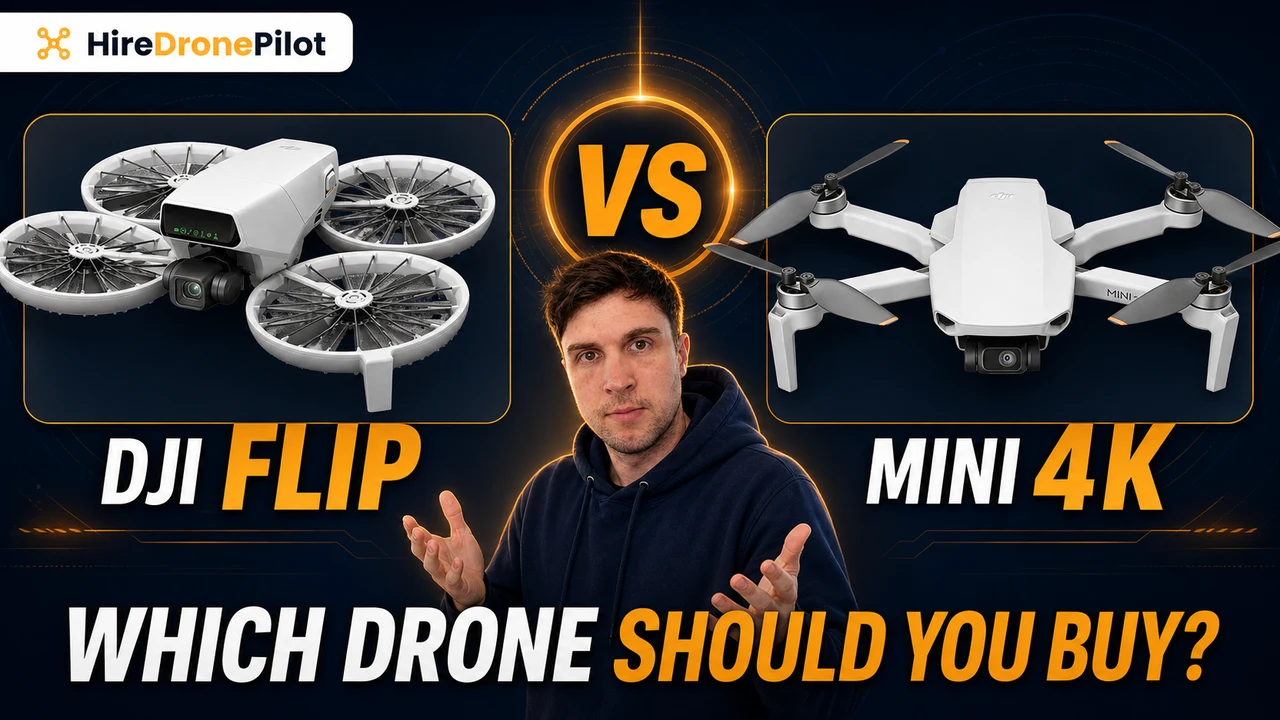
My short answer
I recommend the DJI Flip
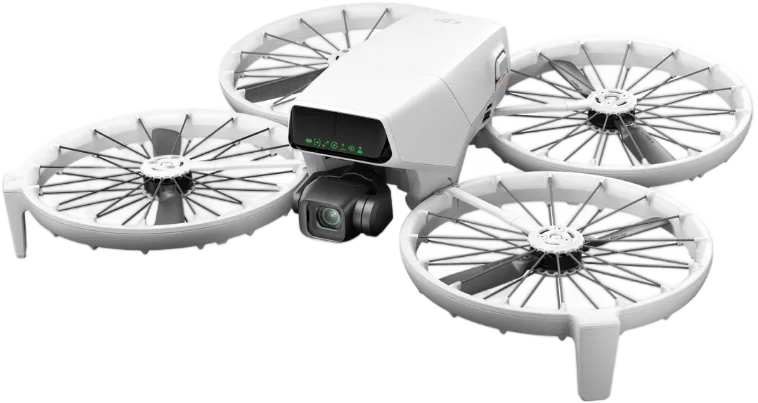
DJI Flip
The 2025 folding palm-launcher
Nearly the same weight, and a completely different class of drone. Four times the stills resolution, forward sensing, caged propellers and palm launch.
- Much larger 1/1.3-inch, 48 MP sensor
- Sees obstacles ahead of it
- Caged propellers, so knocks rarely end a flight
- Launches off your palm, no controller needed
- 4K at 100fps for slow motion
- Almost 249 g, just 1 g under the limit
I recommend this if…
- You care how the finished footage actually looks
- You will fly anywhere near trees, walls or people
- You want to film yourself without a controller
- You want slow motion at full 4K
Only if price is the deciding factor
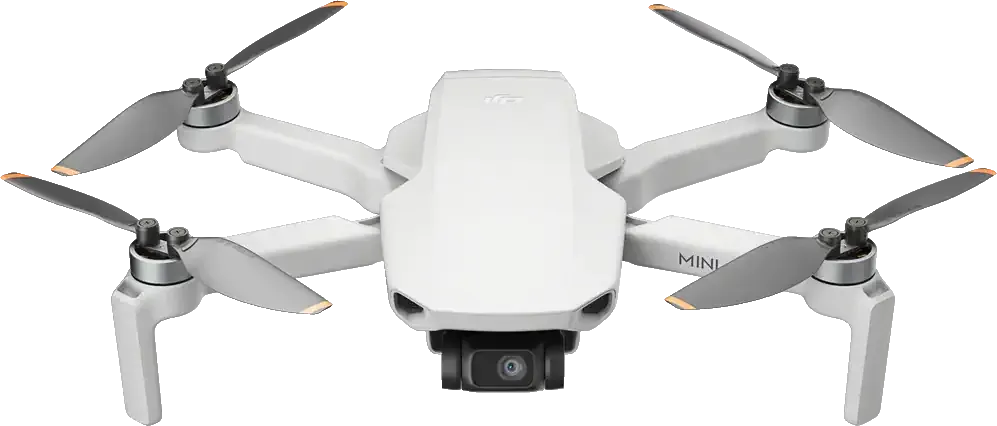
DJI Mini 4K
The 2024 budget folding drone
The cheapest way into a real DJI drone, and it shows. A controller in the box and a high ceiling, but nothing on it looks where it is going.
- Smaller 1/2.3-inch sensor, 12 MP only
- Cannot sense obstacles at all, in any direction
- Bare propellers with no guards fitted
- No palm launch — a controller is required
- 4K capped at 30fps, no slow motion
- 246 g, and a 4000 m ceiling
I recommend this if…
- You want the cheapest route into a DJI drone
- You would rather fly with sticks in your hands
- You want a controller included in the box
- You will fly in genuinely open space
Both links are Amazon affiliate links. As an Amazon Associate I earn from qualifying purchases, at no extra cost to you — full disclosure.
Why these two get compared, and why the comparison is misleading
On paper they look like natural rivals. Both fold, both weigh within three grams of each other, and both sit just under the 250 gram line that UK rules are built around.
That is where the similarity stops.
The Mini 4K is a conventional drone in miniature. It comes with a remote controller, you clamp your phone into it, and you fly the thing yourself with two sticks. Everything it does, you tell it to do.
The Flip will do that too, but it will also launch off your open palm with no controller and no phone, film a move you picked beforehand, and land back on your hand. Its propellers sit inside a cage, so clipping a branch is usually a bump rather than a crash.
So the weights match and the capabilities do not. That is the whole story of this comparison, and it is worth knowing before the specifications start piling up.
Both turn up in my best drones under 250g guide, and the Mini 4K also features in best drone under £300.
Four things that genuinely are the same
These four do not separate them, so put them aside before comparing anything else.
-
Near-identical weight
Under 249 g against 246 g.
-
Same wind rating
Both rated to 10.7 m/s, Level 5.
-
Same UK paperwork
Flyer ID and Operator ID for both.
-
Same rated flight time
31 minutes quoted on both.
-
So ignore all 4
None of it can tell you which to buy. The next four things can.
The flight times are laboratory figures on both counts, measured in still air with the battery run flat. Expect a good deal less on any normal British afternoon, and less again on the Flip with its propeller cages fitted.
The four differences that actually matter
1. The Mini 4K cannot sense obstacles at all. The Flip looks where it is going
This is the one that should settle it, and the Mini 4K manual is unusually blunt about it.
Page 13 states that the drone cannot sense obstacles on its route automatically, and that the pilot should stay alert and steer around them. Its only sensors are a downward vision system and an infrared module, both pointing at the ground.
Those are there to help it hover and land. They do nothing whatsoever about the fence post in front of it.
The Flip carries a forward-facing 3D infrared sensing system as well as its downward pair, so it can detect what is ahead and slow for it.
Flip
Forward infrared, plus downward
- Forward 3D infrared sensing
- Downward visual and infrared
- Caged propellers absorb a clip
- Nothing watching sideways
Mini 4K
Downward sensors only
- Knows its height above the ground
- Nothing facing forwards
- Manual: cannot sense obstacles automatically
- Bare propellers, so a clip is a crash
The two failings compound on the Mini 4K. It cannot see an obstacle coming, and when it meets one there is no cage between a spinning propeller and whatever it hit.
On the Flip the same mistake is usually a bump, a wobble and a sheepish landing.
Winner — DJI Flip
One drone will slow down for a tree and survive brushing it. The other will do neither. For a first drone in particular, that gap is worth more than any specification on the page.
In genuinely open space, over an empty field with nothing but sky around it, the Mini 4K’s missing sensors never come up.
Check the Flip on Amazon2. The Flip has four times the stills resolution and twice the sensor area
Sensor size is the single biggest thing deciding how footage looks, and there is a real gap here.
The Flip uses a 1/1.3-inch sensor. The Mini 4K uses a 1/2.3-inch one. Put plainly, the Flip has roughly twice the light-gathering area.
It also opens much wider, at f/1.7 against f/2.8, and takes 48-megapixel stills where the Mini 4K manages 12.
Flip
48MP
1/1.3-inch sensor, f/1.7
Mini 4K
12MP
1/2.3-inch sensor, f/2.8
The frame rate gap is just as wide. The Flip records 4K at up to 100 frames a second, so a clip can be slowed right down and stay smooth. The Mini 4K records 4K at 30 and nothing faster.
Flip
100fps
smooth 4K slow motion
Mini 4K
30fps
normal speed only
Light sensitivity follows the same pattern. The Flip reaches ISO 6400 where the Mini 4K stops at 3200, and it starts from a wider lens on a bigger sensor.
For overcast afternoons and winter light, which is most of the British year, those three things together are the difference between usable footage and grainy footage.
Flip
A camera you can push
- 1/1.3-inch sensor, twice the area
- Wider f/1.7 lens
- 48 MP stills at 8064 by 6048
- 4K at up to 100fps
- ISO up to 6400
Mini 4K
A camera that needs good light
- 1/2.3-inch sensor
- Narrower f/2.8 lens
- 12 MP stills only
- 4K capped at 30fps
- ISO stops at 3200
Winner — DJI Flip
Twice the sensor area, a much wider lens, four times the stills resolution and slow motion the Mini 4K cannot produce at all. If the footage is going anywhere other than the bin, this is not a contest.
In bright, still conditions the Mini 4K produces perfectly decent 4K. It is a genuinely capable little camera in good light.
Check the Flip on Amazon3. The Flip can fly with nothing in your hands. The Mini 4K cannot fly without a controller and a phone
A practical difference that decides how often each drone actually gets used.
The Flip has palm control. Press a button on the drone, hold your hand flat, and it lifts off, films a preset move and comes back to your hand. No controller, no phone.
The Mini 4K has none of that. It ships with the RC-N1 controller, which has no screen of its own, so your phone clamps in and becomes the display.
That means a flat phone is a cancelled flight. There is no way to see what the camera sees without it.
Flip
Three ways to fly it
- Palm launch with nothing else
- Phone over its own wi-fi
- Or a controller if you want one
- Pocket to hovering in seconds
Mini 4K
One way to fly it
- Controller required, always
- Phone required as the screen
- No palm launch of any kind
- Four arms out before you start
There is a transmission difference behind this too. The Flip uses O4, where the Mini 4K uses OcuSync 2.0 and pipes a 720p live view to your phone.
You still record 4K on the Mini 4K either way. It is the picture you frame the shot on that is softer.
Winner — DJI Flip
The drone you can launch in ten seconds is the drone that comes out of the bag. Setting the Mini 4K up is not difficult, but it is four arms, a controller, a phone clamp and a cable every single time.
If you want to learn to fly properly, sticks in hand, the Mini 4K is arguably the better teacher. It makes you do the work.
Check the Flip on Amazon4. The Mini 4K carries no class mark, and stops working at zero degrees
Two smaller points that both land the same way, and neither appears in a marketing comparison.
The Flip carries a C0 class mark, declared in its manual. The Mini 4K manual contains no class marking of any kind, which makes it a legacy drone in the eyes of the rules rather than a classified one.
Practically that changes little today. A drone under 250 grams flies in the same open category either way, so do not let anyone tell you the Mini 4K is somehow less legal.
The temperature difference is the one you will actually meet. The Flip is rated to work down to minus ten degrees. The Mini 4K is only rated to zero.
For a British winter that is a real constraint. Frosty mornings are some of the best flying light of the year, and one of these two is outside its rated range before you have left the car.
Flip
-10°C
rated to work in frost
Mini 4K
0°C
not rated below freezing
Neither drone has much headroom under the weight limit, and the Mini 4K has slightly more of it: 4 grams against 1. Both manuals warn against adding payload or fitting unapproved parts.
At these weights that warning has teeth on both. Neither is a drone you should be bolting accessories to.
Winner — DJI Flip
The class mark is a technicality, but the cold rating is not. Ten degrees of extra range covers most British winter mornings, and those are mornings the Mini 4K is not rated to fly at all.
The Mini 4K does have marginally more weight headroom, and a 4000 metre ceiling against the Flip’s 3000 — though UK rules hold you to 120 metres regardless.
Check the Flip on AmazonFour questions that will tell you which one to buy
Work down them and stop at the first one you can answer firmly. That is your drone.
Will you fly it anywhere near trees, buildings or people?
FlipDo you care how the finished footage looks, in ordinary British light?
FlipDo you want to film yourself without holding a controller?
FlipNone of the above, and the price gap is what decides it?
Mini 4KThis is the least balanced of the sub-250 gram comparisons. The Mini 4K is a fine cheap drone, but the Flip beats it on camera, on sensing, on safety and on convenience, and they weigh the same. If the Flip is where you have landed, it is worth reading it against the DJI Neo 2 as well.
Two catches worth knowing before you order either one
Neither is a reason to avoid either drone. Both are things I would want to have been told before paying.
The Flip has 2 GB of internal storage, which is not really storage
The Flip does have onboard storage, and the number is 2 GB. In 4K at 100 frames a second that is a matter of seconds of footage.
Treat a microSD card as part of the purchase price rather than an accessory.
In fairness the Mini 4K is worse here. It has no internal storage whatsoever, so a card is compulsory from the first flight rather than merely sensible.
Either way, buy the card at the same time as the drone and save yourself a wasted afternoon.
Neither of these has any real weight headroom
Under 249 grams and 246 grams sound comfortably beneath the 250 gram line. They are not comfortable at all.
One gram on the Flip and four on the Mini 4K is a sticker, a lanyard loop or a slightly heavier third-party propeller.
Cross the line and the rules tighten sharply on how close you may fly to other people, so this is not a technicality to shrug at.
The practical advice is the same for both: fly them as they came, and buy DJI parts rather than cheaper copies.
Size, speed and ceiling
Three specifications people search for that should not change your answer.
Folded, the Mini 4K is slightly the tidier package at 138 by 81 by 58 millimetres against the Flip’s 136 by 62 by 165. The Flip is the longer object folded; the Mini 4K the chunkier one.
Unfolded the Mini 4K is the larger drone, at 245 by 289 millimetres with its propellers out.
Top speed goes to the Mini 4K, at 16 metres per second in Sport mode against the Flip’s 12. Neither is a drone you buy for speed, and the Flip is the one with a cage round its propellers if you get it wrong.
Ceiling also favours the Mini 4K, at 4000 metres against 3000. This has no bearing on UK flying, where you are held to 120 metres either way.
Flip vs Mini 4K: every specification side by side
| DJI Flip | DJI Mini 4K | |
|---|---|---|
| Released | January 2025 | April 2024 |
| Weight | Under 249 g | 246 g incl. battery, props and card |
| Room under the 250 g limit | 1 g | 4 g |
| Class mark | C0 | None — legacy |
| Propeller guards | Yes, full cage | No |
| Palm takeoff | Yes | No, controller required |
| Controller in the box | Depends on package | Yes, RC-N1 |
| Obstacle sensing | Forward 3D infrared, downward visual and infrared | None — downward positioning only |
| Rated flight time | 31 min (28 hovering) | 31 min |
| Operating temperature | −10° to 40° C | 0° to 40° C |
| Gimbal | Three-axis (tilt, roll, pan) | Three-axis (tilt, roll, pan) |
| Camera sensor | 1/1.3-inch, 48 MP | 1/2.3-inch, 12 MP |
| Lens | f/1.7, 82.1° | f/2.8, 83° |
| ISO range | 100–6400 | 100–3200 |
| Max video | 4K at 100fps | 4K at 30fps |
| Max stills | 8064 × 6048 (48 MP) | 4000 × 3000 (12 MP) |
| Internal storage | 2 GB | None — microSD required |
| Transmission | O4 | OcuSync 2.0, 720p live view |
| Battery | 3110 mAh | 2250 mAh |
| Max speed | 12 m/s (Sport) | 16 m/s (Sport) |
| Wind resistance | 10.7 m/s (Level 5) | 10.7 m/s (Level 5) |
| Ceiling | 3000 m | 4000 m |
| On Amazon | Check price | Check price |
Figures from the official DJI specification pages and both user manuals. Amazon affiliate links — disclosure.
Both drones need a Flyer ID and an Operator ID. Neither is exempt
You will read all over the internet that drones under 250 grams need no licence. For a camera drone in the UK that is simply wrong, and both of these are camera drones.
Any camera drone between 100 g and 250 g needs both of these before you fly it outdoors. At under 249 g and 246 g, both of these sit in that bracket — barely.
Flyer ID
Proves you know the rules. A free online theory test, valid five years.
Operator ID
Registers you as responsible for the drone. £12.34 a year, and the number must be labelled on the drone.
Neither drone needs a GVC or an A2 Certificate of Competence, which are the qualifications for heavier or commercial flying. The Flip carries a C0 class mark and the Mini 4K carries none, but both fly in the same open category while they stay under 250 g. There is more in do I need a licence for a sub-250g drone and UK class marking explained.
Why I pick the DJI Flip over the DJI Mini 4K
I pick the DJI Flip over the DJI Mini 4K because they weigh the same and the Flip is a better drone in almost every way that matters.
Twice the sensor area, four times the stills resolution, slow motion the Mini 4K cannot manage, something watching where it is going, a cage round the propellers and the option of flying it with nothing in your hands.
The Mini 4K keeps one real argument, which is price, plus a controller in the box for anyone who wants to learn to fly properly. If that is you, it is not a bad drone. It is simply an older and much barer one.
My recommendation — DJI Flip
DJI Flip
2025 — under 249 g, C0 class mark
I recommend the DJI Flip over the DJI Mini 4K because they weigh within three grams of each other and the Flip is the better drone in almost every way that matters. It has twice the sensor area, four times the stills resolution, and slow motion the Mini 4K cannot produce at all. It also looks where it is going, keeps its propellers in a cage, and will fly with nothing in your hands. The Mini 4K keeps one real argument, and that argument is price.
- 1/1.3-inch sensor, twice the area
- Wider f/1.7 lens, 48 MP stills
- Forward 3D infrared sensing
- Caged propellers absorb a knock
- Palm launch with nothing in your hands
- 4K at 100fps, O4 transmission
- Almost 249 g, just 1 g under the limit
- Only 2 GB inside, so buy a card
Amazon affiliate link — no extra cost to you.
The budget route
DJI Mini 4K
Buy this only if the price gap is the deciding factor, you want a controller in the box, and you are content to be the thing that avoids the trees.
Amazon affiliate links — disclosure.
Written by Peter Leslie — GVC-qualified commercial drone pilot
I fly compact DJI drones alongside enterprise survey kit, and I judge them on the footage and the safety margin they give me in real UK conditions.
Every figure here came out of the official DJI manuals or the CAA, not a press release. Where the manuals contradicted the marketing I went with the manuals.
Comparison you want covered next? peter@hiredronepilot.uk.
Sources