DJI Neo 2 vs DJI Flip: which one should you buy?
This is the closest pair DJI currently sells. Both launch off your open palm, both hide their propellers in a cage, and both carry a C0 class mark. The gap is in what the camera can do, and what each one weighs.
 Written by Peter Leslie, GVC-qualified commercial drone pilot | Every figure checked against both DJI manuals | 3 Aug 2026
My short answer
I recommend the DJI Flip
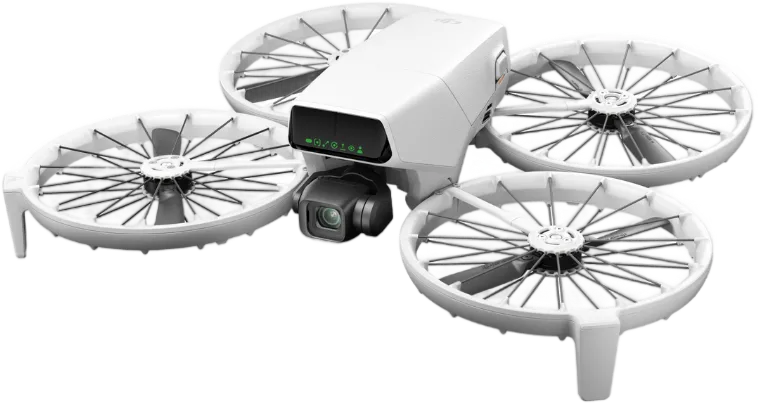
DJI Flip
The 2025 folding palm-launcher
The same palm-launch trick, with a far bigger camera behind it. A 1/1.3-inch sensor, a three-axis gimbal and half an hour in the air.
- Much larger 1/1.3-inch, 48 MP sensor
- Three-axis gimbal with pan as well
- About 31 minutes per battery
- O4 transmission built in, no add-on
- Almost 249 g, just 1 g under the limit
- A near-useless 2 GB of internal storage
I recommend this if…
- You care how the finished footage actually looks
- You want half an hour in the air, not twenty minutes
- You may add a controller or goggles later
- You want it to fold down small
If weight and sensing come first
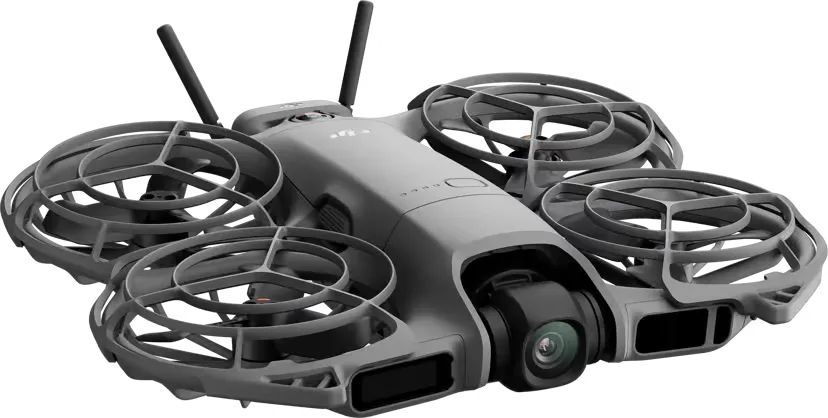
DJI Neo 2
The 2025 featherweight
Lighter, cleverer at seeing trouble, and it needs nothing else bought. The camera is the compromise you make for that.
- Smaller 1/2-inch sensor, 12 MP only
- Two gimbal axes, no pan
- About 19 minutes per battery
- Needs a transceiver add-on for O4
- 151 g, with 99 g of room to spare
- 49 GB of storage built in
I recommend this if…
- You want the lightest drone with the most legal headroom
- You fly close to trees, walls or people
- You would rather not buy a memory card at all
- You want it out of your pocket and flying in seconds
Both links are Amazon affiliate links. As an Amazon Associate I earn from qualifying purchases, at no extra cost to you — full disclosure.
What both of these do that ordinary drones do not
Most drones put a controller in both your hands and leave you to fly. These two do not work like that, and it is the reason people shortlist them together.
Both launch off your open palm. Press a button on the drone, hold your hand flat, and up it goes. No controller, no phone, no flat patch of ground to find first.
Then they film you. You pick a move before takeoff — follow behind, orbit, climb and reveal the view — and the drone does that one job and returns to your hand.
Both also keep their propellers inside a cage, which matters more than it sounds. Clip a branch or a doorframe and you usually get a bump rather than a crash.
So there is no argument to have about which is the more capable pilot’s drone. They do the same trick. The question is which does it with the better camera, and at what cost in weight.
For the wider shortlist, my best beginner drones guide and best drones under 250g put both of these in context.
Five things that are identical on the Flip and the Neo 2
These five do not separate them at all, so put them aside before comparing anything else.
-
Same palm launch
Both lift off and land on your hand.
-
Same caged propellers
A knock is usually a bump, not a crash.
-
Same C0 class mark
And the same Flyer ID and Operator ID.
-
Same wind rating
Both rated to 10.7 m/s, Level 5.
-
Same top frame rate
4K at up to 100fps on either drone.
-
So ignore all 5
None of it can tell you which to buy. The next four things can.
Both are also rated to work down to minus ten degrees, so neither has an advantage on a cold morning. Treat the quoted flight times with suspicion on both counts, mind: they are laboratory figures measured in still air.
The four differences that actually matter
1. The Flip has a far bigger sensor. The Neo 2 cannot make that up anywhere else
Sensor size is the single biggest thing deciding how footage looks, and this is not a close comparison.
The Flip uses a 1/1.3-inch sensor. The Neo 2 uses a 1/2-inch one. Those fractions are awkward to read, so put it plainly: the Flip has roughly twice the light-gathering area.
It also opens wider, at f/1.7 against f/2.2, and shoots 48-megapixel stills where the Neo 2 manages 12.
Flip
48MP
1/1.3-inch sensor, f/1.7
Neo 2
12MP
1/2-inch sensor, f/2.2
A bigger sensor with a wider lens means more light reaching it, and more light is what separates footage that holds together from footage that turns to mush when the sun goes behind a cloud.
There is one genuine counter. The Neo 2 pushes its light sensitivity to ISO 12800 where the Flip stops at 6400, so on paper the Neo 2 reaches further into the dark.
In practice the larger sensor wins that argument anyway. Higher sensitivity on a small sensor buys you a brighter picture with more noise in it, not a better one.
Flip
The better camera
- 1/1.3-inch sensor, roughly twice the area
- Wider f/1.7 lens
- 48 MP stills at 8064 by 6048
- Three-axis gimbal, including pan
- ISO stops at 6400
Neo 2
The smaller camera
- 1/2-inch sensor
- Narrower f/2.2 lens
- 12 MP stills only
- Two gimbal axes, no pan
- ISO reaches 12800
Winner — DJI Flip
Twice the sensor area, a wider lens and four times the stills resolution. If you are keeping the footage rather than binning it, this is the section that should decide the whole purchase.
The Neo 2 is not bad, and 12 megapixels is plenty for a phone screen. It is prints, crops and difficult light where the Flip pulls clear.
Check the Flip on Amazon2. The Neo 2 weighs 151 g. The Flip weighs almost 249 g
UK rules are built around a 250 gram line. Under it you sit in the friendliest bracket there is, and crossing it tightens the rules sharply on how close you may fly to other people.
The Flip comes in at under 249 g, which is DJI deliberately shaving beneath the limit rather than comfortably clearing it. The Neo 2 is not close to it.
Flip
249g
just 1 g under the 250 g limit
Neo 2
151g
99 g under the limit
So the Flip has one gram of room and the Neo 2 has ninety-nine.
One gram is not a margin. It is a sticker, a lanyard loop, a slightly heavier third-party propeller.
Both manuals carry the same C0 warning: do not add payload beyond the listed accessories, do not fit unapproved batteries or propellers, and do not modify the drone.
On the Neo 2 that is a formality you will never bump into. On the Flip it is a live constraint, and worth knowing before you start buying accessories for it.
There is a straightforward carrying difference on top. The Flip folds to a neat 136 by 62 by 165 millimetres, but the Neo 2 is simply a smaller, lighter object that never needs unfolding at all.
Winner — DJI Neo 2
Ninety-eight grams lighter, and it leaves you room to add whatever you like without doing arithmetic. For anyone walking any distance with it, or anyone likely to fit accessories, that is a real advantage.
If you fly the Flip exactly as it comes and add nothing to it, 249 g is under the line and stays under it.
Check the Neo 2 on Amazon3. The Neo 2 sees in every direction. The Flip only looks forwards
Both drones have obstacle sensing, which is the first thing to say, because plenty of comparisons imply the Flip has none.
The Flip carries a forward-facing 3D infrared sensing system, plus a visual sensor and an infrared sensor pointing down. It can see what is ahead of it and it knows its height.
The Neo 2 goes further. It has a forward-facing LiDAR unit, which is a small laser that measures distance, and cameras watching sideways all the way around.
Flip
Forward infrared, plus downward
- Forward 3D infrared sensing
- Downward visual and infrared
- Nothing watching sideways
- Infrared struggles on thin branches
Neo 2
LiDAR ahead, vision all round
- Forward-facing laser rangefinder
- Cameras watching sideways, all round
- Downward infrared sensing
- Brakes or steers round what it sees
The practical difference is sideways movement. An orbit shot takes the drone crabbing round you, and on the Flip nothing is watching the direction it is actually travelling.
Infrared also has a known weakness with thin, complex shapes. Bare winter branches are exactly the sort of thing it reads poorly, and exactly the sort of thing an orbit shot tends to swing through.
Worth saying honestly: on the Neo 2 the avoidance switches itself off in Sport mode, so it is not a safety net you can lean on at all times either.
Winner — DJI Neo 2
For the two moves people actually buy these drones for, following and orbiting, the Neo 2 is watching where it is going and the Flip is not. That is the sort of difference you notice once, expensively.
In open space it makes no odds. The Flip has enough sensing for a beach or an empty hillside.
Check the Neo 2 on Amazon4. The Flip flies for 31 minutes. The Neo 2 manages about 19
A twelve-minute gap per battery, which is the largest proportional difference between these two drones anywhere.
DJI rates the Flip at 31 minutes in forward flight and 28 hovering. The Neo 2 is rated at about 19.
Flip
31min
about 22 to 25 in reality
Neo 2
19min
about 12 to 15 in reality
Neither figure survives contact with a British afternoon. Both are measured in still air with the battery run flat, and both drop once there is wind to push against and a landing reserve to keep back.
The Flip carries a much larger battery to get there, at 3110 milliamp hours against the Neo 2’s 1606, and that battery is a good part of why it weighs what it does.
How much this matters depends on how you fly. Both of these get used in twenty-second bursts off your palm, so you rarely run a battery flat in one continuous flight.
Where it tells is across a whole walk. On one battery each, the Flip gives you noticeably more chances to put something in the air before you are done for the day.
Winner — DJI Flip
Half an hour against twenty minutes, from a drone that also has the better camera. Buy one spare battery for the Flip and you have an afternoon; buy one for the Neo 2 and you have most of one.
The Neo 2 charges over USB-C and is light enough that carrying two spares costs you nothing. That closes the gap for anyone willing to buy batteries.
Check the Flip on AmazonFour questions that will tell you which one to buy
Work down them and stop at the first one you can answer firmly. That is your drone.
Do you care how the finished footage looks, in ordinary British light?
FlipDo you want half an hour in the air rather than twenty minutes?
FlipWill you fly orbits and follow shots close to trees or walls?
Neo 2Are you carrying it any distance, or likely to add accessories to it?
Neo 2Split down the middle, this one, which is why it is the hardest pair DJI sells. If you answered yes to the first two, buy the Flip. If the last two describe you better, buy the Neo 2 and enjoy how little it weighs.
Worth also weighing the Flip against the DJI Mini 4K, and the Neo 2 against the original Neo.
Two catches worth knowing before you order either one
Neither is a reason to avoid either drone. Both are things I would want to have been told before paying.
The Flip has 2 GB of internal storage, which is not really storage
The Flip does have onboard storage, and the number is 2 GB. In 4K at 100 frames a second that is a matter of seconds of footage.
Treat a microSD card as part of the purchase price rather than an accessory. Without one the drone is close to unusable for its intended job.
The Neo 2 has 49 GB built in, which is genuinely enough to fly all day and never think about a card.
It is a small thing on a spreadsheet and an annoying thing in a field, so buy the card at the same time as the drone.
The Neo 2 needs a bolt-on part before any controller will work
If you decide later that you want a proper remote controller, or the goggles that let you see the camera view as you fly, the two drones are not equal here.
The Flip has O4 transmission built in and pairs with DJI controllers directly.
The Neo 2 needs a separate accessory called the Digital Transceiver first. Until it is fitted, no controller, no goggles and no motion controller will connect at all.
It is not a clip-on either. DJI tells you to check its screws every thirty hours, and fitting it takes the drone from 151 g to 160 g.
Speed, ceiling and the numbers that do not decide it
Three specifications people search for that should not change your answer, but which are worth having straight.
Top speed is a wash. Both are rated at 12 metres per second in Sport mode, and the Flip will reach 16 with a 4 metre per second tailwind behind it, which is not really the drone going faster.
Ceiling favours the Flip, at 3000 metres against 2000. Neither figure has any bearing on UK flying, where you are held to 120 metres regardless.
Wind resistance is identical, at 10.7 metres per second, or Level 5, on both. That is roughly 24 miles an hour, and it is one of the more useful numbers here for British flying.
Both are also rated down to minus ten degrees, so neither has the advantage on a frosty morning.
Flip vs Neo 2: every specification side by side
| DJI Flip | DJI Neo 2 | |
|---|---|---|
| Released | January 2025 | November 2025 |
| Weight | Under 249 g | 151 g (160 g with transceiver) |
| Room under the 250 g limit | 1 g | 99 g |
| Class mark | C0 | C0 |
| Folds? | Yes, to 136 × 62 × 165 mm | No, fixed frame |
| Propeller guards | Yes, full cage | Yes, full cage |
| Palm takeoff | Yes | Yes |
| Obstacle sensing | Forward 3D infrared, downward visual and infrared | Forward LiDAR, all-round vision, downward infrared |
| Rated flight time | 31 min (28 hovering) | Approx. 19 min |
| Gimbal | Three-axis (tilt, roll, pan) | Two-axis (tilt, roll) |
| Camera sensor | 1/1.3-inch, 48 MP | 1/2-inch, 12 MP |
| Lens | f/1.7, 82.1° | f/2.2, 119.8° |
| ISO range | 100–6400 | 100–12800 |
| Max video | 4K at 100fps | 4K at 100fps |
| Max stills | 8064 × 6048 (48 MP) | 12 MP |
| Internal storage | 2 GB | 49 GB |
| Transmission | O4, built in | Wi-Fi; O4 with the transceiver |
| Battery | 3110 mAh | 1606 mAh |
| Max speed | 12 m/s (Sport) | 12 m/s (Sport) |
| Wind resistance | 10.7 m/s (Level 5) | 10.7 m/s (Level 5) |
| Ceiling | 3000 m | 2000 m |
| Operating temperature | −10° to 40° C | −10° to 40° C |
| On Amazon | Check price | Check price |
Figures from the official DJI specification pages and both user manuals. Amazon affiliate links — disclosure.
Both drones need a Flyer ID and an Operator ID. Neither is exempt
You will read all over the internet that drones under 250 grams need no licence. For a camera drone in the UK that is simply wrong, and both of these are camera drones.
Any camera drone between 100 g and 250 g needs both of these before you fly it outdoors. At under 249 g and 151 g, both of these sit in that bracket.
Flyer ID
Proves you know the rules. A free online theory test, valid five years.
Operator ID
Registers you as responsible for the drone. £12.34 a year, and the number must be labelled on the drone.
Neither drone needs a GVC or an A2 Certificate of Competence, which are the qualifications for heavier or commercial flying. Both carry a C0 class mark, and although C-class marks stop standing in for UK ones after 31 December 2027, it changes nothing here — a drone under 250 g still flies in the same category afterwards. There is more in do I need a licence for a sub-250g drone and UK class marking explained.
Why I pick the DJI Flip over the DJI Neo 2
I pick the DJI Flip over the DJI Neo 2 because it does the same palm-launch trick with roughly twice the sensor area behind it and twelve more minutes to use it.
That is not a criticism of the Neo 2. It is the lighter drone, it sees in more directions, and it is the one I would hand to somebody nervous or take on a long walk.
But the reason anybody buys a drone like this is the footage that comes off it, and the Flip gives you materially more to work with. Buy the memory card at the same time.
My recommendation — DJI Flip
DJI Flip
2025 — under 249 g, C0 class mark
I recommend the DJI Flip over the DJI Neo 2 because it does the same palm-launch trick with roughly twice the sensor area behind it. It also stays up for half an hour rather than twenty minutes, and its O4 transmission is built in rather than bolted on. The Neo 2 is the lighter drone and it watches more directions, and both of those are real advantages. But the reason anybody buys a drone like this is the footage, and the Flip gives you materially more to work with.
- 1/1.3-inch sensor, roughly twice the area
- Wider f/1.7 lens, 48 MP stills
- Three-axis gimbal, 4K at 100fps
- About 31 minutes per battery
- O4 transmission built in, no add-on
- Palm launch and caged propellers
- Almost 249 g, just 1 g under the limit
- Only 2 GB inside, so buy a card
Amazon affiliate link — no extra cost to you.
The lighter, safer option
DJI Neo 2
Buy this instead if weight, obstacle sensing and never touching a memory card matter more to you than sensor size and flight time.
Amazon affiliate links — disclosure.
Written by Peter Leslie — GVC-qualified commercial drone pilot
I fly compact DJI drones alongside enterprise survey kit, and I judge them on the footage and the safety margin they give me in real UK conditions.
Every figure here came out of the official DJI manuals or the CAA, not a press release. Where the manuals contradicted the marketing I went with the manuals.
Comparison you want covered next? peter@hiredronepilot.uk.
Sources