DJI Flip vs DJI Neo: which one should you buy?
Same idea, two very different executions. Both cage their propellers and take off from your open hand. One of them has four times the stills resolution and a proper three-axis gimbal.
 Written by Peter Leslie, GVC-qualified commercial drone pilot | Every figure checked against both DJI manuals | 3 Aug 2026
My short answer
I recommend the DJI Flip
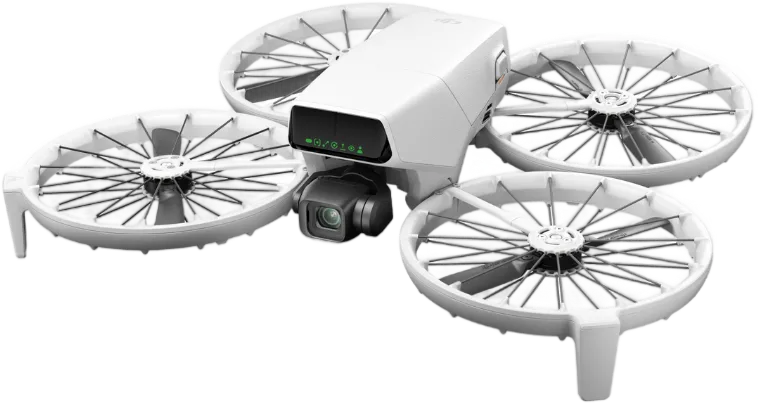
DJI Flip
The 2025 folding palm-launcher
The same palm-launch idea, executed properly. Four times the stills resolution, a three-axis gimbal and nearly twice the airtime.
- 1/1.3-inch, 48 MP sensor against 1/2-inch, 12 MP
- Three-axis gimbal against one axis and software
- 31 minutes against about 18
- Sees obstacles ahead of it
- Under 249 g against 135 g
- Only 2 GB inside against 22 GB
I recommend this if…
- You care how the footage actually looks
- You want more than twenty minutes in the air
- You want a level horizon without software cropping
- You may add a controller or goggles later
If weight and price come first
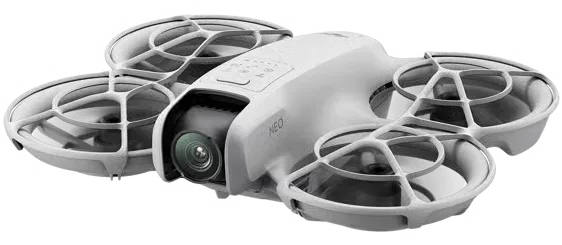
DJI Neo
The 2024 original
The lightest, cheapest way to fly a camera off your palm. Everything about the camera is a compromise, and that is the trade.
- 1/2-inch, 12 MP sensor only
- One gimbal axis, levelled in software
- About 18 minutes per battery
- Downward sensing only, nothing ahead
- 135 g, with 115 g of legal room
- 22 GB inside, so no card needed
I recommend this if…
- You want the lightest drone of the two
- You want the cheapest route into palm flying
- Short clips off your hand are the whole plan
- You would rather not buy a memory card
Both links are Amazon affiliate links. As an Amazon Associate I earn from qualifying purchases, at no extra cost to you — full disclosure.
What both of these do that ordinary drones do not
Most drones put a controller in both your hands and leave you to fly. These two do not work like that, which is why they get compared.
Both launch off your open palm. Press a button, hold your hand flat, and up it goes with no controller and no phone needed.
Both then film you doing something, following or orbiting or climbing away to reveal the view, and land back on your hand.
Both also cage all four propellers, so a clipped branch is usually a bump rather than a repair.
So there is no argument about which is the friendlier idea. The question is which does it with the better camera. Both appear in my best beginner drones guide.
Four things that are identical
These four are the same on both drones, so none of them can decide it.
-
Same palm launch
Both lift off and land on your hand.
-
Same caged propellers
A knock is usually a bump, not a crash.
-
Same C0 class mark
And the same Flyer ID and Operator ID.
-
Same cold limit
Both rated down to minus ten degrees.
-
So ignore all 4
None of it can tell you which to buy. The next four things can.
Both quoted flight times are laboratory figures, and both drop further with the propeller cages fitted and any wind to push against.
The four differences that actually matter
1. The Flip has four times the stills resolution and a much larger sensor
This is the difference the whole comparison rests on, and it is not marginal.
The Flip uses a 1/1.3-inch sensor at 48 megapixels. The Neo uses a 1/2-inch sensor at 12.
Put plainly: the Flip gathers meaningfully more light and resolves four times the detail in a still.
Flip
48MP
1/1.3-inch sensor, f/1.7
Neo
12MP
1/2-inch sensor, f/2.8
The lens compounds it. The Flip opens to f/1.7 where the Neo sits at f/2.8, which is a substantial difference in how much light reaches the sensor at all.
Frame rate follows the same pattern. The Flip records 4K at up to 100 frames a second, so slow motion is genuinely available. The Neo caps 4K at 30.
There is one more quirk in the Neo’s numbers. Its 4K is a 4:3 shape, so an ordinary widescreen video means cropping into it or dropping to 1080p.
Winner — DJI Flip
A bigger sensor, a much wider lens, four times the stills detail and slow motion the Neo cannot produce at all. If you intend to keep the footage, this section decides the purchase on its own.
The Neo is fine for a quick clip on a phone screen in good light. It is everything beyond that where the gap opens.
Check the Flip on Amazon2. The Flip has three gimbal axes. The Neo has one and some software
The camera sits in a motorised cradle called a gimbal, and the number of directions it can move in is what people mean by axes.
The Flip has three: tilt, roll and pan, all on motors, correcting the drone moving underneath it as it happens.
The Neo has one. It tilts, then straightens the horizon afterwards in software by rotating the picture and cropping into it.
Flip
Three axes, all mechanical
- Tilt, roll and pan on motors
- Level horizon with no cropping
- Smoother pans and steadier in gusts
- Nothing thrown away to stabilise
Neo
One axis plus software
- Tilts mechanically
- Roll corrected in software only
- Crops into the frame to level up
- Horizon can wander in gusts
Software levelling works, and DJI does it well. But you are giving away a slice of every frame to get it.
On a breezy day, which describes most of the British year, that is when the difference stops being theoretical.
Winner — DJI Flip
Three mechanical axes against one plus a software crop. It is the difference between footage that holds its framing and footage that quietly loses part of it every time the wind gusts.
On a still day, at low level, in good light, you would struggle to tell them apart.
Check the Flip on Amazon3. The Flip stays up 31 minutes. The Neo manages about 18
Nearly double, and the largest proportional gap in the comparison.
DJI rates the Flip at 31 minutes in forward flight and 28 hovering. The Neo is rated at about 18, dropping to 17 with its cages on.
Flip
31min
about 22 in reality
Neo
18min
about 12 in reality
The Flip carries a much larger battery to get there, at 3110 milliamp hours against the Neo’s 1435, and that battery is a good part of why it weighs what it does.
Both get flown in short bursts off the palm, so you rarely run either flat in one continuous flight.
Where it tells is across a whole walk. On one battery each, the Flip is still going when the Neo has been packed away.
Winner — DJI Flip
Thirteen extra minutes per battery, from a drone that also has the better camera. Buy one spare for the Flip and you have an afternoon.
The Neo is light enough that carrying two spares costs you nothing, and both charge over USB-C.
Check the Flip on Amazon4. The Neo weighs 135 g and holds 22 GB. The Flip is heavier with almost no storage
Two places the older, cheaper drone genuinely wins, and they are worth stating plainly.
The Neo weighs about 135 grams against the Flip’s under-249. That leaves the Neo 115 grams of room under the UK limit and the Flip barely one.
Flip
249g
just 1 g under the limit
Neo
135g
115 g under the limit
One gram is a sticker, a lanyard loop or a heavier third-party propeller. Both manuals warn against adding payload or fitting unapproved parts, and on the Flip that warning has real teeth.
Storage is the second win, and a bigger one in daily use. The Neo has 22 GB built in; the Flip has 2 GB.
Two gigabytes at 4K and 100 frames a second is seconds of footage, so a memory card is part of buying the Flip rather than an accessory.
Winner — DJI Neo
A hundred and fourteen grams more legal headroom and eleven times the onboard storage. The Neo will fly all day with nothing else bought, and it leaves you free to add a lanyard without arithmetic.
A microSD card is not expensive, and once fitted the storage gap stops mattering. The weight gap does not go away.
Check the Neo on AmazonFour questions that will tell you which one to buy
Work down them and stop at the first one you can answer firmly. That is your drone.
Do you care how the finished footage looks?
FlipDo you want more than twenty minutes in the air?
FlipIs spending as little as possible the priority?
NeoDo you want real margin under the 250 gram limit, or no memory card to buy?
NeoIf the footage matters at all, buy the Flip. The Neo is the right answer only when price or weight is the deciding factor. If you are leaning towards the Neo, it is worth reading it against the Neo 2 first, which fixes its two biggest weaknesses for less than the Flip costs.
Two catches worth knowing before you order either one
Neither is a reason to avoid either drone. Both are things I would want to have been told before paying.
The Neo stops at 30 metres without a controller
Flown on palm control or from your phone, DJI caps the Neo at 30 metres of altitude.
Most people who buy a Neo never attach a controller, so that is the real ceiling on every flight they make.
It is not a legal limit. UK rules allow 120 metres, so this is DJI being cautious rather than the CAA.
The figure appears in the manual and on neither specification page, which is why nobody mentions it.
The Flip needs a memory card from the first flight
Two gigabytes of internal storage is not storage in any useful sense at 4K.
Budget for a microSD card as part of buying the Flip rather than something to sort out later.
The Neo has 22 GB inside, which is genuinely enough for a day out with nothing else fitted.
Folding, wind and transmission
Three practical differences worth knowing.
The Flip folds, to 136 by 62 by 165 millimetres. The Neo does not fold at all, and at 130 by 157 by 48.5 it does not really need to.
Neither needs unfolding to launch off your palm, which is the part that decides how often each one comes out.
Wind resistance goes to the Flip, at 10.7 metres per second against the Neo’s 8. In the units your forecast uses, that is roughly 24 miles an hour against 18.
Transmission is a wash in practice. Both reach O4 with the right hardware, and the Neo pairs an RC-N3 directly where the Flip has O4 built in.
Flip vs Neo: every specification side by side
| DJI Flip | DJI Neo | |
|---|---|---|
| Released | January 2025 | September 2024 |
| Weight | Under 249 g | Approx. 135 g |
| Class mark | C0 (manual p83) | C0 (manual p96) |
| Folds? | Yes, to 136 × 62 × 165 mm | No, fixed frame |
| Propeller guards | Yes, full cage | Yes, full cage |
| Palm takeoff | Yes | Yes |
| Obstacle sensing | Forward 3D infrared, downward visual and infrared | Downward vision and infrared only |
| Rated flight time | 31 min | Approx. 18 min (17 with cages) |
| Operating temperature | −10° to 40° C | — |
| Gimbal | Three-axis (tilt, roll, pan) | Single-axis (tilt) plus software stabilisation |
| Camera sensor | 1/1.3-inch, 48 MP | 1/2-inch, 12 MP |
| Lens | f/1.7, 82.1° | f/2.8, 117.6° |
| ISO range | 100–6400 | 100–6400 |
| Max video | 4K at 100fps | 4K (4:3) at 30fps; 1080p at 60fps |
| Max stills | 8064 × 6048 (48 MP) | 12 MP |
| Internal storage | 2 GB | 22 GB |
| Transmission | O4, built in | O4 with RC-N3 |
| Battery | 3110 mAh | 1435 mAh |
| Max speed | 12 m/s (Sport); 16 with a 4 m/s tailwind | 6 m/s Normal, 8 Sport, 16 Manual (FPV controller only) |
| Wind resistance | 10.7 m/s (Level 5) | 8 m/s (Level 4) |
| Ceiling | 3000 m | 2000 m |
| On Amazon | Check price | Check price |
Figures from the official DJI specification pages and both user manuals. Amazon affiliate links — disclosure.
Both drones need a Flyer ID and an Operator ID. Neither is exempt
You will read all over the internet that drones under 250 grams need no licence. For a camera drone in the UK that is simply wrong, and both of these are camera drones.
Any camera drone between 100 g and 250 g needs both of these before you fly it outdoors. At under 249 g and 135 g, both sit in that bracket.
Flyer ID
Proves you know the rules. A free online theory test, valid five years.
Operator ID
Registers you as responsible for the drone. £12.34 a year, and the number must be labelled on the drone.
Neither needs a GVC or an A2 Certificate of Competence for ordinary recreational flying. Both carry a C0 class mark. There is more in do I need a licence for a sub-250g drone and UK class marking explained.
Why I pick the DJI Flip over the DJI Neo
These two do the same trick, so the comparison reduces to how good you want the camera to be.
The Flip has four times the stills resolution, three gimbal axes instead of one, nearly double the airtime and something watching ahead of it.
The Neo is lighter, cheaper, holds more footage and has far more legal headroom, and for somebody who only wants short clips off their hand it remains a likeable little drone.
My recommendation — DJI Flip
DJI Flip
2025 — under 249 g, C0 class mark
I recommend the DJI Flip over the DJI Neo because it does the same palm-launch trick with a far better camera behind it. Four times the stills resolution, a three-axis gimbal and nearly twice the flight time. The Neo is a hundred grams lighter, holds more footage internally and costs less, which keeps it in the conversation. But the Flip is the drone that produces footage you will still want in a year.
- 1/1.3-inch 48 MP sensor, f/1.7
- Three-axis gimbal with pan
- 31 minutes per battery
- Forward 3D infrared sensing
- 4K at 100fps, O4 built in
- Caged propellers and palm launch, same as the Neo
- Under 249 g, so almost no legal margin
- Only 2 GB of internal storage
Amazon affiliate link — no extra cost to you.
The cheaper way in
DJI Neo
Buy this instead if you want the lightest and cheapest way to try flying a camera off your palm, and short clips are all you are after.
Amazon affiliate links — disclosure.
Written by Peter Leslie — GVC-qualified commercial drone pilot
I fly compact DJI drones alongside enterprise survey kit, and I judge them on the footage and the safety margin they give me in real UK conditions.
Every figure here came out of the official DJI manuals or the CAA, not a press release. Where the manuals contradicted the marketing I went with the manuals.
Comparison you want covered next? peter@hiredronepilot.uk.
Sources