DJI Neo 2 vs DJI Neo: which one should you buy?
I own both of these and fly them regularly. They look nearly the same, and mostly they are — but one of them cannot see what is in front of it, and without a controller it gives up at half the height of the other. That is the whole decision, really.
 Written by Peter Leslie, GVC-qualified commercial drone pilot | Every figure checked against both DJI manuals | 3 Aug 2026
My short answer
I recommend the DJI Neo 2
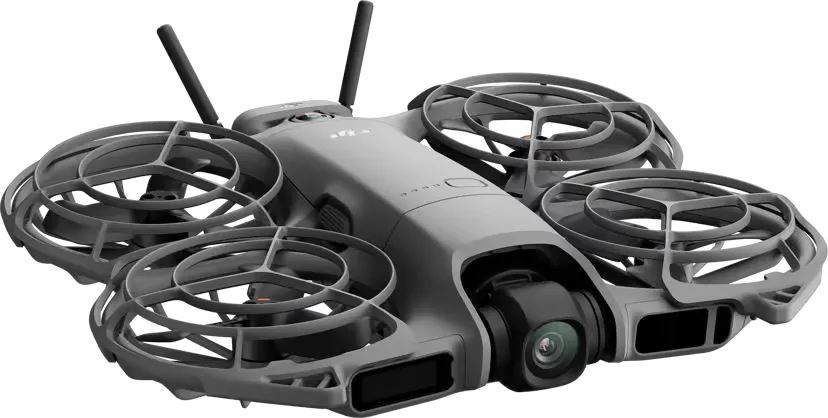
DJI Neo 2
The 2025 model
It can see what is in front of it, and it flies twice as high without a controller. Those two things decide it for almost everybody.
- Spots obstacles ahead of it, not just below
- Climbs to 60 m straight off your palm
- Two-axis gimbal levels the horizon with motors
- Holds up in stronger wind and duller light
- The heavier of the two, at 151 g
- Needs a transceiver add-on to use a controller
I recommend this if…
- You will fly near trees, buildings or people
- You want height without buying a controller
- You are filming something you mean to keep
- You are buying it for a nervous first-timer
Only if the price gap matters
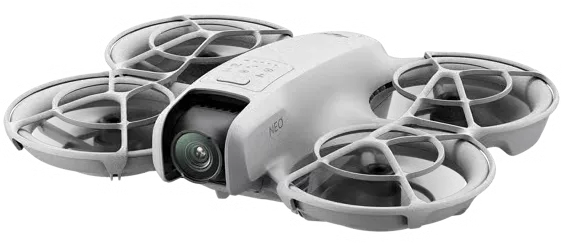
DJI Neo
The 2024 original
Same idea, noticeably less drone. Worth it if short clips off your hand are all you want, and you would rather spend the difference on batteries.
- Senses downwards only, for hovering and landing
- Stops at 30 m without a controller
- One gimbal axis, levelled in software
- Level 4 wind, and it struggles sooner in dull light
- The lighter of the two, at 135 g
- A controller pairs to it with no extra part
I recommend this if…
- You will only ever fly in open space
- You want the cheapest way into palm flying
- You are after short clips and nothing more
- You already plan to add an RC-N3 controller
Both links are Amazon affiliate links. As an Amazon Associate I earn from qualifying purchases, at no extra cost to you — full disclosure.
What a palm-launch drone like the Neo actually does
Here is the thing about the Neos: they are not really drones you pilot. Most drones put a controller in both your hands and leave you to fly the thing around the sky. These do not work like that at all.
Both of them launch off your open palm. Press a button on the drone, hold your hand flat, and up it goes. No controller, no phone, no hunting around for a flat patch of ground first.
Then it films you. You pick a move before takeoff — follow behind me, orbit around me, fly backwards and up to reveal the view — and the drone does that one job and returns to your hand.
And that is the whole product, honestly. It is a camera that flies itself for twenty seconds at a time.
Both keep their propellers inside a plastic cage, and that matters more than it sounds. Clip a branch or a doorframe and you usually get a bump rather than a crash. It is why these are the two I point nervous first-timers towards.
For the wider shortlist, my best beginner drones guide and best drones under 250g put both of these in context.
Five things that are identical on the Neo 2 and the Neo
Before anything else, let us clear the noise. These five points are the same on both drones, so not one of them can tell you which to buy.
-
Same camera sensor
A 1/2-inch sensor in both drones.
-
Same photo quality
12 megapixels either way.
-
Same palm launch
Both lift off and land on your hand.
-
Same flight time
About 18 to 19 minutes per battery.
-
Same UK paperwork
Flyer ID and Operator ID for both.
-
So ignore all five
None of it can tell you which to buy. The next three things can.
Treat those flight times with suspicion, mind. They are laboratory figures. On a normal British day with the cages fitted, expect twelve to fifteen minutes out of either one.
The five differences between the Neo 2 and the Neo that actually matter
1. The Neo 2 sees obstacles ahead of it. The Neo only sees the ground
Drones stay out of trouble using sensors that measure distance. Which way those sensors point is the biggest difference between these two, and you would never spot it from across a room.
The original Neo has one system, and it points straight down. That is what lets it hover steadily and land on your hand. But it has nothing facing forwards, so it genuinely has no idea there is a fence post ahead of it.
The Neo 2 adds a forward-facing LiDAR unit, which is a small laser that measures how far away things are — the same basic idea as the sensor that stops a modern car reversing into a bollard. It also has cameras watching sideways, all the way around.
Put it this way. On the Neo, a follow-me shot along a hedge line is a calculated risk. On the Neo 2 it is just a Tuesday.
Neo 2
LiDAR ahead, vision all round
- Forward-facing laser rangefinder
- Cameras watching sideways, all round
- Infrared sensing underneath
- Brakes or steers round what it sees
- Switches off in Sport mode
Neo
Downwards only
- Knows its height above the ground
- Nothing facing forwards
- Nothing watching sideways
- Will not brake for an obstacle
- You are the collision avoidance
Winner — DJI Neo 2
This is not a close call. One drone can be trusted to fly itself past a tree and the other cannot, and no amount of care on your part changes what the Neo is physically able to detect.
The Neo is still fine in an empty field. If you will only ever fly it on a beach or a wide-open hillside, the sensors are a luxury rather than a necessity.
Check the Neo 2 on Amazon2. The Neo 2 climbs to 60 m off your palm. The Neo stops at 30 m
There are three ways to fly either drone: off your palm with nothing else, from your phone over the drone's own wi-fi, or with a proper remote controller bought separately. Here is what matters — most people who buy a Neo use the first two and never own a controller at all.
DJI applies a height limit in those controller-free modes, and it is not the same on the two drones. The Neo stops at 30 metres. The Neo 2 goes to 60.
If you never buy a controller, that is the ceiling on every single flight you make. The figure sits in both manuals and on neither specification page, which is why nobody mentions it.
Neo 2
60m
roughly twenty storeys
Neo
30m
roughly ten storeys
Neither figure is a legal limit, in case you were wondering. UK rules allow up to 120 metres, so both drones are holding you well below what the law permits. That is DJI being careful, not the CAA.
Is 30 metres enough? Depends on the shot. For a follow-me clip along a beach, plenty.
For the reveal that climbs to show the whole valley behind you, not a chance — and that is exactly the shot people buy these drones hoping to get.
Winner — DJI Neo 2
Doubling the ceiling doubles the range of shots you can get without spending another penny on hardware. For a drone most people fly straight from their hand, this is the difference that shows up on every single flight.
The Neo closes the gap only if you buy a controller for it, and at that point you have spent the saving that made it attractive.
Check the Neo 2 on Amazon3. The Neo 2 levels the horizon with motors. The Neo fakes it in software
The camera sits in a small motorised cradle called a gimbal. Its whole job is holding the camera steady while the drone tilts and shifts about underneath it. The number of directions that cradle can move in is what people mean by axes.
The Neo's gimbal moves in one direction, tilting up and down. When the drone leans sideways in a gust, the horizon in your footage leans with it.
It does straighten that out afterwards, but it does so in software, by rotating the picture and cropping into it. You get a level horizon and you give up a slice of your frame to get it.
The Neo 2's gimbal moves in two directions, tilting and rolling. It corrects the lean physically, as it happens, so nothing has to be thrown away afterwards.
Neo 2
Two-axis gimbal
- Tilts and rolls on motors
- Levels the horizon as it happens
- Keeps your full frame
- Steadier in gusts
Neo
One-axis gimbal
- Tilts, plus software stabilisation
- Rolls corrected in software only
- Crops into the frame to level up
- Horizon can wander in gusts
Winner — DJI Neo 2
Mechanical levelling is the sort of thing you never notice until you compare two clips shot on the same breezy afternoon. Then it is the only thing you notice.
The Neo is fine on a still day. It is wind that separates them, and Britain has plenty of it.
Check the Neo 2 on Amazon4. The Neo 2 shoots proper 4K slow motion and sees further into dull light. The Neo does neither
Both drones use exactly the same size sensor, at 1/2 inch, and both take 12-megapixel photos. Anybody comparing them on megapixels is comparing two identical numbers.
What differs is everything wrapped around that sensor. Three things, and they all pull the same way.
First, frame rate. The Neo 2 records 4K at up to 100 frames a second, so you can slow a clip right down and it stays smooth. The Neo caps out at 30, which is normal-speed footage and nothing else.
There is a quirk worth knowing here too. The Neo's 4K is a 4:3 shape, 3840 by 2880, so for an ordinary widescreen video you either crop into it or drop down to 1080p.
Neo 2
100fps
smooth 4K slow motion
Neo
30fps
normal speed only
Second, light. The Neo 2's lens opens wider, at f/2.2 against f/2.8, so more light reaches the sensor to begin with. Its light sensitivity also pushes twice as far, to ISO 12800 against 6400.
In plain terms: overcast afternoons, late evenings and mid-winter. The conditions that make up most of the British year are exactly where the older drone starts to look grainy first.
Third, room to put it all. The Neo 2 has 49 GB of storage built in against the Neo's 22 GB, which is the difference between offloading clips halfway round a walk and not thinking about it at all.
Neo 2
Camera you can push
- 4K at up to 100fps for slow motion
- Wider f/2.2 lens
- ISO up to 12800
- 49 GB of storage on board
- Widescreen 4K straight out of it
Neo
Camera that needs good light
- 4K capped at 30fps, no slow motion
- Narrower f/2.8 lens
- ISO stops at 6400
- 22 GB of storage on board
- 4K is 4:3, so widescreen means cropping
Winner — DJI Neo 2
If the footage is going anywhere other than straight to the bin, this is the section that should decide it. Slow motion, dull-light headroom and widescreen 4K are three things the Neo simply cannot do.
Shoot only in bright, still conditions and the Neo will not embarrass itself. Ask anything more of it and the gap is obvious.
Check the Neo 2 on Amazon5. The Neo 2 keeps flying in wind that sends the Neo home
This is the specification I would weigh most heavily if you fly anywhere near a British coast, and it is the one people skip past because DJI writes it in metres per second.
The Neo is rated to 8 m/s of wind, which DJI calls Level 4. The Neo 2 is rated to 10.7 m/s, or Level 5. Converted into the units your weather app actually uses, that is 18 mph against 24 mph.
Six miles an hour does not sound like much until you look at a British forecast. A great many otherwise perfect afternoons sit in exactly that band, and they are flyable on one drone and not the other.
Neo 2
24mph
Level 5 — 10.7 m/s
Neo
18mph
Level 4 — 8 m/s
Both are very light drones and both get pushed about. Neither rating is a promise, and I would not fly either one at its stated limit on purpose.
What the higher rating buys you is margin. It is the difference between a clip that looks deliberate and one where the drone is visibly fighting to stay where you put it.
Winner — DJI Neo 2
Wind decides how many days a year you actually get to use the thing. On that measure the Neo 2 is the more useful drone in Britain by a clear margin.
Fly somewhere reliably sheltered and this one matters far less. Most of us do not.
Check the Neo 2 on AmazonFour questions that will tell you which Neo to buy
Work down them and stop at the first one you can answer firmly. That is your drone.
Will you fly it anywhere near obstacles, or is it a gift for a cautious first-timer?
Neo 2Do you want to fly higher than about ten storeys without buying a controller?
Neo 2Is the footage going somewhere that matters, in typical overcast UK light?
Neo 2None of the above, and you would genuinely rather spend the difference on spare batteries?
NeoReached the bottom without a firm yes anywhere? Buy the Neo and enjoy it. It is a likeable little thing, and the cheapest honest way to find out whether flying a camera off your palm is something you will stick with.
If the Neo 2 is where you are leaning, it is also worth reading it against the DJI Flip and the DJI Mini 4K.
Two catches worth knowing before you order either one
The Neo 2 needs a transceiver add-on before a controller will work. The Neo does not
Say you decide six months in that you want a proper remote controller, or the goggles that let you see the drone's camera view as you fly. The Neo 2 has an extra step here that the older drone does not.
It needs a separate accessory called the Digital Transceiver. Until that is fitted, no remote controller, no goggles and no motion controller will connect to the drone at all.
And it is not a clip-on. DJI tells you to check its screws every thirty hours and says it cannot be swapped over while powered on. Fitting it also nudges the drone from 151 g to 160 g.
Winner — DJI Neo
The one round the older drone genuinely wins. A DJI RC-N3 controller pairs straight to the Neo with no extra part to buy or fit. If a controller is part of your plan from the start, check carefully which Neo 2 package you are looking at, because the standard listing is the drone on its own.
Check the Neo on AmazonThe Neo looks faster on paper, but the Neo 2 is quicker in practice
You will see the Neo quoted at 16 metres per second against the Neo 2 at 12. Taken at face value the older drone looks quicker, and I have watched people use that as a reason to buy it. Do not.
The two numbers measure different things. The Neo only reaches 16 m/s in Manual mode, a setting that needs the separate DJI FPV controller and switches off most of the automatic help.
Flown as designed, the Neo manages 6 m/s normally and 8 m/s in Sport. The Neo 2's 12 m/s is its ordinary Sport figure, needing no extra hardware. Like for like, the newer drone is comfortably the quicker of the two.
Weight and flight time: closer than you would think
Two more things I get asked about constantly. Neither should change your answer, but here they are properly.
Weight
The Neo is 135 g and the Neo 2 is 151 g. Both sit in the same UK weight bracket, so the paperwork, the rules and where you are allowed to fly are identical either way.
It helps to know why the number matters at all. UK drone rules are built around a 250 g line, and under it you are in the friendliest bracket there is. Cross it and the rules tighten sharply on how close you may fly to other people.
Both of these sit a long way below that line. The Neo has 115 g of headroom and the Neo 2 has 99 g, so neither is anywhere near the edge.
Neo 2
151g
99 g under the legal limit
Neo
135g
115 g under the legal limit
Sixteen grams is a difference you can feel if you pick them up one after the other, and it changes nothing else. Both go in a jacket pocket, and neither is heavy enough to talk you out of bringing it.
The one time weight bites is the accessory. Fitting the Neo 2's Digital Transceiver takes it to 160 g, which is still 90 g clear of the limit — but if you are the sort of person who weighs their kit before a hike, that is the figure to note.
One caution that applies to both, straight from the DJI manuals. The C0 declaration tells you not to add any payload beyond the listed accessories, not to fit unapproved batteries or propellers, and not to modify the drone.
That matters more than it sounds. Bolt something extra to either of these and it stops being a C0 drone in the eyes of the rules, whatever your kitchen scales say.
Flight time
DJI claims about 18 minutes for the Neo and about 19 for the Neo 2. That one-minute gap is not a reason to choose either drone.
Neo 2
19min
twelve to fifteen in reality
Neo
18min
twelve to fifteen in reality
It is worth understanding where those numbers come from, because they are not what you will see. They are measured hovering in still air, at a sensible temperature, flying the battery all the way down.
Nothing about that resembles a real flight. There is no wind pushing against the motors, no climbing, no chasing you along a path, and no reserve held back for getting home and landing safely.
Fit the propeller cages and fly in any breeze and both land closer to twelve or fifteen minutes. DJI is honest about part of this: it knocks a minute off the Neo itself for flying with the cages on.
Cold takes another bite. Lithium batteries hold less charge when they are cold, and the Neo 2 is only rated down to minus ten degrees. A January flight will not give you a July flight time, whichever drone you own.
The way these two get flown makes it worse again. You are powering up, hovering while you frame a shot, filming twenty seconds, landing, then doing it all again — which costs more than a steady cruise would.
So here is the practical answer. Buy a spare battery with whichever one you choose, because that single decision matters far more than the difference between the two drones.
With two batteries, either drone gives you enough for a decent walk. With one, neither of them really does. Both charge over USB-C, so a power bank in your pocket covers you either way.
Neo 2 vs Neo: every specification side by side
| DJI Neo 2 | DJI Neo | |
|---|---|---|
| Released | November 2025 | September 2024 |
| Weight | 151 g (160 g with transceiver) | 135 g |
| Size | 147 × 171 × 41 mm | 130 × 157 × 48.5 mm |
| Class mark | C0 | C0 |
| Rated flight time | Approx. 19 min | Approx. 18 min (17 with cages) |
| Battery | 1606 mAh | 1435 mAh |
| Height limit, no controller | 60 m | 30 m |
| Obstacle sensing | Forward LiDAR, all-round vision, downward infrared | Downward only |
| Gimbal | Two-axis (tilt, roll) | One-axis (tilt) |
| Camera sensor | 1/2-inch, 12 MP | 1/2-inch, 12 MP |
| Lens | f/2.2, 119.8° | f/2.8, 117.6° |
| ISO range | 100–12800 | 100–6400 |
| Max video | 4K at 100fps | 4K at 30fps |
| Internal storage | 49 GB | 22 GB |
| Top speed | 12 m/s (Sport) | 8 m/s (Sport), 16 m/s (Manual, FPV controller only) |
| Wind resistance | 10.7 m/s (Level 5) | 8 m/s (Level 4) |
| Using a controller | Needs the Digital Transceiver first | RC-N3 pairs directly |
| Goggles support | Yes, with the transceiver | Not supported |
| On Amazon | Check price | Check price |
Figures from the official DJI specification pages and both user manuals. Amazon affiliate links — disclosure.
Both drones need a Flyer ID and an Operator ID. Neither is exempt
You will read all over the internet that drones under 250 grams need no licence. For a camera drone in the UK that is simply wrong, and both of these are camera drones.
Any camera drone between 100 g and 250 g needs both of these before you fly it outdoors. At 135 g and 151 g, both Neos are in that bracket. Neither is exempt.
Flyer ID
Proves you know the rules. A free online theory test, valid five years.
Operator ID
Registers you as responsible for the drone. £12.34 a year, and the number must be labelled on the drone.
Neither drone needs a GVC or an A2 Certificate of Competence, which are the qualifications for heavier or commercial flying. Both carry a C0 class mark, and although C-class marks stop standing in for UK ones after 31 December 2027, it changes nothing here — a drone under 250 g still flies in the same category afterwards. There is more in do I need a licence for a sub-250g drone and UK class marking explained.
Why I pick the DJI Neo 2 over the DJI Neo
I pick the DJI Neo 2 over the DJI Neo because forward sensing and double the controller-free ceiling change what you can actually go out and do with it. Sixteen grams of saved weight does not.
There is one case where I would still buy the original, mind. You want to spend as little as possible finding out whether you enjoy this, you will fly it in open space, and short clips off your hand are all you are after. On those terms it is still a lovely little drone.
My recommendation — DJI Neo 2
DJI Neo 2
2025 — 151 g, C0 class mark
I recommend the DJI Neo 2 over the DJI Neo because forward sensing and double the controller-free ceiling change what you can actually go out and do with it. Sixteen grams of saved weight does not. The original Neo is still a likeable little drone, and still the cheapest honest way to try flying a camera off your palm. But with money on the table between the two, the newer one is the one you will keep reaching for.
- LiDAR ahead plus vision all round
- 60 m ceiling straight off your palm
- Two-axis gimbal levels the horizon
- 4K at 100fps, ISO to 12800
- 49 GB built in, no card to buy
- Level 5 wind resistance
- 16 g heavier, at 151 g
- Transceiver extra if you want a controller
Amazon affiliate link — no extra cost to you.
The cheaper way in
DJI Neo
Buy this if open-space flying and short palm-launched clips are the whole plan, or if you want to spend as little as possible finding out whether you enjoy it.
Amazon affiliate links — disclosure.
Written by Peter Leslie — GVC-qualified commercial drone pilot
I fly both of these drones alongside enterprise survey kit, and I judge them on the footage and the safety margin they give me in real UK conditions.
Every figure here came out of the two official DJI manuals or the CAA, not a press release. Where the manuals contradicted the marketing I went with the manuals, and the height ceilings and the speed figures are both cases of that.
Comparison you want covered next? peter@hiredronepilot.uk.
Sources