DJI Mini 4 Pro vs DJI Flip: which one should you buy?
These two share the same camera, the same storage, the same transmission and near enough the same weight. The differences are all in the body: one sees on every side, the other cages its propellers and takes off from your hand.
 Written by Peter Leslie, GVC-qualified commercial drone pilot | Every figure checked against both DJI manuals | 3 Aug 2026
My short answer
I recommend the DJI Mini 4 Pro
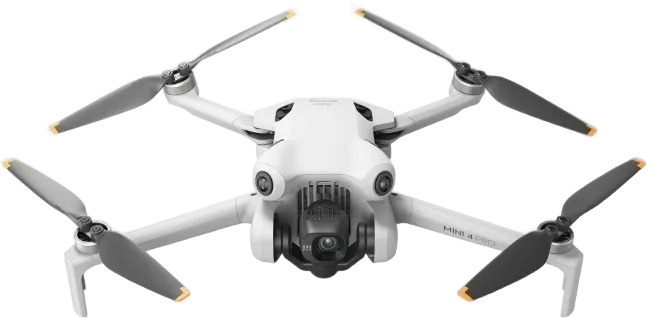
DJI Mini 4 Pro
The 2023 camera drone
The same sensor as the Flip, with sensing on every side of it. Omnidirectional vision, slightly longer flights and a higher ISO ceiling.
- Omnidirectional binocular vision, all round
- About 34 minutes per battery
- ISO to 12800 in night mode
- Also sold as a C1 model if you want the Plus battery
- Bare propellers with no cage
- No palm launch — controller required
I recommend this if…
- You fly close to obstacles on more than one side
- You want the longest flights of the two
- You shoot in genuinely poor light
- You want to pilot properly rather than be filmed
If palm launch and cages come first
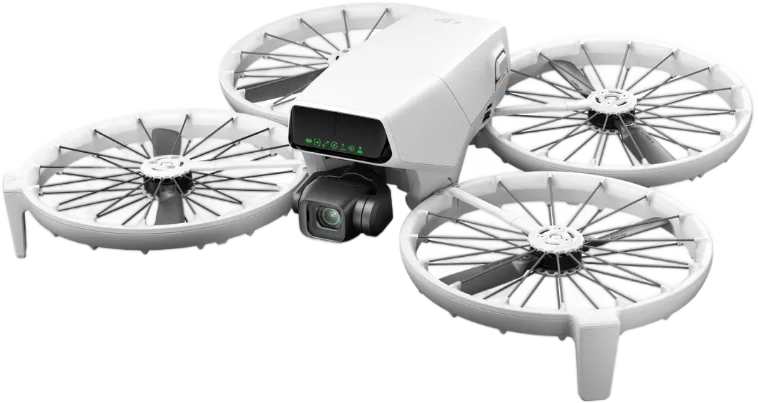
DJI Flip
The 2025 folding palm-launcher
The same camera, in a body you can catch out of the air. Caged propellers and palm launch, at the cost of sideways sensing.
- Forward sensing only, nothing to the sides
- About 31 minutes per battery
- ISO stops at 6400
- Only sold in one configuration
- Caged propellers, so a knock rarely ends a flight
- Launches off your palm, no controller needed
I recommend this if…
- You want to be in your own footage
- You will fly indoors or near people
- You want a drone you can catch by hand
- You want it flying within seconds
Both links are Amazon affiliate links. As an Amazon Associate I earn from qualifying purchases, at no extra cost to you — full disclosure.
How similar these two actually are
It is worth stating up front how much of this comparison is settled before it starts.
Both use a 1/1.3-inch, 48-megapixel sensor behind an f/1.7 lens. Both have three-axis gimbals. Both shoot 4K at up to 100 frames a second, hold 2 GB internally and use O4 transmission.
Both fold, both sit just under 249 grams, and both carry a C0 class mark.
So the camera argument is a draw. What differs is what the drone can see, and what happens when you hit something.
Both appear in my best drones under 250g guide.
Five things that are genuinely identical
This is the longest list of shared specifications in any comparison on this site. None of it can help you choose.
-
Same camera sensor
1/1.3-inch, 48 MP, f/1.7 on both.
-
Same top frame rate
4K at up to 100fps either way.
-
Same internal storage
2 GB, so both want a card.
-
Same class mark and paperwork
C0, plus Flyer ID and Operator ID.
-
Same wind rating
Both rated to 10.7 m/s, Level 5.
-
So ignore all 5
None of it can tell you which to buy. The next four things can.
Both also use O4 transmission and both fold to within a few millimetres of each other. This is as close as two DJI drones get.
The four differences that actually matter
1. The Mini 4 Pro sees in every direction. The Flip only looks forwards
With the cameras matched, this is the difference that carries the most weight.
The Flip has a forward-facing 3D infrared sensing system, plus a visual sensor and infrared pointing down. It can detect what is ahead and slow for it.
The Mini 4 Pro uses omnidirectional binocular vision, which means paired cameras judging depth in every direction at once, with a 3D infrared sensor underneath.
Mini 4 Pro
Omnidirectional binocular vision
- Paired cameras judging depth all round
- Works while flying up to 12 m/s
- 3D infrared underneath
- Sees what it is about to fly sideways into
Flip
Forward infrared, plus downward
- Forward 3D infrared sensing
- Downward visual and infrared
- Nothing watching sideways
- Infrared reads thin branches poorly
The practical difference shows in orbits. An orbit takes the drone crabbing sideways around you, and on the Flip nothing is watching the direction it is travelling.
Infrared also has a known weakness with thin, complex shapes. Bare winter branches are exactly what it reads poorly, and exactly what an orbit tends to swing through.
Winner — DJI Mini 4 Pro
For the shots people actually use these drones for, following and orbiting, the Mini 4 Pro is watching where it is going in every direction and the Flip is not. That is the sort of gap you discover once, expensively.
In open space it makes no odds, and the Flip has enough sensing for a beach or an empty hillside.
Check the Mini 4 Pro on Amazon2. The Flip cages its propellers. The Mini 4 Pro flies on bare rotors
The difference that cuts the other way, and for some buyers it outweighs everything above.
The Flip keeps all four propellers inside a plastic cage. Clip a branch or a doorframe and you usually get a bump, a wobble and a sheepish landing.
The Mini 4 Pro has nothing between a spinning propeller and whatever it meets. It is relying on seeing the obstacle instead of surviving it.
Mini 4 Pro
Bare propellers, better eyes
- Omnidirectional sensing to avoid contact
- No cage if sensing fails
- Not safe to catch by hand
- Awkward indoors or near people
Flip
Caged propellers, narrower eyes
- Full cage on all four rotors
- Safe to catch out of the air
- Usable indoors and around people
- A clip is a bump, not a repair
The two approaches are genuinely different philosophies. One avoids the collision; the other survives it.
Indoors, or anywhere with people close by, surviving matters more. Sensing systems fail in poor light and on thin obstacles, and a cage does not.
Winner — DJI Flip
A cage works in the dark, works on thin branches and lets you catch the drone out of the air. No sensing system on any small drone can promise those three things.
Fly in open space and you will never test the cage, at which point you have paid for something you do not use.
Check the Flip on Amazon3. The Flip launches off your palm. The Mini 4 Pro needs a controller and a phone
The other capability the Mini 4 Pro simply does not have, at any price.
The Flip has palm control. Press a button, hold your hand flat, and it lifts off, films a preset move and returns to your hand.
The Mini 4 Pro needs arms unfolded, a controller powered up and your phone clamped in as the screen. A flat phone is a cancelled flight.
Mini 4 Pro
One way to fly it
- Controller included and pairs directly
- Controller required, always
- Phone required as the screen
- Four arms out before you start
Flip
Three ways to fly it
- Palm launch with nothing else
- Phone over its own wi-fi
- Or a controller if you want one
- Bag to hovering in seconds
This decides how often each drone actually gets used, which is worth more than most numbers on this page.
It also decides whether you can be in your own footage without propping a phone on a fence post.
Winner — DJI Flip
Being able to fly with nothing in your hands is a genuine capability, not a convenience. If you want to be in the shot, the Mini 4 Pro cannot help you at all.
If you were always going to fly with sticks in your hands, palm launch is a feature you will never touch.
Check the Flip on Amazon4. The Mini 4 Pro flies three minutes longer and reaches further into the dark
Two smaller advantages that pull the same way, and neither is decisive on its own.
DJI rates the Mini 4 Pro at 34 minutes on its standard battery against the Flip’s 31. Hovering, that is 30 against 28.
Mini 4 Pro
34min
about 25 in reality
Flip
31min
about 22 in reality
Three minutes is a real difference but a small one, and both drop substantially once there is wind to push against.
Light sensitivity is the more interesting one. Both sit at ISO 6400 normally, but the Mini 4 Pro reaches 12800 in night mode where the Flip stops.
There is a catch on the Mini 4 Pro’s longer figures. The 45-minute Plus battery takes it over 249 grams, and that configuration is the C1 model at 342 grams.
Winner — DJI Mini 4 Pro
Three extra minutes and an extra stop of night-mode sensitivity, from a drone that already had the better sensing. Small margins, but they all point the same way.
Neither difference is one you would notice without comparing clips side by side, and the Plus battery that widens the gap costs you the sub-250 gram bracket.
Check the Mini 4 Pro on AmazonFour questions that will tell you which one to buy
Work down them and stop at the first one you can answer firmly. That is your drone.
Will you fly orbits or follow shots near obstacles on more than one side?
Mini 4 ProDo you want the longest flights and the best low-light headroom?
Mini 4 ProWill you fly indoors, near people, or want to catch it by hand?
FlipDo you want to be in your own footage with nothing in your hands?
FlipThis is the closest of the sub-250 gram comparisons, and either answer is defensible. If you lean towards the Flip, it is worth also reading it against the Neo 2; if you lean towards the Mini 4 Pro, the Mini 5 Pro comparison is the next question.
Two catches worth knowing before you order either one
Neither is a reason to avoid either drone. Both are things I would want to have been told before paying.
The Mini 4 Pro comes in two versions and only one is sub-250 grams
DJI sells the Mini 4 Pro as two models. One carries a C0 class mark at 249 grams; the other carries C1 at 342 grams.
They are hard to tell apart in listings. The difference is the battery and configuration you receive.
If staying under 250 grams matters, check the class label on the drone itself rather than trusting the product title.
The Flip avoids the question by only existing in one configuration, under 249 grams.
Both have 2 GB of storage, which is not storage
Two gigabytes at 4K and 100 frames a second is a matter of seconds of footage.
Treat a microSD card as part of the purchase price on either drone rather than an accessory.
Neither has enough onboard to fly a single afternoon without one, so buy it at the same time.
Weight, folding and what each one costs you in margin
Both sit within a gram of the limit, which is worth a moment.
The Flip is under 249 grams and the C0 Mini 4 Pro is 249. Neither has meaningful headroom below the 250 gram line.
One gram is a sticker, a lanyard loop or a heavier third-party propeller. Both manuals warn against adding payload or fitting unapproved parts, and at these weights that warning has teeth.
Folded, the two are within millimetres: 136 by 62 by 165 for the Flip against 148 by 94 by 64 for the Mini 4 Pro. The Flip is the longer package, the Mini 4 Pro the chunkier one.
Unfolded the Mini 4 Pro is the larger drone at 298 by 373 millimetres, though the Flip only needs unfolding if you want to fly it with a controller.
Mini 4 Pro vs Flip: every specification side by side
| DJI Mini 4 Pro | DJI Flip | |
|---|---|---|
| Released | September 2023 | January 2025 |
| Weight | Under 249 g (C0); 342 g as the C1 model | Under 249 g |
| Class mark | C0 (249 g) or C1 (342 g) — two models (manual p120) | C0 (manual p83) |
| Folds? | Yes, to 148 × 94 × 64 mm | Yes, to 136 × 62 × 165 mm |
| Propeller guards | No | Yes, full cage |
| Palm takeoff | No, controller required | Yes |
| Obstacle sensing | Omnidirectional binocular vision plus 3D infrared underneath | Forward 3D infrared, downward visual and infrared |
| Rated flight time | 34 min standard, 45 with the Plus battery | 31 min |
| Operating temperature | −10° to 40° C | −10° to 40° C |
| Gimbal | Three-axis (tilt, roll, pan) | Three-axis (tilt, roll, pan) |
| Camera sensor | 1/1.3-inch, 48 MP | 1/1.3-inch, 48 MP |
| Lens | f/1.7, 82.1° | f/1.7, 82.1° |
| ISO range | 100–6400 (12800 in night mode) | 100–6400 |
| Max video | 4K at 100fps | 4K at 100fps |
| Max stills | 8064 × 6048 (48 MP) | 8064 × 6048 (48 MP) |
| Internal storage | 2 GB | 2 GB |
| Transmission | O4, 20 km | O4, built in |
| Battery | 2590 mAh standard, 3850 Plus | 3110 mAh |
| Max speed | 16 m/s Sport, 12 Normal | 12 m/s (Sport); 16 with a 4 m/s tailwind |
| Wind resistance | 10.7 m/s | 10.7 m/s (Level 5) |
| Ceiling | 4000 m standard, 3000 m on Plus | 3000 m |
| On Amazon | Check price | Check price |
Figures from the official DJI specification pages and both user manuals. Amazon affiliate links — disclosure.
Both drones need a Flyer ID and an Operator ID. Neither is exempt
You will read all over the internet that drones under 250 grams need no licence. For a camera drone in the UK that is simply wrong, and both of these are camera drones.
Any camera drone between 100 g and 250 g needs both of these before you fly it outdoors. At under 249 g and 249 g, both sit in that bracket — narrowly.
Flyer ID
Proves you know the rules. A free online theory test, valid five years.
Operator ID
Registers you as responsible for the drone. £12.34 a year, and the number must be labelled on the drone.
Neither needs a GVC or an A2 Certificate of Competence for ordinary recreational flying. Both are C0 class marked, though the Mini 4 Pro is also sold as a heavier C1 model. There is more in do I need a licence for a sub-250g drone and UK class marking explained.
Why I pick the DJI Mini 4 Pro over the DJI Flip
With the cameras matched, this comes down to two philosophies. The Mini 4 Pro avoids the collision; the Flip survives it.
I lean towards avoiding it, because omnidirectional sensing works on every shot and a cage only helps once you have already made a mistake.
But if you fly indoors, around people, or want to be in your own footage, the Flip does things the Mini 4 Pro cannot do at all, and no amount of sensing changes that.
My recommendation — DJI Mini 4 Pro
DJI Mini 4 Pro
2023 — under 249 g in C0 form
I recommend the DJI Mini 4 Pro over the DJI Flip because they share the same camera and the Mini 4 Pro sees in every direction while the Flip only looks forwards. It also flies slightly longer and reaches further into the dark. The Flip answers with caged propellers and palm launch, which are genuinely useful and which the Mini 4 Pro cannot match. But on capability the Mini 4 Pro is the more complete drone.
- Omnidirectional binocular vision plus 3D infrared
- 1/1.3-inch 48 MP sensor, f/1.7
- About 34 minutes per battery
- ISO to 12800 in night mode
- 4K at 100fps, O4 transmission
- C0 or C1 models available
- Bare propellers, no cage
- No palm launch
Amazon affiliate link — no extra cost to you.
The forgiving option
DJI Flip
Buy this instead if palm launch and caged propellers matter more to you than sideways sensing and three extra minutes. It is the more forgiving drone and the one you are more likely to actually bring.
Amazon affiliate links — disclosure.
Written by Peter Leslie — GVC-qualified commercial drone pilot
I fly compact DJI drones alongside enterprise survey kit, and I judge them on the footage and the safety margin they give me in real UK conditions.
Every figure here came out of the official DJI manuals or the CAA, not a press release. Where the manuals contradicted the marketing I went with the manuals.
Comparison you want covered next? peter@hiredronepilot.uk.
Sources