DJI Mini 5 Pro vs DJI Neo 2: which one should you buy?
One of these has a one-inch sensor and claims to weigh 249.9 grams. The other weighs 151 grams and takes off from your open hand. Both are sold as sub-250 gram drones, and only one of them has any real margin.
 Written by Peter Leslie, GVC-qualified commercial drone pilot | Every figure checked against both DJI manuals | 3 Aug 2026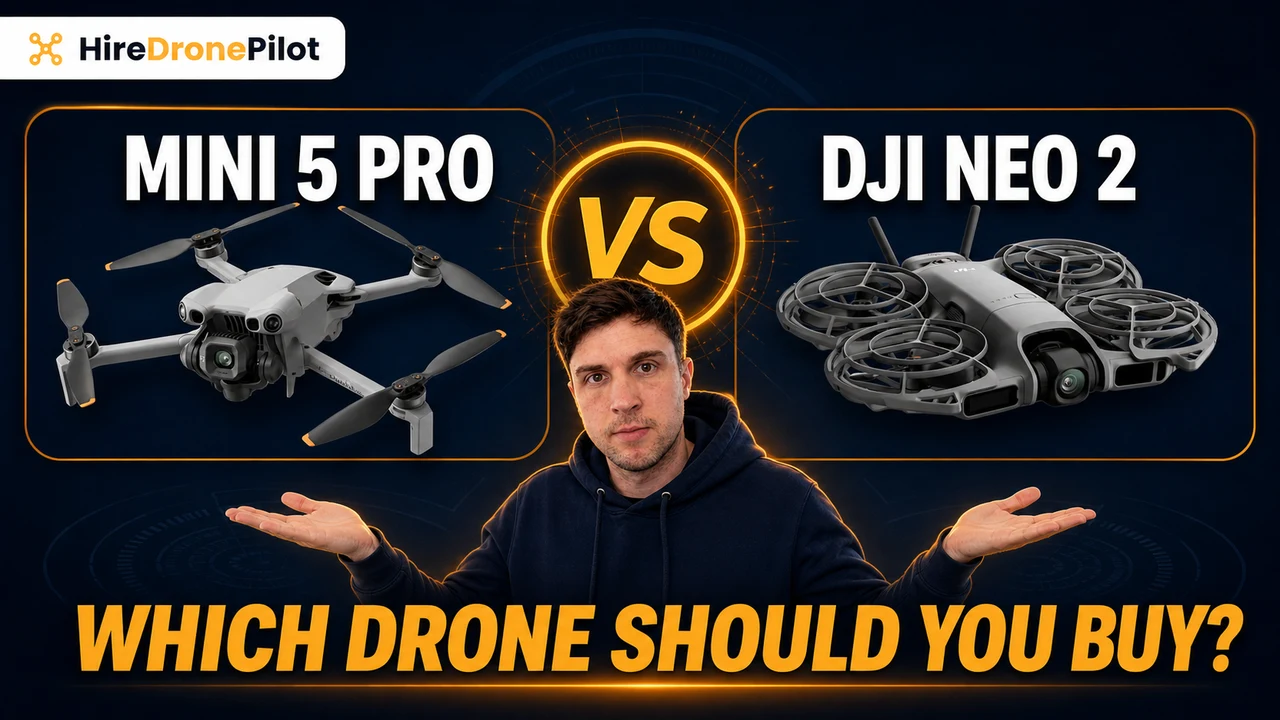
My short answer
I recommend the DJI Mini 5 Pro
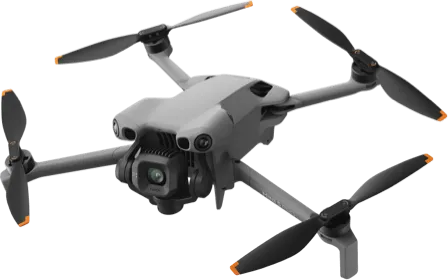
DJI Mini 5 Pro
The 2025 flagship mini
A one-inch sensor in a drone that still claims to be under 250 grams. The most capable small drone DJI sells, with the tightest weight margin of any of them.
- One-inch, 50 MP sensor — four times the area
- LiDAR plus omnidirectional vision
- 36 minutes, and 4K at up to 120fps
- 42 GB inside and O4+ transmission
- 249.9 g leaves no usable margin at all
- Needs a controller and a phone, every flight
I recommend this if…
- The footage is the reason you are buying
- You shoot in low light or want proper slow motion
- You want the best camera that can claim sub-250 g
- You already know you want to pilot a drone
If weight and palm launch come first
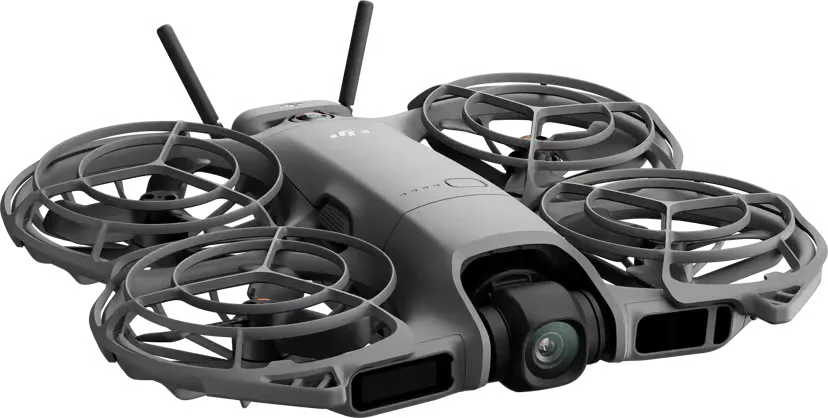
DJI Neo 2
The 2025 palm-launcher
A hundred grams lighter, and it flies itself off your palm. It is not competing on camera and does not try to.
- 1/2-inch, 12 MP sensor
- No LiDAR-plus-binocular combination
- About 19 minutes per battery
- Two gimbal axes, no pan
- 151 g, with 99 g of genuine legal room
- Launches off your palm with nothing in your hands
I recommend this if…
- You want to be filmed, not to pilot
- You want real margin under the 250 g limit
- You want it flying within seconds of leaving a pocket
- You are buying for someone nervous
Both links are Amazon affiliate links. As an Amazon Associate I earn from qualifying purchases, at no extra cost to you — full disclosure.
Why these two end up on the same shortlist
Both are marketed on staying under 250 grams, which in the UK is the weight that keeps you in the friendliest set of rules.
Beyond that they have almost nothing in common. The Mini 5 Pro is a folding camera drone you pilot with a controller and a phone.
The Neo 2 is a camera that flies itself. Press a button, hold your hand flat, and it lifts off your palm, films a preset move and returns to your hand.
The Neo 2 also cages its propellers, so a clipped branch is usually a bump. The Mini 5 Pro flies on bare propellers and relies on seeing the branch first.
Both appear in my best drones under 250g guide if you want the wider field.
Three things that do not separate them
Put these aside first, because they cannot decide it for you.
-
Same UK paperwork
Flyer ID and Operator ID for both.
-
Both C0 class marked
In their standard configurations.
-
Same cold limit
Both rated down to minus ten degrees.
-
So ignore all 3
None of it can tell you which to buy. The next four things can.
Both quoted flight times are laboratory figures measured in still air with the battery run flat. Neither survives a breezy afternoon intact.
The four differences that actually matter
1. The Mini 5 Pro has a one-inch sensor. That is a different class of camera
Sensor size decides more about how footage looks than any other number, and this is the widest gap in the comparison.
The Mini 5 Pro uses a one-inch sensor at 50 megapixels. The Neo 2 uses a 1/2-inch sensor at 12.
A one-inch sensor has roughly four times the light-gathering area of a 1/2-inch one. That is not a refinement, it is a category change.
Mini 5 Pro
50MP
one-inch sensor, f/1.8
Neo 2
12MP
1/2-inch sensor, f/2.2
More sensor area means cleaner footage as the light drops, and more room to crop or grade without the picture falling apart.
The frame rate follows. The Mini 5 Pro shoots 4K at up to 120 frames a second where the Neo 2 stops at 100, and it holds 42 GB internally against the Neo 2’s 49 GB.
That storage figure is the one line in this section the Neo 2 wins, and it is the least important of them.
Winner — DJI Mini 5 Pro
Four times the sensor area and 50 megapixels against 12. If you are choosing between these two on what the footage looks like, there is no argument to have.
The Neo 2 is fine for social clips on a phone screen. It is anything larger, or anything shot in poor light, where the difference becomes obvious.
Check the Mini 5 Pro on Amazon2. The Mini 5 Pro weighs 249.9 g, and DJI states a tolerance on that figure
This is the detail I would want anybody to know before buying a Mini 5 Pro, and it is on DJI’s own specification page rather than hidden away.
The takeoff weight is given as 249.9 grams. The page also states that the actual weight is approximately 249.9 grams, plus or minus 4 grams.
Mini 5 Pro
249.9g
stated tolerance of 4 g either way
Neo 2
151g
99 g under the limit
Read that plainly. A Mini 5 Pro at the top of its tolerance band would weigh nearly 254 grams, which is over the line that the entire sub-250 gram claim rests on.
I am not suggesting DJI is being dishonest. Manufacturing tolerances are normal, and the declared class figure is 249.9 grams.
But it does mean the margin is nominal rather than real. If you want to be certain which side of the line you are on, put the drone on a set of scales with its battery, propellers and card fitted.
The Neo 2 makes the question irrelevant. At 151 grams it has ninety-nine grams of room, so no tolerance, sticker or spare propeller will ever take it near the limit.
There is a second wrinkle on the Mini 5 Pro. Its 52-minute flight figure is the Plus battery, and that configuration is the C1 model at 355 grams — well over the line.
Winner — DJI Neo 2
Ninety-nine grams of genuine margin against a tenth of a gram and a stated tolerance. For anyone who cares about staying in the friendliest UK bracket without thinking about it, the Neo 2 settles the question and the Mini 5 Pro does not.
If you buy the C0 Mini 5 Pro, add nothing and accept the declared figure, it is a sub-250 gram drone and the rules treat it as one.
Check the Neo 2 on Amazon3. The Mini 5 Pro sees in every direction and adds LiDAR on top
Both drones carry real obstacle sensing, so this is a question of coverage rather than presence.
The Neo 2 has a forward-facing LiDAR unit, cameras watching sideways and infrared underneath. That is a genuinely good system for a drone of its size.
The Mini 5 Pro has omnidirectional binocular vision, which means paired cameras judging depth in every direction, and adds forward LiDAR and an infrared sensor to that.
Mini 5 Pro
Omnidirectional vision plus LiDAR
- Paired cameras judging depth all round
- Forward-facing LiDAR as well
- Infrared sensing underneath
- No mode disables it
Neo 2
LiDAR ahead, vision to the sides
- Forward-facing laser rangefinder
- Cameras watching sideways
- Downward infrared
- Switches off entirely in Sport mode
The difference that matters is what happens when you ask for speed. On the Neo 2, selecting Sport mode turns the avoidance off completely.
On the Mini 5 Pro nothing switches it off, and it is rated to a higher wind speed as well, at 12 metres per second against 10.7.
Winner — DJI Mini 5 Pro
Binocular vision on every side with LiDAR layered on top, and no mode that disables it. That is the most complete sensing package on any sub-250 gram drone.
For twenty-second palm-launched clips at low level, the Neo 2 has more than enough.
Check the Mini 5 Pro on Amazon4. The Neo 2 flies off your palm. The Mini 5 Pro cannot do that at all
The one thing on this page that no specification will fix, because it is a design decision rather than a number.
The Neo 2 launches from your open hand with nothing else involved. No controller, no phone, no flat ground to find first.
The Mini 5 Pro needs its arms unfolded, its controller powered up and your phone clamped in as the screen. A flat phone means no flight.
Mini 5 Pro
36min
about 25 in reality
Neo 2
19min
about 12 to 15 in reality
Flight time favours the Mini 5 Pro heavily, at 36 minutes on the standard battery against about 19.
But the two get used differently. The Neo 2 goes up in short bursts off your hand, so a battery lasts across many clips rather than one long flight.
The setup difference decides how often each one actually comes out. A drone that is flying ten seconds after you stop walking gets used; one that needs a bag opened does not always.
Winner — DJI Neo 2
Palm launch and caged propellers make the Neo 2 the drone you will actually bring, and being in your own footage without holding anything is a capability the Mini 5 Pro simply lacks.
If you were always going to carry a bag and set up properly, the Mini 5 Pro repays it with nearly twice the airtime.
Check the Neo 2 on AmazonFour questions that will tell you which one to buy
Work down them and stop at the first one you can answer firmly. That is your drone.
Is the finished footage the reason you are buying?
Mini 5 ProDo you shoot in poor light, or want proper slow motion?
Mini 5 ProDo you need certainty about staying under 250 grams?
Neo 2Do you want to be in the shot without holding anything?
Neo 2If the first two describe you, buy the Mini 5 Pro and accept the weight caveat. If the last two do, buy the Neo 2 and accept the smaller sensor. It is also worth reading the Neo 2 against the DJI Flip, which is a much closer match for it.
Two catches worth knowing before you order either one
Neither is a reason to avoid either drone. Both are things I would want to have been told before paying.
The Mini 5 Pro’s best numbers belong to a heavier drone
Two of the Mini 5 Pro’s headline figures come from the Plus battery, and that configuration is the C1 model at 355 grams.
The 52-minute flight time is one of them. The 19 metres per second top speed is the other.
Neither figure applies to the 249.9 gram drone this comparison is about. On the standard battery it is 36 minutes.
That is still excellent, and it is the number to hold in your head when comparing it to anything else in the sub-250 gram class.
The Neo 2 needs a bolt-on part before any controller works
If you decide later that you want a proper controller or goggles, the Neo 2 has an extra step.
It needs a separate accessory called the Digital Transceiver. Until it is fitted, no controller and no goggles will connect at all.
DJI tells you to check its screws every thirty hours, and fitting it takes the drone from 151 g to 160 g. The Mini 5 Pro comes with a controller in the box.
Transmission, storage and ceiling
Three specifications worth having straight, none of which should decide it.
Transmission goes decisively to the Mini 5 Pro. It uses O4+ with a quoted 20 km range out of the box, where the Neo 2 flies on wi-fi until you fit its transceiver.
Storage is the Neo 2’s one win in this section, at 49 GB against 42 GB. Both are generous enough that a memory card is optional rather than compulsory.
Ceiling favours the Mini 5 Pro at 6000 metres against 2000. This has no bearing on UK flying, where you are held to 120 metres regardless of what the drone can manage.
Wind resistance is the more useful figure and it also goes to the Mini 5 Pro, at 12 metres per second against 10.7. That is roughly 27 miles an hour against 24.
Mini 5 Pro vs Neo 2: every specification side by side
| DJI Mini 5 Pro | DJI Neo 2 | |
|---|---|---|
| Released | 2025 | November 2025 |
| Weight | 249.9 g (C0); 355 g as the C1 model | 151 g (160 g with transceiver) |
| Class mark | C0 (249.9 g) or C1 (355 g) — two models (manual p86) | C0 (manual p97) |
| Folds? | Yes, to 157 × 95 × 68 mm | No, fixed frame |
| Propeller guards | No | Yes, full cage |
| Palm takeoff | No, controller required | Yes |
| Obstacle sensing | Omnidirectional binocular vision, forward LiDAR and infrared | Forward LiDAR, omnidirectional vision, downward infrared |
| Rated flight time | 36 min standard, 52 with the Plus battery | Approx. 19 min |
| Operating temperature | −10° to 40° C | −10° to 40° C |
| Gimbal | Three-axis (tilt, roll, pan) | Two-axis (tilt, roll) |
| Camera sensor | 1-inch, 50 MP | 1/2-inch, 12 MP |
| Lens | f/1.8, 84° | f/2.2, 119.8° |
| ISO range | 100–6400 at 12 MP; 100–3200 at 50 MP | 100–12800 |
| Max video | 4K at 120fps | 4K at 100fps |
| Max stills | 8192 × 6144 | 12 MP |
| Internal storage | 42 GB | 49 GB |
| Transmission | O4+, 20 km | Wi-Fi; O4 with the Digital Transceiver |
| Battery | 2788 mAh standard, 4680 Plus | 1606 mAh |
| Max speed | 19 m/s (Sport, on the Plus battery) | 12 m/s (Sport) |
| Wind resistance | 12 m/s | 10.7 m/s (Level 5) |
| Ceiling | 6000 m standard, 4500 m on Plus | 2000 m |
| On Amazon | Check price | Check price |
Figures from the official DJI specification pages and both user manuals. Amazon affiliate links — disclosure.
Both drones need a Flyer ID and an Operator ID. Neither is exempt
You will read all over the internet that drones under 250 grams need no licence. For a camera drone in the UK that is simply wrong, and both of these are camera drones.
Any camera drone between 100 g and 250 g needs both of these before you fly it outdoors. At 249.9 g and 151 g, both sit in that bracket — one of them very narrowly.
Flyer ID
Proves you know the rules. A free online theory test, valid five years.
Operator ID
Registers you as responsible for the drone. £12.34 a year, and the number must be labelled on the drone.
Neither needs a GVC or an A2 Certificate of Competence for ordinary recreational flying. Both are C0 class marked in standard form, though the Mini 5 Pro is also sold as a C1 model at 355 g. There is more in do I need a licence for a sub-250g drone and UK class marking explained.
Why I pick the DJI Mini 5 Pro over the DJI Neo 2
On results this is a straightforward comparison. A one-inch sensor beats a 1/2-inch sensor, all-round vision beats forward-only, and 36 minutes beats 19.
What complicates it is the weight. The Mini 5 Pro is a sub-250 gram drone by a tenth of a gram, with a stated tolerance of four grams either way.
If that margin bothers you, and for some people it genuinely should, the Neo 2 removes the question entirely at the cost of a much smaller camera.
My recommendation — DJI Mini 5 Pro
DJI Mini 5 Pro
2025 — 249.9 g in C0 form
I recommend the DJI Mini 5 Pro over the DJI Neo 2 because a one-inch sensor is a different class of camera and nothing on the Neo 2 answers it. It also sees further, flies nearly twice as long and holds 42 GB of footage. The Neo 2 is a hundred grams lighter and launches off your hand, which the Mini 5 Pro cannot do. But if you are choosing on results, this is not a close comparison.
- One-inch 50 MP sensor, f/1.8 lens
- LiDAR plus omnidirectional vision
- 36 minutes on the standard battery
- 4K at up to 120fps
- 42 GB built in, O4+ transmission
- 6000 m ceiling, 12 m/s wind rating
- 249.9 g with a stated tolerance either way
- Controller and phone required
Amazon affiliate link — no extra cost to you.
The featherweight option
DJI Neo 2
Buy this instead if palm launch and a genuine weight margin matter more to you than sensor size. It is the drone you will carry more often, even if it is not the drone that makes the better picture.
Amazon affiliate links — disclosure.
Written by Peter Leslie — GVC-qualified commercial drone pilot
I fly compact DJI drones alongside enterprise survey kit, and I judge them on the footage and the safety margin they give me in real UK conditions.
Every figure here came out of the official DJI manuals or the CAA, not a press release. Where the manuals contradicted the marketing I went with the manuals.
Comparison you want covered next? peter@hiredronepilot.uk.
Sources