How to Fly the DJI Neo 2 in Manual Mode

Peter Leslie
22 May 2026
If you bought the DJI Neo 2 expecting to flip the flight mode switch on the standard remote controller and dive straight into full ACRO, the first thing to know is that Manual mode does exist on this drone — but it lives behind a specific hardware combination, not a menu toggle.
Most drone pilots who want Manual on the DJI Neo 2 do it for one of two reasons — to start learning real FPV stick discipline on a small, cheap, robust drone, or to fly a tight indoor or close-quarters line that the assisted modes will not let them attempt. Manual disables precise hovering, auto-brake, self-levelling, and obstacle avoidance, which is exactly the point.
Quick guide
To fly the DJI Neo 2 in Manual mode, you need the DJI FPV Remote Controller 3 paired with the DJI Goggles N3 — slide the flight mode switch on the controller to M (Manual). The standard DJI RC-N3 and the DJI Motion Controller 3 cannot switch the drone into Manual mode. Manual disables precise hovering, auto-brake, self-levelling, and obstacle avoidance.
Step-by-step: How to Fly the DJI Neo 2 in Manual Mode
Follow these top to bottom the first time, and you will know the path off by heart the second time.
Confirm you are flying with the DJI FPV Remote Controller 3 and DJI Goggles N3
Manual mode is locked to the DJI FPV Remote Controller 3 paired with the DJI Goggles N3 — the twin-stick controller and the immersive headset. If you only have the DJI RC-N3 stick controller or the DJI Motion Controller 3, the M position on the flight mode switch does not exist and you cannot enable Manual on this drone.
Fit the DJI Neo 2 Digital Transceiver to the rear of the drone
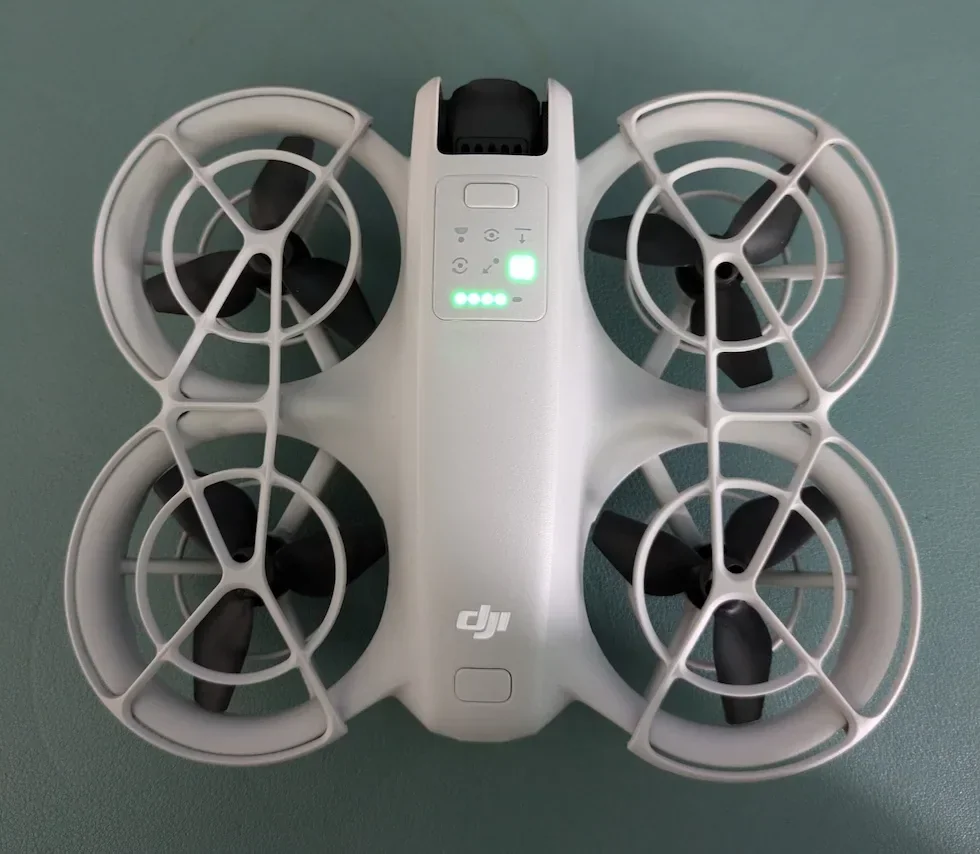
Out of the box the DJI Neo 2 ships in its palm and Wi-Fi configuration — the airframe by itself talks to a phone, not to goggles. The Digital Transceiver is the small antenna unit that screws onto the rear of the drone, and it is what carries the OcuSync video link to the goggles. Fit it with the supplied screwdriver before powering on.
Power on the drone, controller, and goggles in that order and wait for the link
Press and hold the power button on the DJI Neo 2 until the LEDs come on, then power on the DJI FPV Remote Controller 3 and the DJI Goggles N3. Combos ship pre-linked and connect automatically — wait for the goggles to show the live camera view and the controller status bar to show a green link before you do anything else.
Open the Gain and Expo Tuning panel inside the DJI Fly Settings menu
Inside DJI Fly, open the camera view, tap the three-dot menu, and go to Control → Gain and Expo Tuning. This panel sets how aggressively the drone responds to stick input in Manual mode — rates, gains, and the expo curve. The factory defaults are too sharp for a first flight; you want softer rates and more expo around the centre.
Drop the rates and lift the expo curve before your first Manual takeoff
Lower the rate sliders to roughly two-thirds of the default value across pitch, roll, and yaw. Raise the expo so the centre of the stick is softer and the outer travel sharpens up. Save the profile. Manual mode does not let you back out of a sharp input — softer rates buy you the milliseconds to react when the drone goes somewhere you did not intend.
Pick an open site with at least 20 metres of clear air in every direction
Manual mode disables obstacle avoidance and auto-brake, so anything you point the drone at is something the drone will hit. A wide-open field with no trees, fences, or people within at least 20 metres is the right site — not a back garden, not a park footpath, not a beach with anyone else on it. UK Drone Code separation distances still apply on top of that.
Take off in Normal mode first so the drone gets a stable Home Point
Start the motors with the flight mode switch in the middle N position and lift off in Normal mode. Hover for a few seconds at chest height so the drone records a clean Home Point with the satellites it has locked. Switching straight into Manual at the moment of takeoff will work but you lose the safety net of a recorded Home Point if you need to bail.
Slide the flight mode switch on the FPV controller to M for Manual
With the drone hovering in Normal, slide the three-position flight mode switch on the DJI FPV Remote Controller 3 to the M position. The goggles overlay flips to show Manual and the drone instantly stops self-levelling — whatever stick input is on the controller at the moment of the switch is now the input the drone is acting on. Have the throttle stick at roughly half before you flick the switch.
Feather the throttle stick to hold a level hover
In Manual mode the throttle stick controls motor power, not target altitude — let the stick centre and the drone falls out of the sky. Around half-stick holds level in calm air, slightly less descends, slightly more climbs. Spend the first five minutes doing nothing but hovering at chest height with constant throttle input. That hover is the foundation of every Manual skill stacked on top.
Slide the flight mode switch back to N to bail out at any point
If the drone gets ahead of you — and on the first session it will — slide the flight mode switch back to N. The drone re-engages position hold and stops where it is, provided the GNSS signal is strong enough. If GNSS is weak the drone enters ATTI mode and will drift with the wind instead, so land as soon as you can. Always pre-plan the bail-out before the takeoff.
Peter's tip
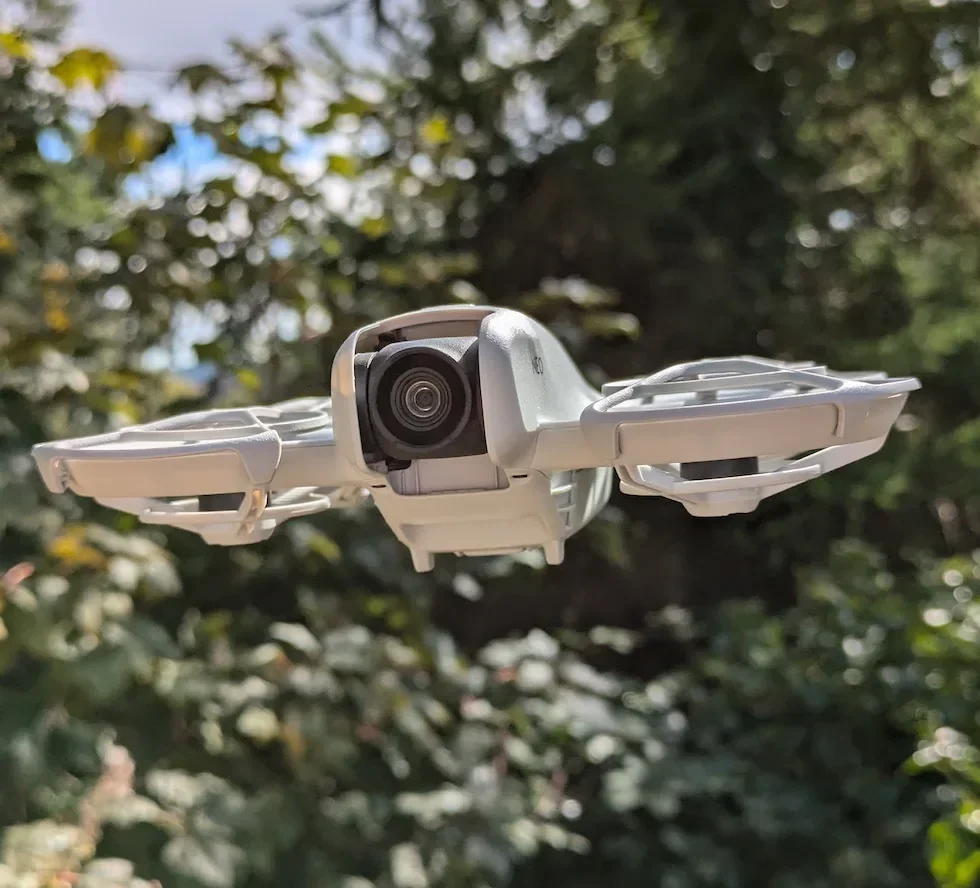
Spend ten hours in a sim before you ever flick the DJI Neo 2 into Manual outdoors. Liftoff, the DRL Sim, or Velocidrone on the lowest settings will teach you the throttle feather faster than crashing a real drone will, and it costs nothing. The DJI Neo 2 will tolerate a Manual learner better than most FPV drones because the propeller guards are integrated and the airframe is solid — but a crash is still a crash, and the propeller wash recovery on this drone is not great when you push it.
| Flight mode | What the drone does | Right call when |
|---|---|---|
| Normal (N) | Precise hover, auto-brake, full obstacle sensing, balanced stick response. The default takeoff and bail-out mode. | Every flight where the goal is not skill-building. Always the takeoff mode and always the mode you fall back to when something goes wrong. |
| Sport (S) | Higher top speed, sharper stick response, self-levelling still active. Forward obstacle sensing disabled. Auto-brake still works. | Fast lines across open ground where you still want the drone to return to level when you let go of the stick. The bridge between Normal and Manual. |
| Manual (M) | No precise hover, no auto-brake, no self-levelling, no obstacle avoidance. The throttle stick controls motor power directly, not altitude. | Skill-building only — learning real FPV stick discipline, slow indoor lines once you can hover reliably, or a controlled outdoor practice session in an empty field. |
Frequently asked questions
Does the DJI Neo 2 have a true Manual mode?
Yes, but only with the right hardware. Manual mode on the DJI Neo 2 is the classic FPV ACRO control mode — precise hovering, auto-brake, and obstacle avoidance are all disabled. It is unlocked through the flight mode switch on the DJI FPV Remote Controller 3 when the drone is flown through the DJI Goggles N3, not through the DJI RC-N3 or the DJI Motion Controller 3.
Can I fly the DJI Neo 2 in Manual mode with the DJI RC-N3 controller?
No. The DJI RC-N3 flight mode switch carries C, N, and S positions only — Cine, Normal, and Sport. There is no Manual position on the standard remote controller. Manual mode is locked to the DJI FPV Remote Controller 3, which has Normal, Sport, and Manual on its flight mode switch instead.
Can I fly the DJI Neo 2 in Manual mode with the DJI Motion Controller 3?
No. The DJI Motion Controller 3 toggles only between Normal and Sport using the mode button on its face. There is no Manual position on the motion controller, and the controller is not designed for the constant throttle and stick input that Manual flight requires. Use the DJI FPV Remote Controller 3 with twin sticks for any Manual session.
Is the DJI Neo 2 a good drone to learn Manual mode on?
Yes for the basics, no for freestyle. DJI itself frames the DJI Neo 2 as an entry-level Manual drone — suitable for practising throttle control, holding altitude, and flying level lines. The drone does not have the propulsion headroom for sustained high-speed flight or full freestyle tricks like power loops, split-S, dive, or yaw-spin, and the attitude can become uncontrollable if you push it that hard. Pair Manual sessions with a proper FPV simulator before you graduate to a higher-power freestyle drone.
What happens to obstacle avoidance in Manual mode?
All of it is disabled. Forward LiDAR, the omnidirectional monocular vision system, and the downward infrared sensor still observe the world, but the drone will not act on what they see in Manual mode. The drone will fly straight through anything you point it at and the auto-brake that catches you in Normal mode is gone. Pick an open, unobstructed site for every Manual flight.
What should I set gain and expo to for a first Manual flight on the DJI Neo 2?
Drop everything from the DJI defaults before your first session. A conservative starting point is rates and gains set well below the factory numbers and expo dialled up so the centre of the stick is soft and the outer travel is sharp. The exact numbers depend on your stick discipline — fly a slow, level hover, land, lift everything a few clicks, and repeat. Tuning Manual rates is a process, not a one-shot setting.
Does the DJI Neo 2 hold altitude in Manual mode?
No. Manual mode disables precise hovering, so the moment you let the throttle stick centre the drone will drop. The throttle stick on the DJI FPV Remote Controller 3 controls motor power directly, not a target altitude — half-stick roughly holds level in calm air, less than that descends, more than that climbs. Every Manual pilot is feathering the throttle constantly. There is no equivalent of letting go and watching the drone hover.
What is the difference between Manual mode and Sport mode on the DJI Neo 2?
Sport mode unlocks the higher top speed and disables forward obstacle sensing, but the drone still self-levels — let go of the stick and the drone returns to a flat attitude. Manual mode disables self-levelling on top of everything Sport disables, so the drone holds whatever attitude you put it in. A roll input in Sport flicks the drone over and snaps it back upright; a roll input in Manual sends it into a continuous roll until you counter it. Sport is fast and assisted; Manual is full FPV control.
How do I bail out of Manual mode mid-flight on the DJI Neo 2?
Slide the flight mode switch on the DJI FPV Remote Controller 3 back to N for Normal. The drone re-engages position hold and stops where it is — as long as the GNSS signal is strong enough for positioning. If positioning is weak the drone enters ATTI mode instead and will drift with the wind, so land as soon as possible. Pre-plan the bail-out before you launch every Manual flight.
Manual mode on the DJI Neo 2 is a real ACRO control mode and the drone is built robustly enough to survive the early crashes — but the hardware combination is fixed and the skill ceiling is real. Get the goggles, get the FPV controller, drop the rates, and treat the first ten flights as throttle-feather practice rather than freestyle attempts.
If you want a second opinion on whether the DJI Neo 2 is the right Manual learning drone for your setup or if a different airframe would serve you better, drop the details to peter@hiredronepilot.uk and I will come back to you directly. The video version of this walkthrough is on YouTube and the comments are open.
References
Primary source material for this article is the official DJI Neo 2 documentation and DJI Fly. External links open in a new tab.
- DJI Neo 2 — Downloads (User Manual, Quick Start Guide, firmware notes) · Section 4.1 Flight Modes confirms Manual is only available with the FPV Remote Controller, and lists which flight assistance functions are disabled.
- DJI Neo 2 — Product page (UK) · Hardware overview, FPV combo contents (Goggles N3 + RC Motion 3 vs FPV Remote Controller 3), and the Digital Transceiver accessory.
- DJI Fly — App download and release notes · The app where the Gain and Expo Tuning panel lives and where the active flight mode is reflected in the status bar.
Peter Leslie
Founder & GVC Drone Pilot
Peter is the founder of HireDronePilot. With thousands of logged commercial flight hours, he writes about drone technology, commercial surveying tactics, and UK aviation compliance.
Connect on LinkedIn