DJI Mini 4 Pro vs DJI Neo 2: which one should you buy?
These two get shortlisted together because both stay under 250 grams. That is about all they share. One is a serious camera drone in miniature; the other is a camera that flies itself and lands on your hand.
 Written by Peter Leslie, GVC-qualified commercial drone pilot | Every figure checked against both DJI manuals | 3 Aug 2026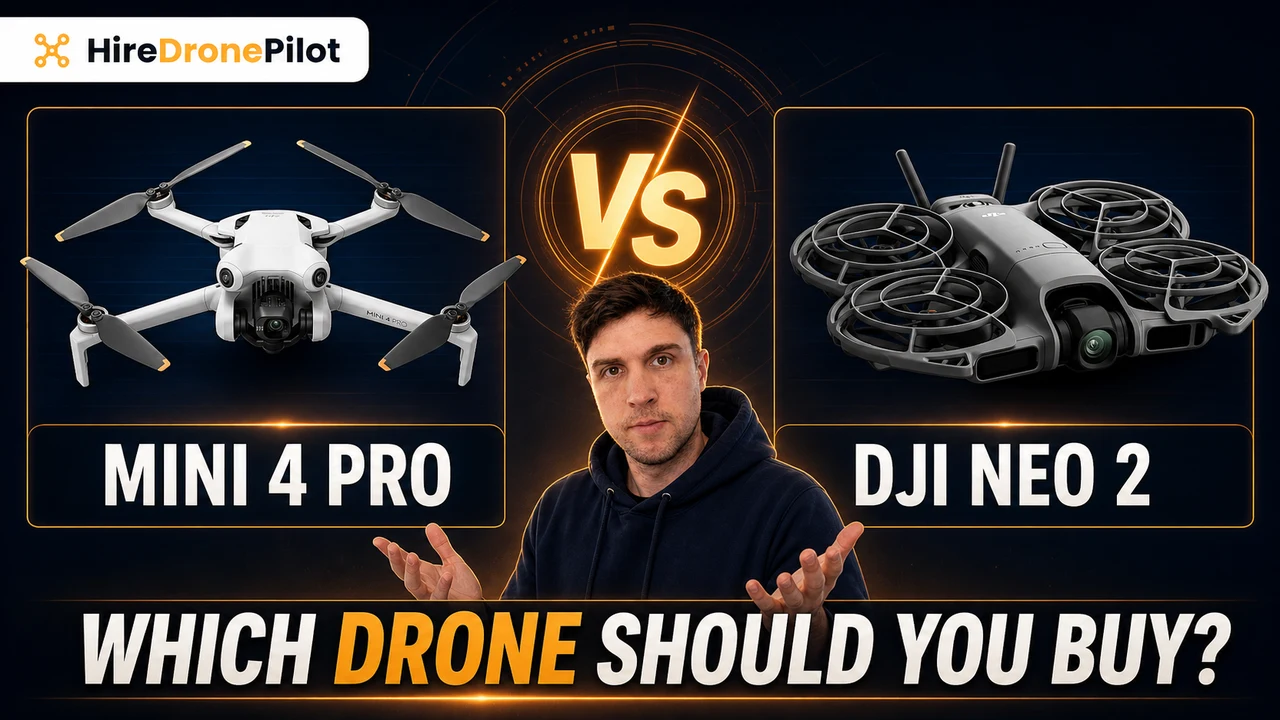
My short answer
I recommend the DJI Mini 4 Pro
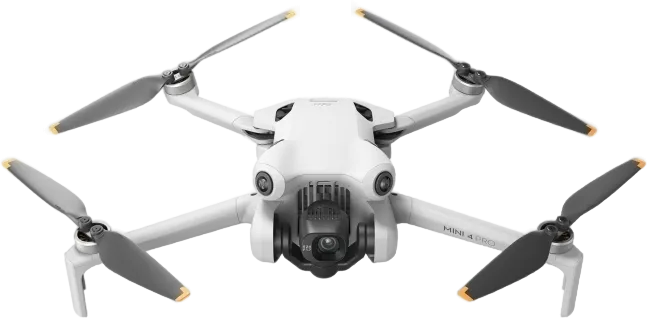
DJI Mini 4 Pro
The 2023 camera drone
A proper camera drone that happens to be tiny. Omnidirectional sensing, a 48-megapixel sensor and half an hour in the air.
- 1/1.3-inch, 48 MP sensor with an f/1.7 lens
- Sees in every direction, not just forwards
- About 34 minutes per battery
- Three-axis gimbal, 4K at 100fps
- Needs a controller and a phone, every flight
- Under 249 g leaves you 1 g of legal room
I recommend this if…
- You care how the finished footage looks
- You want to learn to fly properly
- You shoot in awkward light or want 4K slow motion
- You want sensing on every side
If you want to be filmed, not to fly
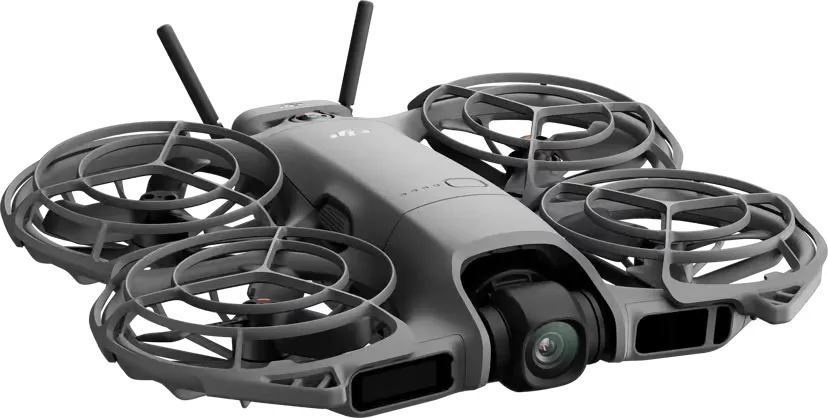
DJI Neo 2
The 2025 palm-launcher
A camera that flies itself off your palm. Lighter, simpler and it needs nothing else bought, but the camera is the compromise.
- 1/2-inch, 12 MP sensor only
- Forward and downward, nothing to the sides in Sport
- About 19 minutes per battery
- Two gimbal axes, no pan
- Launches off your palm with nothing in your hands
- 151 g, with 99 g of legal room
I recommend this if…
- You want to be filmed rather than to fly
- You want it out of a pocket and flying in seconds
- You are buying for someone nervous
- You would rather not own a controller at all
Both links are Amazon affiliate links. As an Amazon Associate I earn from qualifying purchases, at no extra cost to you — full disclosure.
These are two different kinds of product
The Mini 4 Pro is a conventional drone shrunk down. It folds out, it comes with a controller, your phone clamps in as the screen, and you fly it yourself with two sticks.
The Neo 2 is a camera that flies itself. Press a button, hold your hand flat, and it lifts off your palm, films a move you chose beforehand, and comes back to your hand.
The Neo 2 also keeps its propellers in a cage, so clipping a branch is usually a bump rather than a crash. The Mini 4 Pro flies on bare propellers and relies on seeing the branch instead.
So the useful question is not which has better numbers. It is whether you want to fly a drone or be filmed by one.
For the wider shortlist, my best beginner drones guide and best drones under 250g cover both.
Four things that do not separate them
Clear these away first, because none of them can decide this for you.
-
Same UK paperwork
Flyer ID and Operator ID for both.
-
Both C0 class marked
In their standard configurations.
-
Same cold limit
Both rated down to minus ten degrees.
-
Both want a memory card
2 GB and 49 GB fill up eventually.
-
So ignore all 4
None of it can tell you which to buy. The next four things can.
Treat both flight times with suspicion. They are laboratory figures measured in still air, and neither survives a British afternoon with wind to push against.
The four differences that actually matter
1. The Mini 4 Pro has a much bigger sensor, and sensor size decides how footage looks
The Mini 4 Pro uses a 1/1.3-inch sensor at 48 megapixels. The Neo 2 uses a 1/2-inch sensor at 12.
Those fractions are awkward to read, so put it plainly: the Mini 4 Pro gathers noticeably more light and resolves four times the detail in a still.
Its lens is wider too, at f/1.7 against f/2.2, which compounds the advantage in poor light.
Mini 4 Pro
48MP
1/1.3-inch sensor, f/1.7
Neo 2
12MP
1/2-inch sensor, f/2.2
The Neo 2 has one counter worth stating. It pushes sensitivity to ISO 12800 where the Mini 4 Pro sits at 6400 normally, reaching 12800 only in night mode.
That does not overturn the result. Higher sensitivity on a smaller sensor buys a brighter picture with more noise in it, not a better one.
Winner — DJI Mini 4 Pro
Four times the stills resolution, a wider lens and a physically larger sensor. If the footage is going anywhere other than the bin, this section alone should decide the purchase.
The Neo 2 is perfectly good on a phone screen. It is prints, crops and dull light where the gap shows.
Check the Mini 4 Pro on Amazon2. The Mini 4 Pro watches every direction. The Neo 2 watches forwards, and not in Sport mode
Both drones have real obstacle sensing, which is worth saying because plenty of comparisons imply the cheaper one has none.
The Neo 2 carries a forward-facing LiDAR unit, which is a small laser that measures distance, plus cameras watching sideways and infrared underneath.
The Mini 4 Pro uses an omnidirectional binocular vision system with a 3D infrared sensor beneath it. Binocular means paired cameras judging depth, in every direction at once.
Mini 4 Pro
Omnidirectional binocular vision
- Paired cameras judging depth all round
- 3D infrared underneath
- Works while flying up to 12 m/s
- No mode switches it off
Neo 2
LiDAR ahead, vision to the sides
- Forward-facing laser rangefinder
- Cameras watching sideways
- Downward infrared
- Switches off entirely in Sport mode
The practical difference is trust. On the Mini 4 Pro the sensing is always on and always all round, so a fast orbit through trees is a normal request.
On the Neo 2 the moment you select Sport for a quicker shot, the safety net goes away.
Winner — DJI Mini 4 Pro
Binocular vision in every direction, working at speed, with nothing that disables it. That is a meaningfully more capable safety system than a forward laser that switches off when you want to fly quickly.
For the twenty-second palm-launched clips the Neo 2 is built around, its sensing is genuinely enough.
Check the Mini 4 Pro on Amazon3. The Mini 4 Pro stays up 34 minutes. The Neo 2 manages about 19
Nearly double, and it is the largest proportional gap between these two anywhere.
DJI rates the Mini 4 Pro at 34 minutes on its standard battery and 45 on the Plus. The Neo 2 is rated at about 19.
Mini 4 Pro
34min
about 25 in reality
Neo 2
19min
about 12 to 15 in reality
There is a catch on the Plus battery that matters here more than usual. Fitting it takes the Mini 4 Pro over 249 grams, which moves it out of the friendliest UK bracket.
So the 45-minute figure and the sub-250-gram claim cannot both be true at once. Buy the Plus battery and you have chosen the heavier bracket.
How much any of this matters depends on how you fly. The Neo 2 goes up in twenty-second bursts off your palm, so you rarely run a battery flat in one continuous flight.
Winner — DJI Mini 4 Pro
Fifteen extra minutes per battery on the standard pack, without leaving the sub-250-gram bracket. Across an afternoon that is the difference between packing up early and not thinking about it.
The Neo 2 charges over USB-C and weighs so little that carrying two spares costs you nothing.
Check the Mini 4 Pro on Amazon4. The Neo 2 weighs 151 g. The Mini 4 Pro is 1 g under the limit
UK rules are built around a 250 gram line. Under it you are in the friendliest bracket there is, and crossing it tightens the rules sharply on flying near other people.
The Mini 4 Pro is sold in two versions: a C0 model just under 249 g and a C1 model at 342 g. Only the first is in that friendly bracket.
Mini 4 Pro
249g
just 1 g under the limit
Neo 2
151g
99 g under the limit
One gram is not a margin. It is a sticker, a lanyard loop or a slightly heavier third-party propeller.
Both manuals carry the same warning: do not add payload beyond the listed accessories, do not fit unapproved parts, and do not modify the drone.
On the Neo 2 that is a formality. On the Mini 4 Pro it is a live constraint, and it is worth checking which of the two models you are actually buying.
Winner — DJI Neo 2
Ninety-eight grams lighter, and it leaves room to add whatever you like without arithmetic. It also never needs unfolding, so it goes from pocket to hovering in seconds where the Mini 4 Pro needs arms out, controller on and phone clamped.
If you buy the C0 Mini 4 Pro and add nothing to it, 249 g is under the line and stays under it.
Check the Neo 2 on AmazonFour questions that will tell you which one to buy
Work down them and stop at the first one you can answer firmly. That is your drone.
Is the finished footage the reason you are buying?
Mini 4 ProDo you want to learn to fly properly, sticks in hand?
Mini 4 ProWill you fly fast, or close to obstacles on every side?
Mini 4 ProNone of the above, and you want to be filmed with nothing in your hands?
Neo 2These are different products more than they are rivals, so plenty of people end up owning one of each. If you are still torn, it is worth reading the Neo 2 against the DJI Flip, which is the closer comparison for it.
Two catches worth knowing before you order either one
Neither is a reason to avoid either drone. Both are things I would want to have been told before paying.
The Mini 4 Pro comes in two versions and only one is sub-250 grams
DJI sells the Mini 4 Pro as two models. One carries a C0 class mark at 249 grams; the other carries C1 at 342 grams.
They look identical in listings and photographs. The difference is which battery and configuration you get.
If staying under 250 grams matters to you, check the class label on the drone you receive rather than trusting the product title.
The Neo 2 needs a bolt-on part before any controller works
If you decide later that you want a proper controller or goggles, the Neo 2 has a step the Mini 4 Pro does not.
It needs a separate accessory called the Digital Transceiver. Until that is fitted, no controller and no goggles will connect at all.
DJI tells you to check its screws every thirty hours, and fitting it takes the drone from 151 g to 160 g. The Mini 4 Pro simply comes with a controller in the box.
Storage, transmission and folding
Three practical differences that will not decide it but are worth knowing.
Storage goes to the Neo 2, and by a wide margin. It has 49 GB built in against the Mini 4 Pro’s 2 GB, so the Mini 4 Pro needs a memory card from the first flight.
Transmission goes to the Mini 4 Pro. It uses O4 out of the box with a quoted 20 km range, where the Neo 2 flies on wi-fi until you fit the transceiver.
Folding is a genuine split. The Mini 4 Pro packs smaller but needs unfolding; the Neo 2 never folds but never needs setting up either.
That last one decides how often each drone actually comes out of the bag, which is worth more than most specifications on this page.
Mini 4 Pro vs Neo 2: every specification side by side
| DJI Mini 4 Pro | DJI Neo 2 | |
|---|---|---|
| Released | September 2023 | November 2025 |
| Weight | Under 249 g (C0); 342 g as the C1 model | 151 g (160 g with transceiver) |
| Class mark | C0 (249 g) or C1 (342 g) — two models (manual p120) | C0 (manual p97) |
| Folds? | Yes, to 148 × 94 × 64 mm | No, fixed frame |
| Propeller guards | No | Yes, full cage |
| Palm takeoff | No, controller required | Yes |
| Obstacle sensing | Omnidirectional binocular vision plus 3D infrared underneath | Forward LiDAR, omnidirectional vision, downward infrared |
| Rated flight time | 34 min standard, 45 with the Plus battery | Approx. 19 min |
| Operating temperature | −10° to 40° C | −10° to 40° C |
| Gimbal | Three-axis (tilt, roll, pan) | Two-axis (tilt, roll) |
| Camera sensor | 1/1.3-inch, 48 MP | 1/2-inch, 12 MP |
| Lens | f/1.7, 82.1° | f/2.2, 119.8° |
| ISO range | 100–6400 (12800 in night mode) | 100–12800 |
| Max video | 4K at 100fps | 4K at 100fps |
| Max stills | 8064 × 6048 (48 MP) | 12 MP |
| Internal storage | 2 GB | 49 GB |
| Transmission | O4, 20 km | Wi-Fi; O4 with the Digital Transceiver |
| Battery | 2590 mAh standard, 3850 Plus | 1606 mAh |
| Max speed | 16 m/s Sport, 12 Normal | 12 m/s (Sport) |
| Wind resistance | 10.7 m/s | 10.7 m/s (Level 5) |
| Ceiling | 4000 m standard, 3000 m on Plus | 2000 m |
| On Amazon | Check price | Check price |
Figures from the official DJI specification pages and both user manuals. Amazon affiliate links — disclosure.
Both drones need a Flyer ID and an Operator ID. Neither is exempt
You will read all over the internet that drones under 250 grams need no licence. For a camera drone in the UK that is simply wrong, and both of these are camera drones.
Any camera drone between 100 g and 250 g needs both of these before you fly it outdoors. At 151 g and just under 249 g, both sit in that bracket.
Flyer ID
Proves you know the rules. A free online theory test, valid five years.
Operator ID
Registers you as responsible for the drone. £12.34 a year, and the number must be labelled on the drone.
Neither needs a GVC or an A2 Certificate of Competence for ordinary recreational flying. Both are C0 class marked in their standard form, though the Mini 4 Pro is also sold as a heavier C1 model. There is more in do I need a licence for a sub-250g drone and UK class marking explained.
Why I pick the DJI Mini 4 Pro over the DJI Neo 2
The honest summary is that these are not really competitors. One is a camera drone; the other is a camera that flies itself.
If you want to make footage you are proud of, the Mini 4 Pro wins on sensor, on sensing coverage and on endurance, and it is not close.
If you want to be in the shot without holding anything, no specification on the Mini 4 Pro helps you, because it cannot do that at all.
My recommendation — DJI Mini 4 Pro
DJI Mini 4 Pro
2023 — under 249 g in C0 form
I recommend the DJI Mini 4 Pro over the DJI Neo 2 because it is a camera drone and the Neo 2 is a camera that flies itself. The Mini 4 Pro sees in every direction, carries a far bigger sensor and stays up almost twice as long. The Neo 2 is lighter, simpler and launches off your hand, which is a genuine appeal. But if the footage is the point, this is the one that delivers it.
- 1/1.3-inch 48 MP sensor, f/1.7 lens
- Omnidirectional vision plus 3D infrared
- About 34 minutes per battery
- 4K at 100fps, O4 transmission
- Three-axis gimbal with pan
- Also sold as a C1 model if you want the Plus battery
- Controller and phone required
- Only 2 GB inside, so buy a card
Amazon affiliate link — no extra cost to you.
The grab-and-go option
DJI Neo 2
Buy this instead if being filmed without holding anything is the whole point, or if you want the lightest drone with real room under the legal limit.
Amazon affiliate links — disclosure.
Written by Peter Leslie — GVC-qualified commercial drone pilot
I fly compact DJI drones alongside enterprise survey kit, and I judge them on the footage and the safety margin they give me in real UK conditions.
Every figure here came out of the official DJI manuals or the CAA, not a press release. Where the manuals contradicted the marketing I went with the manuals.
Comparison you want covered next? peter@hiredronepilot.uk.
Sources