How Much Storage Does the DJI Neo 2 Have?

Peter Leslie
22 May 2026
Key Takeaways
- The DJI Neo 2 ships with internal storage only soldered to the mainboard and no microSD card slot anywhere on the drone
- DJI lists approximately forty nine gigabytes of usable internal storage, which holds roughly ninety minutes of 4K thirty fps footage or three to four hours at 1080p sixty fps
- There is no upgrade path — the capacity is fixed for the life of the drone, and the only way to free space is to offload footage or delete clips from inside DJI Fly
- The DJI Neo 2 mounts as a USB mass storage device over USB-C and does not need to be powered on for the transfer
- DJI Fly QuickTransfer over Wi-Fi handles small batches to a phone, but USB-C to a laptop is the only sensible route for a full session of 4K clips
The DJI Neo 2 ships with internal storage only. There is no microSD card slot on the drone, no expansion option, and no way to add capacity later — the on-board memory is soldered to the mainboard and what DJI built in is what you have for the life of the DJI Neo 2. DJI lists the usable capacity at approximately forty nine gigabytes, which is enough for roughly ninety minutes of 4K thirty fps footage before the storage warning appears in DJI Fly.
That figure surprises most drone pilots coming from the Mini or Air series, where a microSD card lets you forget about capacity entirely. On the DJI Neo 2 the storage is a real constraint that shapes how you plan a shoot — especially in 4K at the higher frame rates, where a single battery's worth of recording eats a meaningful slice of the drive. The numbers, the offload workflow, and the practical habits all sit below.
The DJI Neo 2 carries approximately forty nine gigabytes of internal storage and zero card slots
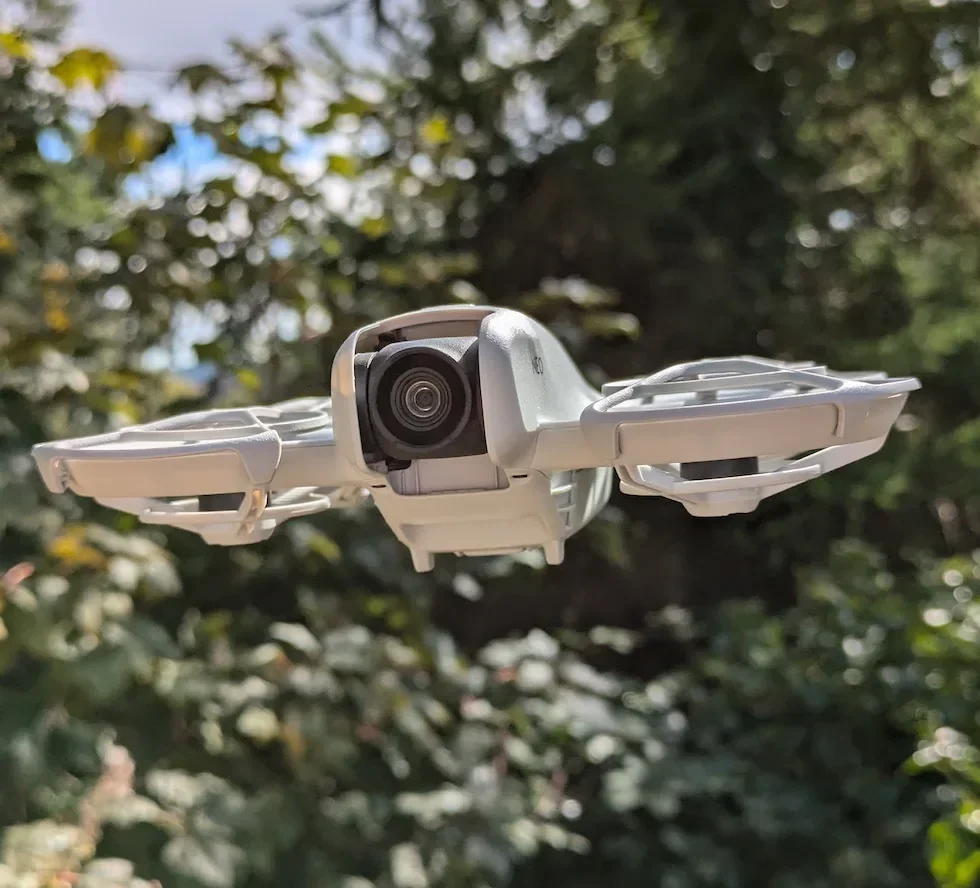
The DJI Neo 2 components diagram in the user manual lists sixteen labelled parts on the drone body — screen, gimbal, forward-facing LiDAR, status indicator, propellers, propeller guard, motors, battery, battery buckle, power button, battery LEDs, omnidirectional monocular vision system, USB-C port, downward infrared sensing system, takeoff button, and select button. A microSD card slot is not on that list. The only physical interface for moving data on or off the drone is the USB-C port on the rear.
DJI lists the usable internal storage as approximately forty nine gigabytes on the official Neo 2 specifications page. The raw chip is larger; firmware, system files, and a small reserve area account for the gap between the chip capacity and what you see when the drone mounts as a drive on a computer. The most accurate live figure for any individual drone is the storage readout printed next to the Format Storage row in DJI Fly's About screen — that number is the one DJI guarantees for your specific unit.
From a drone pilot's perspective, forty nine gigabytes is comfortable for a single session and tight for anything multi-day. It is roughly twice the internal storage on the original DJI Neo, which kept the same no-card design but only shipped with around twenty two gigabytes. The DJI Neo 2 doubles the cushion but keeps the same architectural ceiling — there is no way to add a second drive, no slot to drop a card into, and no firmware update that will ever change that.
Forty nine gigabytes holds around ninety minutes at 4K thirty fps, dropping sharply at higher frame rates
Real-world capacity depends on the recording mode you fly in. The DJI Neo 2 records H.264 and H.265 MP4 at peak bitrates in the seventy to one hundred and fifty megabits per second range depending on resolution and frame rate. At 4K one hundred fps the encoder pushes the highest bitrate, which means the highest gigabytes per minute and the shortest recording window. At 1080p sixty fps the bitrate falls to a fraction of that and the storage stretches out across hours.
| Recording mode | Approx. minutes on the Neo 2 | Full batteries |
|---|---|---|
| 4K at thirty fps | ~90 minutes | 5–6 batteries |
| 4K at sixty fps | ~65 minutes | 4 batteries |
| 4K at one hundred fps | ~45 minutes | 2–3 batteries |
| 2.7K vertical 9:16 at thirty fps | ~140 minutes | 8+ batteries |
| 1080p at sixty fps | ~200 minutes | 10+ batteries |
Two practical things fall out of that table. First, at 4K one hundred fps you will fill the storage before you run out of batteries on a Fly More Combo day. Three packs is roughly fifty minutes of flight, and that is more recording than the storage can hold at the highest frame rate. Second, dropping to 1080p turns the storage problem into a non-issue — the drone holds more 1080p footage than the battery can record across an entire weekend.
Photos barely move the needle. A JPEG is around five megabytes, a DNG raw photo around thirty, both small enough that a thousand stills consume well under a tenth of the drive. Video is what fills it. The vertical 9:16 mode at 2.7K records efficiently because the pixel count is lower than full 4K, so vertical content for Reels and TikTok stretches the storage further than horizontal client work.
When the storage fills up, the only options are offload, delete, or fly home
There is no swapping a chip and no plugging a card into the DJI Neo 2 in flight. Once the internal storage is full, the drone keeps flying but stops recording new clips and shows a storage full warning in DJI Fly. The fix in the field is one of three things — clear space from the phone, accept the loss, or offload to a laptop on the spot.
The fastest field option is to delete clips from inside the DJI Fly album. Open the album, tap into the drone's storage, scrub through what was recorded, and bin the takes you do not need. This frees space immediately and you can keep flying. The risk is obvious — if you delete a clip you wanted to keep, it is gone for good. Be brutal with practice flights and conservative with anything that looked like a real shot.
The slower-but-safer option is to offload over USB-C to a laptop or tablet between batteries. Plug the drone into a computer with a data-capable USB-C cable, copy the DCIM folder across, then format from inside DJI Fly. The full transfer workflow is covered in the DJI Neo 2 PC and laptop guide. The nuclear option for clearing space on demand is the Format Storage action, which wipes the drive in one pass and returns it to full capacity.
Peter's tip
If you are heading out for a full day at 4K sixty fps or higher, take a small laptop or a tablet with a USB-C port and a data-capable cable. Between batteries, copy the morning's footage across while the next pack charges. The DJI Neo 2 is back to empty by the time the battery is full, and you never lose a shot to a storage full warning at the wrong moment.
If a laptop is not in the bag, QuickTransfer the keepers to your phone over the Wi-Fi link, format the drone, then carry on. The phone becomes the offload buffer for the rest of the day.
The transfer workflow is one cable, two routes, and one detail that catches new owners
Getting footage off the DJI Neo 2 onto a computer is a one-cable job. Plug a USB-C cable into the drone's USB-C port, plug the other end into a PC or laptop, and the internal storage mounts as a removable drive within seconds. The drone does not need to be powered on — the USB controller exposes the storage as long as the battery has any charge. The DJI Neo 2 manual confirms this directly in section 4.9 on storing and exporting photos and videos.
The detail that catches new owners is the cable. The short USB-C cable that ships in the standalone box and in the Fly More Combo is rated for charging only on most batches — the data lines are not wired. It will charge the drone happily and the LEDs will light, but no drive will ever appear on the computer. The fix is any modern data-capable USB-C cable, the kind bundled with a recent phone or a USB-C SSD. The DJI Neo 2 Two-Way Charging Hub cable is also power-only, so do not waste time troubleshooting with that one in the loop.
DJI Fly QuickTransfer over Wi-Fi is the alternative when there is no laptop in the bag. The full route for getting clips onto your handset sits in the DJI Neo 2 phone download walkthrough. It is slower than the cable for large 4K transfers but perfectly serviceable for a few clips on the bus home. For desktop editing, the cable wins every time.
Planning around the fixed forty nine gigabytes is the difference between a clean shoot and a lost shot
Because the DJI Neo 2 storage cannot be expanded, the planning happens before takeoff rather than at the gate. Three habits cover ninety per cent of cases. First, format the drone in DJI Fly before any session that matters — a known empty drive removes the question of how much room is left. Second, match the recording mode to the storage you have — if you are filming for a vertical edit, 2.7K vertical 9:16 buys you more headroom than 4K, and if you are filming for a horizontal client, 4K thirty fps is the sweet spot between quality and capacity.
Third, treat the storage as a buffer rather than a library. The DJI Neo 2 is not a hard drive; it is a camera with enough memory to get the footage home. Offload after every session, format before the next, and you will never see the storage full warning. Drone pilots who skip the offload step and treat the drone as long-term storage are the ones who end up deleting clips in the field mid-shoot.
The DJI Neo 2 storage story is short — forty nine gigabytes, no card slot, no expansion, manage carefully. Knowing the number before the first flight rather than after is the difference between a clean weekend and a lost shot at the wrong moment.
Got a specific storage scenario the article did not cover — a write error mid-flight, a corrupt clip on the internal drive, a workflow question for editing on the road? Drop a note to peter@hiredronepilot.uk and I will come back to you directly. If you prefer the video version of this explainer, the comments are open on YouTube.
References
Primary source material for this article is the DJI Neo 2 user manual and DJI specification pages. External links open in a new tab.
- DJI — Neo 2 official specifications · Internal storage capacity, video bitrate at 4K, 2.7K and 1080p, recording format and frame rates
- DJI — Neo 2 User Manual (2025) · Section 1.2 aircraft components diagram (no microSD slot), section 4.9 storing and exporting photos and videos
- DJI — DJI Fly app downloads · QuickTransfer Wi-Fi offload, album view, Format Storage action inside the About screen
Peter Leslie
Founder & GVC Drone Pilot
Peter is the founder of HireDronePilot. With thousands of logged commercial flight hours, he writes about drone technology, commercial surveying tactics, and UK aviation compliance.
Connect on LinkedIn