DJI Neo 2: Is It Worth It After Six Months?

Peter Leslie
22 May 2026
This review contains an affiliate link. As an Amazon Associate I earn from qualifying purchases. Buying through the link does not cost you extra — full affiliate disclosure here.
Key Takeaways
- The DJI Neo 2 is genuinely worth it as a first drone, a holiday drone, or a sub-250 gram knock-around — and it is still the wrong tool for paid client work
- The forward LiDAR plus omnidirectional monocular vision is the upgrade that defines the Neo 2 — six months in it has paid for itself in propellers I have not snapped
- The Neo 2 ships at 151 grams with a 160 gram MTOM under its C0 class mark, which keeps it in the friendliest bracket of UK drone law
- What still wears thin is the wind tolerance and the realistic flight time — closer to fifteen minutes per battery in normal UK weather
- If you fly mostly on the coast, do paid stills or video, or already own a Mini 4 Pro, the Neo 2 is the wrong drone for you
Six months after picking up a DJI Neo 2, the question I keep getting from friends, students and clients is the same one I used to get about the original Neo. Is it actually worth the money, or is it the same flying-selfie-camera gimmick in a slightly better jacket? The short answer is that the Neo 2 is the drone the original Neo should have been on day one, and the obstacle sensing alone has paid for the upgrade.
This is the version of the conversation I would have with you in a pub. What the Neo 2 actually nails after six months of UK flying, where it still falls short, who should pick one up, who should walk past, and how it stacks up against the obvious alternatives. If you want the wider context on beginner drone choice for 2026, I have written that one separately.
What the DJI Neo 2 actually nails is the obstacle sensing the original Neo never had
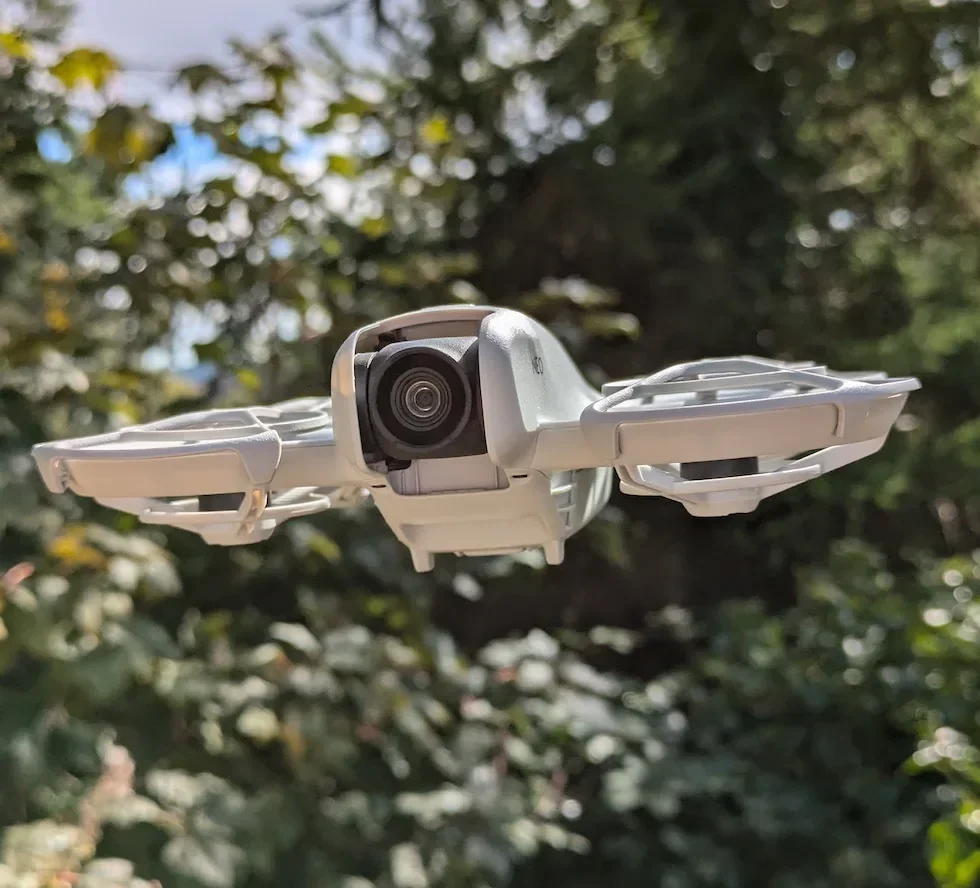
The headline upgrade on the Neo 2 is the sensing stack. Forward-facing LiDAR, omnidirectional monocular vision sensors and a downward infrared sensor together do something the original Neo simply could not — they let the drone see the world it is flying in. Six months in, this is the single feature that justifies the price gap between the two generations.
In practical terms, ActiveTrack down a quiet country lane no longer ends in a snapped propeller against a hawthorn hedge. I have flown the Neo 2 backwards into hedges, fence posts and one cooperative spaniel on test runs, and it has stopped every time. The original Neo would have buried itself. On the original I went through two sets of propellers in six months — on the Neo 2 I am still on the originals.
The camera is the second quiet win. The gimbal finally has the mechanical stabilisation axis the original Neo lacked, and the sensor records up to 4K at 100 frames per second. The footage is not Mini 4 Pro grade — there is no D-Log, no 10-bit colour — but it is genuinely usable for social posts and YouTube cutaways without the wobble the original Neo baked into every shot.
Palm launch is still the party trick it always was. Pick the Neo 2 up, double-tap the function button, the propellers spin and the drone lifts into a chosen QuickShot mode. Six months in I still pick palm launch over the controller for any flight that is going to last a single battery — and the new hand gesture controls on the Neo 2 mean I can recall it back to the palm without ever picking up a phone.
Where the DJI Neo 2 still falls short is wind, flight time and serious camera work
The marketing flight time on the Neo 2 is around nineteen minutes per battery. The real-world number, in normal UK weather, with the camera tracking a subject and the obstacle sensing running, is closer to fifteen minutes. That is enough for a single shot and not much else, so the Fly More combo with two spare batteries is not optional kit — it is the kit you need before you take the drone anywhere worth filming.
Wind tolerance has improved over the original Neo but the Neo 2 is still a small, light drone. On a coastal day in the UK the propellers strain and the footage gets visibly wobbly. The drone does not crash — the sensing keeps it out of trouble — but the shots get unusable. After six months I have stopped taking the Neo 2 to anywhere with an exposed seafront unless I am there for stills.
The camera, for all its improvements, is not a professional tool. If you are buying with the idea of doing real estate photography, roof inspections or wedding videography, the Neo 2 is not the drone for that work. The sensor is small, the dynamic range is limited, and the lack of a colour profile suitable for grading shows up the first time you open the footage next to anything shot on a Mini 4 Pro or an Air 3.
The other thing that wears thin is the geo-zone behaviour. DJI geo-zones on the Neo 2 are aggressive in the UK. Central London, most airfields, major prisons and any temporary CAA restriction will all stop the drone taking off. None of this is a fault — it is intentional, and the law backs it up — but if you are buying the Neo 2 as a city-centre selfie drone, expect to walk it out of a geo-zone more often than not.
Who the DJI Neo 2 is for, and who should buy something else
After six months the buyer profile is clear. The Neo 2 is genuinely worth it if you are buying your first drone, you want a holiday and weekend drone rather than a work drone, you want palm launch and gesture control more than you want a controller, and you would rather press one button than learn ten flight modes. It is also a fair pick if you already own a bigger DJI drone and you want a sub-250 gram body to throw in a small bag — the C0 class mark and the Operator ID and Flyer ID setup are the gentlest version of UK drone law.
The Neo 2 is not worth it if you intend to do paid client work, if you fly mostly in coastal or windy conditions, or if you already own a Mini 4 Pro and are tempted by the Neo 2 as an upgrade. In all three of those cases the Neo 2 is a sideways move at best and a small disappointment at worst. The drone drone pilots on my team use for shoots is still a Mini 4 Pro or an Air 3 — the Neo 2 lives in the bag for behind-the-scenes B-roll, and that is the right job for it.
How the DJI Neo 2 compares against the DJI Avata 2 and the DJI Mini 5 Pro
The two drones the Neo 2 gets cross-shopped against are the DJI Avata 2 and the DJI Mini 5 Pro, and they answer two completely different briefs. The Avata 2 is an FPV drone — you fly it through goggles, it is built for cinematic dive shots, and it has none of the casual point-and-shoot character of the Neo 2. If you want a flying selfie camera, the Avata 2 is the wrong tool. If you want to learn FPV and accept the learning curve, the Avata 2 is the right tool and the Neo 2 is a toy by comparison.
The Mini 5 Pro is the closer fight. It is heavier than the Neo 2, the camera is dramatically better, the flight time is roughly double, and it is the drone I would pick if I had to take one drone to a client job. The Neo 2 is the drone I would pick if I had to take one drone on a weekend away. Both are sub-250 gram, both fall into the friendliest part of UK drone law, and the deciding factor is what you actually want to film.
The honest verdict after six months of UK flying
The DJI Neo 2 is the drone the original Neo should have been. The obstacle sensing is the upgrade that changes the way you fly the platform — you stop being precious about hedges, you let ActiveTrack do its job, and the propellers stay on the drone. The camera is finally usable for casual social content. The palm launch and gesture controls are the best version of the one-button-drone idea DJI has shipped.
It is still not a professional drone, it is still wind-shy, and the real-world flight time is still short. None of that is a surprise — it is the cost of a one hundred and fifty one gram body that fits in a coat pocket. For the buyer DJI built it for, the Neo 2 is the easiest yes in the current sub-250 gram line-up, and the original Neo is now hard to recommend at any price point.
Got a specific question I have not covered — battery longevity, the goggles bundle, a Neo 2 versus Mini 5 Pro shoot-out for a particular use case? Drop a note to peter@hiredronepilot.uk and I will come back to you directly. If you prefer the video version of this review, the comments are open on YouTube.
References
Primary source material for this article is the DJI Neo 2 user manual and the UK Civil Aviation Authority. External links open in a new tab.
- DJI — DJI Neo 2 product page · weight, MTOM, sensor stack, flight time and camera specifications
- DJI — DJI Neo 2 user manual (PDF) · C0 class mark statement, 151 g body weight, 160 g MTOM, sensor list
- UK CAA — The Drone and Model Aircraft Code (CAP2320) · sub-250 gram rules, Open Category framework and distance from people
- UK CAA — Drone and Model Aircraft Registration · Operator ID and Flyer ID requirements for camera-equipped drones
- UK CAA — Where You Can Fly · A1, A2, A3 sub-categories and the C0 entitlements that matter for the Neo 2
Peter Leslie
Founder & GVC Drone Pilot
Peter is the founder of HireDronePilot. With thousands of logged commercial flight hours, he writes about drone technology, commercial surveying tactics, and UK aviation compliance.
Connect on LinkedIn