Best Quieter Propellers for the DJI Neo 2

Peter Leslie
22 May 2026
Key Takeaways
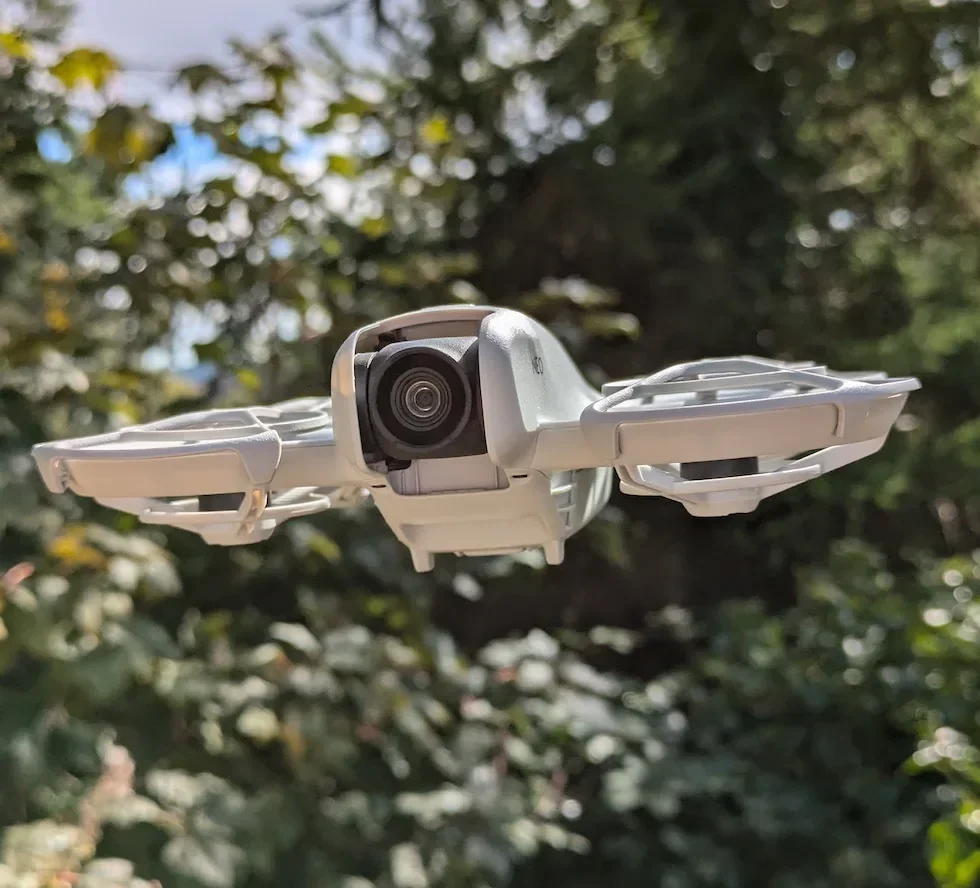
- The DJI Neo 2 uses a three-inch ducted propeller behind a detachable propeller guard, and the duct geometry is what limits aftermarket low-noise options far more than the blade itself
- There is currently no widely sold low-noise propeller from Master Airscrew or any other established brand for the DJI Neo 2 — most third-party Neo 2 props on Amazon are stock-pattern replacements, not noise-reduction designs
- The DJI Neo 2 user manual is unambiguous — only use official DJI propellers, do not mix propeller types — and fitting non-DJI props can void the warranty and disable DJI Care Refresh cover
- Removing the propeller guards trims a couple of decibels off the duct noise, but it also disables forward LiDAR obstacle avoidance and rules out gesture flying at close quarters
- The biggest single thing drone pilots can do for ground-level noise is fly higher and slower — perceived loudness drops by roughly six decibels every time the distance from the source doubles
If you have searched for quieter propellers for the DJI Neo 2, you have probably seen a few Amazon listings selling "low-noise" replacement props, plus a stack of YouTube videos showing five-blade and six-blade upgrades dropping the typical noise level of bigger drones by three or four decibels. The honest answer is that the same accessory ecosystem does not exist for the DJI Neo 2 yet. The Neo 2 uses a tiny three-inch ducted propeller behind a fitted propeller guard, and the established noise-mod brands — Master Airscrew, MAS, Tarot — currently publish low-noise props for the Mini, Mavic and Air ranges but not for the Neo 2.
That does not mean nothing can be done about the high-pitched whine the Neo 2 puts out. It just means most of the win comes from operating choices and from looking after your stock props rather than swapping them. This article walks through what is actually on sale today, what DJI says about fitting it, the manual procedure that keeps the official props running as quietly as possible, and the three flying techniques I rely on when I need a Neo 2 to stay discreet.
The Neo 2's ducted propeller design is what limits aftermarket noise mods in the first place
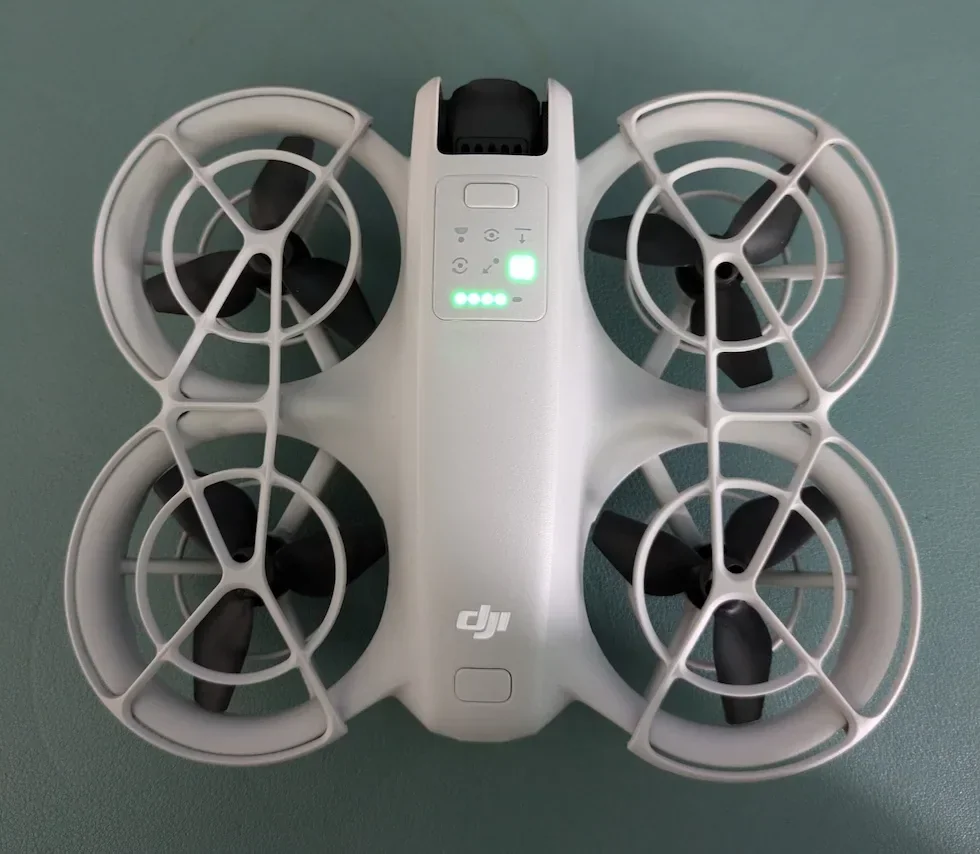
Before going prop shopping, it helps to understand why the Neo 2 is a harder target for a noise mod than a Mini 4 Pro or a Mavic 3. The Neo 2 is built around a tiny three-inch propeller running inside a fitted plastic propeller guard, with a forward-facing LiDAR sensor sitting in the guard structure to feed the omnidirectional obstacle avoidance system. The guard is detachable for cleaning and propeller swaps, but it is not a removable accessory in the same way as a Mini's snap-on guard — the Neo 2 is designed to fly with the guards on.
Two things follow from that. First, any aftermarket propeller has to physically clear the duct walls — there is no room for a longer or wider blade design like the five-blade props that work on a Mini. Second, a meaningful chunk of the Neo 2's sound is duct noise rather than blade-tip noise, and a different propeller does not change the duct. That is the structural reason the established noise-mod brands have not moved into the Neo 2 space yet — there is less room to engineer a win, and the addressable saving in decibels is smaller than it would be on an open-prop drone.
From a drone pilot's perspective, this matters because it explains why the noise comparisons you see on YouTube — five-blade props turning a Mavic 3 from "lawnmower" into "fridge hum" — do not transfer across to the Neo 2. A 2026 Neo 2 with the best aftermarket prop you can currently buy still sounds, in character, like a stock Neo 2.
Most third-party Neo 2 propellers on Amazon are stock-pattern replacements, not noise-reduction designs
Search Amazon UK for "DJI Neo 2 propellers" and you will find listings from third-party brands like Hanatora, Anbee, RCstars, RCGEEK and a handful of generic suppliers. Almost all of these are direct copies of the stock DJI propeller geometry — same blade pattern, same pitch, same diameter, sometimes a slightly stiffer plastic. They are sold as cheap replacements at three or four pounds a pair, not as noise-reduction upgrades. A stock-pattern third-party prop will not make the Neo 2 quieter, and in some cases it will be marginally louder if the moulding is cruder than the official part.
A few listings advertise "low-noise" or "silent" props for the Neo 2. Treat those claims with deep scepticism unless the seller publishes measured decibel data with the test setup. The accepted noise-mod brands — Master Airscrew, MAS, Tarot — list their compatibility tables on their own websites, and as of writing neither the DJI Neo nor the DJI Neo 2 appears on those tables. The Mini 3, Mini 4 Pro, Air 3, and Mavic 3 all do. That gap tells you everything about whether a credible noise-engineered prop exists for the Neo 2 today — it does not.
DJI's own manual says do not mix propeller types — and that is a warranty issue
The DJI Neo 2 User Manual is unambiguous on the topic. In Section 4.6, the Notice block reads: "Only use official DJI propellers. DO NOT mix propeller types." The same notice warns that propellers are consumables, that screws need to be checked every thirty hours of flying time (approximately sixty flights), and that aged, chipped or broken props must be discarded — but the no-third-party rule is the one that matters for a noise mod.
In practice, fitting a non-DJI propeller does three things. It puts you outside DJI's documented operating envelope, which means a flyaway or crash is no longer covered by warranty. It can disable any active DJI Care Refresh policy on that drone, because Care Refresh terms exclude damage caused by unauthorised modifications. And it raises a small but real airworthiness question — if a copied propeller flexes differently from the original, the flight controller's vibration filter may not compensate cleanly, and the gimbal can pick up a low-frequency wobble in your footage that was not there before. The step-by-step DJI Neo 2 propeller change procedure is the same whether you are fitting official spares or third-party copies, but the consequences if something goes wrong are not.
For a sub-twenty-pound consumable that DJI sells direct, the value calculation rarely works out. A pair of official Neo 2 propellers is cheaper than a single hour with an unhappy gimbal, and a lot cheaper than losing your DJI Care cover or your commercial drone insurance if a non-DJI part is named as a contributory factor in a claim.
Looking after your official Neo 2 props is the most reliable noise control you have
Since the aftermarket has not arrived, the realistic move is to keep your official props in the condition that DJI designed them to fly in. A clean, balanced, undamaged stock prop is genuinely quieter than a tired one — even a small chip on a blade tip changes the way the air leaves the propeller and adds a high-frequency edge to the sound. The manual is explicit on this: "DO NOT use aged, chipped, or broken propellers. Clean the propellers with a soft, dry cloth if there is any foreign matter attached."
Three habits make the biggest difference. First, inspect every blade before each flight — run a fingernail over the leading edge and tip, and any nick goes straight in the bin. Second, check the propeller screws every thirty flying hours as the manual specifies, because a slightly loose hub vibrates against the motor and turns into noise you can hear from the ground. Third, store the drone with the propellers and guards installed correctly — squashing a Neo 2 into a tight pocket without the proper case bends the blades just enough to throw the balance off. Follow the removal-and-installation procedure exactly as written — the manual notes that the screws must be kept vertical and flush, and that the included DJI screwdriver is the only one to use.
Flying higher and slower beats every propeller swap on the Neo 2 by a wide margin
The biggest noise win on a Neo 2 is operational, not mechanical. Sound level falls roughly six decibels every time the distance from the source doubles, which is the same physics that applies to every drone in the Open Category. No aftermarket propeller is going to give you that kind of reduction. Altitude will.
Flying slower helps too, for a different reason. The Neo 2's motors run quietest when they are unloaded — hovering in a no-wind condition gives you the lowest baseline noise, and aggressive throttle inputs spike the noise as the propellers bite harder against the air. If you are filming a piece-to-camera in a quiet park and need the Neo 2 to be discreet, set it to Cine mode, fly smooth slow translations rather than punchy moves, and keep the altitude as high as the framing allows. Twenty metres up and eight metres horizontal is the sweet spot on most residential shoots — high enough that the perceived noise from the ground drops below the level of background traffic, low enough that the camera still has the subject sharp.
For UK drone pilots the altitude question also has a legal floor. The Drone and Model Aircraft Code caps the Open Category at one hundred and twenty metres above the surface, and you must keep the Neo 2 within visual line of sight at all times. Inside that envelope, every metre of altitude you trade up reduces ground-level noise — provided you do not lose sight of the drone, and provided you stay within the people-distance rules that apply to your class mark. There is no point being quieter at the cost of a flight rule breach.
Removing the propeller guards is the only "free" mod that genuinely works — but it costs you obstacle sensing
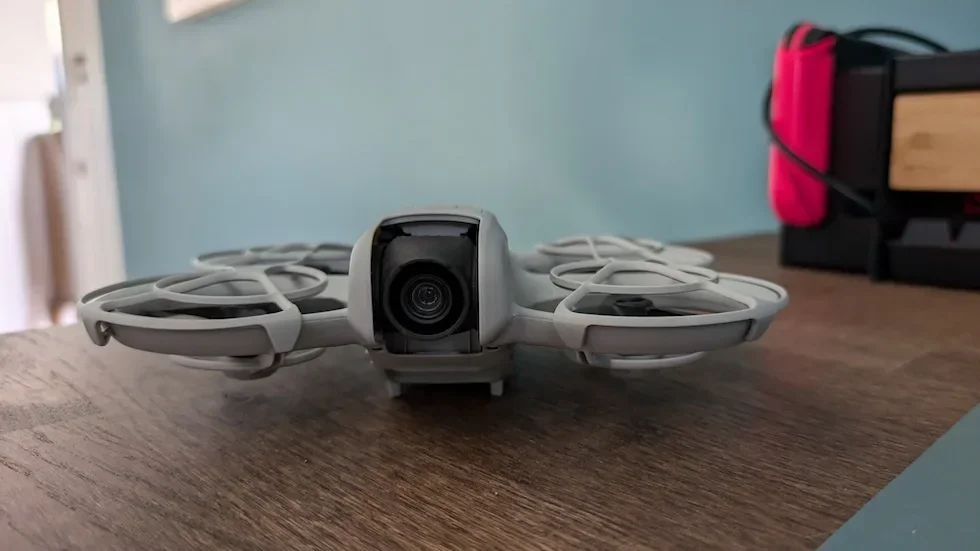
If the noise really matters and the shoot is in an open area with no people or obstacles nearby, taking the propeller guards off is the one structural change that has measurable evidence behind it. The duct turbulence is what gives a Neo 2 its sharp high-pitched whine, and stripping the guards shifts the spectrum slightly downward and removes some of the hiss. The manual itself notes that the guards are detachable and lays out a clean removal procedure with the buckles on the centre, front protrusion and edges.
The trade-off is real and worth being honest about. The Neo 2's forward LiDAR sits in the guard structure, and the manual warns that if the guards are not properly installed "the forward-facing LiDAR may be obstructed, leading to abnormal obstacle avoidance performance." Take the guards off and you are flying with reduced obstacle sensing, no close-quarters gesture safety, and a sharp prop tip exposed if it hits a person or a wall. For a careful open-field flight that is a fair trade for two decibels. For anything close to people, it is not.
Where the Neo 2 prop market actually goes from here
The Neo 2 launched in November 2025, and the third-party accessory market is usually twelve to eighteen months behind the DJI release cycle on noise-engineered parts. The Mini 3 launched in 2022 and the Master Airscrew low-noise props for it followed about a year later. The same pattern is likely to play out for the Neo 2, but the ducted-prop architecture means whoever ships first has a harder engineering brief than the open-prop competitors.
If a measured aftermarket low-noise propeller for the Neo 2 does ship, it will probably be a three-blade design with a swept tip rather than the five-blade or six-blade format that works on bigger DJI drones — the duct simply does not have room for higher blade counts. Watch the Master Airscrew compatibility list, watch the MAS site, and watch the verified-purchase reviews on the prop maker's own store rather than Amazon. Until that happens, the answer to "are there quieter propellers for the DJI Neo 2" is the boring one — not really, but you can knock a couple of decibels off by removing the guards in safe conditions, far more by climbing five metres, and the rest in post-production audio cleanup if it is the recorded sound that is bothering you.
Got a specific Neo 2 noise scenario you want me to walk through — a wedding shoot, a wildlife site, a residential street with thin walls? Drop a note to peter@hiredronepilot.uk and I will come back to you directly. If you prefer the video version of this explainer, the comments are open on YouTube.
References
Primary source material is the DJI Neo 2 User Manual and the UK Civil Aviation Authority. External links open in a new tab.
- DJI — Neo 2 User Manual and Quick Start Guide · §4.6 Propellers and Propeller Guards (three-inch ducted propeller, detachable propeller guards, screwdriver-mounted hubs, thirty-hour screw check interval, "Only use official DJI propellers — DO NOT mix propeller types" notice, forward LiDAR obstruction warning)
- UK CAA — The Drone and Model Aircraft Code (CAP2320) · One hundred and twenty metre Open Category altitude cap and visual-line-of-sight requirement underpinning the "fly higher" noise mitigation
- UK CAA — UK Regulatory Framework for Drones · Open Category structure within which Neo 2 flights operate, including class-mark and people-distance rules
Peter Leslie
Founder & GVC Drone Pilot
Peter is the founder of HireDronePilot. With thousands of logged commercial flight hours, he writes about drone technology, commercial surveying tactics, and UK aviation compliance.
Connect on LinkedIn