How to Stop Birds Attacking Your Drone Mid-Flight

Peter Leslie
12 Sept 2025
Key Takeaways
- Territorial birds — hawks, buzzards, gulls, crows, corvids — are the main threat, and they defend harder during nesting season from spring into early summer
- Avoidance is always cheaper than breaking off an engagement — a proper site survey and seasonal awareness stop most incidents before they start
- If a bird engages, stop forward motion, gain altitude steadily, and move away from its territory rather than trying to outrun it at low level
- A dedicated observer focused on airspace is the single most effective upgrade you can make, and they spot incoming birds long before you do
- A drone lost to a bird strike is a reportable occurrence under UK rules if it endangered people, property or other aircraft
Birds are the single most common wildlife hazard to UK drones, and any drone pilot who has flown any significant number of commercial hours has stories about a peregrine that dropped out of nowhere, a pair of gulls that would not leave a rooftop inspection alone, or a corvid that escorted the drone half a mile home. The good news is that almost every bird incident is preventable with sensible pre-flight planning, and the ones that are not preventable are usually survivable if you know how to break off cleanly.
The article below is the playbook I actually use. Avoidance first. Breaking off second. Reporting and recovery third. None of it is regulated the way airspace rules are, but the last section ties into UK drone law around lost-drone reporting and occurrence reporting, which you need to understand before an engagement turns into a crash.
Territorial birds are the main threat, and their aggression is seasonal
The birds that cause real problems for drones in the UK are territorial. That means raptors — buzzards, sparrowhawks, peregrines, kestrels — plus gulls on coastal and urban rooftops, and corvids like crows, rooks, ravens and magpies that defend nesting territories in parks, woodland and city centres.
Their aggression is highly seasonal. Spring into early summer is the dangerous period, when parent birds are defending nests and young. A buzzard that would ignore a drone in January will escort it aggressively in May. Urban gulls nesting on commercial rooftops become genuinely dangerous from April through July, which is the same period most UK drone roof inspections happen.
Outside nesting season, territorial behaviour drops sharply. Winter flights tend to be the quietest. Songbirds and non-territorial flocks almost never engage a drone and are not a tactical concern — accidental contact with a pigeon flock is a different category of risk, and the way to manage that is to avoid flying through the flock in the first place, not to worry about aggression.
Avoidance is always cheaper than breaking off from an engagement
The single best way to deal with a bird attack is to not have one. A proper site survey the day before the flight, or at worst the morning of, will catch ninety per cent of UK bird hazards before the drone leaves the case. Stand on the planned take-off point for ten minutes and watch the sky. If raptors are using the site, you will see them. If gulls are nesting on an adjacent building, you will hear them.
There are three practical avoidance habits that consistently reduce the incident rate. The first is altitude discipline. Climb steadily through the raptor band — roughly thirty to eighty metres — rather than lingering at the altitude where most buzzards and kestrels patrol. The second is time of day. Most raptors are less active in the middle of the day than in the two hours after sunrise or the last two hours before sunset. A midday flight usually beats a dawn flight for bird safety even if the light is worse for photography. The third is route planning. A drone flown in a straight line at constant altitude is much less interesting to a territorial bird than one that is hovering, circling, or descending slowly on a static target.
On roof inspections, where hovering is the whole point of the flight, the sensible mitigation is to use a longer focal length so the drone can work at a larger stand-off distance. The extra zoom keeps you physically further from the roosting birds and almost always reduces the aggression response.
If a bird engages, stop forward motion and climb steadily rather than outrun it
When a bird does engage, the instinct is to accelerate and run. That usually makes things worse. A drone that is actively retreating horizontally looks like prey, and a territorial raptor will pursue over surprisingly long distances. The better response is to stop forward motion and climb steadily.
Most UK birds struggle to gain altitude as quickly as a modern drone. A clean vertical climb of fifty to a hundred metres typically breaks the engagement. Once you are above the engagement altitude and the bird has lost interest, move laterally out of the territory before descending again. If the bird persists even after a climb, the correct call is to land at the nearest safe location and move the operation to a different time of day or a different vantage point.
What you absolutely do not do is try to engage the bird back. Any deliberate action that harms a wild bird in the UK — striking with the drone, deploying a physical deterrent at it, firing a device — risks prosecution under the Wildlife and Countryside Act 1981, and most birds are protected at species level. The drone is recoverable. A prosecution is not.
A dedicated observer is the single most effective upgrade you can make
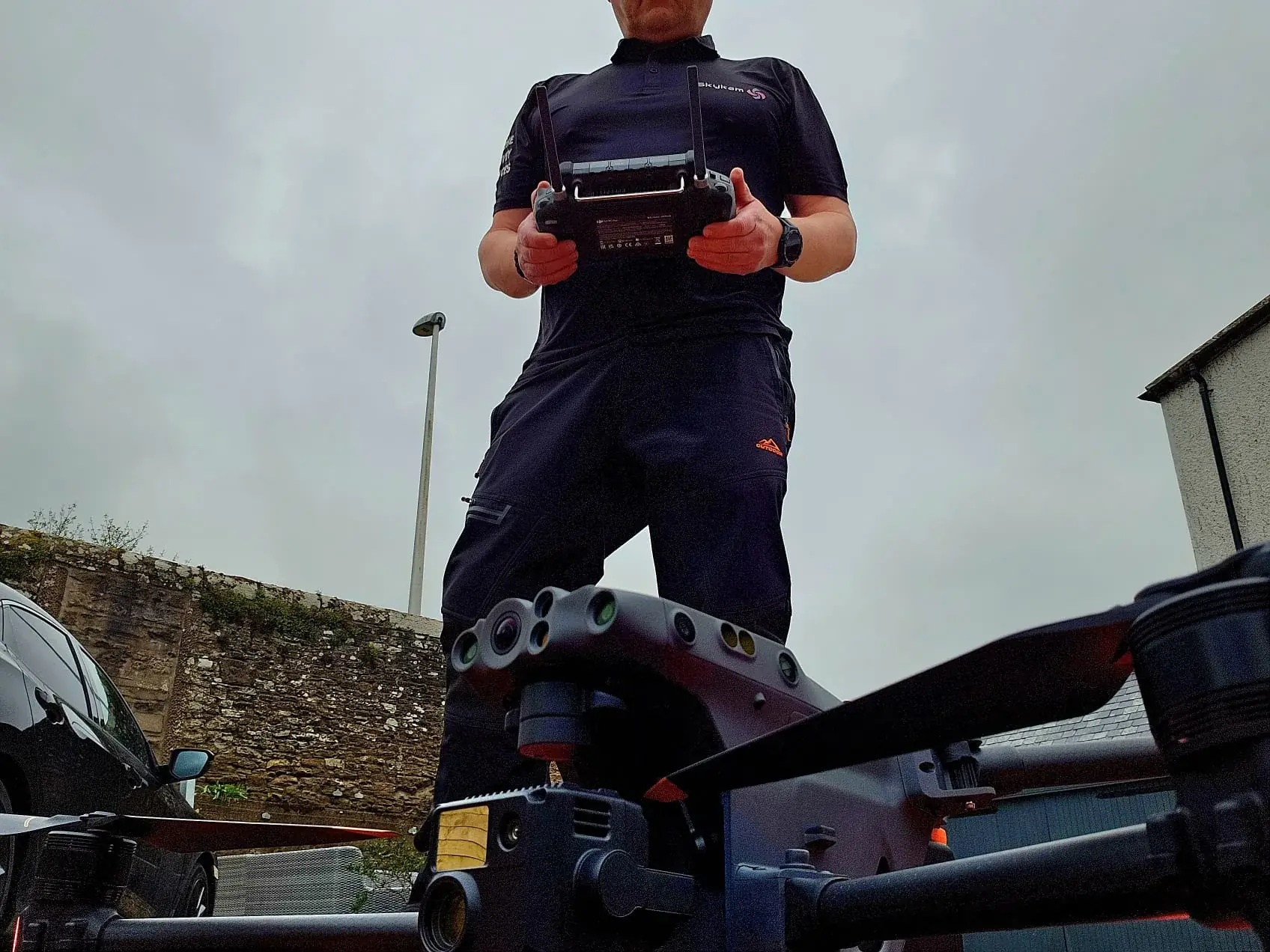
Every experienced drone pilot will tell you the same thing. The observer is worth their weight in drone repair bills. The Drone Code allows an observer to stand next to you and hold Visual Line of Sight on your behalf, and the eyes-on-sky job is exactly the one you cannot do well while your own eyes are on the controller screen.
The overall observer framework is the same one that underpins Visual Line of Sight for every UK flight. On sites with known bird activity, brief the observer specifically on the bird species present. Agree a callout phrase — bird inbound, twelve o'clock, closing — that gives you both direction and urgency without a long discussion. Agree a standing instruction: on a confirmed bird call, stop and climb. You do not want to be discussing tactics during an engagement.
On commercial flights where the brief is complex — topographical surveying, thermal imaging, construction progress — a second pair of eyes on the airspace also covers low aircraft, deviating helicopters and other drones, which is how the observer usefulness compounds well beyond bird avoidance alone.
Physical deterrents and modifications are mostly marketing, not mitigation
There is a whole genre of advice online about reflective tape, predator decals, ultrasonic devices and hawk-silhouette stickers. In my experience, almost none of it reliably changes bird behaviour in the UK, and all of it adds weight and drag that degrades the drone's own performance. Predator decals are the most harmless option and do no real damage, but I would not rely on them as protection.
Weight is the serious side of this. Any retrofit to a UK drone adds to its maximum take-off mass, and on a drone that sits near a class-mark or weight threshold that can push it into a different Open Category sub-category with different distance rules. If you are thinking about modifying your drone for bird protection, weigh the drone with and without the modification and confirm the sub-category rules still work for your flight. The altitude ceiling is unaffected, but the people-distance rules can shift materially.
A far more useful upgrade than any decal is a well-lit drone during dusk flights. The same green flashing light that is mandatory for UK night flying — covered in the flying at night in the UK piece — does add something measurable to daylight bird visibility, because it breaks the drone's silhouette up visually and reduces the chance a bird misidentifies it as a natural competitor.
A lost drone from a bird strike is a reportable occurrence under UK rules
If a bird strike results in loss of control, damage to the drone, or worse — an impact with a building, a vehicle or a person — the event is likely a reportable occurrence to the CAA. The CAA's safety advice specifically frames collision avoidance as a primary risk category in UK drone operations, and occurrence reporting is the mechanism the CAA uses to monitor what is actually causing UK drone incidents.
The practical threshold is whether the event endangered people, property, or other aircraft. A clean vertical break-off with no damage is not reportable. A bird strike that led to a hard landing in a private garden probably is. A bird strike that caused a drone to fall onto a road or a pavement is almost certainly reportable. When in doubt, report — the system is designed to capture data, not to punish honest reports.
For commercial operators, a reportable occurrence also ties back to the third-party liability insurance carried under flying drones for work rules. Your insurance policy will almost certainly require prompt occurrence reporting as a condition of cover. Not reporting can invalidate a claim for a lost drone — which is exactly the situation a bird strike tends to create.
So the playbook: avoid aggressive bird periods and territories with a proper site survey; climb and move away rather than run horizontally; use an observer on bird-heavy sites; keep the drone weight and performance inside the sub-category you are operating under; and report any incident that crosses the endangered-other-people threshold.
For the broader safety framework, the CAA's safety advice is the best single reference, and the UK drone laws explainer covers the regulatory basis.
Got a specific bird experience you want covered — a raptor engagement mid-flight, a gull-infested roof inspection, a corvid that followed you home — drop a note to peter@hiredronepilot.uk and I will come back to you directly. If you prefer the video version of this explainer, the comments are open on YouTube.
References
Primary source material for this article is the UK Civil Aviation Authority. External links open in a new tab.
- UK CAA — Safety Advice for Drone Operations · collision avoidance, human factors, and the occurrence-reporting framework for loss-of-control events
- UK CAA — The Drone and Model Aircraft Code (CAP2320) · Rule 17 (responding to changing conditions), Rule 18 (incident reporting), observer rules
- UK CAA — Flying Drones for Work · commercial third-party liability insurance and the reporting obligations it creates
Peter Leslie
Founder & GVC Drone Pilot
Peter is the founder of HireDronePilot. With thousands of logged commercial flight hours, he writes about drone technology, commercial surveying tactics, and UK aviation compliance.
Connect on LinkedIn