Flying Drones at Night in the UK: What the Law Actually Says

Peter Leslie
16 Apr 2026
Key Takeaways
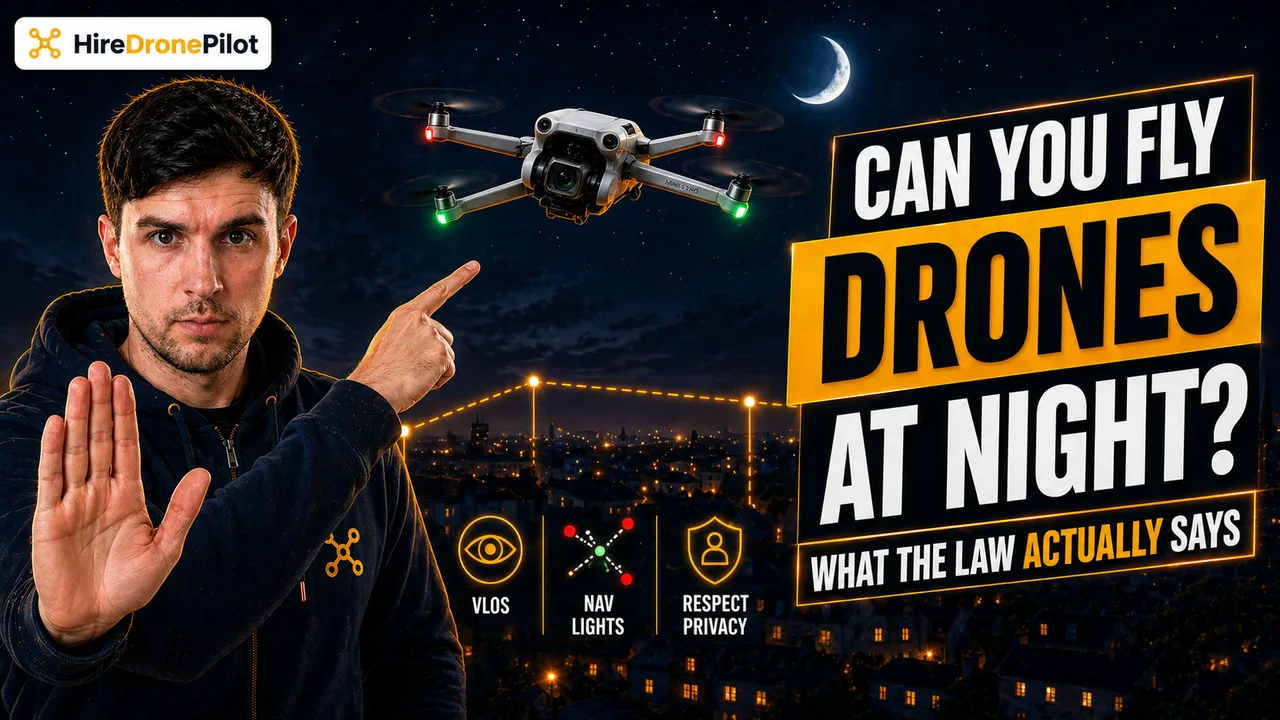
- Night flying is permitted in the UK Open Category — there is no ban, and there never was
- Since 1 January 2026, your drone must have a green flashing light switched on throughout any night flight
- Visual Line of Sight still applies at night, which in practice means flying closer and slower than you would by day
- UK0 and UK4 class drones are not required to ship with a built-in green light, so many will need a retrofit before night flights
- Genuinely dark or extended night operations usually sit in the Specific Category with a tailored Operational Authorisation, not the Open Category
The single most common myth I hear about UK drone law is that flying at night is banned. It is not, and it never has been. Night flying is permitted in the Open Category, and it has some of the best air I have ever flown in — calm, empty skies, stable footage, almost nobody on the ground.
What did change, and recently, is the lighting rule. Since January 2026 your drone must carry a green flashing anti-collision light that stays on for the entire flight, and the regulation names the drone pilots who hold the direct view as legally responsible for making sure it does. The rest of UK drone law still applies — you just have to work harder to stay inside it.
Night flying is permitted in the UK Open Category, and the ban that people talk about does not exist
If you read the Drone and Model Aircraft Code from front to back, you will not find a time-of-day prohibition anywhere in it. The Open Category sets its limits on weight, altitude, distance from people, and airspace — not on whether the sun is up.
That is why recreational drone operators can fly after sunset without applying for anything extra, and why commercial drone operators do not need a separate night endorsement on a standard Open Category flight. The CAA treats night as a risk factor to manage, not an activity to licence.
Where the misunderstanding comes from is worth naming. People confuse night flying with Beyond Visual Line of Sight flying, because both involve a drone that is hard to see. BVLOS genuinely is banned in the Open Category. Night flying is not.
Your drone must carry a green flashing anti-collision light from take-off to landing
This is the one rule that trips up every drone operator new to night work. From 1 January 2026, any drone flown at night in the Open Category must have a green flashing light active for the entire flight. The legal basis is UK Regulation (EU) 2019/947 UAS.OPEN.060(2)(g), and the UK regulatory framework makes the Remote Pilot personally responsible for keeping it on.
The purpose is not orientation for the drone operator — it is so that anyone else on the ground, and any manned aircraft nearby, can tell a drone apart from something else in the sky. Green flashing is the distinguishing signal.
Not every class-marked drone ships with one built in. Regulation 2019/945 only requires UK1, UK2, UK3, UK5 and UK6 class drones to have a factory-fitted green flashing light. UK0 and UK4 class drones, plus legacy drones bought before January 2026, usually need a retrofit. The weight of the retrofit light counts towards your drone's maximum take-off mass, which for a sub-250g drone can quietly push you over the threshold into a different sub-category.
And if the light deactivates at any point mid-flight — even for something as mundane as starting a recording on an older drone — you are no longer compliant. The flight has to end.
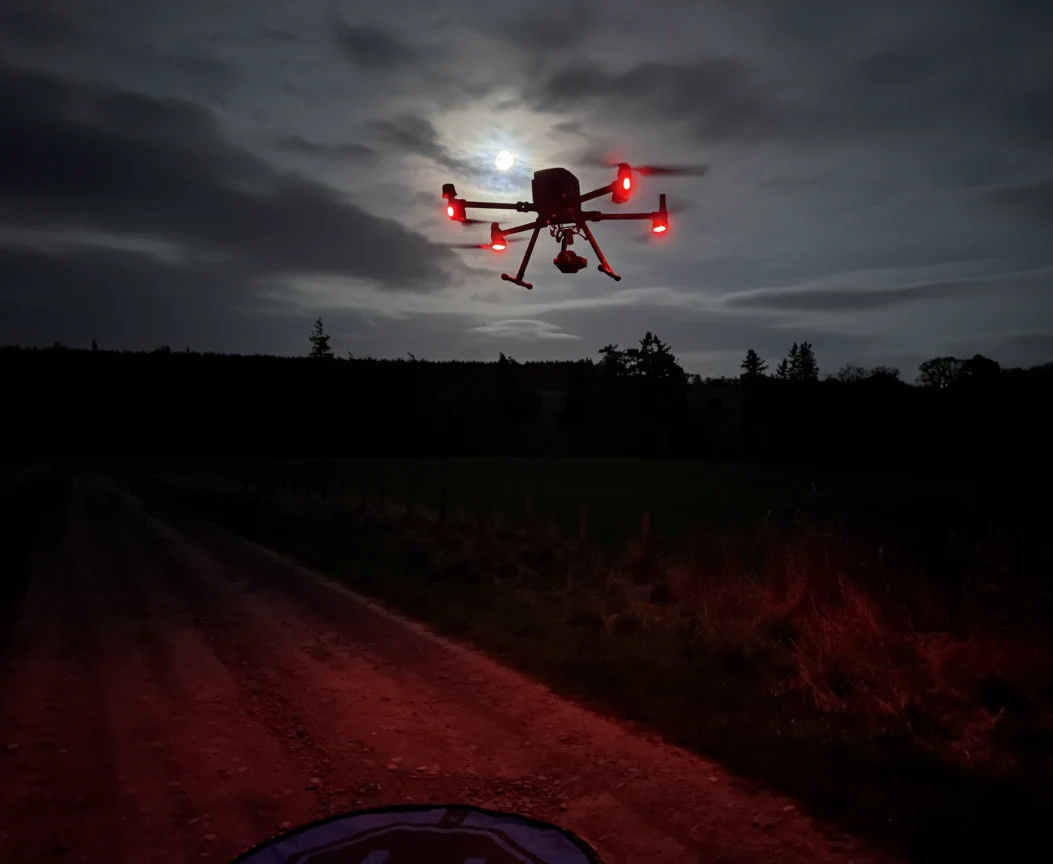
Visual Line of Sight does not get a night exemption, which is why realistic night flights are closer and slower
Visual Line of Sight is the bedrock of the Open Category and it does not relax after sunset. You still have to see your drone directly, with your own eyes, clearly enough to tell which way it is facing and clearly enough to spot other aircraft.
The problem is that the physical cues you rely on by day — the shape of the drone, its contrast against the landscape, the tilt of its gimbal — disappear. At night you are tracking a pattern of lights against a black background, which is a very different skill. Depth perception collapses, and a drone parked straight above you becomes almost impossible to orient.
My own rule of thumb is to halve my daytime range and slow every stick input down. A site I would happily push out to 300 metres by day I will keep inside 150 at night, and every turn is deliberate rather than reactive. The 1-to-1 rule matters even more after dark, because the horizontal offset is what preserves the viewing angle you need.
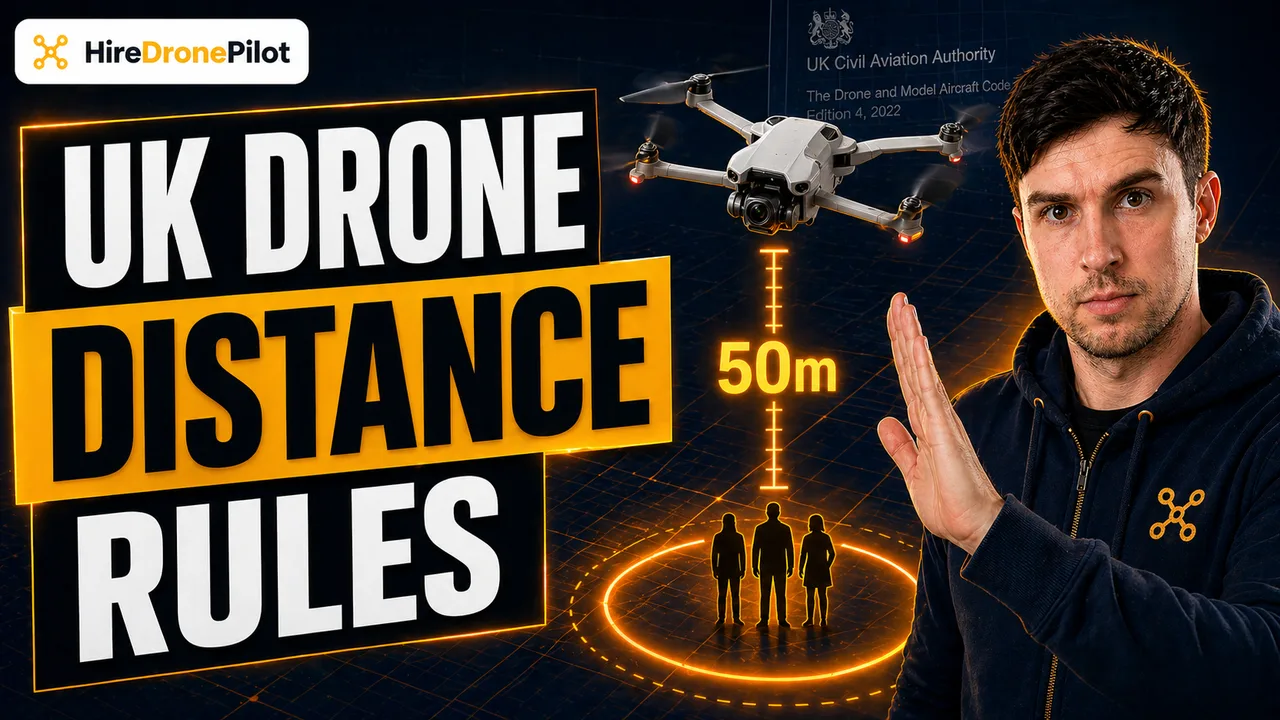
All the Open Category distances still apply. The 50 metre people buffer is unchanged, the 120 metre altitude ceiling is unchanged, and controlled airspace and flight restriction zones remain active twenty-four hours a day.
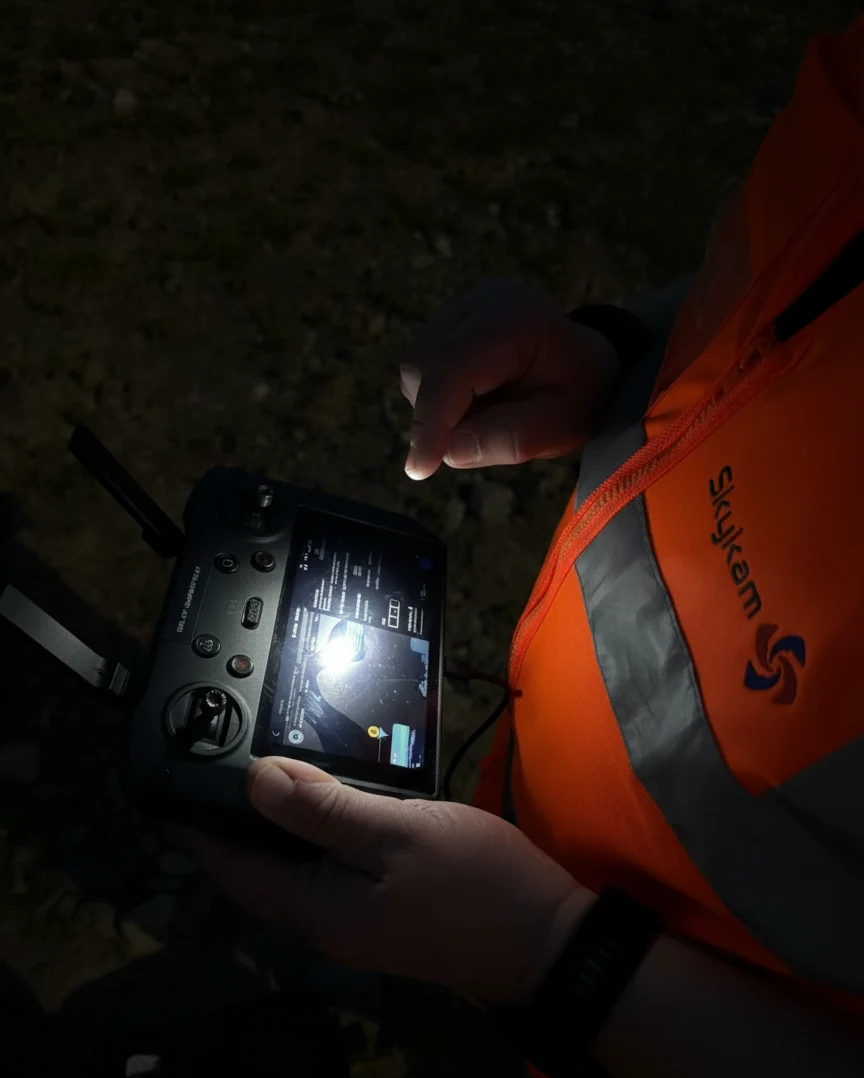
Genuinely dark or long-range night operations usually belong in the Specific Category
There is a point where Open Category night flying stops being sensible. If the site is genuinely dark — unlit countryside, a coastal path with no ambient glow, a rural inspection job — holding VLOS on nothing but a flashing light at any useful distance becomes a stretch, and if the operation involves overflight of people or built-up areas, the Open Category will not cover it either.
That is where the Specific Category comes in. An Operational Authorisation is tailored to the operation, and for night work it will typically require additional lighting, a documented site survey conducted in daylight, specific observer arrangements, and a revised risk assessment in your Operations Manual. A PDRA01 authorisation can cover night flying if you have explicitly included it.
On the pilot qualification side, the GVC covers VLOS Specific Category flying, which is what most professional night work sits inside. Extended operations beyond that step into BVLOS territory and the RPC framework.
Remote ID visibility and the different night airspace picture are the practical risks drone operators underestimate
From 1 January 2026, Remote ID must be activated on every UK1, UK2 and UK3 class drone before flight. Your drone is broadcasting its identity and position whether you are flying at midday or midnight. It is a point worth remembering — night does not equal anonymity, and the police, the CAA, and anyone else with a compatible receiver can pick up the signal.
The more practical risk is that night airspace looks different. Air ambulances, police helicopters and emergency medical flights do a lot of their work after dark, often low and without a scheduled route you can check. Drone Code Rule 17 is blunt about it — if you hear or see a low-flying manned aircraft, reduce height or land immediately. At night you may hear rotor wash before you see anything at all.
The same applies to people. A drone that would read as "somebody taking photos" at noon reads as "what is that thing above my house" at eleven o'clock at night, and complaints tend to follow. A short conversation with neighbours before a residential night flight, or a courtesy call to the local non-emergency police line on 101 for anything unusual, is worth more than any amount of paperwork after the fact.
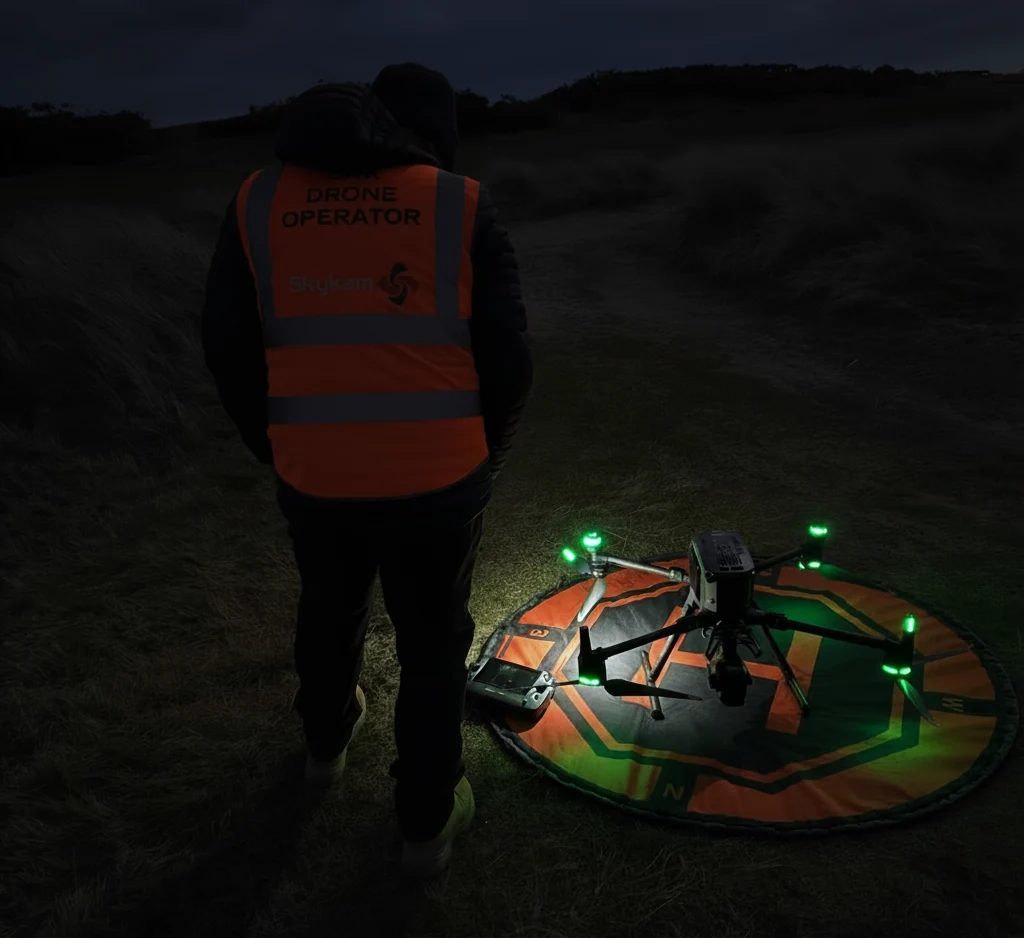
Night flying in the UK is legal, straightforward in principle, and genuinely rewarding when the conditions are right. The green flashing light is mandatory from January 2026, VLOS still applies, and a proper pre-flight in daylight saves you from the power line you forgot about.
Got a specific night scenario you want covered — a coastal job, a residential overflight, a site that edges into the Specific Category? Drop a note to peter@hiredronepilot.uk and I will come back to you directly. If you prefer the video version of this explainer, the comments are open on YouTube.
References
Primary source material for this article is the UK Civil Aviation Authority. External links open in a new tab.
- UK CAA — Flying at Night in the Open Category · green flashing light rule, mandatory from 1 January 2026, Remote Pilot responsibility, UK0/UK4 retrofit
- UK CAA — The Drone and Model Aircraft Code (CAP2320) · Rule 19 on night lighting, Rule 17 on manned aircraft response, VLOS and people-buffer rules
- UK CAA — UK Regulatory Framework for Drones · UK Regulations (EU) 2019/945 and 2019/947, including UAS.OPEN.060(2)(g)
- UK CAA — Remote ID · mandatory activation for UK1/UK2/UK3 from 1 January 2026
- UK CAA — Beyond Visual Line of Sight (BVLOS) · BVLOS requires the Specific Category and an Operational Authorisation
- UK CAA — PDRA01 Operational Authorisation Overview · pre-defined Specific Category authorisation framework and conditions
Peter Leslie
Founder & GVC Drone Pilot
Peter is the founder of HireDronePilot. With thousands of logged commercial flight hours, he writes about drone technology, commercial surveying tactics, and UK aviation compliance.
Connect on LinkedIn