Where Can You Fly the DJI Neo 2 in the UK? (Geo Zones)

Peter Leslie
22 May 2026
Key Takeaways
- The DJI Neo 2 weighs 99 grams and ships with a C0 class mark, so it sits in the friendliest UK sub-category — A1 — and is legal in most everyday locations
- UK law overlays two restricted-airspace systems: Flight Restriction Zones around airports, and bespoke restricted airspace over prisons, royal palaces, military ranges and government buildings
- DJI's own GEO Zone system sits on top of UK law — Restricted, Authorisation, Warning and Altitude Zones can stop the Neo 2 arming even when the airspace is legal
- Use Drone Assist from NATS as the authoritative pre-flight airspace check; the DJI Fly geo-fence is a useful belt but not the legal source of truth
- Endangering an aircraft — for example by flying inside an airport FRZ without permission — carries a maximum sentence of five years in prison under the Air Navigation Order 2016
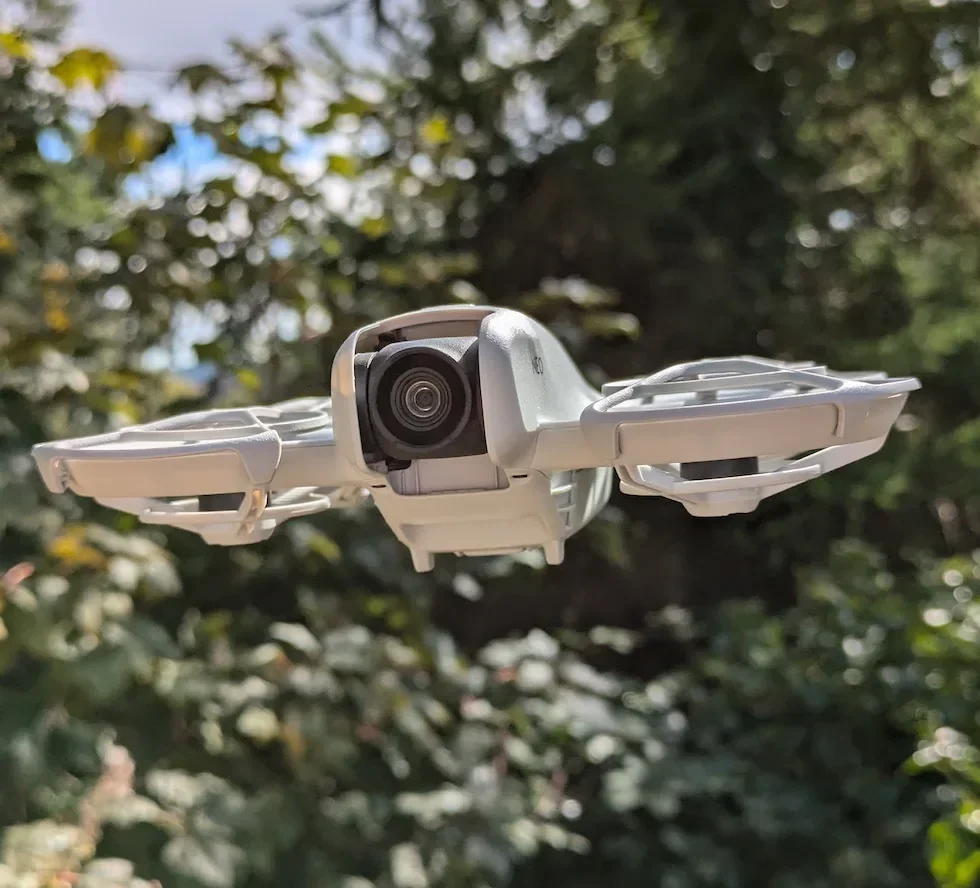
The short answer to where can you fly the DJI Neo 2 in the UK is almost anywhere outdoors, with two big asterisks. The DJI Neo 2 weighs 99 grams, comes with a C0 class mark, and drops straight into the friendliest Open Category sub-category — A1. That gets you legal access to gardens, fields, beaches, permitting parks and open countryside under UK drone law. The asterisks are the airspace restrictions baked into UK regulation and the geo-fence DJI builds into the drone itself. Get either wrong and the consequences scale from "the drone will not take off" all the way to a five-year prison sentence.
This guide separates the two systems — UK law and the DJI GEO Zone overlay — and walks through how a careful drone pilot checks both before every flight of the DJI Neo 2.
The DJI Neo 2 sits under 100 grams and lands in the friendliest UK sub-category
At 99 grams, the DJI Neo 2 is one of the lightest mainstream drones on the UK market. Weight is the lever that decides almost every Open Category rule, and 99 grams puts the Neo 2 firmly inside the A1 sub-category of the Open Category. Under the Where You Can Fly rules, A1 lets you fly closer than 50 metres to people who are not part of the flight, fly over them, and operate in residential, recreational, commercial and industrial areas. You must not fly over crowds, and the 120 metre altitude ceiling still applies.
Because the DJI Neo 2 has a camera and weighs under 250 grams, the registration rules are at the friendlier end too. The Drone Code requires a Flyer ID for anyone flying a 100 gram drone or above, and the DJI Neo 2 sneaks under that threshold by a single gram. The Operator ID rule is the one that catches owners out — any drone with a camera that weighs 100 grams or more needs an Operator ID, and the same registration framework also requires Flyer ID and Operator ID for any drone of 250 grams or above. The DJI Neo 2's 99 gram weight is the deliberate design move that keeps it on the lighter side of both tests. See the DJI Neo registration and 99 gram weight guide for the full breakdown.
In practice that opens up most of the UK. Your own garden is fine. A field with the farmer's permission is fine. A beach with no local by-law banning drones is fine. A public park where the council permits drones — and the list of councils that do is shorter than most people expect — is fine. Open countryside is fine. What turns a "fine" location into an illegal one is almost never the type of place. It is the airspace overhead.
Flight Restriction Zones around airports are the first hard no-fly area you have to check
Most UK airports, airfields and spaceports sit inside a Flight Restriction Zone — an FRZ. Rule 7 of the Drone and Model Aircraft Code is blunt: never fly inside an FRZ without permission. Flying inside one without authorisation can be prosecuted as endangering an aircraft, which carries a maximum sentence of five years in prison.
Typical FRZ dimensions are a 5 kilometre circle around the airport, with 1 kilometre extensions along each runway end. That covers a lot of ground. Heathrow, Manchester, Edinburgh, Birmingham and the rest of the major airports each lock out a substantial chunk of the surrounding suburbs. Smaller airfields without an FRZ are not a free pass either; you must still keep the drone clear of any flying activity, and the safety obligations around manned aircraft do not soften because the airfield is small.
This is the area where the DJI Neo 2's tiny weight buys you nothing. A 99 gram drone climbing into the approach path of a passenger jet is a hazard, and the law treats it the same as a 25 kilogram one. The DJI Neo 2 sits under the same airport FRZ rules as every other drone, despite being well under 250 grams.
Prisons, royal palaces and military ranges sit in their own restricted airspace with bespoke offences
Beyond airports, the Drone Code lists a second category of restricted airspace: areas around prisons, military ranges, royal palaces and government buildings. These are not airport-style FRZs, but they are no-fly zones that overlay specific criminal offences on top of the general drone rules.
Flying a drone over a UK prison is not just a Drone Code breach — it is a separate offence under section 40F of the Prison Act 1952, carrying up to two years inside. The deep-dive on flying a drone over a UK prison walks through how that bespoke offence works in practice. Royal palaces — Buckingham Palace, Windsor, Sandringham — sit inside Restricted Areas under the Air Navigation Order, and the same is true of military ranges and several Crown estates.
National security sites such as the Houses of Parliament, key government buildings and certain critical national infrastructure are protected under standalone legislation as well as the Drone Code. Sites of Special Scientific Interest can carry their own wildlife-disturbance restrictions on top. Treat the entire category the same way you treat an airport: do not take off anywhere near them without checking, and never fly across the boundary even if the DJI Fly app says the drone is happy to arm.
DJI's GEO Zone system layers a separate manufacturer geo-fence on top of UK law
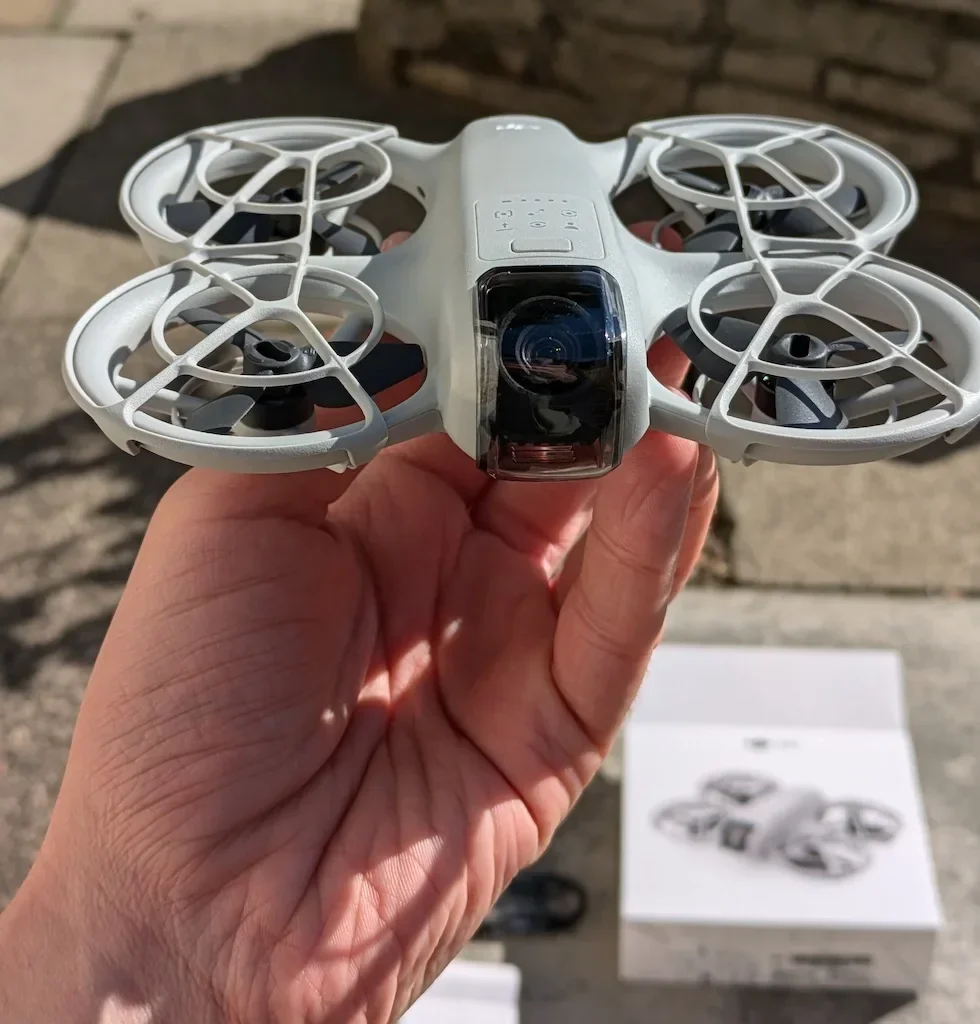
UK law tells you where you are legally allowed to fly. The DJI Fly app's GEO Zone system tells you where the DJI Neo 2 physically will fly. Those two questions overlap a lot but they are not the same question. DJI's geo-fence reflects the manufacturer's interpretation of airspace data, refreshed by firmware updates, and the company's risk appetite is not always identical to the CAA's.
DJI splits GEO Zones into a small number of bands. Restricted Zones stop the DJI Neo 2 from taking off at all without an unlock from DJI — these typically cover airports and security-critical sites. Authorisation Zones require you to log in to a DJI account and confirm a self-unlock prompt before the drone will arm. Warning Zones show an in-app caution that you must acknowledge but do not block the flight. Altitude Zones let you fly but cap the maximum height the DJI Neo 2 will climb to in that location.
The DJI Neo 2 honours all four zone types through the DJI Fly app. If the app blocks you, the drone does not arm. The companion guide on how to unlock a GEO Zone on the DJI Neo 2 covers the Self-Unlock and Custom Unlock flows for the cases where you have the legal right to fly somewhere DJI's geo-fence has flagged. There is more on the underlying mechanism in the geo-fencing explainer.
DJI's geo-fence is not the legal source of truth — the CAA position is what binds you
This is the carve-out that new DJI Neo 2 drone operators get wrong most often. The fact that the DJI Fly app lets the drone take off does not mean the location is legal under UK law. DJI ships its airspace data on its own update cycle. Smaller airfields, short-notice restrictions, temporary NOTAMs around events and incidents, and bespoke restrictions like prison overflights are not all reflected in the app's geo-fence. The drone may happily lift off, climb to 120 metres, and cruise across exactly the airspace that puts you in front of a magistrate.
The CAA's own guidance on geo-awareness systems makes the same point in the regulator's own words: built-in drone software may not always be up to date, and you should always check a separate, authoritative source before flying. Treat the DJI Fly GEO Zone display as a useful belt, not as the braces.
If the DJI Fly geo-fence and an official airspace map disagree, the official map wins every time. The drone takes off; you go to court. That asymmetry is the whole reason you run the separate check.
Drone Assist from NATS is the pre-flight check worth running before every DJI Neo 2 flight
The CAA recommends checking airspace through a dedicated drone safety app before every flight, and the one to start with is Drone Assist, the official app from NATS, the UK's air traffic control provider. Drone Assist pulls live data from authoritative sources, shows FRZs and restricted areas as overlays on a UK map, and lets you tap a postcode or pinpoint a location to confirm whether the airspace is clear. It also surfaces short-notice restrictions through NOTAMs (Notices to Aviation), which are exactly the temporary closures the DJI Fly geo-fence is most likely to miss.
From a drone pilot's perspective the workflow is straightforward. Pick the location the night before. Open Drone Assist, drop a pin, and look for any red, orange or yellow shading. Cross-check the DJI Fly map separately for any GEO Zone overlay that might stop the DJI Neo 2 arming. Watch the take-off site on the day for any local signs of flying activity at smaller fields that may not appear on either map.
If both checks agree the location is clear, you have what the CAA would call a "reasonable diligence" position. If either flags the spot, do not fly. The cost of a wasted trip is the price of staying out of a five-year prison sentence.
Even in clear airspace, you still need the landowner's permission to take off and land
Clear airspace is necessary but not sufficient. The Drone Code is explicit that you must have the permission of the person or organisation that owns the land where you take off and land. That is the bit that quietly rules out most of the UK's public parks. Many local authorities ban drone take-off and landing across all their parks unless you are a permitted commercial operator with insurance and a flight plan. The airspace overhead may be unrestricted; the grass underneath is not.
In practice that leaves a DJI Neo 2 drone operator with a handful of reliable categories of place. Your own garden — covered in the flying a drone in your garden guide. A field where you have the farmer's explicit go-ahead. A public park the council has confirmed allows drones. A beach with no local restriction. Open countryside on land where rights of way or open access apply, again with the landowner's awareness.
London is its own special case — see the London-specific drone rules for the overlap between the Royal Parks ban, the central FRZ around government buildings, and the noise-sensitive zones across the city. Scotland is broadly similar to England with a few local twists set out in the Scotland-specific drone laws guide.
Quick reference for DJI Neo 2 zones, checks and consequences
| Zone or area | Source | Effect on the DJI Neo 2 |
|---|---|---|
| Airport FRZ (5 km + 1 km runway extensions) | UK CAA / Air Navigation Order | No-fly without ATC permission. Up to 5 years for endangering an aircraft. |
| Prison overflight | Prison Act 1952 s.40F | No-fly. Bespoke offence, up to 2 years in prison. |
| Royal palace, military range, government building | Restricted airspace | No-fly without authorisation. Multiple bespoke offences may apply. |
| DJI Restricted Zone | DJI geo-fence | DJI Neo 2 will not arm without a DJI unlock. |
| DJI Authorisation Zone | DJI geo-fence | Self-Unlock through DJI account required before take-off. |
| DJI Warning / Altitude Zone | DJI geo-fence | In-app caution or capped altitude. Drone still flies. |
| Open countryside, garden, permitting park | Open Category A1 | Legal with landowner permission and the standard 120-metre cap. |
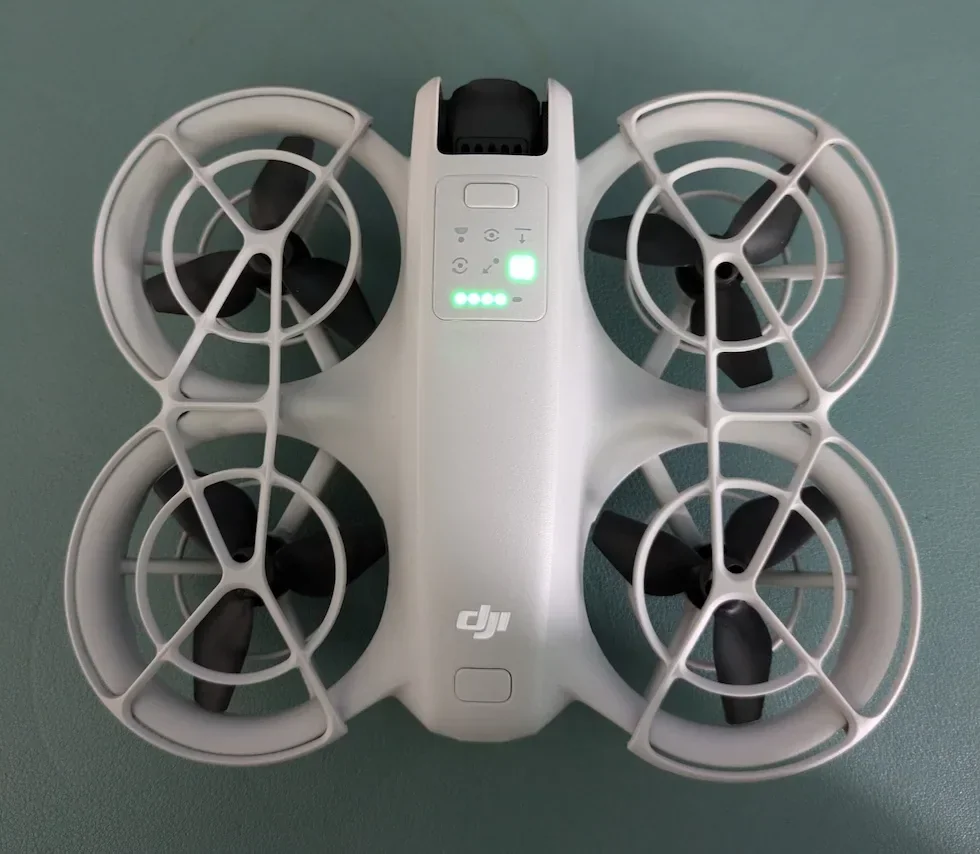
So where can you fly the DJI Neo 2 in the UK? Almost anywhere outdoors — open countryside, gardens, permitting parks and beaches — provided you stay outside airport FRZs, away from prisons, royal palaces and military ranges, under the 120-metre ceiling, and within visual line of sight. The job before every flight is two checks, not one: a UK airspace check using Drone Assist from NATS, and a separate look at the DJI Fly map for GEO Zone overlays that might stop the drone arming. If both clear, fly. If either flags the spot, find another.
If your check spots a temporary restriction you did not expect, the caught flying a drone illegally guide walks through how breaches actually get prosecuted in practice, and the drone insurance requirements piece covers what your cover does — and does not — do when the flight goes wrong.
Got a specific take-off site you want me to sense-check — a coastal village, a town park, a borderline FRZ edge? Drop a note to peter@hiredronepilot.uk and I will come back to you directly. If you prefer the video version of this explainer, the comments are open on YouTube.
References
Primary source material for this article is the UK Civil Aviation Authority and the official DJI Neo 2 user manual. External links open in a new tab.
- UK CAA — The Drone and Model Aircraft Code (CAP2320) · Rule 7 (FRZ no-fly), Rule 8 (restricted-airspace categories), penalties
- UK CAA — Where You Can Fly (A1, A2, A3 sub-categories) · A1 sub-category that covers the DJI Neo 2
- UK CAA — UK Regulatory Framework for Drones · Air Navigation Order 2016 and UK Regulations (EU) 2019/945 and 2019/947
- NATS — Drone Safe UK and the Drone Assist app · Authoritative UK airspace map and pre-flight check tool
- DJI — Fly Safe GEO Zone map and unlock policy · Restricted, Authorisation, Warning and Altitude Zone definitions
Peter Leslie
Founder & GVC Drone Pilot
Peter is the founder of HireDronePilot. With thousands of logged commercial flight hours, he writes about drone technology, commercial surveying tactics, and UK aviation compliance.
Connect on LinkedIn