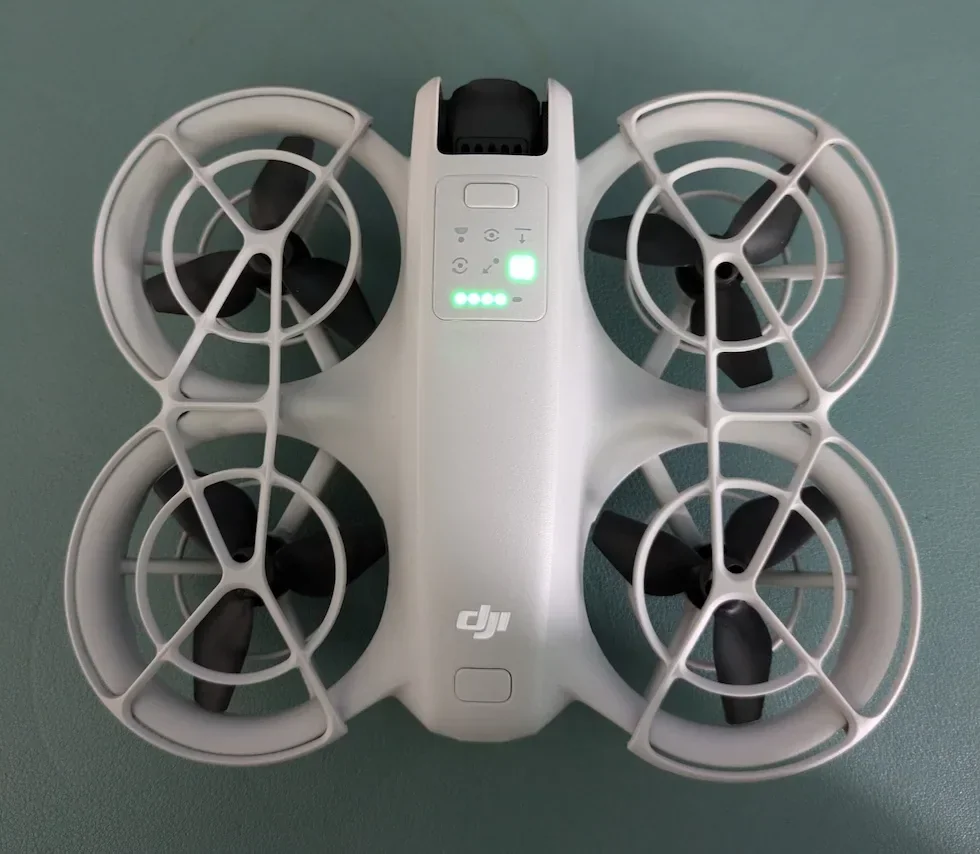
How to Charge the DJI Neo 2

Peter Leslie
22 May 2026
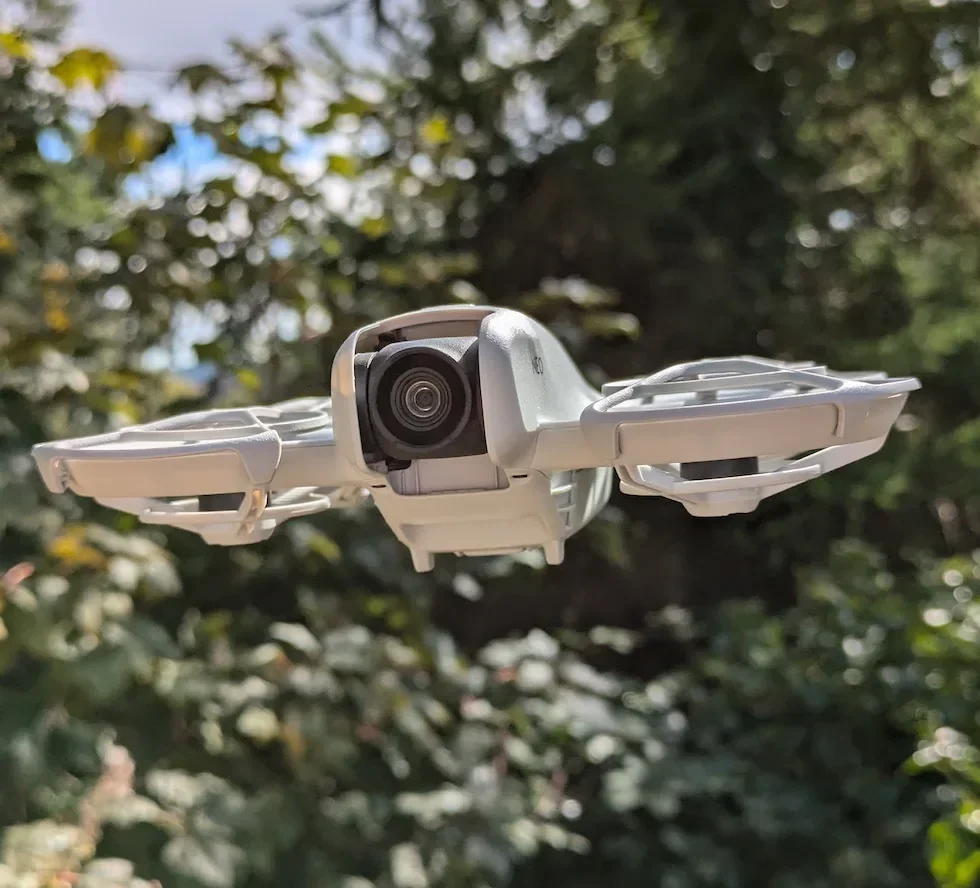
If you have just unboxed the DJI Neo 2 and noticed there is no wall brick in the box, the charger you already use for a recent phone or laptop almost certainly works. The pack charges over USB-C Power Delivery from any brick that delivers at least 15 watts. You might leave a 65W charger on the Charging Hub to fill three batteries in parallel, or use a slower phone charger to top a single pack up before a flight — the cells accept both as long as the temperature sits in the right window.
Most drone pilots get the click path right on the first attempt, then trip on the temperature rule. Land a hot pack straight onto a charger and the battery refuses to charge until it cools — that is a protection feature, not a fault.
Quick guide
To charge the DJI Neo 2, plug a USB-C Power Delivery charger of 15W or higher into the USB-C port on top of the battery, or into the back of the Charging Hub for the three-pack workflow. A single pack fills in roughly 50 minutes on a sufficient charger; the Hub needs 65W or more in to charge three batteries together.
Step-by-step: How to Charge the DJI Neo 2
Follow these top to bottom the first time, and you will know the path off by heart the second time.
Land the DJI Neo 2 and pull the battery out of the drone
Land the drone, power it down, then press the latch on the back of the battery compartment and slide the pack out. The cells cannot charge while the battery is installed in a powered-on drone, and the safest workflow is to charge the pack out of the airframe on a flat surface.
Wait for the battery to cool into the 5 to 40 degrees Celsius window
A pack straight off a flight is too hot to charge — the cells refuse current outside 5 to 40 degrees Celsius. Sit the battery on a flat surface for five to ten minutes until it feels cool to the back of your hand. The ideal charging window is 22 to 28 degrees Celsius, and charging in that range gets the cells to 100 per cent quicker.
Pick a USB-C Power Delivery charger rated 15W or higher
Any USB-C PD adapter that delivers at least 15 watts (5 volts at 3 amps) works — a recent phone charger, a USB-C laptop brick, or DJI's own 65W USB-C Power Adapter. Higher-wattage chargers do not damage the cell; the pack only pulls what it needs. The win at 65W is unlocking the Charging Hub's three-pack workflow.
Plug the USB-C cable into the port on top of the DJI Neo 2 battery
The USB-C port sits on the top edge of the pack, between the battery LEDs. Plug a USB-C to USB-C cable rated for Power Delivery into that port, with the other end in the wall brick. The same USB-C port handles charging the drone when the battery is paired with a laptop, so a known-good cable is worth keeping.
Watch the four battery LEDs to track the charge level
One LED blinking is 0 to 50 per cent. Two blinking is 51 to 75. Three blinking is 76 to 99. Four solid LEDs — no blinking at all — means the pack is at 100 per cent and ready to fly. If the LEDs are blinking slowly when you expect fast charging, the cable or the brick is dropping current; a higher-rated cable usually fixes it.
Slot multiple batteries into the Charging Hub for the parallel workflow
If you own the Charging Hub, push each battery into the Hub's battery ports until you hear a click. The Hub takes up to three packs at once and shares the USB-C input across them, sequencing or paralleling depending on the input wattage. Place the Hub on a flat, well-ventilated surface — the cells charge faster in moving air at around 25 degrees Celsius.
Plug a 65W or higher USB-C PD charger into the back of the Charging Hub
The Hub has a "≥65W" marking printed beside its USB-C input for a reason — at 65 watts or more it charges all three packs in parallel rather than working through them in sequence. A lower-wattage brick still works, it just slows the workflow down to one or two packs at a time.
Read the Charging Hub status LED for the state of the whole stack
The small status light beside the Hub's USB-C port tells a different story to the LEDs on each pack. Pulsing green means it is charging. Solid green means every pack is full or the Hub is supplying power to an external device. Blinking yellow means at least one pack is outside the temperature window. Solid red is a fault — pull the packs and reseat everything before you re-plug the charger.
Wait for four solid LEDs on each pack before you call it done
A pack with three LEDs solid and one blinking is still on the way up. The drone is only at 100 per cent when all four LEDs sit solid and the Hub's status LED has gone solid green. Plan on roughly 50 minutes for a single pack on a sufficient charger; allow longer in the cold or on a slower brick.
Peter's tip
I keep three packs in rotation on a 65W laptop brick and the Charging Hub between flights, and a small 30W phone brick in the car for top-ups on the way to a job. The cheap brick is the difference between landing at 30 per cent on the last pack and turning the car around — but it is the Hub plus 65W that gets me three full batteries back to back without me sitting next to the desk.
| Charging method | Speed and capacity | Best for |
|---|---|---|
| Single battery on a 15 to 30W USB-C PD brick | One pack in roughly 50 to 90 minutes depending on charger wattage and ambient temperature | A second pack between flights, top-ups in the car, light hobbyist use |
| Charging Hub on a 65W USB-C PD adapter | Up to three packs in parallel after the Hub levels the lower packs, all four LEDs solid on each pack when done | Paid jobs, full session days, anyone flying more than two packs back to back |
Frequently asked questions
How long does the DJI Neo 2 battery take to charge?
Plan on roughly 50 minutes to fully charge a single DJI Neo 2 battery from empty on a USB-C Power Delivery charger that supplies sufficient wattage. A 15 to 18 watt phone brick will stretch closer to an hour and a half because the cell can only pull the current the charger is willing to deliver. Charging is also faster in a well-ventilated environment at around 25 degrees Celsius.
Do I need the DJI 65W charger to charge the DJI Neo 2?
No. Any USB-C Power Delivery charger of 15 watts or higher (5 volts at 3 amps) will charge the DJI Neo 2 battery. The DJI 65W USB-C Power Adapter is the recommended pairing for the Charging Hub because the Hub needs at least 65 watts in to charge three batteries simultaneously, but any compliant 65W USB-C PD laptop charger does the same job.
How does the DJI Neo 2 Charging Hub decide whether to charge one battery or three at once?
The Hub stages packs based on the wattage of the input charger. At 30 watts or less it charges in sequence from highest to lowest battery level, one pack at a time. Between 30 and 45 watts it levels the lower pack up to the highest then charges two batteries together. Above 45 watts it levels the two lower packs up to the highest then charges all three together — which is why a 65W input is the published target.
What is the safe charging temperature for the DJI Neo 2 battery?
The DJI Neo 2 battery only charges when the cell temperature is between 5 and 40 degrees Celsius (41 to 104 degrees Fahrenheit). The ideal range — fastest charge and longest cell life — is 22 to 28 degrees Celsius. Charging stops automatically if the cells exceed 55 degrees Celsius during the charge. Never plug a hot battery in straight off a flight; let it cool for five to ten minutes first. The same temperature rules sit behind the question of whether you can charge a drone battery overnight safely.
Can I fly the DJI Neo 2 while it is charging?
No. The DJI Neo 2 battery will not charge while the drone is powered on, and the pack has to be in the drone or in the Charging Hub to charge — there is no way to fly and charge at the same time. Land, power the drone off, then plug the USB-C charger into the battery directly or into the Hub.
What do the LEDs mean if the DJI Neo 2 battery will not charge?
The four battery LEDs double as fault codes. LED 4 blinking twice per second means the cells are below 5 degrees Celsius; three times per second means they are above 40 degrees Celsius. LED 2 or 3 blinking at the same rates signals over-current, short circuit, overcharge or over-voltage charger. Unplug, wait for the pack to come back to room temperature, then plug back in. Four LEDs blinking simultaneously is the only pattern that means the battery itself is damaged — retire that pack.
Can I use the DJI Neo 2 Charging Hub as a power bank?
Yes. Insert one or more batteries into the Hub, connect an external device such as a phone or the remote controller to the Hub USB-C port, then press the function button. The status LED turns solid green and the Hub discharges the lowest-power battery first, then works through the rest. Packs below 5 per cent cannot push charge to external devices.
How often should I fully charge the DJI Neo 2 battery if I am not flying for a while?
Fully charge the pack at least once every three months to maintain cell health. A battery that sits unused and uncharged for more than three months risks permanent capacity loss and falls outside the DJI warranty. For day-to-day storage between flights, the recommended state of charge sits well below 100 — see the long-term battery storage guide for the exact figure.
Charging the DJI Neo 2 is more straightforward than it looks once you treat the drone as a USB-C PD device with a smart battery. The 65W charger pays for itself the first time you put three packs on the Hub at once; for one or two packs a recent laptop brick gets the job done with no fuss. Pair that with the Battery Info diagnostic check before each session and the charging routine becomes the easiest part of owning this drone.
If you are wrestling with a specific charger that the Neo 2 will not play with, or a Hub status LED that will not settle, drop the details to peter@hiredronepilot.uk and I will come back to you directly. The video version of this walkthrough is on YouTube and the comments are open.
References
Primary source material for this article is the official DJI Neo 2 documentation. External links open in a new tab.
- DJI Neo 2 — User Manual (v1.2, December 2025) · §4.7 Intelligent Flight Battery — charger requirements, Charging Hub power-staging table, LED patterns and battery protection mechanisms.
- DJI Neo 2 — Specifications (UK) · Battery capacity, supported charger ratings and operating temperature figures.
- DJI Neo 2 — Product page (65W USB-C Power Adapter and Portable Charger accessories) · Optional charging accessories listed by DJI for the Neo 2.
Peter Leslie
Founder & GVC Drone Pilot
Peter is the founder of HireDronePilot. With thousands of logged commercial flight hours, he writes about drone technology, commercial surveying tactics, and UK aviation compliance.
Connect on LinkedIn