Quietest Drone UK 2026: What Your Neighbours Actually Hear

Peter Leslie
31 July 2026 · 16 min read
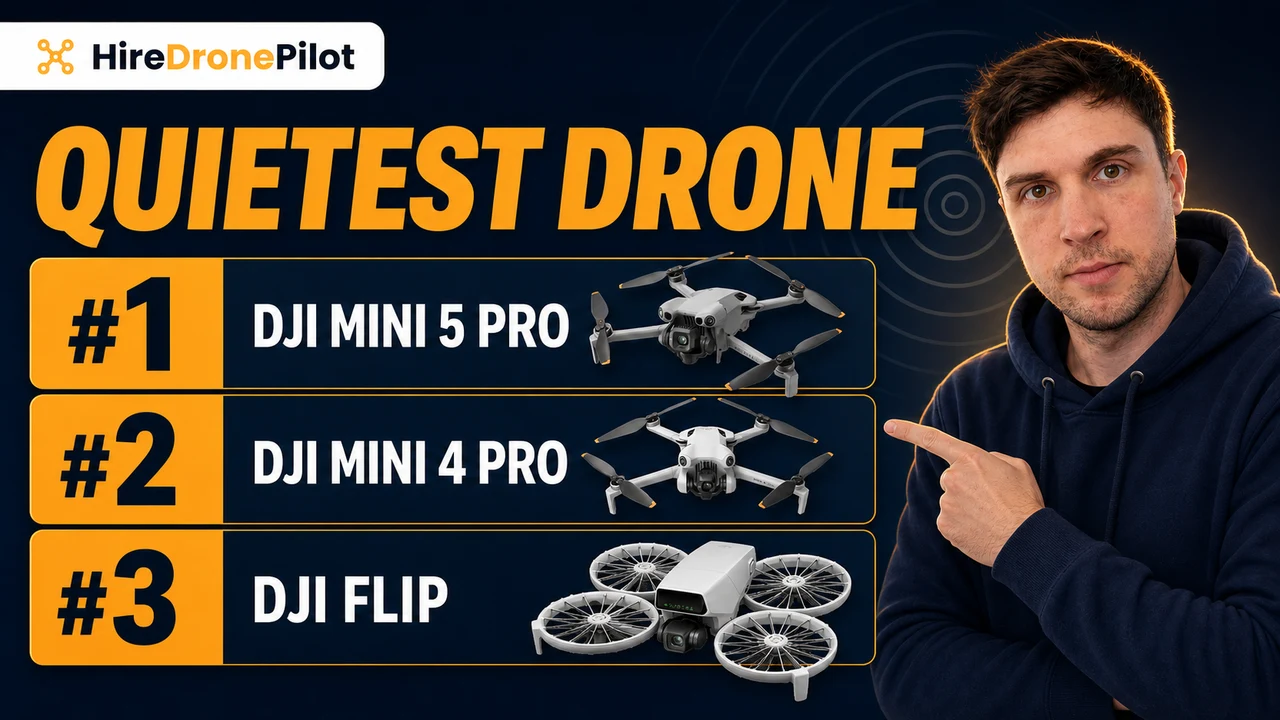
Nobody arrives at this question casually. You are here because a neighbour has said something, or because you have watched a field of sheep move as one, or because you already own a drone and have started leaving it in the bag.
So let me deal with the thing you came for straight away. There is no decibel figure you can look up and compare. Not because nobody has measured it — because the one number UK law actually requires is a figure with no distance in it, and the drones most people want to buy are legally exempt from publishing even that.
Which turns the question into something more useful. The quietest drone in 2026 is not the one with the lowest number on a spec sheet. It is the one that puts the least sound where a person is standing — and that is decided by how much the drone weighs, how far away you can afford to be, and how long you stay up there.
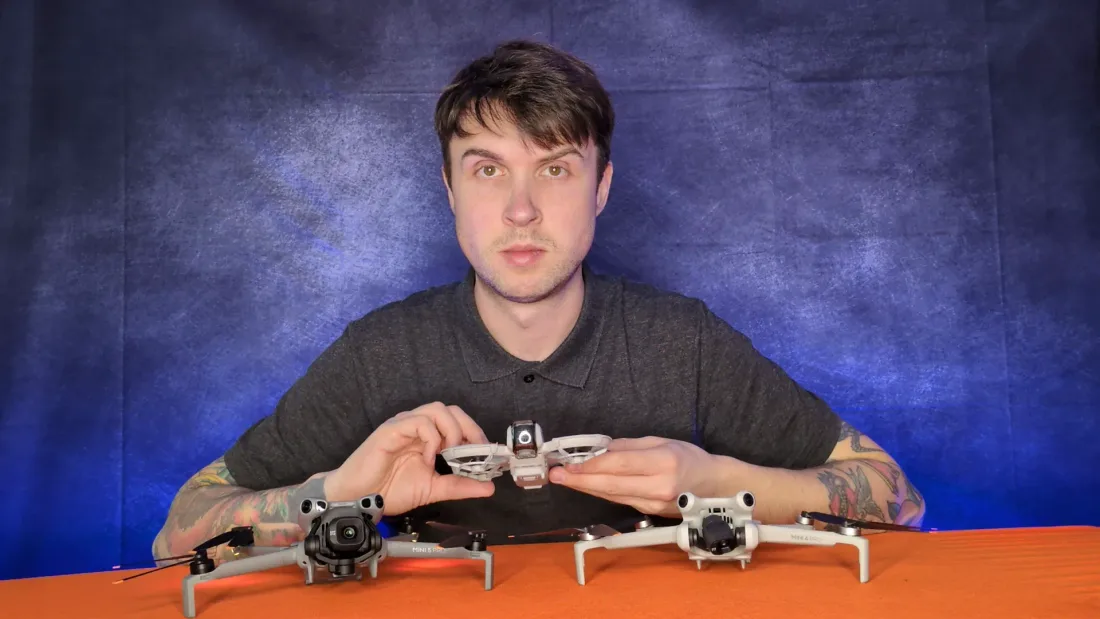
I have flown every DJI drone on this page. The gap between the loudest and the quietest of them, stood next to them on the ground, is real but smaller than you would guess. The gap between the same drone at twenty metres and at eighty is enormous, and it is free.
So this guide does three things. It asks four questions about who the noise is actually a problem for, and narrows twelve drones to the one that fits. Then it explains what a decibel figure hides, so you can read the ones you find elsewhere properly. Then it shows you the one noise figure the law does require, which drones have to carry it, and why the answer is the exact opposite of what everyone assumes.
How I get paid: the Amazon links below are affiliate links, so if you buy through one I earn a small commission at no extra cost to you. It does not change what I recommend — one of the twelve has no affiliate link at all, and I spend a fair part of this article telling you that the free fix beats the paid one.
The Quietest Drone in 2026, Where It Counts, Is the DJI Mini 5 Pro
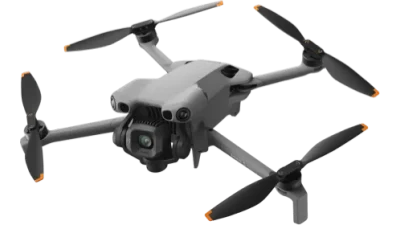
Lighter drones make less noise. This one buys you something better: the distance to stop being heard at all.
- Stays under 250 grams, so it needs no test and no licence — just a £12.34 registration you do online.
- A 1-inch, 50-megapixel camera, so the shot you would take from thirty metres you can take from eighty and crop in.
- Sound drops about six decibels each time you double your distance. Eighty metres instead of twenty is roughly twelve decibels the drone never has to be quieter by.
- 36 minutes on the standard battery. Not a reason to use all of them — the shortest flight is always the quietest one.
- The catch: at 249.9 grams it is the heaviest sub-250 drone here, so up close it is not the quietest of them. It is the one that never has to be up close.
Affiliate link · costs you nothing extra · full disclosure
PART ONE
Here are the five that win their categories outright. Each one carries what is wrong with it, because on this subject in particular nothing is clean — every drone here trades noise for something.
Quietest Drone at the Source: DJI Neo
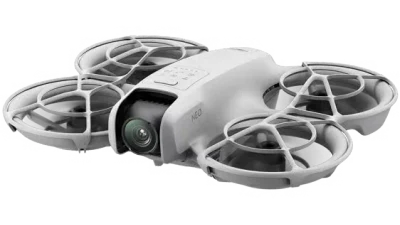
135 grams. Every other drone here is asking its propellers to hold up more.
- The least weight on the page, and weight is the first term in the noise.
- Palm launch and palm catch, so flights are naturally short.
- The catch: a 12-megapixel 1/2-inch camera with no room to crop, so it has to be near what it films.
Quietest Drone for a Back Garden: DJI Neo 2
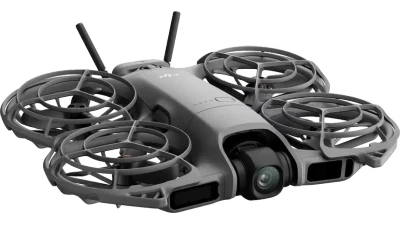
When you cannot buy distance, buy brevity. This one is up and down before anybody has finished looking out of the window.
- 151 grams, or 160 with the transceiver, and it takes off from your hand with no set-up.
- Obstacle sensing all round, which is what makes a confined garden flight sensible at all.
- The catch: those ducted guards give it a higher, harder note than an open propeller, and cost two minutes of flight.
Quietest Drone Across a Park: DJI Mini 4 Pro
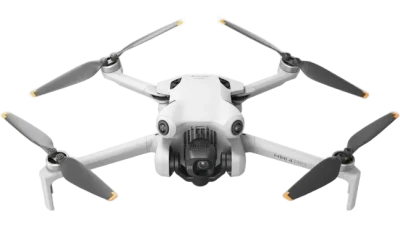
Fifty metres is the awkward distance. Too far for a palm-launch drone to be any use, too close to justify a telephoto and a qualification.
- 48 megapixels on a 1/1.3-inch sensor, so you can stand at fifty metres and crop back to the frame you would have flown to twenty-five for — one doubling, about six decibels.
- Obstacle sensing in every direction, which is what lets you sit high and well back rather than creeping in low to keep it out of trouble.
- Under 250 grams and C0 marked, so no test now and, unlike the Air 3S below, no January 2028 change coming.
- The catch: a crop is not a lens. Push past sixty metres and you are enlarging detail that was never recorded, which is the point where a real 70 mm lens starts to win.
Quietest Drone for Staying Far Back: DJI Air 3S
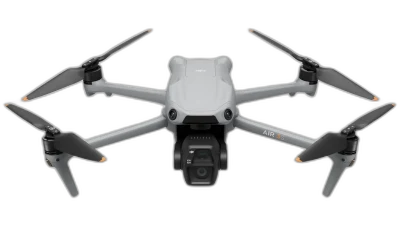
A real 70 mm lens is the cheapest distance you can buy, and distance is worth more than any propeller.
- Two real focal lengths, 24 mm and 70 mm, so you can frame tight from twice as far away.
- The only drone here DJI makes a set of Low-Noise Propellers for.
- The catch: 724 grams, and from January 2028 it needs the A2 test to fly near people.
Quietest Drone for Paid Work: DJI Mavic 4 Pro
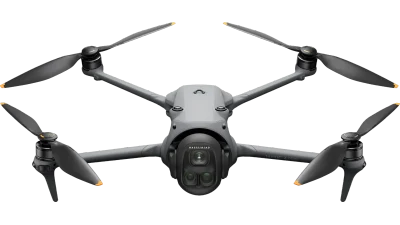
Loudest on the bench, least noticed on the job. One high pass with a long lens beats twenty minutes of a small drone hunting for the shot.
- A 168 mm equivalent lens, so it gets the frame without ever coming close.
- C2 marked, so it has to carry a guaranteed A-weighted sound power figure — a number most of this page never has to publish.
- The catch: 1,063 grams and an A2 Certificate of Competence before you can fly it near anybody.
Affiliate links · costs you nothing extra · full disclosure
Take the quiz: find the quietest drone for your particular problem
“Quiet” means something different in a back garden than it does over a river. Four questions sorts it.
- Matched to who the noise is actually bothering, not a generic top ten.
- Twelve drones ranked by take-off weight, which is what sets the noise.
- Tells you where each one stops being the answer, and why.
- About 20 seconds, and no email needed.
STEP 1 OF 4
12 of 12 still fit
All twelve, lightest first, and where each one stops being quiet
-
DJI Neo
135 g · C0 · 1/2″ 12MP · 18 min · no test needed
The least weight on this page by a clear margin, and weight is what sets how hard the propellers have to work. It is also a very small camera, and it knows it.
- No test and no licence — just a £12.34 registration you do online.
- 135 grams is the lightest here, and less weight means less thrust, which means less noise.
- You throw it off your palm and catch it again, so most flights are over in well under a minute.
- No obstacle sensing — DJI only added that on the Neo 2 — so it wants open space around it.
-
DJI Neo 2
151 g · C0 · 1/2″ 12MP · 19 min · no test needed
Palm launch, forty seconds of orbit, back in your hand. The ducted guards it flies with give it a harder, higher note than an open propeller of the same size.
- No test and no licence — just a £12.34 registration you do online.
- 151 grams, or 160 with the transceiver fitted. Second lightest here.
- DJI quotes 19 minutes, or 17 with the propeller guards on — the guards cost you flight time and add a sharper note.
-
HOVERAir X1 PROMAX
192 g · C0 · 8K · 16 min · no test needed
The one I would look at if I wanted a flying camera that behaves like an action camera. Sixteen minutes is the shortest flight time here, which for a noise problem is much less of a drawback than it looks.
- No test and no licence — just a £12.34 registration you do online.
- 192 grams, and HOVERAir marks it C0, so it has no obligation to publish a noise figure either.
- Sixteen minutes a battery. Short flights are quiet flights, so I count that as a feature here.
-
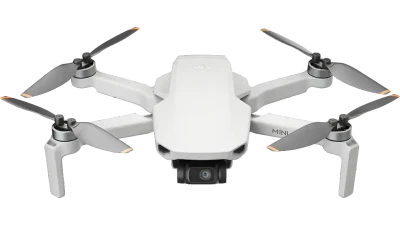
DJI Mini 4K DJI UK no longer lists it
246 g · 1/2.3″ 12MP · 31 min
The cheapest folding drone that still ducks under the 250-gram line. A lovely first drone and a genuinely poor camera, which here means you will be tempted to fly it closer than you should.
- No test and no licence — just a £12.34 registration you do online.
- 246 grams, which is under the line, and a folding airframe with open propellers.
- DJI no longer lists it in the UK, so you are buying up remaining stock.
-
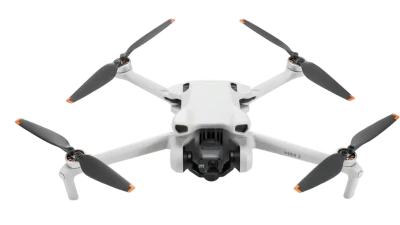
DJI Mini 3
248 g · C0 · 1/1.3″ 48MP · 38 min · no test needed
The longest-flying sub-250-gram drone here on its standard battery, at 38 minutes. For a noise problem that is a reason to buy it and a reason to be careful with it.
- No test and no licence — just a £12.34 registration you do online.
- 248 grams, and 38 minutes on the standard battery — the longest here without going over the line.
- The link points at the version with DJI’s own screen controller, not the bare drone — check which one you are looking at before you buy.
-
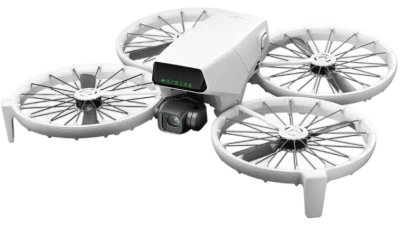
DJI Flip
<249 g · C0 · 1/1.3″ 48MP · 31 min · no test needed
Full propeller cages, which is why I would hand it to a nervous beginner — and why it is not the quietest 249 grams you can buy. A cage is one more surface for the blade wake to hit.
- No test and no licence — just a £12.34 registration you do online.
- The same class of camera as the Mini 4 Pro (1/1.3-inch, 48 megapixels) in a caged airframe.
- The cages make it the safest thing here to fly indoors, and slightly the noisiest of the small ones.
-
DJI Mini 4 Pro
<249 g · C0 · 1/1.3″ 48MP · 34 min · no test needed
Obstacle sensing in every direction, which matters more than it sounds when your plan is to sit high and far back rather than close and low.
- No test and no licence — just a £12.34 registration you do online.
- 48 megapixels on a 1/1.3-inch sensor, so there is real crop room to trade for distance.
- 34 minutes on the standard battery. DJI does not sell the bigger one in Europe.
-
DJI Mini 5 Pro
249.9 g · C0 · 1″ 50MP · 36 min · no test needed
A one-inch sensor under the 250-gram line. It is the drone that lets you take from eighty metres the shot everything else here has to come to thirty metres for.
- No test and no licence — just a £12.34 registration you do online.
- A 1-inch, 50-megapixel camera, which is how you buy distance: shoot wide from far away and crop.
- 36 minutes on the standard battery. DJI advertises 52, but only with the bigger battery that pushes it over 249 g.
-
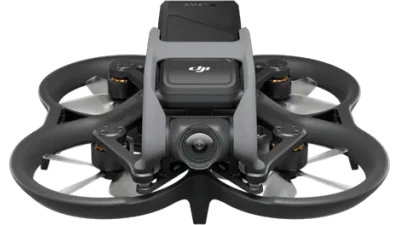
DJI Avata 2 loses privileges in 2028
377 g · C1 · 1/1.3″ 12MP · 23 min · observer required
The most fun on this page and the worst thing you could possibly fly near somebody who has already complained. It is flown on the throttle, so the noise surges and drops with every input.
- The law requires a second person watching the drone whenever you fly it through goggles.
- Ducted propellers held at high revolutions, and a flying style built on throttle changes. Noise that varies is noise people notice.
- From January 2028 it needs the A2 test to fly near people — one of only two here that lose that freedom.
-
DJI Air 3S loses privileges in 2028
724 g · C1 · 1″ 50MP + 70 mm tele · 45 min
The cheapest real telephoto lens that flies, which is the most direct way there is to buy distance. It is also the cheapest drone here that has to carry a printed sound power figure.
- A genuine 70 mm equivalent second lens, so you can frame tight from a long way back.
- 724 grams and C1 marked, so it carries a guaranteed sound power figure that nothing lighter here has to publish.
- No test needed today, but from January 2028 it needs the A2 to fly near people. You are buying about eighteen months of that freedom.
-
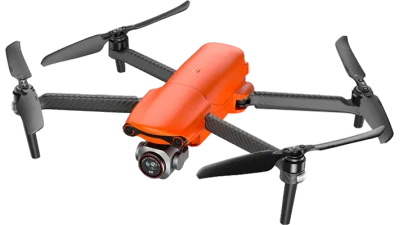
Autel EVO Lite+ no affiliate link — I could not find UK stock
835 g · legacy, no class mark · 1″ 20MP · 40 min
Here so nobody can call this a DJI catalogue. For a noise problem it is the worst of both worlds: heavy enough to be heard, and old enough that Autel no longer serves a specification page I can read.
no link- Needs the A2 test to fly near people, because at 835 grams with no class mark it falls back on weight alone.
- No class mark means no obligation to publish a sound power figure either, despite being one of the heaviest here.
- I could not find UK stock, so there is no buy link for it.
-
DJI Mavic 4 Pro
1,063 g · C2 · Four Thirds 100MP + 70 and 168 mm tele · 51 min
The heaviest drone here, and flown properly the one people are least likely to notice. A 168 mm equivalent lens means it never has any reason to come close.
- Needs the A2 test to fly near people.
- Three lenses, out to a 168 mm equivalent, so it can frame a roof or a bird from further away than anything else here.
- C2 marked, so it must carry a guaranteed A-weighted sound power figure on the drone or its box.
Ordered by take-off weight, lightest first, because that is what actually sets the noise. Every link points at a specific configuration rather than at the cheapest listing with that name on it — the Mini 3 link includes DJI’s screen controller, and the Avata 2 link includes the goggles it cannot legally or practically fly without. Check what is in the box on the listing before you buy, because the same drone name covers several bundles. Weights, flight times and class marks from manufacturer specification pages, except the Mini 4K and the EVO Lite+, which are from DroneCompare, CC BY 4.0.
PART TWO
Why drones are loud, and what a dB figure hides
You have narrowed the field. Now the part that will let you read every other noise claim on the internet properly — including the ones on this site.
A multirotor is loud for a reason it cannot design away
A drone holds itself up by throwing air downwards. That is the whole mechanism. There is no wing doing the work for free, no forward speed generating lift — four small propellers are physically hurling air at the ground hard enough to cancel gravity, continuously, for the entire flight.
Two things follow, and they are the whole of drone acoustics.
First, weight sets the floor. A 1,063-gram Mavic 4 Pro has to generate roughly eight times as much lift as a 135-gram Neo, continuously, for as long as it is airborne. There is no clever engineering that gets you out of that. It is why this article’s list is ordered by take-off weight rather than by price, and why the ordering does most of the work.
Second, small propellers pay for that thrust with speed. A big, slow propeller and a small, fast one can produce the same lift, but the small one has to turn its blade tips much faster to do it — and the sound a propeller makes climbs extraordinarily steeply with tip speed. That is the compromise a mini drone makes: it is light, which helps, but it holds itself up on three-inch blades spinning very fast, which does not. The sound comes out higher-pitched and thinner, more angle-grinder than lawnmower.
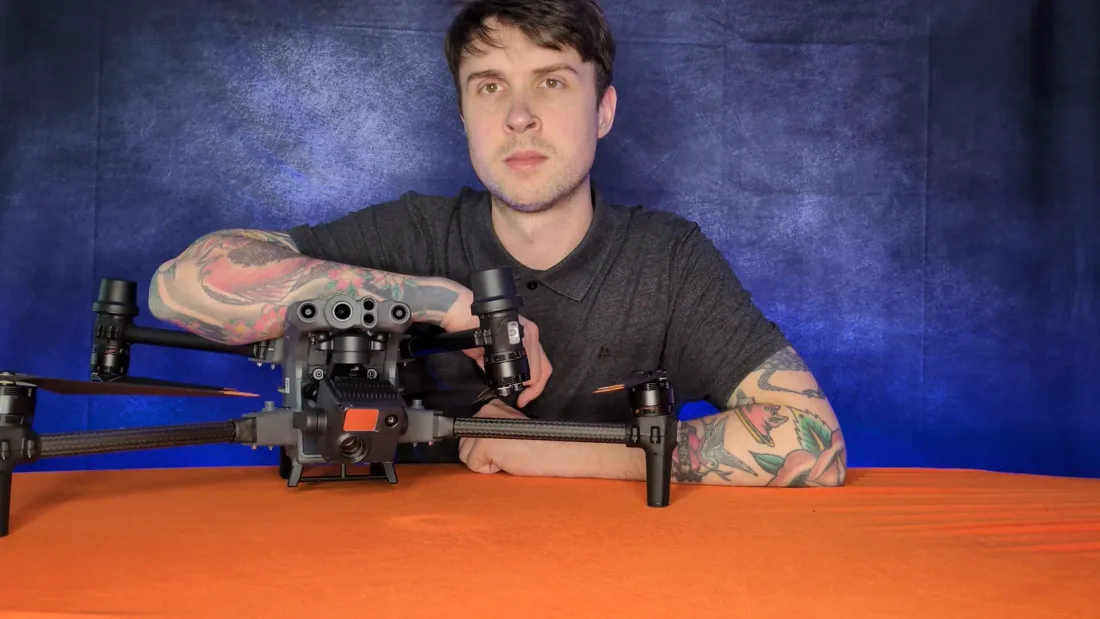
This is the enterprise drone I fly for survey work. Its propellers are longer than my forearm and they turn slowly. It is unambiguously louder than a Mini 5 Pro — and it is a deeper, duller, more distant sound, because most of its energy is down at frequencies your ear is less sensitive to. Two drones can measure the same and feel nothing alike.
What a decibel figure hides, in five parts
Here is the honest problem with every noise number you will find on a drone. Not one of them is wrong. They just each leave out something that changes the answer.
FIVE THINGS A SINGLE dB NUMBER LEAVES OUT
1. Distance — and it is usually not stated
Sound falls by roughly six decibels every time the distance from the source doubles. A drone measured at 85 dB from two metres is in the region of 67 dB at sixteen. A figure quoted without its distance is not a specification, it is a noise.
2. Power versus pressure
The only figure UK law requires is a sound power level. Sound power is a property of the source, like the wattage of a bulb — there is no distance in it at all. It cannot tell you what anybody hears. Everything you actually experience is sound pressure, which depends entirely on where you are stood.
3. Weighting — the “A” in dB(A)
Almost every published figure is A-weighted: a filter that discounts low frequencies because the ear is less sensitive to them at quiet levels. It is the right tool most of the time. But it systematically under-counts the low rumble of a big drone and flatters nothing about the whine of a small one.
4. Duration
A peak level says nothing about how long it went on. A forty-second palm-launch orbit and a twenty-five-minute hover can hit the identical number and be entirely different events to the person underneath. Complaints track duration far more closely than they track level.
5. Character — and this one is measured
NASA Langley ran a listening test putting recorded drones against recorded road vehicles. Road vehicles were judged consistently less annoying than drones carrying the same measured noise — by 5.6 dB on A-weighted sound exposure level and 7.6 dB on the metric international regulators use to certify airliners for community noise. Whatever it is about a drone that irritates people, the standard metrics do not capture it.
Point five is from Christian & Cabell, Initial Investigation into the Psychoacoustic Properties of Small Unmanned Aerial System Noise, NASA Langley Research Center, 2017.
That last one deserves a moment, because it is the single most useful fact on this page. A drone gets a roughly six-decibel penalty for simply being a drone. If you stood a drone and a van next to each other and got a sound meter to agree they were equally loud, your neighbour would still find the drone worse — by about as much as you would gain from doubling your distance from it.
Which reframes the whole question. You cannot argue with somebody about the reading on a meter, because their objection was never really to the reading.
Propeller design changes noise more than motor size does
The motors themselves are nearly silent. Brushless motors on a modern drone contribute a faint electrical whirr and almost nothing else. Essentially everything you hear is aerodynamic: blades cutting air, blade tips shedding vortices, and each blade passing through the disturbed wake the blade in front of it left behind.
That is why propellers are where the engineering happens, and why a propeller swap is the only component change that moves the needle at all. Blade count, tip shape, blade twist and the amount of sweep at the tip all change how violently the blade meets its own wake. DJI sells exactly this: Low-Noise Propellers, for the Air 3 series and a Mavic 3 series set that DJI lists as compatible with the Mavic 4 Pro. A set costs a tiny fraction of what the drone does — propellers are consumables, priced like consumables. DJI’s own description says each blade is dynamically balanced “to increase aerodynamic efficiency and output less noise”.
And here is the part nobody mentions. DJI does not make a low-noise propeller for a single drone under 250 grams. Not for the Mini 5 Pro, not for the Mini 4 Pro, not for the Flip, not for either Neo. The only two ranges that get one are the heavy ones. If you buy a small drone specifically because you want to be quiet, the accessory that would help you does not exist — and DJI publishes no decibel comparison for the two sets that do, so even those are a cheap improvement rather than a measured one.
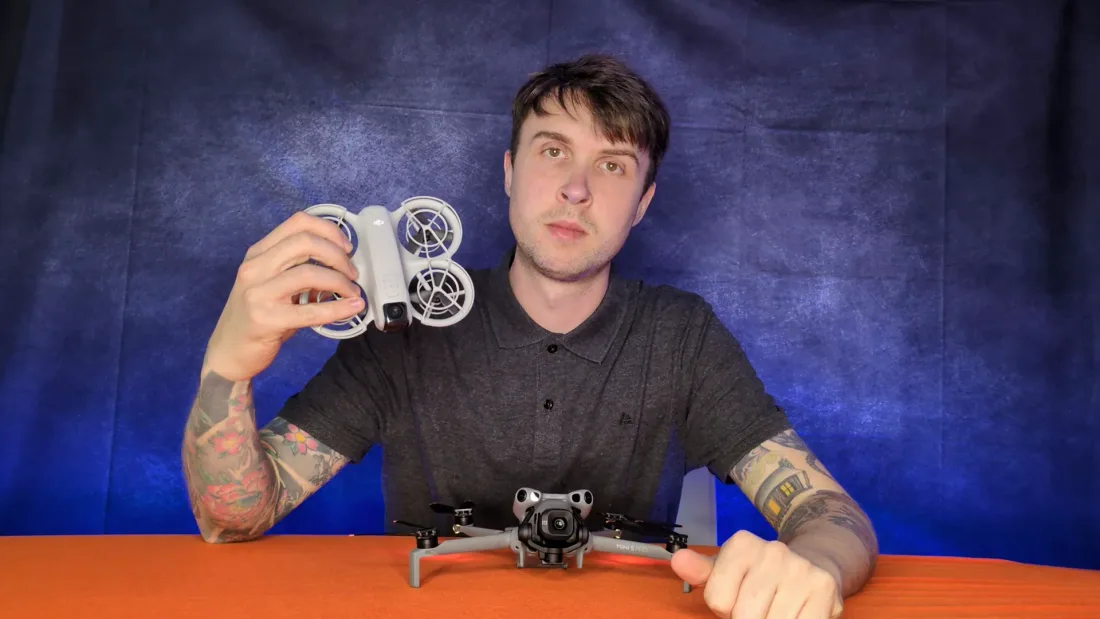
Guards and ducts are the same story pointing the other way. The Neo 2 and the Flip both fly inside protective structures, and a guard is one more surface for the blade wake to hit. DJI’s own figures show the cost in flight time — the Neo 2 does 19 minutes bare and 17 with the guards fitted — and the sound acquires a harder, hissier edge. That is a trade worth making indoors and around children. It is not one to make on noise grounds. I have written separately on whether quieter propellers exist for the Neo 2 — the short version is that the established noise-mod brands have not covered it, and the ducted design is why.
Noise is a complaint even when the flight is perfectly legal
This is the bit that catches people, and it is worth being blunt about. Flying inside the Drone Code is not a defence against a noise complaint, because they are two entirely separate sets of rules with two separate enforcers.
The CAA’s own guidance, written for members of the public who are annoyed by a drone, puts it in one line: “Drone users must always respect your privacy and not cause a nuisance.” Nuisance sits alongside privacy, and it is not defined by a decibel figure.
Behind that sits the Environmental Protection Act 1990. Section 79 lists “noise emitted from premises so as to be prejudicial to health or a nuisance” as a statutory nuisance, and defines premises to include land, which is how a garden gets inside it. The same section places a duty on every local authority, where somebody living in its area complains, to take such steps as are reasonably practicable to investigate. If it agrees, section 80 requires it either to serve an abatement notice or to take other steps to get the nuisance stopped, and breaching an abatement notice is a criminal offence carrying a fine up to level 5 on the standard scale plus a further daily fine while it continues.
I am not raising that to frighten you. Almost nobody gets there. I am raising it because it explains why “but I checked the map and I am allowed to fly here” does not end the conversation with a neighbour, and why the honest advice on this page is behavioural before it is about which drone you buy. The UK drone laws tell you where you may fly. They have almost nothing to say about whether you should.
PART THREE
The one noise figure the law requires, and who never has to publish it
There is exactly one decibel figure in UK drone law. It is worth understanding, partly because it is genuinely useful and mostly because who it applies to is the reverse of what everybody assumes.
The design rules behind the class marks are Commission Delegated Regulation (EU) 2019/945, retained in UK law and amended for UK classes with effect from 1 January 2026. Buried in its annex is a requirement that a C1 or C2 drone must “have a guaranteed A-weighted sound power level”, and must “have the indication of the guaranteed A-weighted sound power level affixed on the UA and/or its packaging”.
The regulation even specifies what the label looks like: the single number in decibels, the sign LWA, and a pictogram which “should, if possible, not be less than 20 mm” tall. It is a physical sticker on a physical drone, and if you own an Air 3S or a Mavic you can go and look at it right now.
And there is a cap, which tightens over time:
| CLASS | TAKE-OFF MASS | MUST PUBLISH A NOISE FIGURE? |
|---|---|---|
| C0 / UK0 | under 250 g | No. Nothing at all. |
| C1 / UK1 | under 900 g | Yes — capped at 85 dB on entry into force, then 83, then 81 |
| C2 / UK2 | under 900 g | Yes — same cap, 85 then 83 then 81 dB |
| C2 / UK2 | 900 g to 4 kg | Yes — a sliding formula that rises with mass |
| No class mark | any | No. Legacy drones are outside it entirely. |
From Regulation (EU) 2019/945, Annex Parts 1, 2, 3, 14 and 15. The three-step tightening runs from entry into force, then two years after, then four years after. I have not been able to establish from the legislation which step a drone on sale in the UK today has to meet, so the honest range is 85 down to 81 dB.
Read the first row again. Class C0 — every drone under 250 grams — has no sound power requirement whatsoever. Not a generous limit. No limit, and no label.
So the drones with a legally guaranteed, printed, verifiable noise figure are the Air 3S, the Mavic 4 Pro and every other heavyweight. The drones with nothing are the Mini 5 Pro, the Mini 4 Pro, the Mini 3, the Flip, both Neos and the HOVERAir — the small, light, conscientious-looking ones that somebody worried about their neighbours would actually buy.
Nor does the manufacturer fill the gap voluntarily. I read the full specification page for the Mini 5 Pro, Mini 4 Pro, Mini 3, Flip, Neo, Neo 2, Avata 2, Air 3S and Mavic 4 Pro. Not one of them carries a sound power level. Every single decibel figure on a DJI specification page is a dBm transmitter power rating for the radio link — a completely different quantity that happens to share three letters. If you have ever found “20 dBm” on a DJI spec sheet and thought it sounded reassuringly quiet, that was the video transmission, not the propellers.
That is not DJI being evasive. It is doing exactly what the regulation asks: put the number on the box of the drones that need one, and nothing anywhere for the rest.
What actually changes what your neighbour hears
So if you cannot shop by number, here is what does work, in order of how much difference it makes. The first two are free, and between them they dwarf everything you can buy.
IN ORDER OF EFFECT
-
1. Climb, and stay climbed
About six decibels per doubling of distance. Twenty metres to eighty is two doublings, so roughly twelve decibels — more than any propeller, cage or model change on this page can offer. The Open Category ceiling is 120 metres above the surface, and you must keep the drone in sight, but there is a great deal of room under that.
-
2. Be brief
Plan the shot on the ground, fly it, land. Three ninety-second flights across an afternoon annoy people far less than one twenty-five-minute hover, even though the peak level is identical. This is the entire argument for a palm-launch drone in a garden.
-
3. Fly smoothly
Noise that changes is noise people attend to. Cine mode, gentle stick inputs and slow translations keep the motors at a steady load. Punchy flying is louder in the way that matters even when it is not louder on a meter.
-
4. Keep your propellers perfect
A chipped or bent blade is out of balance, and an out-of-balance propeller is audibly worse than a new one. Run a fingernail along each leading edge before you fly, and bin anything with a nick. A fresh set of propellers is the cheapest noise fix in existence — consumable money against the cost of the drone, and the one purchase on this list I would make without thinking twice.
-
5. Then, if it exists for your drone, buy the low-noise propellers
Cheap enough that I would fit them without needing to see a measurement — which is just as well, because DJI does not publish one. There is nothing to buy here for any drone under 250 grams.
-
6. Take the guards off, but only when it is safe to
Worth a little on a ducted drone in open ground with nobody about. It also disables some obstacle sensing and rules out close-quarters flying, so this one is genuinely conditional. There is more in my note on reducing recorded noise on the Neo 2.
To put those last two in proportion: a replacement set of DJI Mini 5 Pro propellers costs less than a spare battery, and the DJI Air 3 Series Low-Noise Propellers sit in the same bracket — replaceable parts, and trivial next to what the drone cost. DJI also lists a Mavic 3 Series Low-Noise Propeller set as compatible with the Mavic 4 Pro. Those are the only two low-noise sets DJI makes, and neither comes with a published decibel saving, which is why I fit them on principle rather than on evidence.
Notice that only two of those six involve spending money, and neither is the one that helps most. That is the honest shape of this problem. The drone you buy sets a floor; how you fly it decides everything above the floor, and the range between best and worst practice is wider than the range between the lightest and heaviest drone on this page.
If you want the general version of the numbers — what a drone measures against a vacuum cleaner, a lawnmower and a conversation — I have set that out separately in how loud drones really are. And if the reason you are here is animals rather than people, the disturbance research and the distances it recommends are in the wildlife photography guide, because for a bird the noise is only one of the cues it is responding to.
PART FOUR
The quietest drone I would actually buy, and what it costs
The DJI Mini 5 Pro — and I want to be clear that I am not claiming it is the quietest drone here, because it is not. At 249.9 grams it is the heaviest thing on this page that still ducks under the line, and stood next to a 135-gram Neo you can hear the difference. It is also nowhere near the cheapest way out of this problem, which is why the next few paragraphs are about when to spend less.
It wins because of the arithmetic in Part Two. Six decibels per doubling of distance is a bigger number than anything else available to you, and the only thing that lets you take distance is a camera good enough to crop. A one-inch, 50-megapixel sensor is that camera. The shot you would fly to thirty metres for with a Mini 4K, you take from eighty with this and crop in — and eighty metres is two doublings, about twelve decibels, quieter than any propeller you could bolt to anything.
Which is the whole of what your neighbours actually hear: not the drone’s rating, but how far away it was and how long it stayed. It also keeps you under 250 grams, which is the line that decides your legal life. Under it you need a Flyer ID — a free online theory test, valid five years — and an Operator ID, £12.34 a year, on a label stuck to the drone. Nothing else. Over it, you are into class marks and, for most interesting drones, a qualification.
What it costs in year one
The list is shorter than you might expect, and that is the point. The drone, which is by a long way the largest line and the only one worth agonising over. The Operator ID at £12.34 a year, which is a government fee and the same for everybody. A second standard battery, because two short flights beat one long one and you want to be able to land the moment you have the shot rather than hovering while you decide. A fast 256 GB V30 card, which is the cheapest way to stop yourself flying a second lap because the first one dropped frames. And a spare set of propellers, which on this subject is the only accessory that does anything at all. Set a little aside for a crash while you are at it — on something this light it is usually a propeller set and a scuffed gimbal cover rather than anything serious.
Everything after the drone adds a little over twenty per cent on top — the fee, the battery, the card and the propellers together. That is the whole of it, and it is worth noticing what is not on the list. There is no low-noise propeller line, because DJI does not make one for this drone. There is no A2 Certificate of Competence line, because under 250 grams it buys you nothing you do not already have. Buy the second battery. Skip the bigger one — the Intelligent Flight Battery Plus takes it over 249 grams and out of C0, and takes the whole no-test position with it.
Spend less if your problem is a garden. The DJI Neo 2 costs a small fraction of the Mini 5 Pro, cannot buy you distance, and does not pretend to. What it does instead is be finished before anyone reacts: off your palm, one orbit, back in your hand. In a confined space where you cannot get eighty metres away, brevity is the whole of the strategy, and nothing here is briefer.
Spend more only if the reach earns its keep. The DJI Air 3S costs half again as much as the Mini 5 Pro and has a real 70 mm lens rather than a crop, which for wildlife or for a long lens onto somebody’s roof is a genuine step. It is also a bigger, heavier drone that will be heard if you ever do fly it close, so the reach is the only reason to own it. Go in knowing you are buying about eighteen months of its current no-test status, and that from January 2028 it needs the A2 to fly near people.
The one I’d actively tell you to avoid
The DJI Avata 2 — and it hurts, because it is the most enjoyable drone I own and I would recommend it happily in almost any other guide on this site.
But look at what it is, for this reader. It is 377 grams held up on small ducted propellers running hard. It is flown through goggles, on the throttle, with constant changes of load, which produces exactly the varying, surging noise that people notice and object to. It legally requires a second person stood beside you watching it, so you are now two people conspicuously doing something in a public place. And from 1 January 2028 its C1 mark stops counting and it needs an A2 Certificate of Competence to fly near anyone.
If you want to fly FPV, fly FPV — but do it somewhere nobody is trying to have a Sunday, and do not buy it as an answer to a noise problem. It is the question, not the answer.
And if what you actually need is one set of pictures rather than a hobby — a single survey, one afternoon over a property — owning is rarely the cheaper answer, and it is certainly not the quieter one. You can hire a qualified drone pilot who will be there for twenty minutes, once, with the right lens to do it from a distance.
Quiet drones: the questions I get asked most
What is the quietest drone you can buy in the UK in 2026?
At the source, the DJI Neo — the lightest and the cheapest drone in this guide, at 135 grams, so its propellers have less weight to hold up than anything else here. But the drone that leaves the least noise where a person is standing is the DJI Mini 5 Pro, which costs several times as much, because its one-inch 50-megapixel camera lets you shoot from two or three times the distance, and sound falls by roughly six decibels every time you double the distance. No propeller swap on any drone in this guide will give you six decibels.
How many decibels is a drone?
There is no honest single number, and that is the real answer. Consumer drones measure somewhere around 70 to 90 decibels close to the source — vacuum cleaner to petrol lawnmower — but a decibel reading is meaningless without the distance it was taken at, and most published figures do not state one. The only decibel figure UK law requires is a guaranteed A-weighted sound power level, and sound power is a property of the source with no distance in it at all, so even the official number cannot tell you what your neighbour hears.
Do drone manufacturers have to publish a noise figure?
Only for the heavier ones. Under Commission Delegated Regulation (EU) 2019/945, a class C1 or C2 drone must have a guaranteed A-weighted sound power level and must carry that figure on the drone or its packaging as a number, the sign LWA and a pictogram at least 20 mm tall. Class C0 — everything under 250 grams — has no sound power requirement at all. So the small, unobtrusive-looking drones most people buy are exactly the ones with no published number, and DJI publishes no sound power level on any of its specification pages.
Can my neighbours complain about drone noise even if I am flying legally?
Yes, and it is the most common complaint there is. The CAA’s own guidance to the public says drone users must always respect your privacy and not cause a nuisance. Separately, section 79 of the Environmental Protection Act 1990 makes noise emitted from premises so as to be prejudicial to health or a nuisance a statutory nuisance, and puts a duty on every local authority to investigate a complaint made by someone living in its area. Flying inside the Drone Code is not a defence against a noise complaint, because they are two different sets of rules.
Do low-noise propellers actually work?
Propeller design changes noise more than motor size does, because most of what you hear is blades cutting through their own wake rather than the motors themselves. But DJI only sells Low-Noise Propellers for two of its ranges — the Air 3 series, and a Mavic 3 series set that DJI lists as compatible with the Mavic 4 Pro — and publishes no decibel comparison for either. There is no low-noise propeller from DJI for any drone under 250 grams. Fit them as a cheap improvement, not a measured one, and keep your existing blades unchipped, because a nicked blade is louder than a new one.
Are quiet drones better for filming near wildlife?
Quieter helps, but it is not the whole mechanism and it is not permission to be close. Noise is one cue among several — shape and approach path matter too, and a small drone flown straight at an animal will provoke more reaction than a larger one held at distance. The practical version is the same as for neighbours: get the reach to stay far away, climb rather than close in, and keep the flight short. Distance is the only variable that reliably buys you six decibels at a time.
The short version
If you read all of that and still want me to just say it: buy the DJI Mini 5 Pro, then fly it higher and for less time than you were planning to. The drone gets you the distance. The habit does the rest, and it is free.
OR, IF YOUR PROBLEM IS SHAPED DIFFERENTLY
A garden, not a field — DJI Neo 2 You need a real long lens — DJI Air 3SAffiliate links · costs you nothing extra · full disclosure
Amazon and DJI UK store listings checked on 31 July 2026 for configuration and availability; this guide does not quote prices, because they change faster than an article can. Noise requirements from Commission Delegated Regulation (EU) 2019/945 as published on legislation.gov.uk; nuisance provisions from the Environmental Protection Act 1990. Regulatory guidance from the UK Civil Aviation Authority. Psychoacoustic findings from Christian & Cabell, NASA Langley Research Center, 2017. Comparison specifications from DroneCompare, licensed under CC BY 4.0. Amazon links are affiliate links.