DJI Mini 5 Pro Review UK 2026: Is It Worth It?

Peter Leslie
Updated 16 Jul 2026
This review contains affiliate links. As an Amazon Associate I earn from qualifying purchases. Buying through these links does not cost you extra — full affiliate disclosure here.
Key Takeaways
- The one-inch 50 MP camera is the reason to buy the Mini 5 Pro
- The standard battery is rated for up to 36 minutes, not 52 minutes
- DJI sells separate C0 and C1 models, so check the class label and included battery
- Forward LiDAR strengthens sensing, but it does not make collisions impossible
- Buy the Mini 4 Pro instead if its camera already meets your needs
If you sat down with me and asked whether to buy the Mini 5 Pro, I would first ask what you want the footage to look like. Buy it when image quality is your first priority: its one-inch camera gives you more room when the light is poor, the sky is bright or you need to crop. It is harder to justify if you already like your Mini 4 Pro footage and mainly publish compressed social clips. Start with my direct Mini 5 Pro versus Mini 4 Pro comparison if that is your decision.
The one-inch camera is the hardware reason to upgrade
The Mini 5 Pro uses a one-inch CMOS sensor with 50 MP effective resolution. It records regular 4K footage at up to 60 frames per second and 4K/120 in slow-motion mode. The larger sensor gives it more room when shadows are noisy, skies are bright, or a crop is needed in editing.
This matters most for landscape, property and paid work where the output may be inspected on a large screen. It matters less when every clip will be reduced for a phone feed. The Mini 4 Pro still records 4K/60 HDR and 10-bit colour, so the upgrade decision should start with the finished work rather than the specification sheet.
The standard battery is the honest sub-250g comparison
DJI rates the standard battery for up to 36 minutes in controlled conditions. The widely repeated 52-minute figure belongs to the heavier Plus battery. The important detail is that DJI documents separate C0 and C1 certified models, with maximum take-off masses of 249.9 g and 355 g respectively. A battery headline does not tell you which class-marked model you are buying.
For most UK buyers, I would start with the C0 model and its approved standard battery when the light-drone rules are part of the appeal. More standard batteries usually add more useful flying time than chasing one maximum figure because you still need safe landing margin and time to inspect the drone between flights. Check the physical class label and the battery approved for that exact model before ordering.
My starting point for most UK buyers
C0 model and approved standard battery
Up to 36 min
The manual lists a 249.9 g maximum take-off mass for the C0 model. Confirm the C0 label on the drone you receive.
Check before chasing 52 minutes
Plus battery and C1 packages
Up to 52 min
DJI also documents a separate C1 model at 355 g maximum take-off mass. Check the model, class label and approved battery rather than assuming any Plus setup has one fixed weight.
LiDAR improves the sensing package without making it infallible
The sensing stack combines omnidirectional binocular vision, forward LiDAR and downward infrared. LiDAR is laser ranging aimed ahead of the drone. It gives the Mini 5 Pro another source of distance information, particularly useful when vision cameras have less contrast to work with.
The manual still lists limitations around fine obstacles, reflective surfaces, light and flight mode. Sport mode does not offer the same avoidance behaviour. You remain responsible for the route, and drone pilots should never plan a shot around the assumption that the drone will save itself.
The controls feel familiar, but the bundle still deserves attention
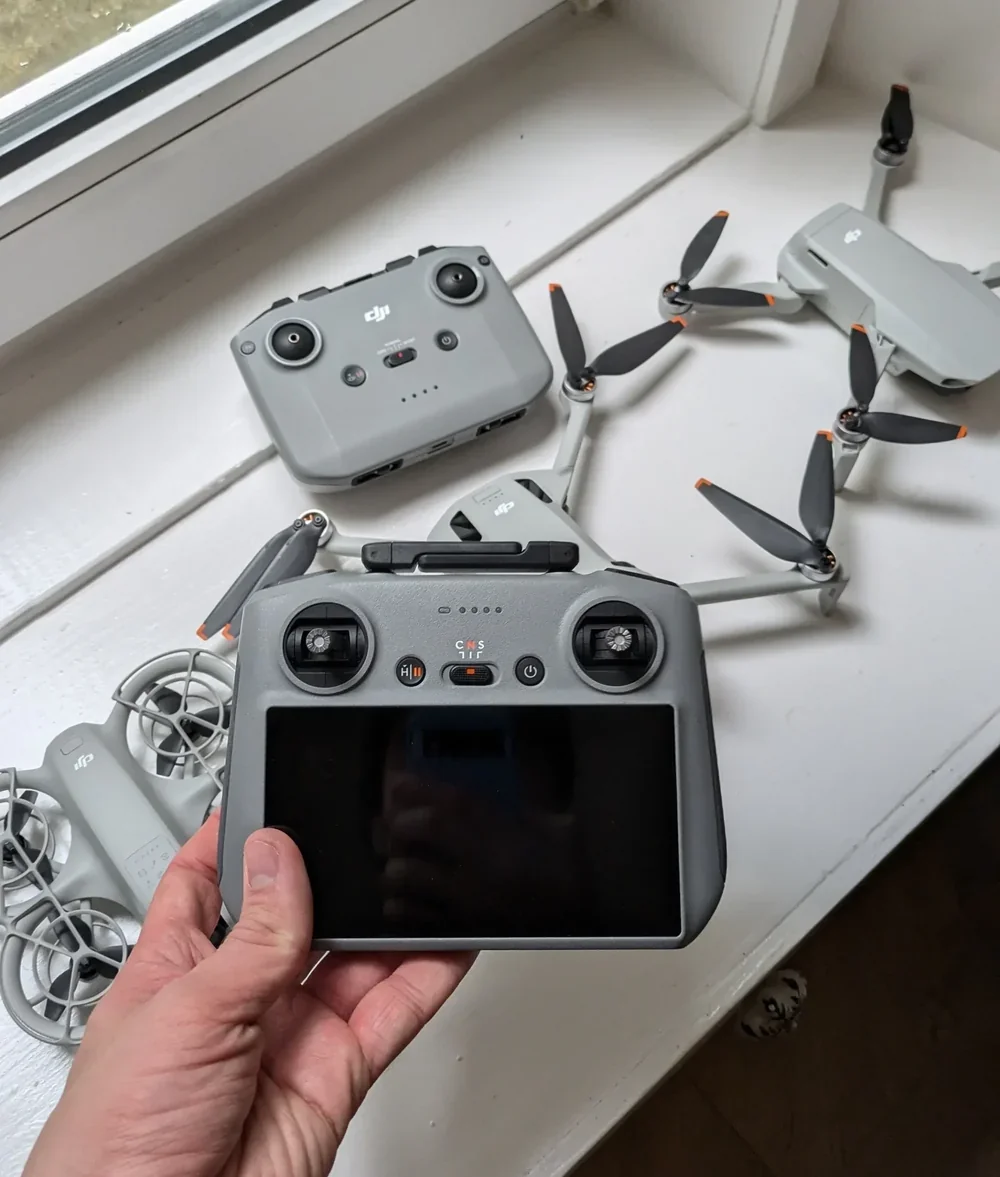
The Mini 5 Pro works with the screen-equipped DJI RC 2 or phone-based DJI RC-N3, depending on the bundle. It uses O4+ video transmission, which DJI rates up to 10 km under CE test conditions. That is a link specification, not a legal operating distance; UK flights must remain within Visual Line of Sight.
It has folding arms rather than a ready-to-launch guarded body. It does not provide Neo-style palm takeoff or landing. That small setup difference matters if you want quick automated clips; the DJI Neo 2 is faster from bag to air, even though its camera is much less capable.
The weaknesses are price, battery confusion and a less spontaneous flying style
I recommend it if you…
- Care about stills and difficult light
- Want one compact drone for several years
- Need portrait and landscape capture
- Value modern obstacle sensing
I do not recommend it if you…
- Already like your Mini 4 Pro footage
- Mainly want casual palm-launched clips
- Expect 52 minutes below 250 g
- Want the lowest-cost route into 4K
The Mini 5 Pro is also less spontaneous than a Neo. You unfold the arms, prepare a controller and find a suitable takeoff point. That process is normal for a camera drone, but it is worth acknowledging when compact marketing makes every small model look equally immediate.
UK registration still applies even when the standard configuration is below 250g
Every configuration has a camera and weighs more than 100 g, so the remote drone pilot needs a Flyer ID and the responsible operator needs an Operator ID. The Flyer ID test is free and lasts five years. The Operator ID costs £12.34 per year and must be displayed on the drone.
In 2026 and 2027, C0 and C1 class marks are treated as the corresponding UK classes. Check the actual model and label, particularly when buying a Plus-battery configuration. The normal 120 m UK height ceiling, airspace restrictions, safe-distance duty and ban on flying over crowds still apply.
What you need before the first UK flight
1
Pass the Flyer ID test
Free and valid for five years
2
Get an Operator ID
£12.34 each year
3
Label the drone
Display the Operator ID
4
Check the flight
Airspace, people and permission
No GVC is needed for normal Open Category flying. Check the class label and approved battery on the exact model you buy.
Amazon Affiliate link — see the disclosure.
The final verdict is positive but specific: the Mini 5 Pro is worth it for camera-first buyers, not simply because it is newer. See how it fits into the full best drones under 250g shortlist.
Got a Mini 5 Pro scenario you want covered? Drop a note to peter@hiredronepilot.uk and I will come back to you directly.