How Far Can a Drone Fly in the UK? The Legal Limit vs the Spec Sheet

Peter Leslie
31 Oct 2025
Key Takeaways
- The legal answer in the UK Open Category is Visual Line of Sight — you can fly only as far as you can keep the drone in direct, unaided sight
- In practice, VLOS caps the useful horizontal distance at a few hundred metres for most drones, well short of the spec-sheet range
- The 120 m vertical ceiling is absolute under the Drone Code, measured from the closest point of the Earth's surface
- Flying Beyond Visual Line of Sight requires a Specific Category authorisation from the CAA and is not available in the Open Category
- Breaking VLOS is a criminal offence under the Air Navigation Order 2016, with fines and up to five years in prison for endangering a manned aircraft
Walk past any camera shop or open any manufacturer's website and you will see drones advertised with ranges of several miles. The DJI Mavic 3, the DJI Air 3, the Autel flagships — all promise eye-catching maximum transmission distances that sound like a licence to fly anywhere you can see. They are not.
The legal answer for a UK drone pilot flying in the Open Category has almost nothing to do with the spec sheet. It has to do with your eyes. The rule is Visual Line of Sight, and in practice it caps your legal flight distance at a few hundred metres on a good day. This piece walks through why that gap exists, what the rule actually says, and what happens if you ignore it. If you want the wider context first, the hub post on UK drone laws sets up the rest.
The legal answer is Visual Line of Sight, not the number printed on the box
The Open Category rule, straight out of the Drone and Model Aircraft Code, is that you must keep your drone in direct sight throughout the flight, clearly enough to tell which way it is facing and clearly enough to spot any other aircraft entering your airspace. Visual Line of Sight — VLOS — is the phrase you will hear for this.
VLOS is specifically unaided. No binoculars. No telephoto lens. No phone screen, tablet, or FPV goggles, unless you have an observer standing next to you holding the direct view for you. Normal glasses and contact lenses are fine.
What that translates to in the real world depends on the drone, the light, the sky, and you. A DJI Mini-class drone at 300 metres becomes a speck. Past that, most drone pilots are guessing at orientation rather than seeing it. A larger drone like a DJI Mavic 3 or a DJI Matrice holds its silhouette for longer, which is why commercial drone pilots gravitate toward bigger drones even when the job does not require the extra payload. But even on the biggest consumer drone, you are going to lose meaningful VLOS well under a kilometre. Not five, not ten, and absolutely not the fifteen-kilometre transmission headline on the box.
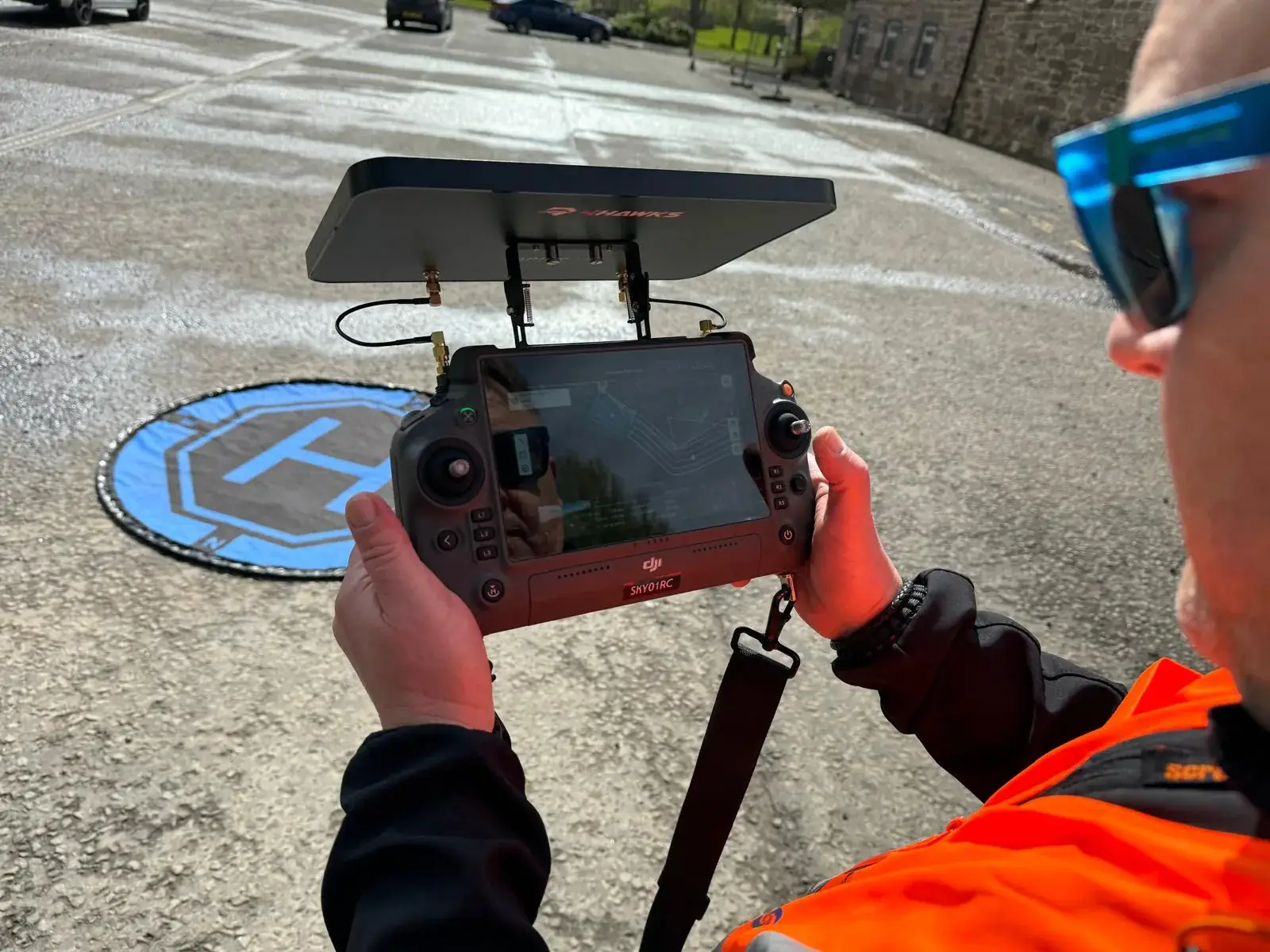
In practice, the comfortable horizontal distance is a few hundred metres, not 500
You will see the number 500 metres quoted online as a kind of informal UK limit. That figure comes from the PDRA01 Specific Category authorisation, which sets a hard 500-metre cap on how far the drone may be from the Remote Pilot. It is a ceiling, not a target.
In the Open Category — where the overwhelming majority of hobbyists and independent drone pilots sit — there is no single numerical cap at all. The cap is VLOS, and VLOS is shorter than 500 metres for most drones on most days. The practical range most Open Category drone pilots should be working within is closer to 300 to 400 metres horizontally, and often less in an urban setting where rooflines swallow the silhouette.
If you find yourself pushing the drone further to make a shot work, the more honest fix is to walk further or use a longer lens on the drone's camera — not to break VLOS and hope the telemetry carries you back.
The 120-metre altitude ceiling is absolute and does not scale with the drone's technical range
Vertical distance gets its own rule. The Drone Code is clear: maximum altitude is 120 metres (400 feet) from the closest point of the Earth's surface. It applies to every Open Category flight regardless of drone class, weight, or transmission technology.
That phrasing matters if you fly in the hills. The ceiling is not 120 m above the drone pilot's standing position — it is 120 m above whatever ground the drone is currently over. Fly along the edge of a cliff and the ceiling steps down with the cliff. The only minor exemption is a surveying task on a structure taller than 105 m, where you may climb above 120 m if the structure's operator has specifically asked you to — a niche carve-out most drone pilots never touch.
The wider write-up on the 120 m altitude ceiling covers the edge cases. For a standard flight, treat it as an absolute line.
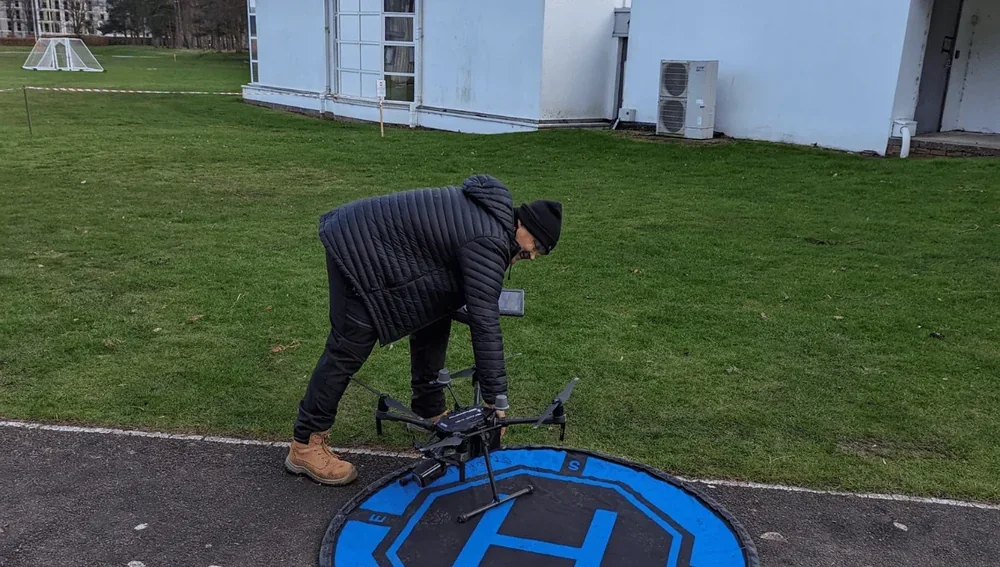
The horizontal people-buffer grows with altitude, so range is never a single number
Once you leave the ground, the distance you have to keep from uninvolved people changes too. Default buffer is 50 metres horizontally. But the moment your altitude climbs above 50 m, the Drone Code tells you to grow the horizontal buffer to match. Fly at 80 m and you must stay 80 m from uninvolved people. Fly at the 120 m ceiling and the buffer becomes 120 m.
This is the 1-to-1 rule as it actually appears in UK law. It is not a single standalone regulation — it is a scaling buffer that binds the Open Category above 50 m of altitude and a separately-named condition inside the PDRA01 Specific Category authorisation for assemblies of people. Either way, range is never a single scalar. It is a vertical number, a horizontal number, and a compound buffer that responds to altitude.
Flying beyond visual line of sight is a Specific Category job, not an Open Category shortcut
If the job genuinely needs the drone further than VLOS — a long pipeline inspection, an agricultural mission across a full estate, a linear survey — you are not in the Open Category at all. You are in the Specific Category, and you need an Operational Authorisation from the CAA.
Two common routes handle most of this. EVLOS — Extended Visual Line of Sight — lets you push the drone further by positioning trained observers along the flight path who hold VLOS for segments of the route. BVLOS — Beyond Visual Line of Sight — takes the drone out of sight entirely and requires a much more involved safety case, often including detect-and-avoid systems and segregated airspace.
Both sit under a Specific Category Operational Authorisation, typically held by a commercial operator with a qualified RPC-L2 drone pilot or above. A GVC on its own is a VLOS certificate — it does not unlock long-range flying. If the job needs distance, the question is who holds the right authorisation, not which drone has the longest transmission range.
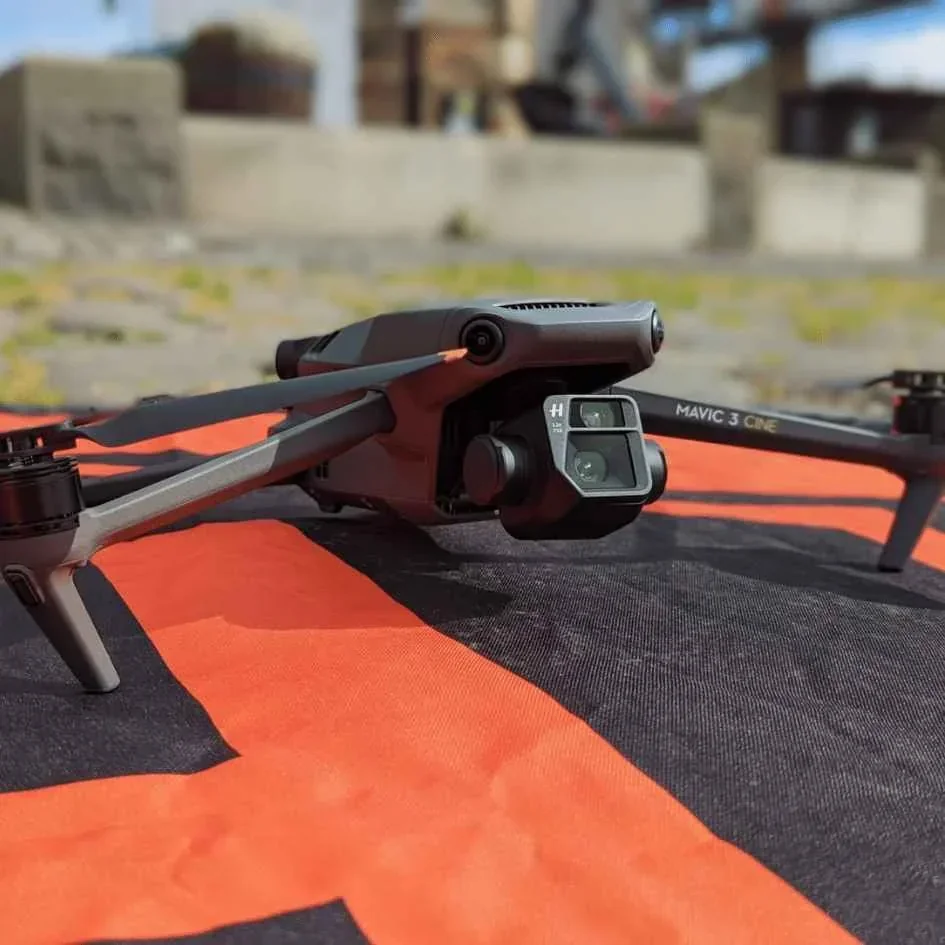
Breaking VLOS is a criminal offence, not a gentle paperwork breach
The Air Navigation Order 2016 is the legal backbone under the Drone Code. Breaking VLOS is a criminal offence, and the penalties scale with how badly a flight goes wrong.
Routine breaches can attract a fine. Serious cases can attract prison. Endangering an aircraft in flight carries up to five years. On top of the criminal side, a flight outside the rules invalidates your third-party drone insurance, which turns any accident from an insurance claim into a direct personal liability. If you fly commercially, that usually also ends the client relationship.
In other words, the honest cap on range in UK airspace is not advisory. It is enforceable, and enforcement can be severe.
Signal loss is a different problem, and the spec-sheet range has its own failure modes
It is worth closing on what the manufacturer range number actually represents, because it is not useless — it just measures something different. The numbers on the box describe the transmission range, which is the maximum distance at which the controller's radio link to the drone stays stable under ideal, obstruction-free conditions. Drop a building or a patch of dense trees in between, and that number halves. Add electromagnetic interference from power lines or urban Wi-Fi and the usable range shrinks further.
The practical implication is that VLOS usually goes before the radio link does, but on a bad day in a dense environment, the signal can drop at far less than the spec-sheet range. Modern drones handle this with a Return to Home failsafe — set the home point, set the RTH altitude above any local obstructions, and the drone will come back on its own if the connection drops. The GPS lock does the heavy lifting there.
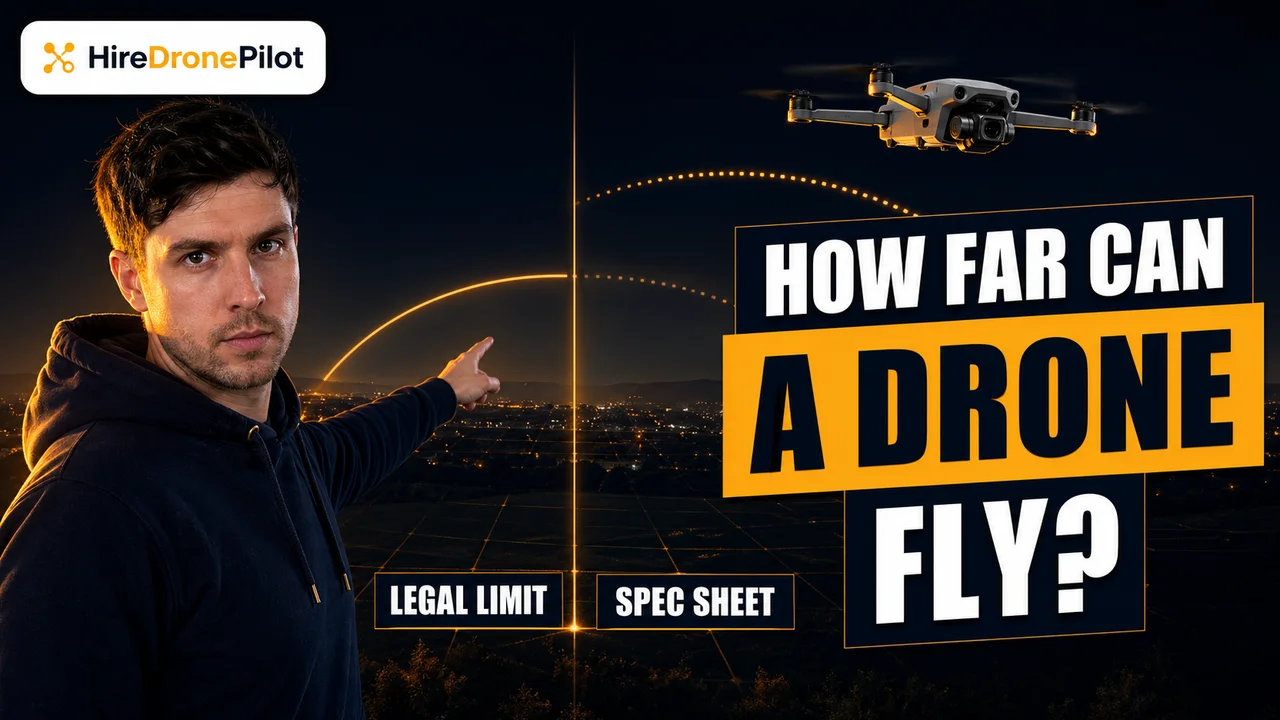
So the honest answer to how far can a drone fly in the UK? is: as far as you can keep it in direct sight with your own eyes, vertically no higher than 120 metres above the ground it is over, horizontally scaled around any uninvolved people. That is the legal range. The spec sheet describes a radio limit. The two live in different worlds.
If the project genuinely needs the drone further than VLOS, the route is a Specific Category authorisation and a commercial operator who holds one — not a drone with a bigger transmitter.
Got a scenario in mind — a long linear survey, a remote coastline, a stretch of road you want covered in one flight? Drop a note to peter@hiredronepilot.uk and I will come back to you with the right route. If you prefer the video version of this explainer, the comments are open on YouTube.
References
Primary source material for this article is the UK Civil Aviation Authority. External links open in a new tab.
- UK CAA — The Drone and Model Aircraft Code (CAP2320) · VLOS rule, 120 m altitude ceiling, people-buffer scaling above 50 m
- UK CAA — Beyond Visual Line of Sight (BVLOS) · Specific Category authorisation required; BVLOS unavailable in the Open Category
- UK CAA — Where you can fly (A1, A2, A3) · Open Category sub-category rules and distances
- UK CAA — UK Regulatory Framework for Drones · Air Navigation Order 2016 and the UAS Regulations, including penalties
Peter Leslie
Founder & GVC Drone Pilot
Peter is the founder of HireDronePilot. With thousands of logged commercial flight hours, he writes about drone technology, commercial surveying tactics, and UK aviation compliance.
Connect on LinkedIn