Is the DJI Neo 2 an FPV Drone?

Peter Leslie
22 May 2026
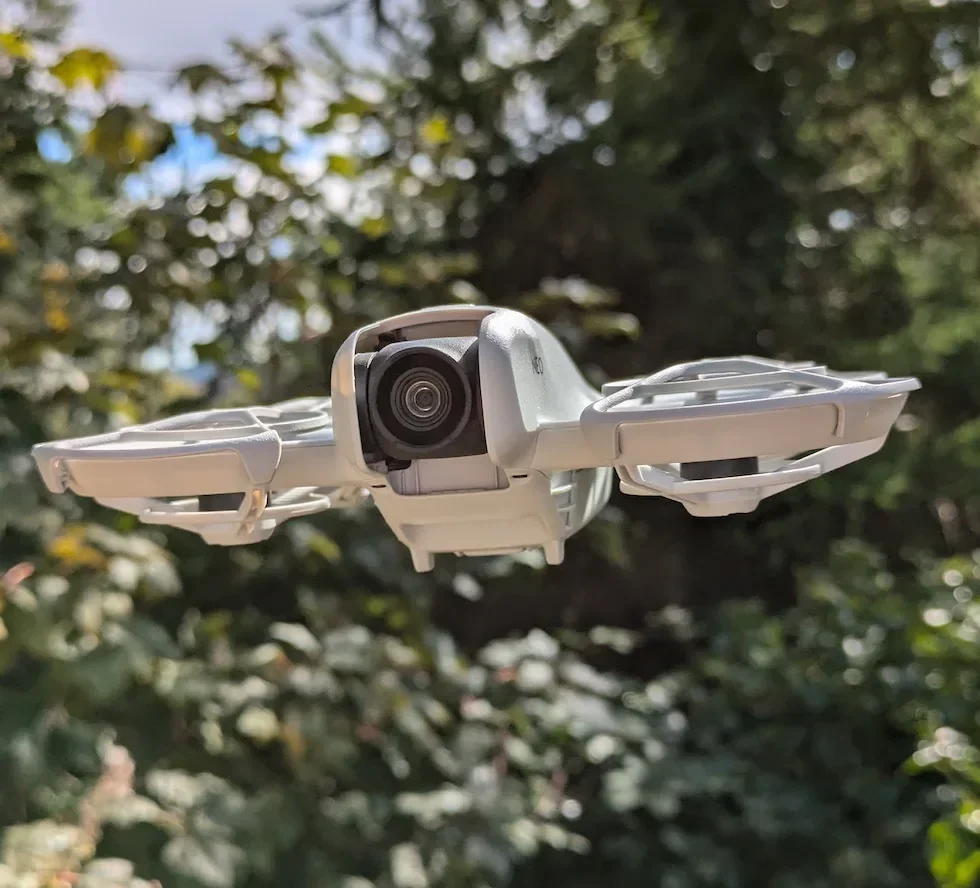
Key Takeaways
- The DJI Neo 2 is not a true acro FPV drone like the DJI Avata 2 — it is a stabilised sub-250 gram camera drone that can be flown FPV style through DJI Goggles N3 and a DJI RC Motion 3
- To unlock real acro FPV flight you need the DJI FPV Remote Controller 3, which exposes Manual mode with a sticky throttle, no self-levelling, and no obstacle avoidance
- Out of the box the Neo 2 flies in Normal, Sport, or Cine mode with GNSS hover, auto-brake, and the new forward LiDAR obstacle avoidance — none of which behave like a racing quad
- DJI markets the Neo 2 as an entry-level Manual mode trainer, suitable for throttle and altitude practice but not for Dive, Split-S, Power Loop, or Yaw-Spin moves
- Any goggles flight in the UK still needs a competent observer beside you — wearing a headset does not satisfy Visual Line of Sight on its own
The short answer is no, the DJI Neo 2 is not an FPV drone in the sense most people mean when they say "FPV" — it is a 151 gram stabilised camera drone that can be flown FPV style through a headset, which is a different thing. The longer answer matters, because the Neo 2 sits in an unusual middle ground that DJI has been deliberately vague about in marketing. It gives drone pilots the goggles experience without the acro flight characteristics, unless they go out of their way to unlock them.
This guide covers the distinction in plain English — what FPV actually means under UK rules, what the DJI Neo 2 gives you out of the box, what you have to add to turn it into a true acro drone, and how the headset rules interact with the rest of the Open Category. If you came here from a YouTube ad showing a Neo 2 doing rolls behind a bike rider, this is the article that explains what is really going on.
FPV means flying through a video feed, not a specific drone class — and that is where the DJI Neo 2 confusion starts
The CAA defines First Person View as flying by watching a live video feed on a phone, tablet, or video goggles instead of watching the drone itself. That is a description of how you view the flight. It is not a description of how the drone flies, what flight mode it is in, or whether the drone has self-levelling. FPV is a viewing method, not a drone category.
In normal hobby conversation, however, the phrase "FPV drone" almost always means a true acro or freestyle quad — a drone with no self-levelling, no GPS hover, no auto-brake and no obstacle avoidance, where stick inputs translate directly into the drone’s attitude. Think DJI Avata 2 or any of the home-built five-inch racing rigs you see at FPV meets. Those drones are designed to be flown only through a headset, and they are unflyable without one because they will not hover for you.
The DJI Neo 2 is not that drone. By default the Neo 2 is a normal stabilised drone — it self-levels, it GNSS-holds, it auto-brakes, it has a forward LiDAR plus an omnidirectional sensing system, and it returns to home if it loses signal. You can wear DJI Goggles N3 to view its camera, which is FPV by the strict CAA definition, but the drone underneath is still flying like a Mini, not like an Avata.
Out of the box the DJI Neo 2 flies in Normal mode with full stabilisation, which is closer to a Mini than an Avata
Pull a DJI Neo 2 out of the box, fly it with palm control, the DJI Fly app, the DJI RC-N3, or the RC Motion 3, and the drone is in Normal mode. That is the same flight mode the DJI Mini uses. GNSS lock holds the position, the vision system stabilises the hover, the propellers feather to brake the moment you let the sticks go, and return to home kicks in if you lose signal or the battery drops below the threshold.
There is a Sport mode on top of Normal — same stabilisation, just higher speed limits. There is a Cine mode below it — same stabilisation, just slower stick response for smoother cinematic moves. And the Neo 2 carries a full obstacle avoidance stack on top of all that, with Bypass and Brake options sitting in the menu. None of those modes are FPV in the acro sense. The Neo 2 is doing the same flight-controller maths it always does, just with different gain and speed limits.
If you bought a Neo 2 Motion Combo and put on the DJI Goggles N3, you are flying in Normal mode through a video feed. Lean the RC Motion 3 forward, the Neo 2 tilts forward, and the flight controller automatically brings it back to a level horizon when you let go. That is great for cruising behind a bike or filming a smooth tracking shot — and useless for freestyle acro, because the Neo 2 will not let you hold an inverted attitude long enough to do a flip.
From a drone pilot’s perspective this is actually a feature, not a flaw. It makes the DJI Neo 2 flyable on day one for someone who has never touched a drone before. No simulator, no muscle memory, no eight-figure mental gymnastics on the sticks. You point and it goes. The trade-off is that you cannot do the things FPV is famous for — ripping through a forest, looping behind a moving car, drifting through a window — until you change the controller.
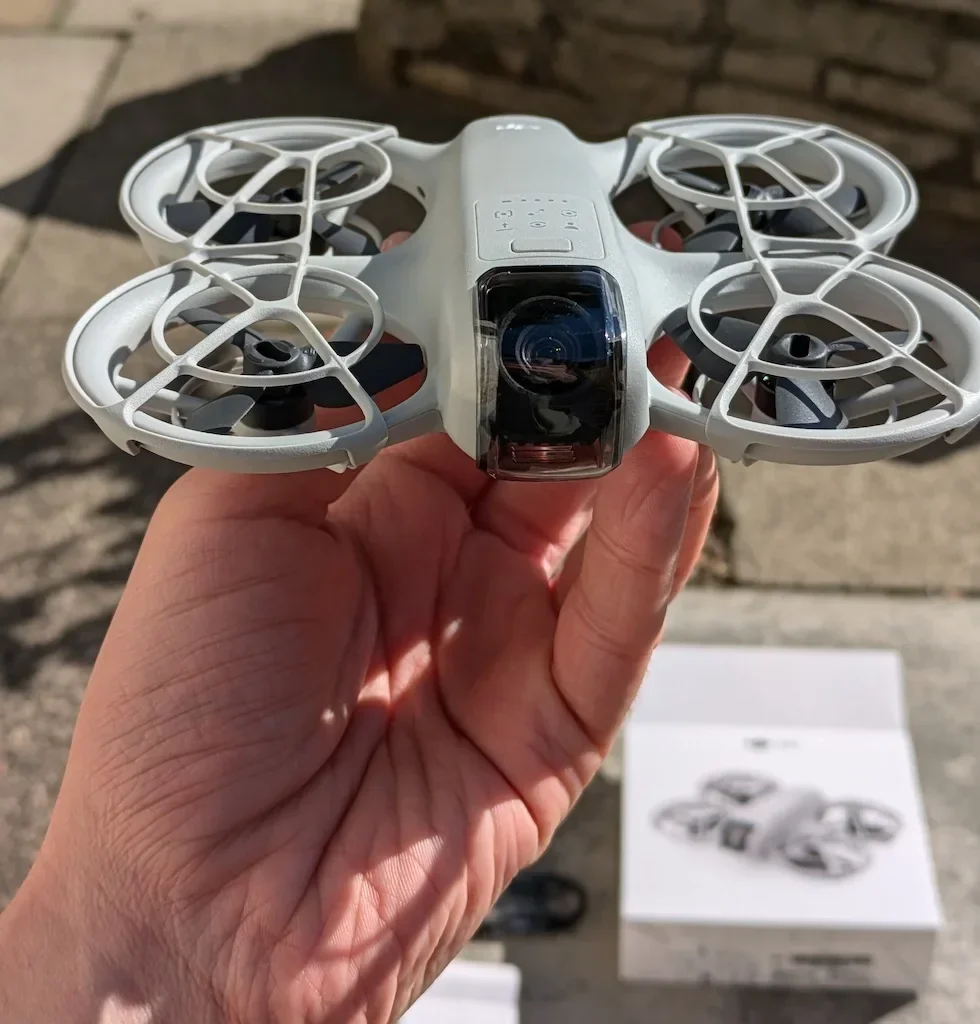
Manual mode turns the DJI Neo 2 into a true acro FPV drone, but only with the DJI FPV Remote Controller 3
The line in the Neo 2 manual that decides this is short and unambiguous — "Manual mode is only supported when using the DJI FPV Remote Controller 3." No other controller in the Neo 2 ecosystem unlocks it. The DJI RC-N3 carries Normal, Sport, and Cine. The RC Motion 3 carries Normal and Sport. Palm flight has no mode selector. The DJI Fly app has no mode selector. Only the FPV Remote Controller 3 — the one shipped with the DJI Avata 2 and the original DJI FPV combo — has a three-position switch with a Manual position.
Flick that switch to M and the Neo 2 immediately becomes a different drone. Self-levelling stops. Auto-brake stops. Precise hovering stops. Obstacle avoidance is disabled. The throttle stick on the FPV Remote Controller 3 does not return to centre, so wherever you push it, that is the new throttle setting until you move it again — exactly like a true acro radio. Pitch, roll, and yaw inputs translate directly into the Neo 2’s attitude, and the drone holds that attitude until you say otherwise. The horizon does not come back for free.
The full breakdown of what changes, plus the step-by-step routine for getting the switch to work safely, is in the dedicated DJI Neo 2 manual mode guide. The summary worth carrying with you is that this is the same acro mode the DJI FPV and DJI Avata use — the Neo 2 is not a softer, beginner-friendly version of acro flight. The flight controller behaves the same way. The only thing that is softer is the propulsion limit, which DJI is unusually frank about.
DJI explicitly markets the Neo 2 as an "entry-level" Manual mode drone, and the manual states it is suitable for practising throttle control, holding altitude, and level flight, but not for high-energy aerobatics like Dive, Split-S, Power Loop, and Yaw-Spin. The motors do not carry the thrust margin to recover from those moves on a 151 gram drone. So the Neo 2 is the cheapest place in the DJI line-up to learn acro muscle memory on a real drone — but it is a trainer, not a competition machine.
DJI Goggles N3 and the DJI RC Motion 3 are the FPV style combo most Neo 2 buyers will actually use
The Neo 2 was designed to pair with the DJI Goggles N3 and the DJI RC Motion 3, and the Motion Combo bundles both in the box. The Goggles N3 wraps the camera feed across your eyes with low latency over DJI’s O4 video transmission. The Motion 3 is a one-handed pistol-grip controller — tilt it forward to fly forward, tilt it up to climb, twist to yaw, and the accelerator trigger drives the speed.
That combo is FPV by the CAA definition the moment the goggles are on. It is also the friendliest immersive setup DJI has ever sold, because the stabilisation never disengages. You can hand the Motion 3 to a friend who has never flown a drone, point them at a tree, and they will fly a usable tracking shot inside ten minutes.
The Neo 2 also carries a feature called Easy ACRO through the Motion 3 — front flips, backflips, rolls, and a 180-degree drift — but the manual is clear that these are not Manual mode. Easy ACRO disables obstacle avoidance for the duration of the move, runs the trick, then hands control back to a stabilised hover. It is a one-button stunt system, not a freestyle flight mode.
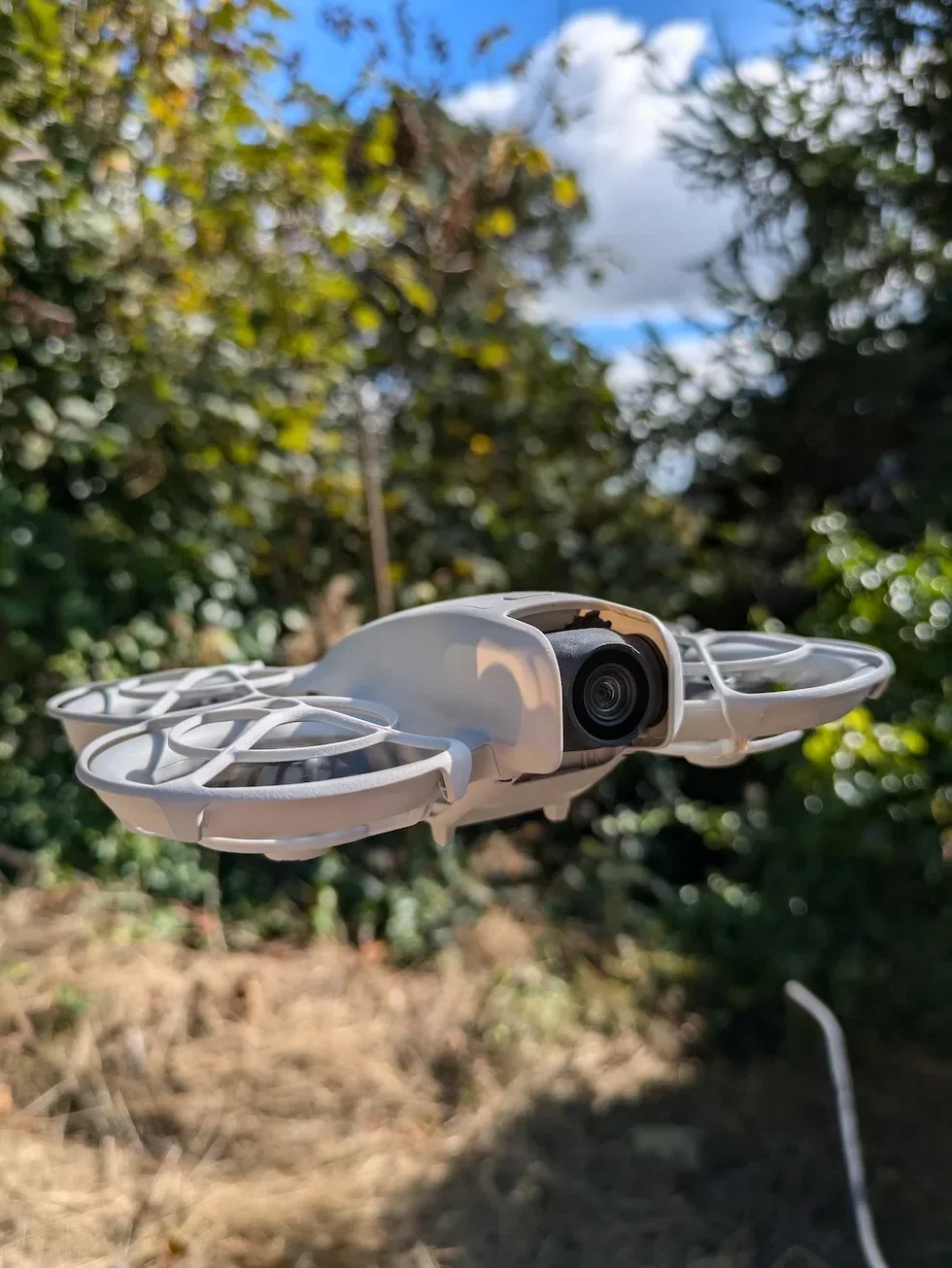
UK law treats every DJI Neo 2 flight through goggles as FPV, which means a competent observer is non-negotiable
Whichever version of FPV you are flying — Normal-mode goggles cruising, RC Motion 3 immersion, or full acro Manual mode — UK law sees it the same way. The moment you put a headset on, you have lost Visual Line of Sight on the drone, and the CAA First Person View rules apply.
In practice that means three things. One — you need a competent observer next to you, with their own eyes on the drone, who can talk to you continuously throughout the flight. The observer does not need a Flyer ID or any qualification, but they have to actually be there. Two — at least one of you must be able to see the drone in direct sight, clear enough to tell which way it is facing, and have a full view of the surrounding airspace at all times. Direct sight excludes binoculars, telephoto lenses, and any other electronic viewing equipment. Three — wearing a headset does not authorise Beyond Visual Line of Sight flight. The drone still has to be inside your observer’s direct visual range.
Everything else from the Drone and Model Aircraft Code applies in full. The 120 metre altitude ceiling still binds. The 50 metre buffer from people you are not flying with still binds. The Neo 2 is a sub-250 gram drone, which puts it in the friendliest weight bracket in UK drone law, but the FPV rules sit on top of that and are the same regardless of weight.
Solo goggles flight in a back garden is not legal under Open Category rules, no matter how light the drone is. That is why most acro drone pilots in the UK fly with a friend rather than alone. Your drone insurance reads the situation the same way — hobby cover holds for a UK-legal flight; the moment the rules lapse, the cover lapses with them.
So is the DJI Neo 2 an FPV drone? It is a stabilised camera drone that flies FPV style very well, and that becomes a real acro FPV drone when you add the FPV Remote Controller 3. That is a more useful answer than yes or no. If you came in expecting a five-inch racing quad, this is not your drone. If you came in expecting a sub-250 gram cinematic drone with optional headset immersion and a route into acro practice, you have already bought the right thing.
Got a specific Neo 2 FPV scenario you want covered — a Goggles bundle you are weighing up, an RC Motion 3 versus FPV Remote Controller 3 decision, or an observer setup you are not sure is legal? Drop a note to peter@hiredronepilot.uk and I will come back to you directly. If you prefer the video version of this explainer, the comments are open on YouTube.
References
Primary source material for this article is the official DJI Neo 2 user manual and the UK Civil Aviation Authority. External links open in a new tab.
- DJI — Neo 2 user manual (downloads) · flight modes (Normal, Sport, Cine, Manual), Manual mode only supported with DJI FPV Remote Controller 3, entry-level Manual mode framing, Easy ACRO behaviour, propulsion-limit caveats
- DJI — FPV Remote Controller 3 · three-position flight mode switch (Normal / Sport / Manual) and sticky throttle stick
- DJI — Goggles N3 · goggles paired with DJI RC Motion 3 for Neo 2 FPV style flight
- UK CAA — First Person View (FPV) · competent observer requirement, direct sight definition, FPV does not authorise BVLOS
- UK CAA — The Drone and Model Aircraft Code (CAP2320) · Visual Line of Sight requirement, 120 metre altitude ceiling, 50 metre people buffer
- UK CAA — Beyond Visual Line of Sight (BVLOS) · FPV equipment does not authorise BVLOS in the Open Category
Peter Leslie
Founder & GVC Drone Pilot
Peter is the founder of HireDronePilot. With thousands of logged commercial flight hours, he writes about drone technology, commercial surveying tactics, and UK aviation compliance.
Connect on LinkedIn