UK Drone Insurance Requirements: What the Law Actually Demands

Peter Leslie
10 Sept 2025
Key Takeaways
- Third-party insurance compliant with Assimilated Regulation (EU) 785/2004 is mandatory for every commercial drone flight in the UK, regardless of drone weight
- Recreational, sport and hobby flying under 20 kg is not legally required to carry insurance, but the operator is still personally liable for any damage or injury caused
- Any drone of 20 kg or above must always carry third-party cover, even when flying purely for fun
- The UK legislative basis for drone insurance is the Civil Aviation (Insurance) Regulations 2005, and the named Operator on the Operator ID is the person who must hold the policy
- Proof of a compliant policy is part of every Operational Authorisation application in the Specific Category, including PDRA01
- Flying commercially without compliant cover is a criminal offence under the Air Navigation Order 2016 and will invalidate your Operational Authorisation
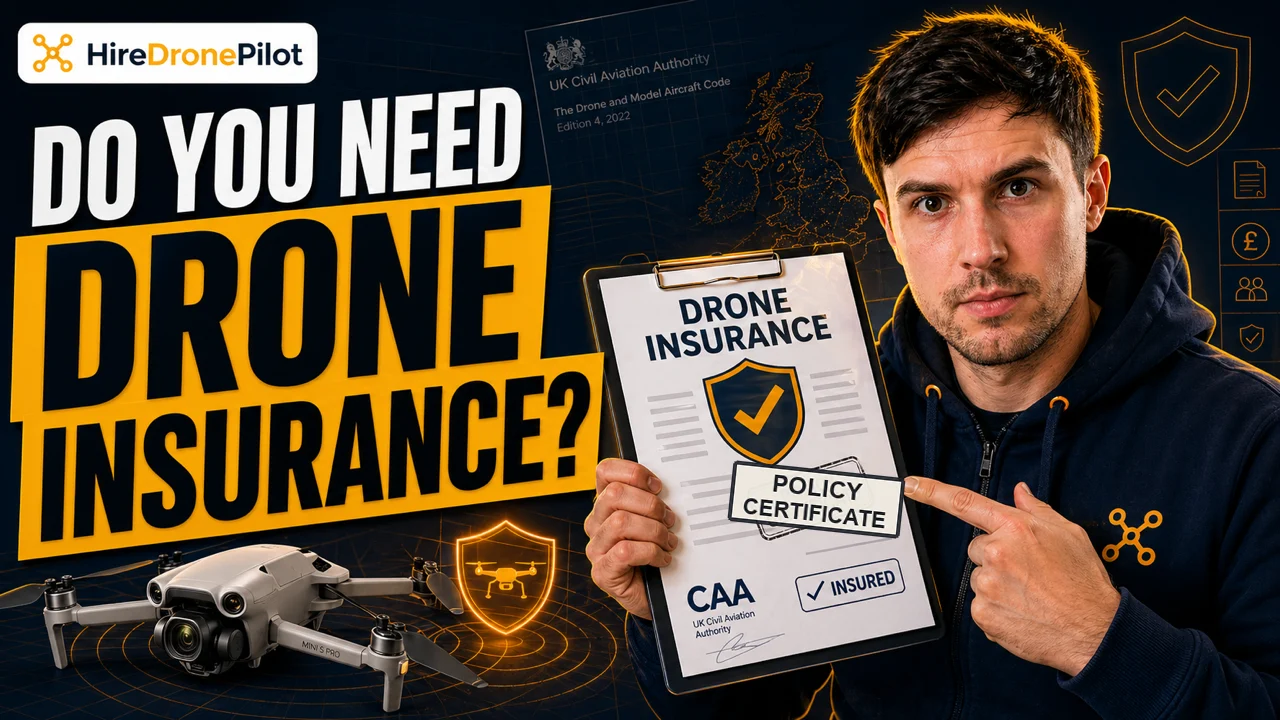
Drone insurance is one of the most-asked, least-understood subjects in the UK drone world. The law draws a very hard line in one place — the moment money changes hands — and is almost silent in another — recreational flying. Get the line wrong and you are either overspending for cover you do not need, or worse, flying commercially without the statutory minimum.
This guide walks through the actual legal position under UK drone laws, what compliant cover means, how insurance ties into Operational Authorisation, and what actually happens if you get caught without it. Pricing is a separate subject — our drone insurance cost guide covers the numbers. This article is about the rules.
Commercial drone operations in the UK must carry third-party insurance compliant with Assimilated Regulation (EU) 785/2004
The statutory anchor for drone insurance in the UK is Assimilated Regulation (EU) 785/2004. This is the retained EU rule on insurance requirements for air carriers and aircraft operators, and it was carried over into UK law after Brexit. It applies to drones as much as it applies to manned aircraft, and it is the reason every commercial drone flight in the UK must be backed by a compliant third-party liability policy.
The UK-specific implementation sits inside the Civil Aviation (Insurance) Regulations 2005, which is the piece of domestic legislation the CAA enforces against. A policy that does not comply with 785/2004 is, for these purposes, no policy at all — household contents cover, standard business liability cover, and motor-trade style policies all fail this test.
The trigger is commercial use, and the CAA draws the net wide. You need 785/2004-compliant insurance if you are paid to take photographs or video, paid to carry out surveys, providing a delivery service, using your drone for work on a farm, park or estate, or flying in any educational setting including schools, colleges and universities. The question is not whether you feel like a professional. The question is whether the flight has a commercial purpose.
Recreational, sport and hobby flying under 20 kg is not legally required to carry insurance
This is the exception most drone pilots care about. If you are flying a drone that weighs less than 20 kg, and the flight is genuinely for fun, sport, recreation or hobby, insurance is optional under UK law. No policy, no offence. You can legally take a Mini, an Air, a Neo or a Mavic out and fly it uninsured.
What the law does not do is remove your personal liability. You remain responsible in full for any damage or injury your drone causes, whether that is a broken greenhouse, a cracked car windscreen, or something worse involving a person or an animal. The Drone and Model Aircraft Code is explicit that an optional insurance position is not a protective one — you carry the risk, not the law.
This is why most experienced hobbyists take out some form of cover anyway. The cheapest route by a distance is membership of one of the recognised model-flying associations — the BMFA and FPV UK are the two most commonly cited — both of which bundle public liability insurance into the annual membership fee. It is not a statutory requirement, it is a decision about whether you want a single repair bill to become a legal case.
Any drone of 20 kg or above must always carry third-party insurance, regardless of how it is flown
The 20 kg threshold is the one place the recreational exemption falls away completely. The Drone and Model Aircraft Code is clear: for any drone or model aircraft 20 kg or above, third-party insurance is always required — whether you are flying a heavy survey platform for a client or a big fixed-wing model at a club field on a Saturday morning.
In practice this catches heavier Specific Category platforms, some model-aircraft operations, and any bespoke industrial build above the threshold. The reasoning is proportional to energy. A 20 kg drone falling out of the sky carries enough kinetic force that the state is no longer comfortable leaving cover to personal choice.
Weight here means the maximum take-off mass, not the bare drone weight. If you are close to the threshold with added payload, sensors or a green flashing light for night work, check the numbers carefully — the insurance requirement follows the real flying weight, not what is printed on the box.
Third-party liability is the legally required layer — hull and equipment cover is optional and separate
Drone insurance policies routinely bundle two very different things together, and it is worth pulling them apart. Third-party liability is the layer the law cares about: cover for damage your drone causes to other people or property. Hull cover — sometimes called equipment or physical-damage cover — protects the drone itself against crash, flyaway, theft and loss. Only the first of these is a legal requirement for commercial flights.
The commercial market in the UK typically sells third-party liability in tranches: £1 million, £2 million, £5 million, £10 million. A £1 million policy is the practical floor most drone pilots start with, and it satisfies 785/2004 for the vast majority of jobs. Larger works — utilities, critical national infrastructure, filming with crew, anything in central London — routinely ask for £5 million or £10 million in the contract itself, even when the underlying law requires less.
Hull cover is a business decision, not a legal one. If the drone is a DJI Neo, most drone operators self-insure. If it is a Matrice with a payload, the maths flips and equipment cover starts to make sense.
| Cover type | What it protects | Legally required? |
|---|---|---|
| Third-party liability | Injury to other people and damage to their property | Yes, for any commercial flight and for any drone 20 kg or above |
| Hull / equipment | Your own drone — crash, flyaway, theft, loss | No — optional |
| Pay-as-you-fly | Short-duration liability cover for one-off jobs | Legally counts if it is 785/2004 compliant for the flight window |
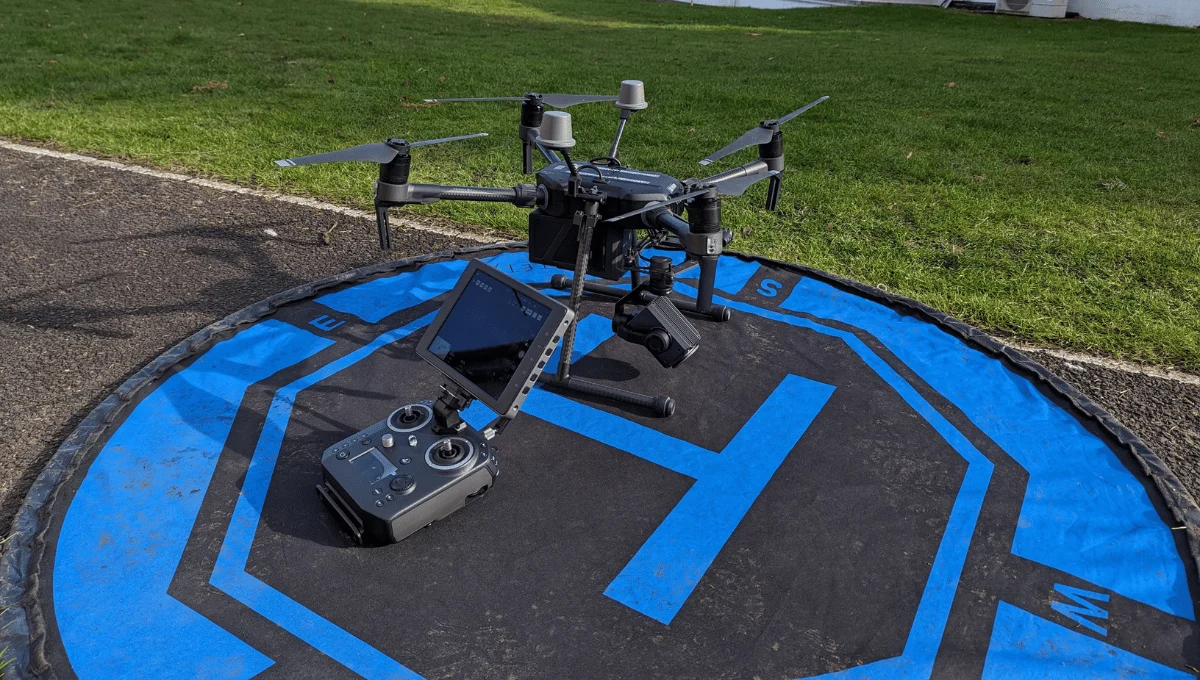
Compliant insurance is part of every Operational Authorisation application, including PDRA01
Once you step out of the Open Category and into the Specific Category, insurance stops being a background requirement and becomes a visible condition written into the authorisation itself.
PDRA01 — the pre-defined risk assessment most UK drone operators apply for first — names the insurance requirement directly: insurance cover meeting the requirements of UK Reg (EU) 785/2004 must be held. It is one of the stated operational conditions, not an administrative extra. The same expectation runs through the bespoke Specific Category route and any UK SORA authorisation issued by the CAA.
Practically, this means you upload proof of cover at application and again at renewal. The policyholder name has to match the name registered on the Operator ID, because under UK law the Operator — not the Remote Pilot — is the person legally responsible for ensuring insurance is in place. If you fly as a freelancer for somebody else's Operator ID, it is their policy that matters, not yours.
Qualification-wise, PDRA01 requires each Remote Pilot to hold a valid Flyer ID and either an RPC-L1 or a GVC. The insurance requirement sits alongside those competency checks as a document the CAA will ask to see. No compliant cover, no authorisation.
BMFA, FPV UK and similar scheme insurance is built for recreation — not for commercial work
The membership schemes most commonly mentioned in UK drone circles are the British Model Flying Association (BMFA) and FPV UK. Both include third-party liability insurance as part of an annual membership fee, and both are popular with hobbyists for exactly that reason. Scheme cover limits are typically set at £25 million, which looks enormous until you read the policy terms.
The critical constraint is scope. These schemes are written for recreational, sport and hobby flying. The cover responds when you fly for fun. It does not respond when the flight has a commercial purpose, however minor — a paid wedding flyover, an Instagram brand collaboration, a neighbour paying you fifty quid to photograph a roof. If the job is commercial, the scheme policy is not the right tool, and 785/2004-compliant commercial cover is the only route.
If you fly both ways, the cleanest setup is two policies sitting alongside each other. Scheme cover for the club field at weekends, a commercial policy for the jobs that invoice.
Flying commercially without compliant cover is a criminal offence and will invalidate your Operational Authorisation
If you are flying commercially and your insurance does not meet 785/2004, you are not just underinsured — you are flying outside UK law. The legal backbone is the Air Navigation Order 2016, and breaches of it are criminal rather than civil in nature.
The CAA has the authority to suspend or revoke an Operational Authorisation where the conditions are not being met. That is the operational consequence. Alongside it sit potential fines and, in the most serious cases — where an uninsured flight injures somebody or damages property — the prospect of personal liability that no post-incident insurance purchase can retrofit.
The commercial consequence is the one most drone pilots feel first. A reputable client asks for a certificate of insurance before the job begins; an underwriter reviews the paperwork before the cover incepts; a production company will not put a drone operator on set without proof. Flying uninsured is almost self-selecting out of the professional market.
It is also worth noting that flying outside the Drone Code in any respect — breaching VLOS, busting the 120-metre altitude ceiling, ignoring the 50-metre distance from people — will typically invalidate the policy itself, even if the cover was compliant on paper. Insurers do not pay out on flights that were never legal in the first place.
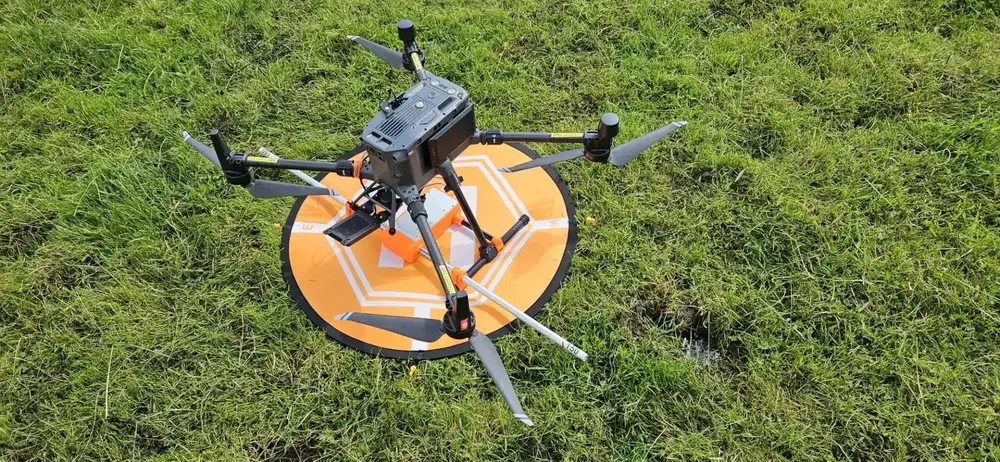
What a compliant policy should actually show on paper
Before a flight, three things should be legible on the certificate. The policyholder name must match the Operator ID registration — either your individual name or the registered organisation. The cover must state compliance with Assimilated Regulation (EU) 785/2004 in plain English. And the policy period has to include the date of the flight, not start the week after.
Beyond the legal minimum, most commercial drone pilots check three further items. Is the territorial limit correct — UK only, Europe, or worldwide? Does the cover include the specific activity you are flying, especially anything involving filming, drone photography over crowds, or roof inspections at close range? And does the liability limit meet the client's contract — because commercial contracts routinely demand more than the statutory floor.
Keep digital copies of the certificate, the schedule, and the full policy wording. A client who asks for proof of insurance wants the certificate. A client who knows what they are reading will ask for the wording too.
The short version is this. If money is involved, 785/2004 cover is the price of admission and there is no workaround. If the drone weighs 20 kg or more, the same rule applies whatever the reason for the flight. Everything else — hull cover, fleet discounts, pay-as-you-fly convenience — is a business choice layered on top of the statutory minimum.
Got a specific scenario you want covered — a borderline commercial flight, a PDRA01 question, an Operational Authorisation application stuck on the insurance step? Drop a note to peter@hiredronepilot.uk and I will come back to you directly. If you prefer the video version of this explainer, the comments are open on YouTube.
References
Primary source material for this article is the UK Civil Aviation Authority. External links open in a new tab.
- UK CAA — Insurance requirements for drones · Assimilated Regulation (EU) 785/2004, Civil Aviation (Insurance) Regulations 2005, who needs cover
- UK CAA — The Drone and Model Aircraft Code (CAP2320) · rule on insurance for drones under and over 20 kg, operator liability
- UK CAA — PDRA01 Operational Authorisation Overview · named 785/2004 insurance condition within the authorisation
- UK CAA — Where you can fly · commercial vs recreational flying and insurance obligations
- UK CAA — UK Regulatory Framework for Drones · Air Navigation Order 2016 and the UAS Regulations (945 and 947)
Peter Leslie
Founder & GVC Drone Pilot
Peter is the founder of HireDronePilot. With thousands of logged commercial flight hours, he writes about drone technology, commercial surveying tactics, and UK aviation compliance.
Connect on LinkedIn