Best Indoor Drone: The One That Will Not Wreck Your House, or Itself

Peter Leslie
31 July 2026 · 18 min read
Two things go wrong the first time somebody flies a drone in their own front room, and neither of them is a lack of skill. The drone slides sideways when nobody has touched the sticks. And then it meets something — a lampshade, a doorframe, a hand reaching out to catch it — with four unprotected propellers spinning.
Both have the same root. Indoors, a drone loses the satellite signal it uses to hold itself still, and almost nothing sold as a camera drone comes with anything covering the blades. Every other spec — megapixels, transmission range, flight time — is noise against those two.
Which is why the best indoor drone in 2026 is not the best drone. It is the one that can still see where it is with the roof over its head, wearing something around the propellers.
So this guide asks four questions about the room you actually have and the nerve you actually have, then narrows ten drones down to one. It does not rank them on camera quality, because the drone with the best camera here is also one of the worst things you could launch in a kitchen.
Then it explains the part nobody sells you: why a drone that hovers like a rock in a field wanders across your living room, exactly what its downward camera needs to see in order to stop doing that, and what propeller guards cost you in flight time — because they are not free either. By the end you will know which drone to buy, roughly what a year of owning it adds up to once the breakages are in, and why the £12.34 registration is probably still your problem even though you are flying indoors.
How I get paid: the Amazon links below are affiliate links, so if you buy through one I earn a small commission at no extra cost to you. It does not change what I recommend — my pick here is the second-cheapest drone on the page, the two most expensive ones get told off, and one of the ten has no buy link at all.
The Best Indoor Drone in 2026 Is the DJI Neo 2
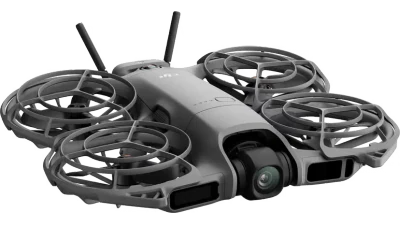
The only drone here that arrives with its propellers already covered and can see in every direction at once. Indoors, that is the whole argument.
- Propeller guards in the box, fitted. Nothing to order, nothing to forget.
- It looks in every direction, with a laser rangefinder facing forward, so it stops itself before the wall.
- 151 grams and it takes off from your palm — no controller, no run-up, no space needed.
- About 17 minutes a battery with the guards on, and a spare set of guards is one of the cheapest parts DJI sells.
- Its camera is the weak part — a 12-megapixel 1/2-inch sensor, fine for the group chat, not for a print.
Affiliate link · costs you nothing extra · full disclosure
PART ONE
The Neo 2 above wins outright. Here are the four that win the categories it does not — each with the thing that is wrong with it, because indoors every one of them is a compromise.
Best Cheap Indoor Drone: DJI Neo
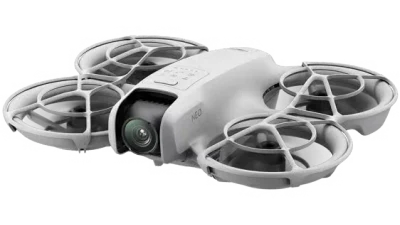
The cheapest thing on this page that is genuinely safe to launch in a kitchen.
- Full-coverage propeller guards are part of the product, not an accessory.
- It takes off from your palm and lands back on it, so you never need floor space.
- It only sees downwards. It will not brake for a wall — that part is still your job.
Best Indoor Drone for Picture Quality: DJI Flip
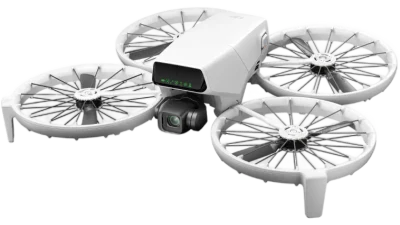
A proper 48-megapixel camera behind cages that do not come off.
- Permanent propeller cages, not clip-on guards. There is nothing to leave in the box.
- A 1/1.3-inch, 48-megapixel camera — the same class of sensor as a Mini 4 Pro.
- It sees down and forwards, but not sideways or up, so ceilings still catch it out.
Best Indoor Drone for Flying Through Goggles: DJI Avata 2
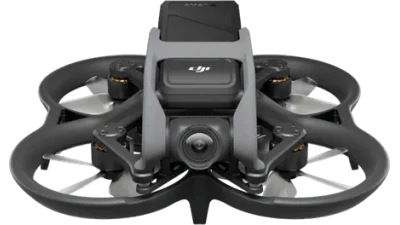
Ducted, tough, and built for exactly the shot everyone wants: straight through a doorway without stopping.
- Ducted propellers, built to be flown into things. Indoors it is the toughest drone here.
- It will not fly without goggles, so the real price is the combo price, not the drone price.
- Outdoors, from January 2028 it needs the A2 test to fly near people. Indoors that rule never applies.
Best Indoor Drone for a Barn or a Warehouse: DJI Mini 5 Pro
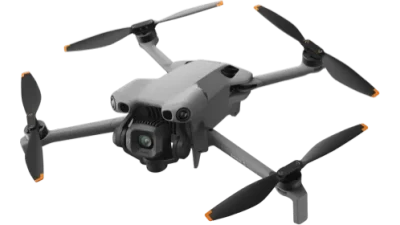
The only drone here that can still see the floor in a dim, cavernous space — which is the space where the others give up.
- Its vision system is rated to 1 lux against 15 on everything else here — it holds still in a dim hall.
- A one-inch, 50-megapixel camera that focuses from half a metre, so close-up work actually works.
- No guards, 380 mm across, and the most expensive thing here to repair.
Affiliate links · costs you nothing extra · full disclosure
Take the quiz: find the best drone for your room
Four questions about the space you have and how much you mind breaking things.
- Matched to your actual room, not a generic top ten.
- Judged on guards and position-holding first, camera second.
- Every DJI drone here is one I have flown myself.
- About 20 seconds, and no email needed.
STEP 1 OF 4
10 of 10 still fit
All ten, and what each one does in a real room
-
DJI Neo
135 g · C0 · guards in the box · downward vision only · 17 min
The cheapest drone in Britain that is genuinely safe to launch in a kitchen. I have flown it round my own house and it is a toy in the best possible sense.
- Full-coverage propeller guards are part of the product, not an accessory.
- It takes off from your palm and lands back on it, so you never need floor space.
- It only sees downwards. It will not brake for a wall — that part is still your job.
-
BETAFPV Cetus Pro no buy link — sold out at BETAFPV
33 g · ducted frame · no position hold at all · 4–5 min · goggles included
The purist’s indoor drone: a 33-gram ducted whoop you fly on sticks through goggles. It is also the only thing here that will not hold itself still for a single second, which is the entire point of it and the reason I cannot recommend it to you.
no link- No buy link: BETAFPV has it sold out and Amazon UK carries only spare parts.
- Four to five minutes a battery, and no camera worth calling a camera.
- It has no position hold whatsoever. Let go of the sticks and it drifts into a wall.
-
DJI Neo 2
151 g · C0 · guards in the box · omnidirectional sensing · 17 min
Guards fitted out of the box and eyes on every side, which no other drone here manages at the same time. In my hands it is the first small drone that stops itself rather than making me do it.
- Propeller guards in the box, fitted. Nothing to order, nothing to forget.
- It looks in every direction, with a laser rangefinder facing forward, so it stops itself before the wall.
- 151 grams and it takes off from your palm — no controller, no run-up, no space needed.
-
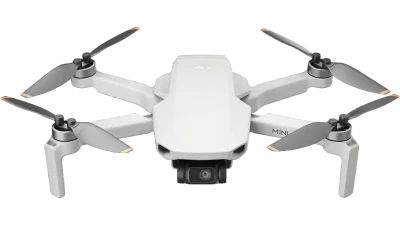
DJI Mini 4K DJI has replaced it with the Lito 1
246 g · no guards · downward vision only · 31 min · no test needed
A perfectly nice first drone for a park and a genuinely poor one for a hallway. Nothing covers the propellers, and nothing is going to stop it hitting the ceiling except you.
- No guards, and nothing looking forward. Every wall is your responsibility.
- Its propellers span 362 mm unfolded — wider than most doorways feel once it is moving.
- DJI UK now sells the Lito 1 in its place, so you are buying up remaining stock.
-
DJI Flip
<249 g · C0 · full propeller cages · downward vision · 31 min
The only drone here with a properly good camera behind cages you cannot remove. I have handed it to nervous people more often than anything else I own.
- Permanent propeller cages, not clip-on guards. There is nothing to leave in the box.
- A 1/1.3-inch, 48-megapixel camera — the same class of sensor as a Mini 4 Pro.
- It sees down and forwards, but not sideways or up, so ceilings still catch it out.
-
DJI Lito 1 camera focuses no closer than 4 m
249 g · C0 · no guards in the box · omnidirectional sensing · focus from 4 m
DJI’s replacement for the Mini 4K, and a big step up outdoors. Indoors it has one flaw that settles the argument: its lens cannot focus on anything nearer than four metres.
- Fixed focus from four metres to infinity. Most of a house is inside that distance.
- The cheapest folding drone DJI sells with sensing on every side, which is the good news.
- No propeller guard in the box, and DJI quotes 249 g standard against about 340 g with guards fitted.
-
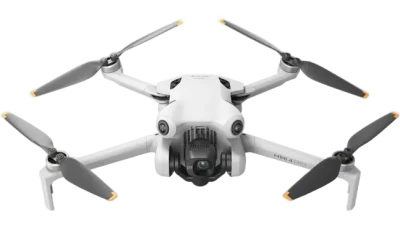
DJI Mini 4 Pro
<249 g · C0 · no guards in the box · omnidirectional sensing · 34 min
Sees in every direction and still arrives with nothing over the blades. A superb drone that I would fly outdoors and carry, folded, through my own house.
- No propeller guards included, and DJI itself warns against hanging extra weight on a Mini.
- 373 mm across with the propellers out — bigger than it sounds in a hallway.
- Its vision system wants better than 15 lux, which is brighter than a lot of rooms in winter.
-
DJI Mini 5 Pro
249.9 g · C0 · no guards · sees down to 1 lux · 36 min
The only drone here whose eyes are rated for a genuinely dim room, and the only one with a one-inch camera. It is also 380 mm of naked propeller, which is why it belongs in a barn and not a bedroom.
- Its vision system is rated to 1 lux against 15 on everything else here — it holds still in a dim hall.
- A one-inch, 50-megapixel camera that focuses from half a metre, so close-up work actually works.
- No guards, 380 mm across, and the most expensive thing here to repair.
-
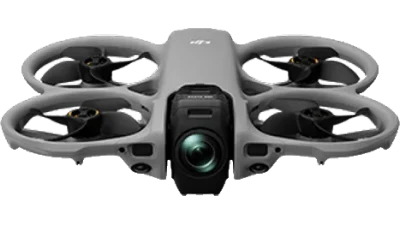
DJI Avata 360 loses privileges in 2028
455 g · C1 · ducted propellers · sees down to 1 lux · 23 min
Ducted blades, eyes everywhere and a 360-degree camera, which is a startling combination to fly through a building. Also 455 grams of it, moving, indoors.
- The propellers run inside ducts, so a wall strike is a bounce rather than a repair.
- 455 grams. Indoors that is a lot of energy looking for something to hit.
- Outdoors, from January 2028 its C1 mark stops counting and it needs the A2 test to fly near people.
-
DJI Avata 2 loses privileges in 2028
377 g · C1 · ducted propellers · downward vision · 23 min
The drone that made flying through doorways a genre. Ducted, tough and completely at home in a building — and the only way to buy one that flies is the combo with the goggles in it.
- Ducted propellers, built to be flown into things. Indoors it is the toughest drone here.
- It will not fly without goggles, so the real price is the combo price, not the drone price.
- Outdoors, from January 2028 it needs the A2 test to fly near people. Indoors that rule never applies.
Rows are ordered cheapest first, and each Amazon link points at the exact configuration described — on the Avata 2 that means the combo with the goggles in it, because the drone alone will not fly. Drone prices move constantly, so this guide does not print them; the link shows you the current one. Two products have no photograph in the open dataset this site uses, so they carry a plain label instead. Comparison specifications from DroneCompare, CC BY 4.0.
PART TWO
Why flight without GPS is hard, and why guards are not optional
Here is the thing that catches everybody. A drone hovering over a field looks like it is doing something clever. It is not. It is doing something extremely simple: asking a constellation of satellites where it is, several times a second, and correcting itself whenever the answer changes.
Take the sky away and that conversation stops. Under a roof the satellite signal a drone uses to navigate is reflected, blocked and delayed by everything between it and the sky. The drone does not crash when this happens. It does something more unsettling: it carries on flying, perfectly stable, with no idea that it is moving.
What it uses instead, and what that needs
Every drone in this guide has a fallback. There is a small camera pointing at the floor, and usually an infrared or laser sensor beside it measuring height. The camera photographs the floor many times a second, compares each frame with the last, and works out which way the drone has slid. Fly over a paving slab and it can see the aggregate move. That is vision positioning, and indoors it is doing all the work.
When it works it is better than satellites, not worse. DJI publishes both numbers for its drones and the gap is not close.
HOW STILL IT HOVERS — DJI NEO 2
| DRIFT | ON SATELLITES | ON VISION |
|---|---|---|
| Up and down | ±0.5 m | ±0.1 m |
| Side to side | ±1.5 m | ±0.3 m |
Three metres of possible wander on satellites, against sixty centimetres on vision. In a field the first number is invisible. In a hallway it is the width of the hallway.
So the indoor problem is not that vision positioning is worse. It is that vision positioning has conditions, and your house probably breaks at least one of them. DJI states them plainly in the specifications for every drone it sells, and they are the four most useful lines on the whole page.
WHAT THE DOWNWARD CAMERA NEEDS
-
A surface with a discernible pattern
Plain carpet, a single-colour rug, a sheet of MDF: nothing for the camera to lock on to. It is trying to spot a texture moving. Give it nothing and it has nothing.
-
Diffuse reflectivity above 20 per cent
DJI’s own example is concrete pavement. Gloss laminate, polished wood and anything with water on it reflect rather than scatter, and the picture the camera gets back is a light, not a floor.
-
Adequate lighting — brighter than 15 lux
That is the figure DJI gives for the Flip, the Avata 2 and the Mini 4 Pro. The Mini 5 Pro and the Avata 360 are rated down to 1 lux, which is a genuinely different machine in a dim room.
-
Height between about half a metre and ten
DJI quotes a precise hovering range of 0.5–10 m on the Neo and the Flip. Below half a metre the floor is too close to read, which is exactly the height at which people try their first indoor take-off.
Read those four together and the classic indoor accident writes itself. A plain cream carpet, a lamp on in one corner at six in the evening, and a first hover at knee height. The drone has no pattern, not enough light and is too low to focus. It does not warn you, because from its point of view nothing is wrong. It simply stops holding still, and by the time you notice it is going somewhere, it is going there at walking pace.
There are two ways round it and you should use both. Put something patterned on the floor — a doormat, a towel, a landing pad, anything with edges in it — and turn the lights on properly. And take off from your hand rather than the floor, which is precisely why the Neo, the Neo 2 and the Flip all launch off a palm. That is not a party trick. It puts the drone straight into the height band where its eyes work.
And then the propellers
Everything above explains why the drone will, at some point, go somewhere you did not intend. Guards are the part that decides what happens next.
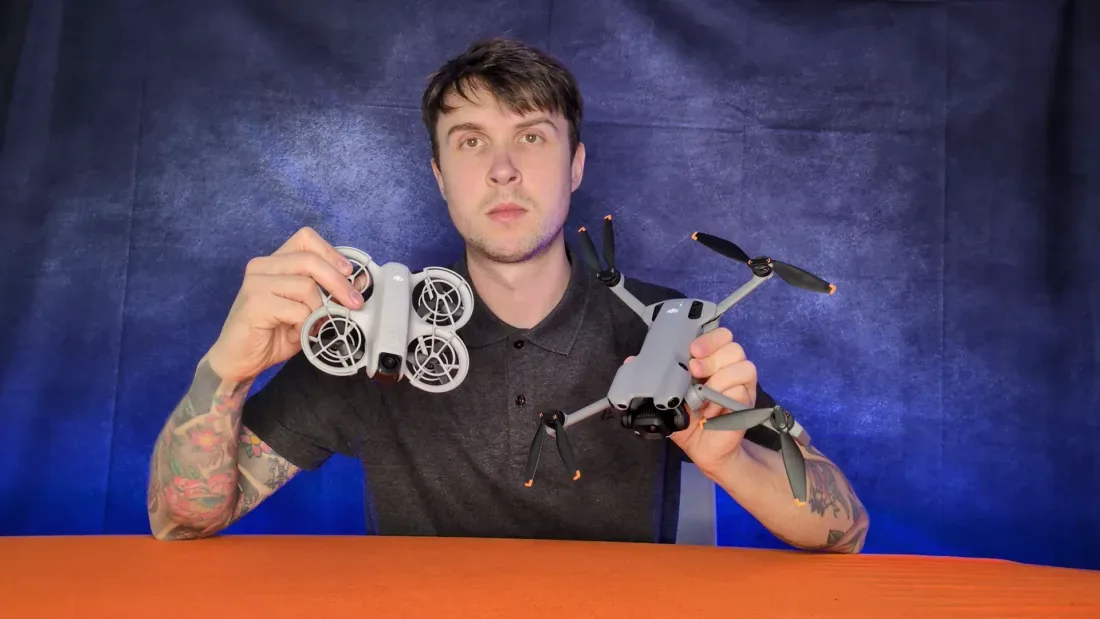
That is the entire argument in one photograph. On the left, four propellers you cannot get a finger into. On the right, four carbon-plastic blades on an open arm, spinning fast enough to be invisible. Outdoors the right-hand drone is the better machine by a distance. Indoors it is the one that takes a chunk out of a doorframe, a lampshade, or the hand of whoever tries to catch it.
Guards do two separate jobs and people usually only think of the first. They stop the drone hurting the room and the people in it. But they also stop the room hurting the drone: a guarded drone that clips a wall bounces off and keeps flying, where an unguarded one snaps a propeller, tips, and lands on its camera. That matters more than it sounds, because the two outcomes are not on the same scale: on every drone here a replacement set of propellers is among the cheapest parts the manufacturer sells, while the gimbal that holds the camera steady is the single most fragile and most expensive part of any of them. A guard is what stands between one of those and the other.
The rule I would give anybody: if you cannot put your finger flat against the guard and feel it stop before the blade, the drone does not fly indoors. That single test rules out four of the ten drones on this page, including the best camera on it.
Guards are not free, and here is the bill
I would still fit them every time, but let us be honest about what they cost, because the marketing never is. A guard is drag and it is weight, and both come out of your flight time. DJI publishes the before and after.
| DRONE | WITHOUT GUARDS | WITH GUARDS |
|---|---|---|
| DJI Neo flight time | 18 min | 17 min |
| DJI Neo 2 flight time | 19 min | 17 min |
| DJI Lito 1 take-off weight | 249 g | up to 340 g |
Two minutes off a Neo 2 is a tenth of the flight, and I would pay it without thinking. The Lito 1 line is the one worth staring at — see below.
That last row is the trap nobody mentions. On a folding drone sold at 249 grams, fitting propeller guards takes it over the line. DJI states the Lito 1’s standard take-off weight as about 249 g and its maximum, with the guards and a card fitted, as about 340 g. On the Mini 4 Pro, DJI goes further and tells you not to hang a propeller guard on it at all when the larger battery is in, because the propulsion cannot carry it.
Indoors none of that matters, because indoors weight classes are irrelevant. The instant you step into the garden it matters a great deal, and it is covered properly in the next section. The short version: a 249-gram drone with guards on is not a 249-gram drone.
The UK rules for flying a drone indoors, which are almost none
This is the happiest paragraph in any drone article I have written. Indoors, nearly all of it goes away. There is no height limit to break, because there is a ceiling. There is no requirement to keep the drone in sight, no minimum distance from other people, no airspace to check and no restricted zone in your own living room.
And the registration goes away too. The Civil Aviation Authority — the body that runs all of this in Britain — states it directly. You do not need a Flyer ID or an Operator ID if you will only fly indoors, or somewhere the drone has no possibility of escaping, such as within a closed netted area.
The word doing all the work is “only”
That exemption holds for as long as the drone never goes outside. Not the garden. Not the balcony. Not once, on a still Sunday, to see what the roof looks like. The moment it does, you are in the ordinary rules with no grace period, and there are two of them.
A Flyer ID is a free online multiple-choice test about where you may fly. Pass it and it lasts five years. Any drone weighing 100 g or more needs one.
An Operator ID is a registration, not a test. It costs £12.34 a year, covers every drone you own, and its number goes on a label stuck to the drone. Any drone weighing 100 g or more with a camera needs one.
Nine of the ten drones on this page weigh more than 100 grams and carry a camera, so all nine need both the moment they leave the house. Only the Cetus Pro escapes, and only because it weighs 33 grams: under the 100-gram line the Flyer ID is recommended rather than required and the Operator ID is optional.
My honest advice: pay the £12.34 and do the free test anyway. “I am only ever flying indoors” is a promise almost nobody keeps past the first sunny afternoon, and the registration is the price of never having to think about whether you have broken it. If you do take it out, flying a drone in your own garden has its own set of gotchas, most of them about the neighbours rather than the CAA.
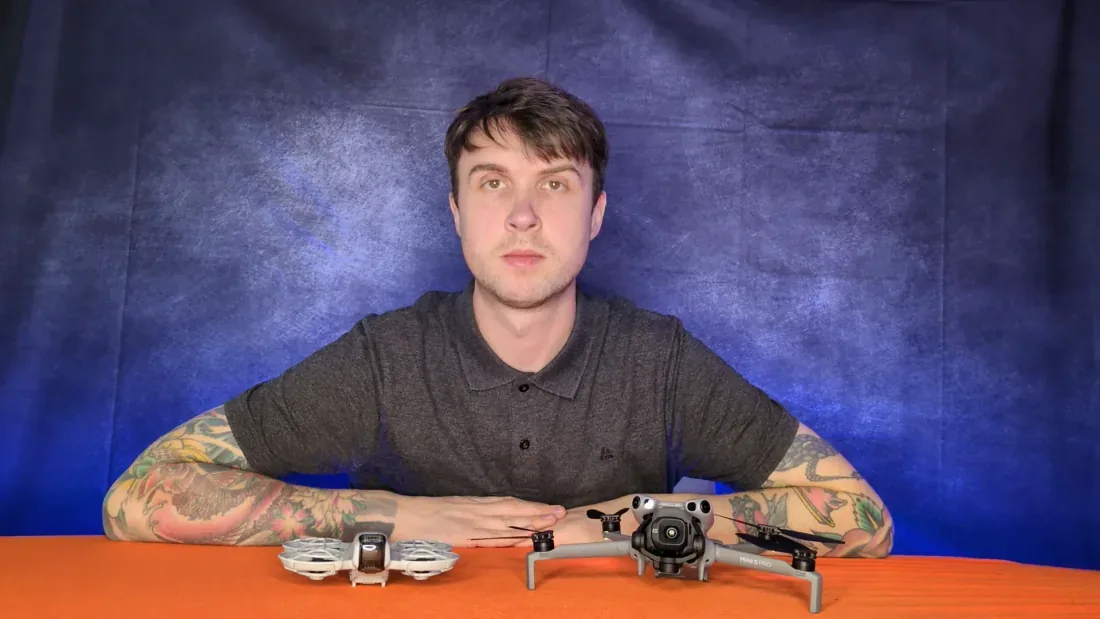
Who is the operator, if you bought it for a child
Worth knowing before you buy, because it surprises people. The Operator ID belongs to a person, and you must be 18 or over to hold one. Whoever registers is the operator in law and is responsible for the drone, whoever happens to be holding the controller. Buy a Neo for a ten-year-old and the drone is legally yours in every sense that matters.
The one outdoor rule that should change what you buy
Two drones here, the Avata 2 and the Avata 360, carry a European C1 class mark. Until 31 December 2027 the UK lets a C-marked drone be flown as its UK equivalent. From 1 January 2028 that stops, and each becomes a legacy drone judged on weight alone. Both weigh well over 250 grams, so from that date flying either of them near other people needs an A2 Certificate of Competence — a paid theory test of at least thirty questions taken with a CAA-approved assessor.
Indoors that change means nothing at all. But if part of your reasoning for buying an Avata 2 — already one of the most expensive ways onto this page, because the drone will not fly without the goggles and the goggles are most of what you are paying for — is that you might take it outside, understand you are buying about eighteen months of doing that without a qualification. Everything else on this page is under 250 grams and is unaffected — which is the same reason the sub-250-gram class keeps winning these guides.
PART THREE
What you will break, in the order you will break it
Outdoor drone guides price the hobby in filters and memory cards. Indoors the running cost is different, because indoors you hit things. Not might — will. Every wall, ceiling and door handle in your house is inside the drone’s stopping distance.
So here is the bill in the order it actually arrives, using the DJI Neo 2 because that is what I am recommending. Every part in it is one DJI sells for that drone, listed in the order you will find yourself ordering them, and ranked cheapest first — which turns out to be the same as soonest first, and is the whole argument of this section.
THE ORDER OF EVENTS
-
WEEK ONE
A propeller, from clipping a doorframe
The cheapest thing that can go wrong and the one that always goes first. A spare set of Neo 2 propellers is the least expensive part in this entire article — comfortably the cheapest line on the bill. Buy two sets with the drone and stop thinking about it.
-
WEEK TWO
A propeller guard, from the same doorframe
The guard is a consumable. It is meant to take the hit. A replacement Neo 2 guard costs a few times what a set of propellers does and a tiny fraction of a gimbal repair, which makes it the best money in this article and the reason I will not recommend a drone with nothing over its propellers.
-
MONTH ONE
Your patience, at seventeen minutes a battery
Indoor flying is short bursts. You will land, look at the clip, and want to go again. A second Neo 2 battery is a small fraction of what the drone cost, and it is the upgrade that changes the experience most.
-
MONTH THREE
Something that is not the drone
A lamp, a vase, a photo frame, the paint on a doorframe. Nobody budgets for this and everybody pays it, and by then it is usually costing more than the propellers and the guard put together. Put aside enough to replace one ordinary household thing, and fly with the good crockery put away.
-
THE ONE THAT HURTS
The gimbal, from a landing on a hard floor
The little motorised cradle holding the camera is the most delicate assembly on any drone, and it is on the underside where it meets the floor first. This is the repair that makes people give up. It is also the one guards do most to prevent, because a guarded drone bounces flat instead of tipping onto its nose.
Add it up and the Neo 2 is not a one-line purchase. Year one is the drone, two sets of propellers, a spare guard, a second battery, the £12.34 registration you should pay whether or not you go outside, and that allowance for the lamp — which lands you roughly half as much again as the figure on the box. That is the multiplier to carry in your head when you compare two drones, not the sticker. It is not a nasty surprise if you decide on it deliberately, and every line of it is small, which is the point.
Now run the same sum on the drone a lot of people nearly buy instead. A Mini 5 Pro costs more than three times the Neo 2 before you have broken anything, arrives with nothing over its propellers, and puts its gimbal 380 mm out between four bare propellers. One bad landing on a tiled kitchen floor and the gap between the two decisions stops being about cameras.
The one-sentence version. Indoors, the cost of owning a drone is the cost of the parts you break, so buy the drone with the cheapest parts and the best chance of not breaking them — not the one with the best sensor.
Five minutes of setting up that saves all of it
None of this needs buying. It is just the routine I go through before I fly anything in a room, and it removes most of what goes wrong in Part Two.
-
Put a patterned mat where you will take off and land
A doormat, a folded towel, anything with edges. You are giving the downward camera something to read.
-
Turn every light on, including the ones you never use
Most of these drones want more than 15 lux under them. An evening room lit by one lamp is not it.
-
Take off from your palm, not from the floor
It skips the sub-half-metre band where vision positioning has nothing to work with, and it means no dust storm.
-
Close the doors and shut the animals out
A drone that leaves the room you are in has left the only room you have made safe.
-
Fly at chest height, not head height
Ceilings pull a drone towards them as the downwash bounces back. Staying low keeps you out of that entirely.
PART FOUR
The best indoor drone for most people in 2026
The DJI Neo 2, the second-cheapest drone on this page. It is not close, and it is not close for a reason that has nothing to do with its camera.
Everything above comes down to two questions: can the drone tell that it is drifting, and is there anything over the blades when it stops being able to. The Neo 2 is the only drone on this page that answers both in the box. Guards fitted on arrival, sensing on every side, and a laser rangefinder facing forwards so it slows down before the wall rather than after it. At 151 grams it launches off your palm, which puts it straight into the height where its eyes work, and lands back on it, which keeps it off the floor entirely. That is the whole of not wrecking your house, or itself.
Its camera is the weak part and I am not going to dress that up: a 12-megapixel 1/2-inch sensor is a camera for the group chat, not for anything you would print. But indoors you are shooting a room from three metres away in artificial light. No sensor in this price class was ever going to make that beautiful, and the difference between a good indoor clip and a bad one is whether the drone was steady, not whether it had a bigger sensor.
Spend less if you want to find out whether you enjoy this. The DJI Neo is the same idea with simpler eyes — guards in the box, palm launch, and it will happily potter round a front room. It cannot see forwards, so it will not stop itself, and at close to half the money that is a fair trade. It is also the cheapest thing here I would put in a child’s hands, and the only one on the page I would not be furious about crashing.
Spend more only for the camera. The DJI Flip costs meaningfully more than the Neo 2 and wraps a proper 48-megapixel camera inside cages you physically cannot remove. It is the drone I would choose if the footage mattered as much as the flying. Its weakness is that it sees down and forwards but not up or sideways, so it is the one that finds your ceiling. If you have read the beginner drone guide and liked the sound of the Flip, this is the same recommendation for a different reason. Past that, you are into what five hundred pounds actually buys, and none of it buys you anything indoors.
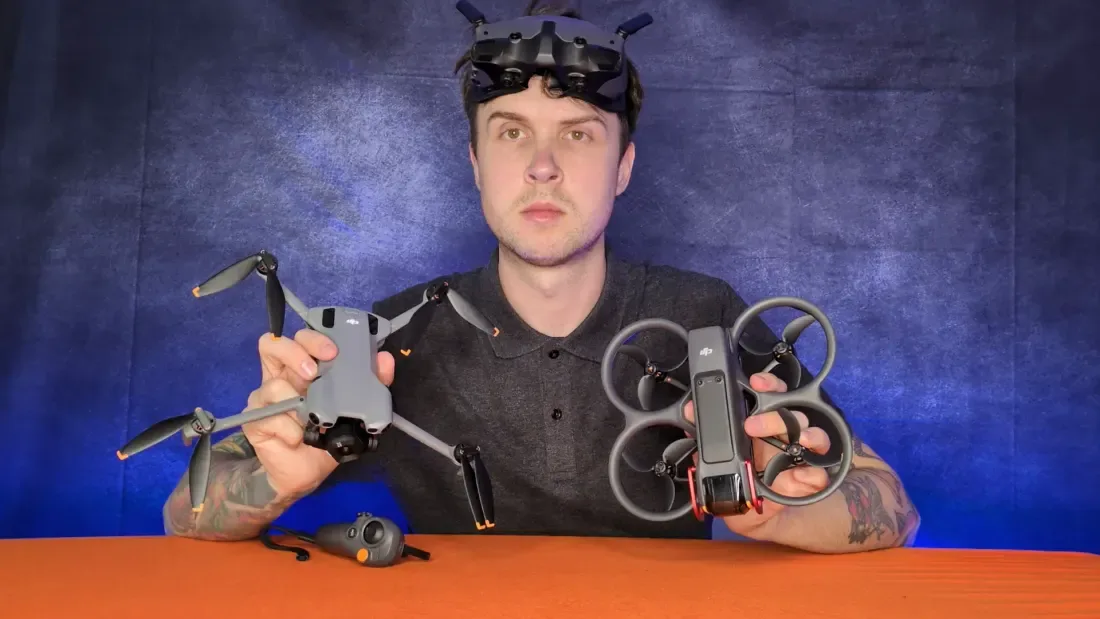
The one I’d actively tell you not to fly indoors
The DJI Mini 5 Pro, and it pains me, because it is the best drone on this page by a mile and I would take it over everything else here for any flight that happens outside.
But look at what you would be doing with it. It is 304 by 380 mm with the propellers out, which is a chopping board with four exposed blades on the corners. There is no propeller guard in the box, and on its sister drone DJI explicitly warns against bolting one on. It costs more than three times what my pick does, and the part nearest the floor is the most expensive component on it. The single genuine indoor advantage it has — a vision system rated to 1 lux, where everything cheaper wants 15 — only pays off in a space big enough that you were never going to hit anything anyway.
If you have a barn, a riding school or an empty warehouse, take it and enjoy yourself: that is why it won its category above. In a three-bedroom semi it is an expensive way to learn a lesson that a drone costing a third as much teaches you for nothing.
And if what you actually want is one good set of interior shots rather than a hobby — an estate agent’s walkthrough, a venue, a factory floor — buying a drone is usually the expensive way round. You can hire a qualified drone pilot who already owns the drone, the guards and the insurance, and who has hit somebody else’s ceiling before rather than yours.
Best indoor drone: the questions I get asked most
What is the best indoor drone in 2026?
The DJI Neo 2, which is the second-cheapest drone on this page. It is the only drone I know of that arrives with its propeller guards in the box and can see in every direction at once, which are the two things that decide whether a flight indoors ends well. It weighs 151 grams, takes off from your palm without a controller, and its omnidirectional sensing plus a forward-facing LiDAR will stop it before it reaches a wall. Spend less and the DJI Neo does the same trick with a simpler set of eyes for close to half the money; spend more and the DJI Flip puts a far better camera inside full propeller cages.
Do I need to register a drone if I only fly it indoors?
No. The Civil Aviation Authority states that you do not need a Flyer ID or an Operator ID if you will only fly indoors, or somewhere the drone has no possibility of escaping, such as a closed netted area. The word doing the work there is “only”. The moment the drone goes outside — and your own garden counts as outside — the normal rules apply: anything weighing 100 g or more needs a free Flyer ID, and anything weighing 100 g or more with a camera also needs an Operator ID at £12.34 a year.
Why do drones drift indoors when they hold position perfectly outside?
Because the satellites are gone. Outdoors a drone anchors itself with GPS. Under a roof that signal is unusable, so the drone falls back on a downward-facing camera that watches the floor and works out how far it has moved. DJI publishes the conditions that camera needs: a surface with a discernible pattern, diffuse reflectivity above 20 per cent, and adequate lighting — brighter than 15 lux on most of its drones. Plain carpet, a gloss floor or a dim room takes the pattern away, and a drone that cannot see the floor cannot tell that it is moving.
Are propeller guards really necessary indoors?
Yes, and I would treat that as non-negotiable rather than cautious. Indoors there is a wall, a ceiling, a lamp or a person within a couple of metres in every direction, and an unguarded propeller turns a light contact into a cut hand and a broken motor arm. Guards cost you something real — DJI’s own figures put the DJI Neo at 18 minutes of flight without its guards and 17 with them — but a replacement guard for a DJI Neo 2 costs less than one set of replacement propellers does on most drones.
Can you fly a DJI Mini indoors?
You can, but it is the wrong tool and it is the single most common way people break a drone. A DJI Mini 5 Pro measures 304 by 380 mm with its propellers out, which is most of a coffee table, and DJI does not include propeller guards with any Mini in the box. The Mini 5 Pro is genuinely the best of them in a dim room because its vision system is rated down to 1 lux rather than 15, so if you have a hall or a barn to fly in it will hold position where cheaper drones will not. In an ordinary front room, buy something the size of a paperback instead.
What is the safest drone to fly around children?
A drone whose propellers you cannot reach. That means the DJI Neo or DJI Neo 2, which arrive with full-coverage guards fitted, or the DJI Flip, whose propellers sit inside permanent cages you cannot take off. All three are under 250 grams, all three take off from your hand, and none of them needs a licence or a test. It is also worth knowing who is responsible: whoever registers for the Operator ID is the operator in law, so if you buy a drone for a child, that is you.
The short version
If you read all of that and still want me to just say it: buy the DJI Neo 2. It is the only drone here that arrives with its propellers covered and can see in every direction, and it will land back in the palm you launched it from. Budget for a spare set of propellers and a second battery, and put the ornaments away first.
Affiliate links · costs you nothing extra · full disclosure
This guide does not print prices. Drone prices move constantly and Amazon’s terms allow a site like this one to show them only where Amazon itself serves the figure, so the honest version is the live one on the other end of the link. Sensing, weight, lighting and flight-time figures are from the manufacturers’ own specification pages. Regulatory detail from the UK Civil Aviation Authority. Comparison specifications from DroneCompare, licensed under CC BY 4.0. Amazon links are affiliate links.