Best Professional Drone UK 2026: What I’d Put on a Paid Job

Peter Leslie
31 July 2026 · 20 min read
A hobby flight that goes wrong costs you a photograph. A paid flight that goes wrong costs you the job, the client, an insurance claim, and a day you cannot re-fly because the scaffolding comes down on Friday.
That is the whole difference, and almost nothing in a drone review is written about it. Reviews are written about sensors. The question you are actually asking is which of these will still be flying when something has already gone wrong, and what does the law want from me before anyone is allowed to pay me for it.
Answer those honestly and the ranking changes. There is a drone on this page that costs more than the model built to replace it, and gives you worse eyes, an older radio and a shorter flight for the extra money. There is a 249.9-gram drone that can legally work in streets the most expensive drone here is not allowed to go near. Neither of those facts is on a spec sheet under a heading you would think to read.
So the best professional drone in 2026 is not the one with the biggest sensor. It is the one that gets you home, gets you paid, and does not need a conversation with your insurer afterwards.
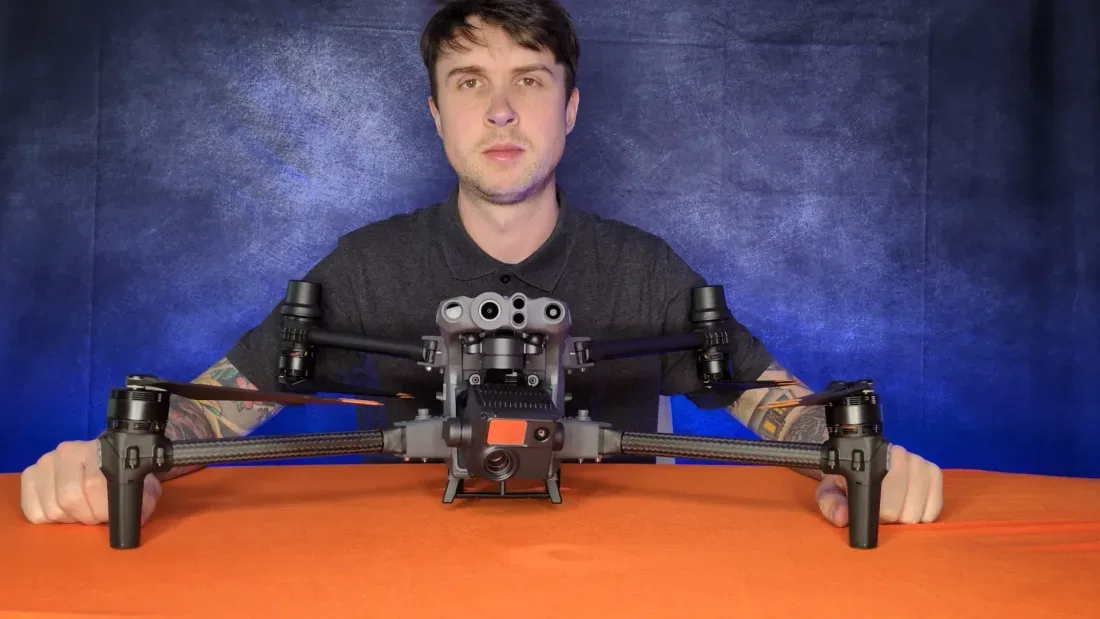
I have flown every DJI drone made, from the palm-sized ones up to the Matrice above, and I have been paid to fly a good many of them. The pattern is boring and consistent: the jobs that go wrong go wrong for reasons that have nothing to do with the camera.
So this guide does three things. It asks four questions about the work you intend to take on, then narrows eleven drones to the one that fits. It explains, precisely and without blurring them together, what registration, what insurance and what qualification UK law actually requires — because they are three separate things and only two of them are triggered by being paid. Then it puts a real number on year one, which is roughly double what you think it is.
How I get paid: the Amazon links below are affiliate links, so if you buy through one I earn a small commission at no extra cost to you. It does not change what I recommend — two of the eleven drones here have no buy link at all, and one of the most expensive is in the section headed “the one I’d avoid”.
The Best Professional Drone in 2026 Is the DJI Mavic 4 Pro
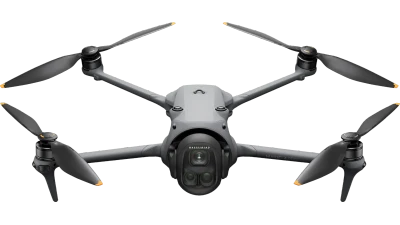
Bought as the three-battery combo, it is the only drone here built to finish a job after something has already gone wrong.
- Obstacle sensing that still works at 0.1 lux, which is effectively dusk. Everything else here gives up somewhere between 1 and 15 lux.
- Three batteries in the box at 51 minutes each, and a three-band radio — so a long job does not become two visits, and a noisy site does not end one early.
- Three focal lengths on one flight — 28, 70 and 168 mm equivalent — so you reframe without repositioning.
- It weighs 1,063 g and carries a C2 class mark, so budget for an A2 Certificate of Competence, or an Operational Authorisation if you want to work in a street.
Affiliate link · costs you nothing extra · full disclosure
PART ONE
Here are the five that win their categories outright — each with the thing about it that will annoy you, because a working kit has no room for surprises.
Best Professional Drone for Working Over People: DJI Mini 5 Pro
On a terraced street this is not the cheaper option. It is the only one of the two you can legally fly.
- Under 250 g in this configuration, so it works over uninvolved people with no A2 test and no Operational Authorisation.
- A one-inch, 50-megapixel camera and sensing that works down to 1 lux.
- One camera and one focal length. Everything you cannot reach, you crop.
Best Value Professional Drone: DJI Air 3S
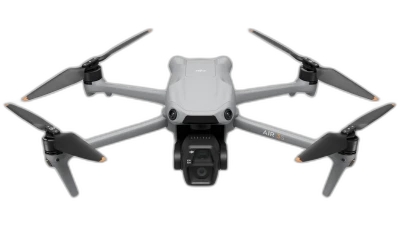
Better eyes, a newer radio and a longer flight than a Mavic 3 Pro costing a thousand pounds more.
- A 70 mm second camera, so you can stand three times further back for the same detail.
- Omnidirectional sensing plus a forward laser down to 1 lux, and 45 minutes a battery.
- Its C1 mark lets it work over people until 31 December 2027. From January 2028 it needs the A2 test.
Best Backup Drone for a Working Kit: DJI Mini 4 Pro
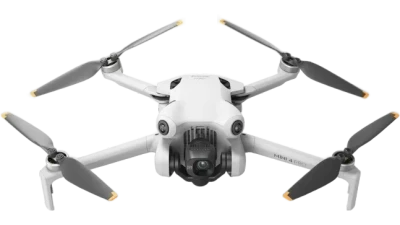
The cheapest drone here that still sees in every direction. A second drone is the only real redundancy a sole trader can buy.
- Obstacle sensing all round, which nothing else at this money offers.
- Under 249 g, so it can finish a job in places your main drone is not allowed to go.
- One battery in the box and sensing that stops working below 15 lux.
Best Professional Drone for Filming an Interior Walkthrough: DJI Avata 2
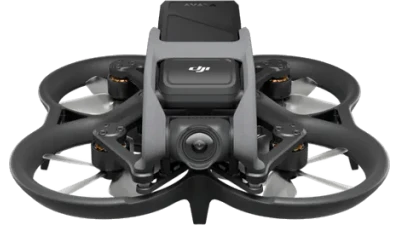
It sells a continuous walkthrough of a building that nothing else in this guide can shoot.
- Built-in propeller guards and goggles in the box, so it is bought and flown as one system.
- The law requires a second person watching it whenever you fly through goggles — price the job for two.
- From January 2028 it needs the A2 test to work near people, and it senses only downwards and backwards.
Best Professional Drone for a One-Person Interior Job: DJI Flip
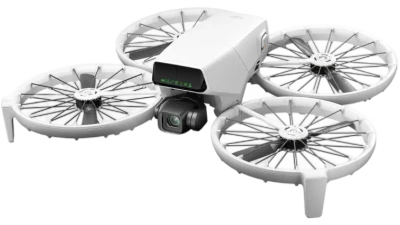
Caged like the Avata 2, but under 250 g and flown by one person — the difference between quoting an interior job and staffing one.
- Full propeller cages built in, so it is the one here I would fly in a room with a client standing in it.
- No goggles, so no observer. The law puts a second person beside you on every Avata 2 flight; this one you quote as a single day.
- Forty-eight megapixels on a 1/1.3-inch sensor and three batteries in the box — printable interior stills, and enough power to cover a whole floor in one visit.
- It watches forwards and downwards only and gives up below 15 lux, so indoors the cages are doing the work, not the sensing.
Affiliate links · costs you nothing extra · full disclosure
Take the quiz: which drone fits the work you are taking on?
Four questions about the work and the paperwork. Then one drone.
- Scored on redundancy and legal reach, not on megapixels.
- Every DJI here is one I have flown myself.
- Tells you which qualification the answer commits you to.
- About 20 seconds, and no email needed.
STEP 1 OF 4
11 of 11 still fit
All eleven, and why each one might let you down
-
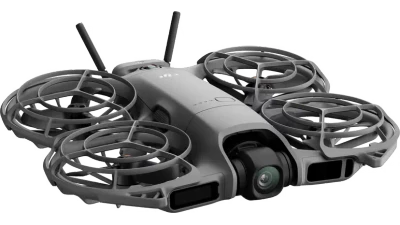
DJI Neo 2 not a drone you can invoice for
151 g · C0 · 12MP 1/2″ · sensing down to 5 lux · 3 batteries · 19 min
A genuinely clever little thing that takes off from your palm, and I use one constantly. It is in this list to mark the floor, not to be bought for work.
- Twelve megapixels on the smallest sensor here. That is a social clip, not a deliverable.
- Nineteen minutes a battery, and it ships with three, which is the one professional thing about it.
- Its radio is plain Wi-Fi unless you buy the separate transceiver. On a site with a busy 2.4 GHz band that is a short flight.
-
DJI Flip
<249 g · C0 · 48MP 1/1.3″ · forward and downward only, 15 lux · 3 batteries · 31 min
The cheapest way to turn up with something that produces a printable file and full propeller cages. I would take it inside a building and nowhere else on a paid day.
- Propeller cages built in, which is why it is the one I would fly indoors around a client.
- Forty-eight megapixels on a 1/1.3-inch sensor — enough for a brochure, not enough for a crack.
- It watches forwards and downwards only, and gives up below 15 lux. Sideways and above are entirely on you.
-
DJI Mini 4 Pro
<249 g · C0 · 48MP 1/1.3″ · omnidirectional, 15 lux · 1 battery · 34 min
The cheapest drone here that watches in every direction, which makes it the sensible second body in a working kit rather than the first.
- Obstacle sensing in every direction, which nothing else at this money gives you.
- Under 249 g, so it works over people and streets with no extra qualification at all.
- One battery in the box and a 15-lux floor on the sensing. Both are fine on a bright day and not otherwise.
-
DJI Avata 2 loses privileges in 2028
377 g · C1 · 12MP 1/1.3″ · downward and backward only, 15 lux · goggles included · 23 min
The one that sells a walkthrough of a building nothing else can shoot. It is also the least redundant drone in this guide, and the law makes it a two-person job.
- The law requires a second person watching the drone whenever you fly it through goggles, so price the job for two people.
- It only looks down and backwards. Flying forwards, nothing is watching for you at all.
- From January 2028 it needs the A2 test to work near people — one of only two here that lose that freedom.
-
DJI Mini 5 Pro
249.9 g · C0 · 50MP 1″ · omnidirectional + LiDAR, 1 lux · 3 batteries · 36 min
A one-inch camera and proper eyes under the 250-gram line. On a terraced street it is not a compromise on the Mavic — it is the only one of the two you can legally use.
- Under 250 g in this configuration, so it may be flown over uninvolved people with no A2 test and no Operational Authorisation.
- Obstacle sensing all round plus a forward laser, working down to 1 lux — fifteen times darker than a Mini 4 Pro copes with.
- Three batteries in the box at 36 minutes each. Buy the bigger Plus battery and you lose the sub-250-gram status that makes it useful.
-
DJI Air 3S loses privileges in 2028
724 g · C1 · 50MP 1″ + 70 mm tele · omnidirectional + LiDAR, 1 lux · 3 batteries · 45 min
Pound for pound the most professional drone on this page. It out-specifies a Mavic 3 Pro costing a thousand pounds more on eyes, radio and endurance.
- A second 70 mm camera, so you can stand three times further from a building for the same detail.
- Omnidirectional sensing plus a forward laser down to 1 lux, and 45 minutes a battery with three in the box.
- Its C1 mark lets it work over people today, but from January 2028 that stops and it needs the A2 test. You are buying about eighteen months of it.
-
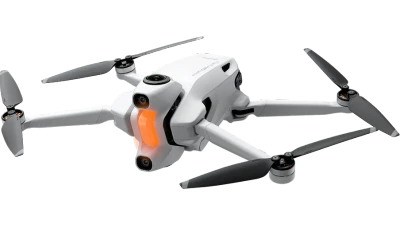
Antigravity A1 wrong deliverable for most paid work
249 g standard battery · C0 (EU) · 8K 360° · sensing not published · 24 min
The most interesting object in this guide and the hardest to invoice for. I would buy one for virtual tours and for nothing else on this list.
- Eight-K in every direction at once, which is a real deliverable for virtual tours and a poor one for everything else here.
- 249 g on the standard battery and 24 minutes with it. The high-capacity pack advertises 39 minutes and 291 g, and Antigravity’s own page says that pack is not sold in European regions.
- Antigravity publishes no obstacle-sensing specification I could verify, which for paid work is an answer in itself.
-
DJI Mavic 4 Pro
1,063 g · C2 · 100MP 4/3 + 70 + 168 mm · omnidirectional + LiDAR, 0.1 lux · 3 batteries · 51 min
Every layer that keeps a drone in the air is the best version DJI sells outside its enterprise channel. That, not the hundred megapixels, is what you are paying for.
- Obstacle sensing that still works at 0.1 lux, which is the single most useful number on its specification page.
- Three focal lengths on one flight, so you reframe without repositioning over a client’s roof.
- C2 and 1,063 g. Plan for the A2 test, and for an Operational Authorisation if the work is in built-up areas.
-
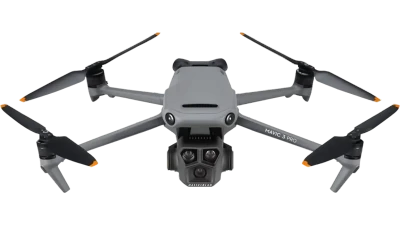
DJI Mavic 3 Pro superseded, and priced as though it were not
958 g · C2 · 20MP 4/3 + two tele · omnidirectional, 15 lux · 3 batteries · 43 min
Still a superb camera and now the clearest trap on this page. The combo you can actually buy costs more than a Mavic 4 Pro and is behind it on every layer that keeps it flying.
- A Four Thirds sensor and two telephoto cameras, which is a genuinely professional set of framings.
- Its obstacle sensing gives up below 15 lux and its radio uses two bands rather than three. Both matter more on a job than the sensor does.
- The bare drone is cheaper, but the configuration on sale here is the three-battery combo with the screen controller.
-
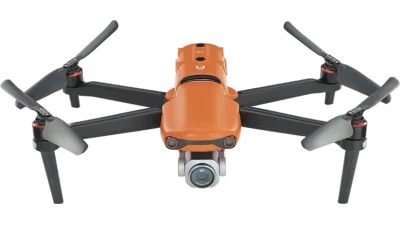
Autel EVO II Pro V3 no affiliate link — no UK listing I could confirm
1,191 g · no class mark · 20MP 1″ · four satellite systems · 39 min
Here so this is not purely a DJI catalogue, and it makes the legal point better than any DJI drone can. Without a class mark, its weight is the only thing the rules look at.
no link- It uses four satellite systems rather than three, which is more positioning redundancy than any DJI drone here.
- No class mark at all, so the rules judge it purely on weight and an A2 test only gets you to 50 metres from people.
- I could not confirm UK stock, so there is no buy link for it.
-
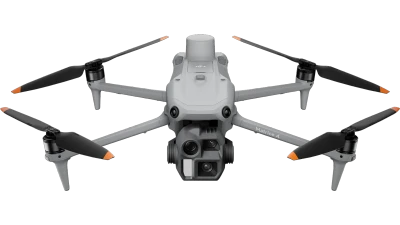
DJI Matrice 4E enterprise channel — not sold in shops
1,219 g · class mark not published · 20MP 4/3 with a mechanical shutter · RTK to 1 cm + 1 ppm · 49 min
In the list to show what you are not buying. A mechanical shutter and centimetre positioning are the two things that turn photographs into a survey somebody will sign off.
no link- A mechanical shutter on the wide camera, which removes the rolling-shutter smear that ruins fast mapping runs.
- RTK positioning to about a centimetre, and a fourth satellite system that switches on with it.
- Not sold in shops. If a client needs this data, they are hiring somebody who already owns one.
Every buy link points at one exact configuration, and for a working kit that is the multi-battery combo rather than the bare drone, because one battery is not a professional configuration. The ordering above runs cheapest to dearest, so you can read the trade-offs against each other without me quoting a figure that will be wrong by the time you click. Weights, class marks, flight times, sensing types and light thresholds are from each manufacturer’s own specification page, checked 31 July 2026. Comparison data from DroneCompare, CC BY 4.0.
PART TWO
“Professional” means redundancy, not megapixels
Every drone listing sells you the camera, because the camera is the bit that photographs well. But a drone is not a camera with propellers. It is five systems stacked on top of each other, and a paid job is the situation in which one of them failing actually costs you something.
Here is the honest way to read a spec sheet for work: find the layer that has no backup, and assume that is the one that will fail on the day.
Layer one: what it can see, and how dark before it stops seeing
Obstacle sensing is the layer everybody compares, and almost everybody compares it wrong. The question is not “does it have omnidirectional sensing”. Nearly all of these do. The question is how little light it needs before that sensing switches itself off, and manufacturers bury that number.
It is on the specification page, usually as a line about “adequate lighting” with a lux figure attached. Here it is pulled out and put side by side. This is the table I would have wanted before my first paid inspection.
THE REDUNDANCY LADDER
| DRONE | WHAT IT WATCHES | STOPS AT | RADIO | BATTERIES |
|---|---|---|---|---|
| Mavic 4 Pro | All round, plus forward laser | 0.1 lux | O4+, three bands | 3 |
| Mini 5 Pro | All round, plus forward laser | 1 lux | O4+, three bands | 3 |
| Air 3S | All round, plus forward laser | 1 lux | O4, three bands | 3 |
| Matrice 4E | All round, 3D infrared below | — | O4 Enterprise | — |
| Neo 2 | All round (single-eye), forward laser | 5 lux | Wi-Fi as standard | 3 |
| Mavic 3 Pro | All round, infrared below | 15 lux | O3+, two bands | 3 |
| Mini 4 Pro | All round, 3D infrared below | 15 lux | O4, three bands | 1 |
| Flip | Forward and downward only | 15 lux | O4, three bands | 3 |
| Avata 2 | Downward and backward only | 15 lux | O4, three bands | 1 |
| EVO II Pro V3 | — | — | Four bands | — |
| Antigravity A1 | — | — | — | — |
Light thresholds are each manufacturer’s own stated minimum for the vision system, taken from their specification pages on 31 July 2026. A dash means the manufacturer publishes nothing I could verify — Antigravity and Autel both do this — so I have left it blank rather than guess. Battery counts are for the configuration each buy link points at.
Fifteen lux is roughly a stairwell. It is a north-facing elevation on an overcast January afternoon, the underside of a bridge deck, the inside of a barn. If your work involves any of those, obstacle sensing rated at 15 lux is decoration — it will politely switch itself off exactly where you needed it.
And look at the row that ought to embarrass somebody. The Mavic 3 Pro is the most expensive drone here that you can actually buy, and it is 15 lux, two radio bands, and no forward laser. The Air 3S, at a little over half the money, is 1 lux, three bands and a laser. If you were buying on the camera you would get this exactly backwards.
Layer two: knowing where it is
Every DJI drone in this guide uses the same three satellite systems — GPS, Galileo and BeiDou. The Autel adds GLONASS for four, and the enterprise Matrice 4E adds GLONASS too, but only when its RTK module is switched on.
What matters more is the fallback. DJI publishes two hover accuracies for every drone here: about ±0.1 m using the vision system and ±0.5 m on satellites alone. Read that as a statement about what happens when one layer drops out. Under a canopy, beside a steel-framed building, in the lee of a wind turbine, satellites go first — and the vision system is the thing holding the drone still. Which returns you to the previous table, because a vision system that needs 15 lux is not much of a backup on a dark elevation.
The enterprise number worth knowing, so you can quote it when a client asks: RTK positioning on the Matrice 4E is specified at 1 cm + 1 ppm horizontally. That is the difference between a nice photograph of a site and a measurement somebody will put their name to.
Layer three: the link, and the one you cannot control
A drone radio hops between bands to get away from interference. Three bands give it somewhere to go; two do not. Every current drone here transmits on 2.4, 5.1 and 5.8 GHz — except the Mavic 3 Pro, which is 2.4 and 5.8 only.
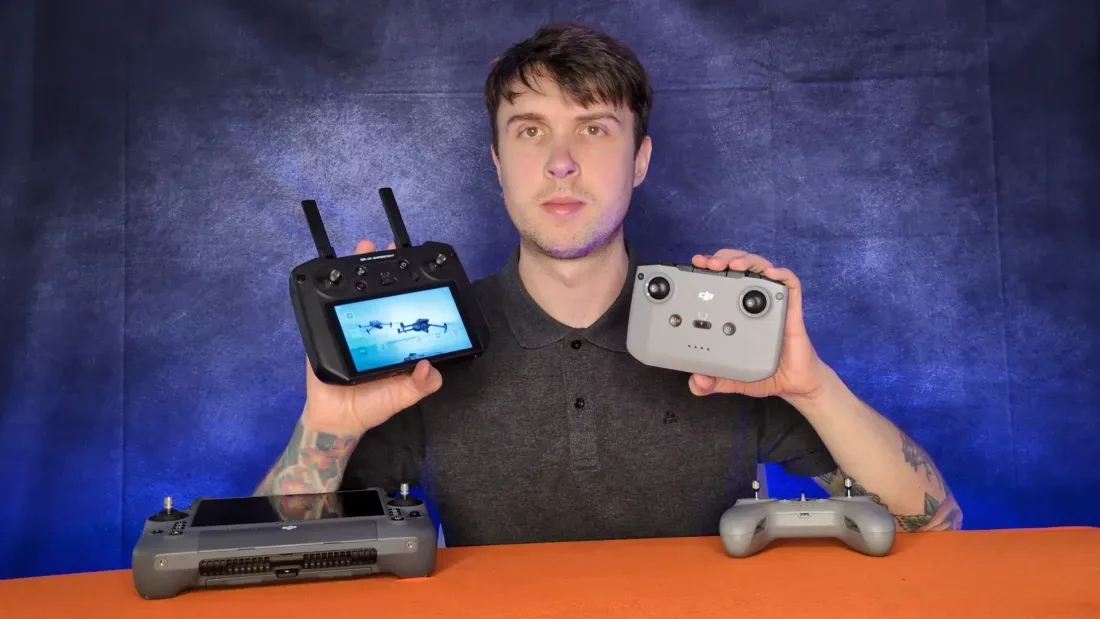
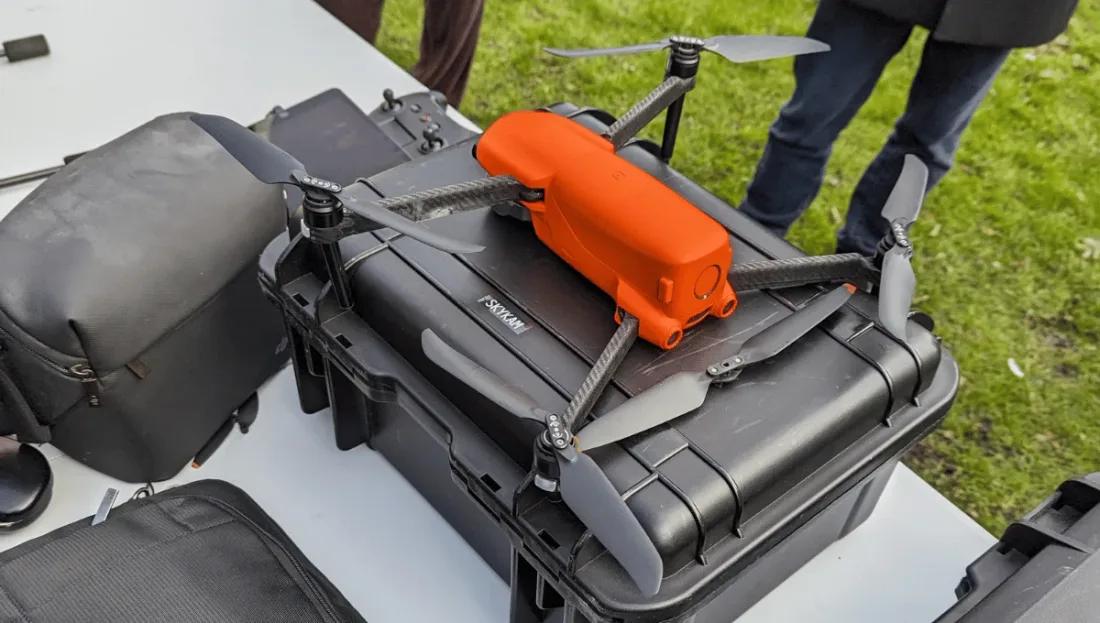
This is the layer that surprises people on their first commercial job, because the sites that pay well are exactly the sites that are electrically noisy: industrial estates, retail parks, anywhere with a mast on the roof. The controller in my left hand above is the one I take to those, because losing the picture is not the same as losing the drone, but it does end the job.
Layer four: power, and why one battery is not a professional configuration
A single battery is a single point of failure with a hard time limit attached. Fifty-one advertised minutes is not fifty-one minutes: it is measured flying at a steady speed in a windless tunnel, and on a real job with wind, hovering and a return-to-home reserve you should plan on roughly two-thirds of it.
That is why every drone in the list above is linked as a multi-battery combo rather than as the bare drone on its own. It is not an upsell — it is the difference between one visit and two, and a second visit is the most expensive thing on any job sheet.
The one exception to buy the bigger battery for. Not on the Mini 5 Pro. DJI states plainly that fitting the Intelligent Flight Battery Plus to the C0 version means it “can no longer be operated as a C0/UK0” drone. You would be trading the legal position that makes a sub-250 g drone worth owning for sixteen minutes. Buy a third standard battery instead.
Layer five: the only redundancy you can actually buy
You cannot buy a second flight controller. You cannot buy a second motor. What you can buy, and what separates people who do this for a living from people who do it beautifully once, is a second drone.
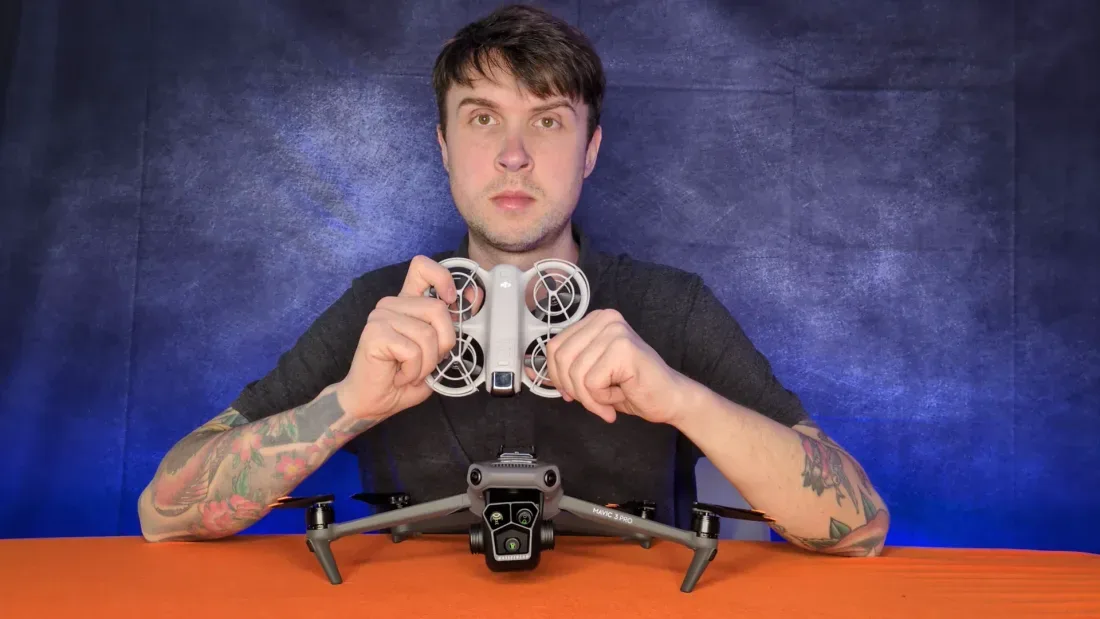
And here is the part that is specific to the United Kingdom, and the reason this guide has an award for a backup drone. Your second drone should not be a spare copy of your first one. It should be under 250 grams — because a sub-250 g drone is not just smaller, it is legally allowed places your main drone is not.
A cracked gimbal ribbon on a 1,063-gram Mavic in the middle of a job means going home. The same failure with a Mini 5 Pro in the boot means you finish the job at slightly lower resolution, and in a terraced street you might find the small one was the legal choice all along. That is why the year-one bill further down has two drones in it and not one.
So where do the megapixels come in?
They decide the deliverable, not the reliability, and they are worth exactly as much as the detail your client asked for. A hundred megapixels spread across a whole industrial estate resolves less than twelve megapixels pointed at one dormer window. The number that matters is how many pixels land on the thing you were hired to look at, which is a function of the lens and the distance far more than the sensor.
This is why the Air 3S punches so far above its price for inspection work: its second 70 mm camera does not add pixels, it adds standoff. Same detail, three times further from the building — and standoff, on a paid job, is a safety margin you can write into a risk assessment. If that argument interests you, I have taken it apart properly in the guide to choosing a drone for roof inspections.
What UK law actually requires before anyone can pay you
This is the part that catches people, and it is almost always because three separate things get blurred into one imaginary thing called a “commercial drone licence”. There is no such licence. The Permission for Commercial Operations was withdrawn at the end of 2020 and the CAA has been explicit that there is no direct replacement. If a training provider is still selling you a PfCO, walk away.
Here is what is actually true, in the order it applies to you.
1. Registration — two IDs, and both apply to everybody
A Flyer ID is a free online theory test, valid five years, and it belongs to the person flying. Since 1 January 2026 you need one to fly anything weighing 100 grams or more. That threshold used to be 250 grams, which is why a lot of older buying advice says a sub-250 g drone needs no test at all. It does now. Every drone on this page is over 100 grams.
An Operator ID costs £12.34 a year, belongs to the person or business responsible for the drone, and goes on a label stuck to it. You need one for anything 250 grams or more, or anything 100 grams or more with a camera — which is all eleven drones here.
If you are a sole trader, there is a decision here worth getting right first time. You can register as yourself or as an organisation, and the name on the Operator ID is the name that appears on any Operational Authorisation and the name your insurance should be in. An Operational Authorisation cannot be transferred between an individual ID and an organisation ID, so if you want to trade under a business name, register the organisation now rather than after you have paid for the authorisation.
2. Insurance — this is the one being paid actually triggers
The CAA is unambiguous. If you fly for any reason other than recreation, sport or a hobby, you must have third-party insurance as a minimum. That covers being paid to take photographs or video, being paid to carry out surveys, delivery work, using a drone for work on a farm, park or estate, and using one in a school, college or university.
Two details people get wrong. First, the policy has to comply with Assimilated Regulation (EU) 785/2004 — the CAA suggests asking your insurer directly whether it does, and a general public liability policy usually does not. The UK legislative basis is the Civil Aviation (Insurance) Regulations 2005. Second, the operator is responsible for having it, not the pilot, and the policyholder name should match the name on the Operator ID. If you have any doubt about what a policy should look like, I have written up what UK drone insurance has to cover separately.
Note what this rule does not say. It does not say that being paid requires a qualification. It requires registration and insurance. Everything after this point is decided by the flight, not the invoice.
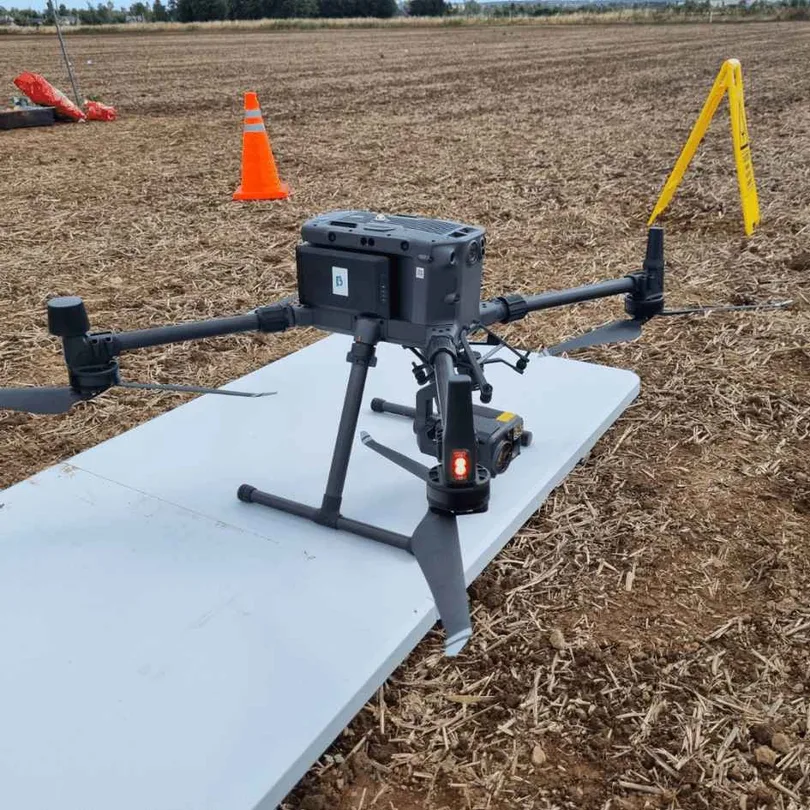
3. Qualification — decided by weight and distance, not by money
UK flying is split into categories. Almost all commercial work happens in one of two of them, and the choice between them is the single biggest cost decision you will make in year one.
The Open category is everyday flying with no authorisation needed. It has three sub-categories, and which one you are in depends on the drone’s class mark and weight:
- Over People (A1) — under 250 g, or a UK0, UK1 or C0 drone, and until 31 December 2027 a C1 drone too. You may fly closer than 50 m to uninvolved people and over them. Never over crowds.
- Near People (A2) — needs an A2 Certificate of Competence. With a UK2 or C2 drone you must stay 30 m from uninvolved people, or 5 m in low-speed mode. With an unclassed drone under 2 kg it is 50 m. Either way, never over them.
- Far from People (A3) — 50 m from people and 150 m from residential, recreational, commercial or industrial areas. In most of Britain that means driving to a field.
So the A2 Certificate of Competence is not a commercial qualification at all. It is an Open-category test that buys you the Near People sub-category for a heavier drone: at least 30 multiple-choice questions with a CAA-approved Recognised Assessment Entity, valid five years, and the providers set their own fees. Buy a sub-250 g drone and it grants you nothing you do not already have, because A1 is a better position than A2.
When you need to go further, you leave the Open category and enter the Specific category, and that requires an Operational Authorisation issued by the CAA. There are two routes to one.
PDRA01 — THE ROUTE MOST WORKING PILOTS TAKE
PDRA01 is the only pre-defined risk assessment currently available in the UK, and it is the simplest way to hold an Operational Authorisation. It authorises drones between 250 g and 25 kg, within visual line of sight, anywhere in the UK subject to airspace restrictions — explicitly including residential, commercial, industrial and recreational areas. The CAA names roof inspections, photographing buildings and surveying recreational sites as typical reasons people hold one.
- £524 a year, no VAT, valid 12 months. The CAA aims to issue within 24 hours.
- The pilot needs a Flyer ID plus a GVC (General Visual Line of Sight Certificate) or a Level 1 Remote Pilot Certificate.
- Minimum 50 m from uninvolved people, reduced to 30 m for take-off and landing only. No overflight of assemblies of people.
- Maximum 120 m height, maximum 500 m from you, visual line of sight throughout. No dropping articles.
- You must maintain an operations manual, a technical logbook and a pilot flight log, and keep records for three years. The CAA can ask for them at any point in the 12 months.
- Currency: at least two hours of flying in the previous three months before any flight under it.
Anything beyond that — flying beyond visual line of sight, dropping items, working close to crowds, higher than 120 m, or close to people with a drone of 500 g or more — needs the longer UK SORA route, which replaced the old Operating Safety Case method in April 2025. If that is your plan, read how to obtain an Operational Authorisation before you buy anything at all.
The clean way to hold all of this in your head is that the drone you choose decides the paperwork, not the other way round.
| ROUTE | PILOT NEEDS | WHERE YOU CAN WORK | FIXED FEES |
|---|---|---|---|
| Sub-250 g in Over People (A1)Mini 5 Pro, Mini 4 Pro, Flip | Flyer ID | Near and over uninvolved people. Not over crowds. | £12.34/yr |
| Heavier drone in Near People (A2)Mavic 4 Pro, Mavic 3 Pro | Flyer ID + A2 CofC | 30 m from uninvolved people with a C2 drone. Never over them. | £12.34/yr+ provider fee |
| Specific category, PDRA01Any drone 250 g–25 kg | Flyer ID + GVC or RPC-L1 | Residential, commercial and industrial areas. 50 m from uninvolved people. | £12.34 + £524/yr+ provider fee |
Insurance is mandatory on all three routes, because it is triggered by being paid rather than by the flight. CAA fees checked 31 July 2026. Recognised Assessment Entities set their own prices for the A2 CofC and the GVC, so those are not fixed and are shown as estimates in the bill below.
PART THREE
What a client expects to receive, and what year one really costs
Nobody hires you to fly a drone. They hire you to hand over a file that answers a question they already have, and the gap between amateurs and professionals here is much wider than the gap in flying skill.
The four things a client actually wants
Files, not screenshots. Full-resolution originals, plus the raw DNGs if you shot them. An estate agent wants edited JPEGs sized for their portal; a surveyor wants everything, untouched, in one dated folder. Ask which before you fly, not after.
Coverage they can check. A named, dated set that clearly covers every elevation, corner and roof plane you agreed — not thirty good-looking frames of the same side. On an inspection I shoot a full circuit before I shoot anything pretty, so there is never a gap that means going back.
Video that cuts together. One frame rate, one colour profile and a consistent shutter across the whole shoot. That last one is why filters are in the list below rather than in a nice-to-have box: on a fixed-aperture drone they are the only way to hold a sensible shutter speed in daylight, and without them your clips will not match each other in an edit.
For anything measured, a stated accuracy. If the deliverable is a survey, a model or a volume, the client needs to know the ground sample distance and the positional accuracy behind it. This is where consumer kit runs out and the enterprise answer — a mechanical shutter and RTK — starts. If a client asks for a survey to a stated tolerance and you cannot state one, the honest answer is to sub-contract it rather than guess.
And the paperwork. Larger clients, and every managing agent I have worked for, will ask for your Operator ID, your insurance certificate and — if the site is in a built-up area — your Operational Authorisation and a site risk assessment before you are allowed on site. Have all four as PDFs in one folder. Under PDRA01 you must keep those records for three years anyway.
The bill nobody quotes you
Say you take the recommendation and buy the Mavic 4 Pro combo, with a sub-250 g second drone behind it and a PDRA01 so you can work in built-up areas. The number in your head is the price of the Mavic. It is not the number that leaves your account before you invoice anybody, and it is not close.
I am not going to print a figure against every line, because a drone price quoted in July is wrong by October and the only honest place to read one is the shop itself. What does not move is the shape of the bill — what is on it, roughly how the lines rank against each other, and which of them the CAA fixes to the penny. That is the part nobody tells you in advance, and it is the part that decides whether year one works.
Here is the whole list, heaviest line first.
YEAR ONE — A ONE-PERSON DRONE BUSINESS
-
The main drone — Mavic 4 Pro Fly More Combo
Three batteries. The heaviest single line on the list, and still not half of it.
AMAZON UK
-
The second drone — Mini 5 Pro Fly More Combo
The backup, and the drone that works over a street. A little over a third of what the Mavic costs.
AMAZON UK
-
The qualification the authorisation demands of you. The largest line here that is not a drone, and one of the two the CAA does not set.
ESTIMATE — PROVIDER SETS IT
-
PDRA01 Operational Authorisation
Twelve months, no VAT. Fixed, published, and the only way to work inside a residential street.
CAA — £524/YR
-
Commercial third-party insurance
Must meet EU 785/2004. The other line the CAA does not set, and the same order of money as the GVC.
ESTIMATE — INSURER SETS IT
-
A year of accidental damage cover
DJI Care Refresh on the Mavic. Call it the crash allowance, because you will use it.
DJI UK
-
An ND filter set
Not optional. The aperture is fixed on most of these, so filters are the only way to hold one shutter speed across a shoot.
AMAZON UK
-
Two 256 GB V30 cards
Two, not one. A single card is a single point of failure holding the entire job.
AMAZON UK
-
Operator ID
Annual, and the smallest thing on this list that it is illegal to skip.
CAA — £12.34/YR
-
Flyer ID
A free online theory test, valid five years. The only line here that costs nothing.
CAA — FREE
Realistic year one: somewhere north of five thousand pounds.
Two drones, one qualification, one authorisation, one insurance policy, filters, cards and a crash allowance. Work it out at today’s shop prices and it lands at well over double what the main drone cost you.
The main drone is under half of that. That is the number to take away, and it is the reason the choice of drone matters rather less than every article about drones implies. Two more things worth noticing while the list is in front of you. The qualification and the insurance together cost more than the second drone — and they are the two lines you cannot look up, because a training provider and an insurer each set their own. And a slice of this repeats every single year before you have flown anything: the £12.34 Operator ID, the £524 authorisation, and the insurance renewal alongside them.
If the work is genuinely all sub-250 g — small properties, gardens, marketing shots over streets — the shape changes completely. Delete the Mavic, the GVC and the PDRA01, make the Mini 5 Pro your main drone, and swap the filters and the damage cover for the Mini’s own, which are a fraction of the big drone’s. That takes year one down to roughly under a third of the bill above, and the only thing still recurring is the £12.34 Operator ID and the insurance. It is a legitimate business and I know several people running one. What you cannot do is take the cheap route and then quietly fly a Mavic over a terrace.
THE THREE THINGS YOU WILL ACTUALLY NEED
- Check price
A second drone, under 250 g
The only redundancy you can buy, and it goes places the big one cannot.
- Check price
ND filters
So every clip in a client’s edit was shot at the same shutter speed.
- Check price
A second memory card
V30 is the rating that keeps up with 4K. One card is a single point of failure holding the whole job.
Affiliate links · costs you nothing extra · full disclosure
THE ONE THAT CATCHES PEOPLE IN YEAR TWO
A PDRA01 does not roll over quietly
The authorisation lasts twelve months and you may reapply from 28 days before it expires. Reapplying before expiry keeps your anniversary date and leaves no gap in cover. Let it lapse and you must not fly under it — and every job you quoted for a residential street just became one you cannot legally do.
The other half of it is currency. Under PDRA01 you must have flown at least two hours in the previous three months before any flight, and if the CAA selects you for a compliance check you have 28 days to produce your operations manual, your qualifications, your last three site surveys and your last three flight logs. Those site surveys have to be from three different dates. A quiet winter is a paperwork problem, not just a cashflow one.
Put both dates in a calendar the day your authorisation is issued: one at eleven months for the renewal, and a recurring one to keep your hours up. It is the cheapest insurance on this page.
PART FOUR
The best professional drone for most people in 2026
The DJI Mavic 4 Pro, bought as the three-battery Fly More Combo rather than the bare drone. That is what I would put on a paid job, and I would not spend long deciding.
Not because of the hundred megapixels. Because it has the best version of every layer that keeps a drone flying: obstacle sensing that works at 0.1 lux when everything else here surrenders between 1 and 15, a three-band radio, a forward laser, 51 minutes a battery and three of them in the box. On a job where the light is going and the client is standing next to you, those are the specifications you will actually be leaning on.
Understand what it commits you to. At 1,063 grams with a C2 mark it needs an A2 Certificate of Competence before it may work near people, and if your work is inside residential streets it realistically needs a PDRA01 Operational Authorisation at £524 a year on top of that. Go in knowing that. The drone is the cheap part.
Buy the second drone at the same time. The DJI Mini 5 Pro is not a downgrade in the bag — it is a one-inch camera with proper eyes that is legally allowed over the people your Mavic is not. If the whole of your work is small properties and marketing shots, make it your only drone, skip the qualification and the authorisation, and you are earning after under a third of the outlay above.
Spend less than that and the honest answer is the DJI Air 3S, which costs roughly half what the top pick does and is the best value on this page by a distance. Its 70 mm second camera is genuinely useful for inspection work, and it beats the far dearer Mavic 3 Pro on every reliability number that matters. Just diarise 1 January 2028, when its C1 mark stops carrying A1 privileges and you will need the A2 test to keep working near people with it.
The one I’d actively tell you to avoid
The DJI Mavic 3 Pro — and it pains me, because it is a wonderful camera and I have shot paid work with one very happily.
But look at what is on sale. The configuration you can actually buy is the Fly More Combo, and it costs more than the Mavic 4 Pro combo that replaced it. For that extra money you get obstacle sensing that stops working below 15 lux instead of 0.1, a two-band radio instead of three, no forward laser, 43 minutes instead of 51, and a twenty-megapixel main sensor instead of a hundred. There is not one line in that list where the older drone wins.
It is the clearest illustration on this page of the thing this whole guide is about. Nobody buying on camera reputation would see any of that. Everybody buying on redundancy would see it immediately.
And if, having read the bill, the honest answer is that the numbers do not work yet — that is a perfectly good conclusion, and it is what the rest of this site exists for. Clients who need one survey a year are usually better off hiring, and you can hire a qualified drone pilot who already holds the authorisation, the insurance and the kit. There is no shame in sub-contracting the flights you are not yet set up to take.
If you are still working out which drone earns its keep before you commit to the paperwork, the two guides worth reading next are the ones on what estate agents actually want delivered and on picking a camera drone on sensor rather than price.
Professional drones in the UK: the questions I get asked most
What is the best professional drone in the UK in 2026?
The DJI Mavic 4 Pro, bought as the Fly More Combo with three batteries. It is the only drone here whose obstacle sensing still works at 0.1 lux, it carries three focal lengths on one flight, and it flies for 51 minutes. It weighs 1,063 g and carries a C2 class mark, so budget for an A2 Certificate of Competence, or a full Operational Authorisation if you intend to work in built-up areas. If your work is over streets and gardens rather than open land, the DJI Mini 5 Pro is the more useful drone, because at 249.9 g it may legally be flown over uninvolved people with nothing more than a Flyer ID.
Do I need a licence to be paid for drone work in the UK?
There is no such thing as a UK commercial drone licence. The Permission for Commercial Operations was withdrawn at the end of 2020 and has no direct replacement. Being paid changes two things and only two things: you must be registered with the CAA as the operator, and you must hold third-party insurance. Everything else is decided by the flight, not by the invoice. A 249.9 g drone flown over a garden needs a free Flyer ID and nothing more. A 1,063 g drone flown near people needs an A2 Certificate of Competence, and one flown inside a residential street needs an Operational Authorisation.
Is drone insurance a legal requirement for commercial work?
Yes. The CAA states that if you fly for any reason other than recreation, sport or a hobby, you must hold third-party insurance as a minimum. That includes being paid for photos or video, being paid for surveys, delivery work, using a drone for work on a farm, park or estate, and use in a school, college or university. The policy must comply with Assimilated Regulation (EU) 785/2004, and the UK legislative basis is the Civil Aviation (Insurance) Regulations 2005. The operator is responsible for having it, and the policyholder name should match the name on the Operator ID.
What is the difference between an A2 CofC and a GVC?
They belong to different categories of flying. The A2 Certificate of Competence sits inside the Open category and unlocks the Near People (A2) sub-category: 30 m from uninvolved people with a UK2 or C2 drone, or 50 m with an unclassed drone under 2 kg, and never over them. It is a theory test of at least 30 multiple-choice questions with a CAA-approved Recognised Assessment Entity, valid five years. The General Visual Line of Sight Certificate is the Specific category qualification, and it is what a PDRA01 Operational Authorisation requires of the pilot, alongside a Flyer ID. The GVC does not authorise anything on its own — the Operational Authorisation does.
How much does it cost to start a drone business in the UK?
Working through it properly for a DJI Mavic 4 Pro Fly More Combo with a sub-250 g second drone, a GVC, a PDRA01 Operational Authorisation, commercial insurance, filters, cards and a year of accidental damage cover, year one lands somewhere north of five thousand pounds — well over double the main drone, which is under half the bill on its own. The only figures the CAA fixes are the £12.34 Operator ID and £524 for a PDRA01, both annual. The qualification and the insurance are the two lines nobody quotes you up front, and they are the two I have marked as estimates.
Can I do professional drone work with a sub-250 g drone?
Yes, and in built-up areas it is often the only drone that can do the job legally without an Operational Authorisation. Under 250 g you fly in Over People (A1), which permits flight closer than 50 m to uninvolved people and over them, though never over crowds. You still need a Flyer ID, because since 1 January 2026 that applies to anything 100 g or heavier, an Operator ID because the drone has a camera, and insurance because you are being paid. What you give up is redundancy — one battery bay, one link, one small camera — which is why I would treat a sub-250 g drone as half of a kit rather than all of it.
The short version
If you read all of that and still want me to just say it: buy the DJI Mavic 4 Pro as the three-battery combo, and a Mini 5 Pro behind it. Register as the operator, insure it properly, and sit the qualification the work actually needs rather than the one that sounds most professional. Year one costs well over double the drone, and the list above names every line of it.
Affiliate links · costs you nothing extra · full disclosure
There are no prices on this page. Drone prices move constantly, and the only figure worth having is the one on the shop page at the moment you buy — so every buy link goes straight to the exact configuration I am recommending, and you read the price there. Weights, class marks, flight times, sensing types and light thresholds are from manufacturer specification pages on the same date. Regulatory detail, fees and operational limits from the UK Civil Aviation Authority. Comparison specifications from DroneCompare, licensed under CC BY 4.0. Amazon links are affiliate links. This guide is written to help you buy; it is not legal advice, and the CAA is the authority on every rule described here.