Best Drone for Real Estate Photography 2026: What I’d Buy to Shoot a House Legally

Peter Leslie
31 July 2026 · 19 min read
A drone shot puts a house in its setting. It shows the plot, the outlook, the length of the garden and how far the neighbours really are — four things that no amount of wide-angle work from the landing window will ever convey. Every agent who has run a listing with one and a listing without knows which gets clicked.
What almost nobody mentions is that the useful shot and the legal shot are not automatically the same shot. To photograph a house on a normal street you have to fly inside what the Civil Aviation Authority calls a residential area, and there is exactly one bracket of the rules that allows that. Buy the wrong drone and you own a machine that must legally stay 150 metres away from anything built-up, which in most of Britain means a field, and no house in it.
The second thing nobody mentions is smaller and sharper. The moment you are flying because it is your job, you have left the hobby rules behind. Third-party insurance stops being sensible and starts being a legal requirement. That is true whether you are a freelance property photographer, a self-employed agent, or an employee whose boss said “bring the drone”.
So the best drone for real estate photography in 2026 is not the one with the biggest sensor. It is the lightest one that can still produce the four or five frames a listing actually uses — because weight is what decides whether you are allowed to be above the property at all.
This guide does three things. It asks four questions about the work you actually take on and narrows ten drones to the one that fits, and for a fair number of readers the honest answer at the end is that you should not buy one at all. Then it sets out the shot list a property listing really uses, and which of these drones can physically produce each frame — one of them cannot point its camera straight down, which rules it out of the most valuable shot on the list. Then it does the arithmetic on buying against commissioning, because there is a number of listings per year below which owning a drone is simply the expensive way to get photographs.
How I get paid: the Amazon links below are affiliate links, so if you buy through one I earn a small commission at no extra cost to you. It does not change what I recommend — two of the ten drones here are ones I would tell an agent to walk straight past, one has no buy link at all because I could not find it for sale in Britain, and a whole section of this article argues that plenty of you should hire somebody instead of buying anything.
The Best Drone for Real Estate Photography in 2026 Is the DJI Mini 5 Pro
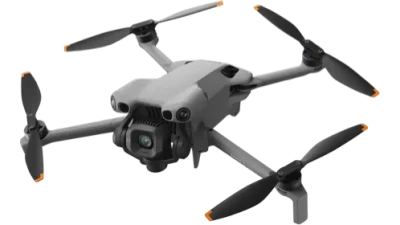
It takes off at 249.9 grams, which is the only reason it is legally allowed to hover above a residential street — and it carries a camera you would otherwise have to leave on the ground to get one.
- Under 250 grams, so it flies in Over People (A1) — the only bracket that lets you fly inside a residential area with no extra exam. Fly it on the standard battery and its 36 minutes: DJI’s 52-minute figure needs the Plus pack, which puts it back over 249 grams and out of C0.
- A one-inch, 50-megapixel sensor that holds a bright sky and a dark north elevation in the same frame.
- The gimbal tilts to a true 90 degrees down, so you get a square site plan rather than a slightly skewed one.
- Obstacle sensing in every direction, which is what you want when the drone is between a chimney and a mature oak.
Affiliate link · costs you nothing extra · full disclosure
PART ONE
Here are the five that win their categories outright — and the honest problem with each of them, because not one is without one.
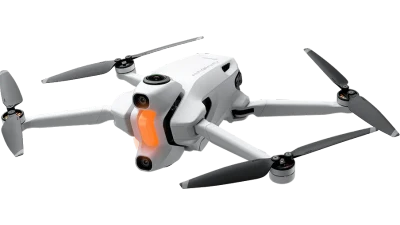
Best Drone for the Vertical Social Clip: DJI Mini 3
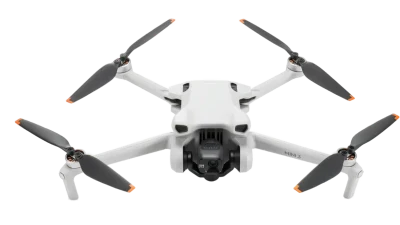
The cheapest gimbal here that physically turns on its side — the difference between a full-resolution 9:16 clip and a crop of a landscape one.
- A controllable roll axis that rotates the camera into true portrait, so the whole sensor shoots the vertical frame rather than a third of it.
- 248 grams and C0-marked, so it flies in residential areas on registration alone.
- 38 minutes a battery — the longest of any sub-250-gram drone here, which is what lets you re-fly a move until the light is right.
- A downward vision system and nothing forward, so a low pass along a gutter or a hedge line is entirely your problem.
Best Budget Drone for Property Listings: DJI Flip
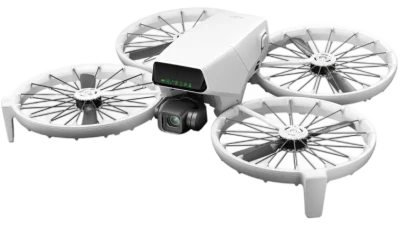
The right lens and the right weight for under three hundred pounds. You give up the sensing, not the shot.
- 249 grams and C0-marked, so it flies in residential areas with no exam beyond registration.
- A 1/1.3-inch, 48-megapixel camera behind a 24 mm equivalent lens — the right focal length for a house.
- Obstacle sensing forward and down only, with a forward range DJI publishes as 0.3 to 8 metres.
Best Drone for Roofline and Elevation Detail: DJI Air 3S
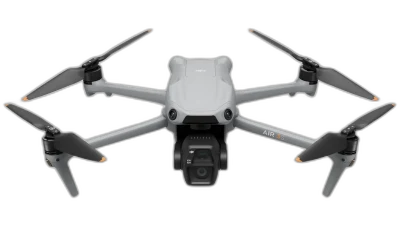
A 70 mm lens changes how a building sits in the frame. Nothing else under a thousand pounds gives you one.
- Two real focal lengths, 24 mm and 70 mm, which is the difference between one hero shot and four.
- 724 grams with a C1 mark. It flies in residential areas today, but from January 2028 it needs the A2 exam to fly near people at all.
- 45 minutes a battery and omnidirectional sensing, so it handles a full day of instructions.
Best Drone for a Full-Time Property Photographer: DJI Mavic 4 Pro
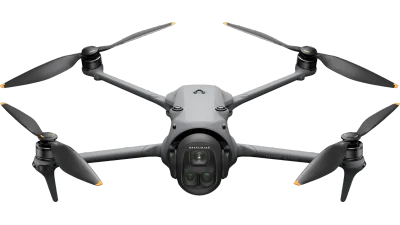
If photographs are the product rather than a bonus on the listing, this is the one — and you sit the exam.
- Needs the A2 Certificate of Competence before you can fly it near people, and even then you keep 30 metres from anyone uninvolved.
- Three focal lengths — 28 mm, 70 mm and 168 mm — on a 100-megapixel Four Thirds sensor.
- The only drone here with a variable aperture, f/2.0 to f/11, which is what lets you shoot video at a proper shutter speed in daylight.
Best Drone for 360° Property Tours: Antigravity A1
The only drone here that captures the whole scene at once, so a buyer can drag the view around the plot themselves.
- 249 grams on its standard battery and EU C0, so it flies in residential areas on registration alone.
- An 8K 360 capture at 55 megapixels, which is what an interactive property tour is built from.
- 24 minutes on the standard pack. The 39-minute figure needs the high-capacity battery, which Antigravity’s own page says is not sold in European regions.
Affiliate links · costs you nothing extra · full disclosure
Take the quiz: find the right drone for your listings
Four questions about the work, not about megapixels.
- Built around what a property listing actually needs delivered.
- Ten drones, from a caged palm-launcher to a 100-megapixel Hasselblad.
- Tells you when hiring a pilot is the cheaper answer, and says so plainly.
- About 20 seconds, and no email needed.
STEP 1 OF 4
10 of 10 still fit
All ten, and why each one might not suit you
-
DJI Flip
249 g · C0 · 1/1.3″ 48MP · 24 mm · tilt to −90° · 31 min
The cheapest drone on this page I would let anywhere near a paying instruction. It sees forward and downward and nothing else, which is the compromise you are buying.
- 249 grams and C0-marked, so it flies in residential areas with no exam beyond registration.
- A 1/1.3-inch, 48-megapixel camera behind a 24 mm equivalent lens — the right focal length for a house.
- Obstacle sensing forward and down only, with a forward range DJI publishes as 0.3 to 8 metres.
-
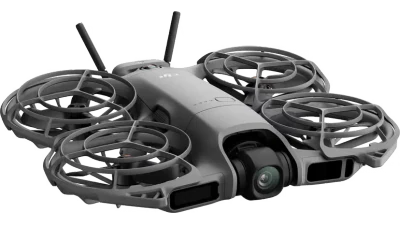
DJI Neo 2 wrong lens for a building
151 g · C0 · 1/2″ 12MP · 16.5 mm · JPEG only · 19 min
A delightful little thing that throws itself off your palm, and completely the wrong tool for architecture. Its 16.5 mm lens bends every straight roofline it sees.
- 151 grams, so nothing in the regulations stands in your way — the camera is the problem.
- A 16.5 mm equivalent lens, which is far wider than any architectural photographer would choose.
- JPEG only, with no raw file to recover a blown sky from.
-
DJI Mini 3
248 g · C0 · 1/1.3″ 48MP · true vertical · 38 min · downward sensing only
The longest flight time here and a gimbal that rotates for proper portrait frames. It also has no forward obstacle sensing whatsoever, which near a building is a real decision rather than a footnote.
- 248 grams and C0-marked, so residential flying needs nothing beyond registration.
- DJI publishes 38 minutes a battery — the longest of any sub-250-gram drone here.
- A downward vision system and nothing forward, so obstacles ahead are entirely your problem.
-
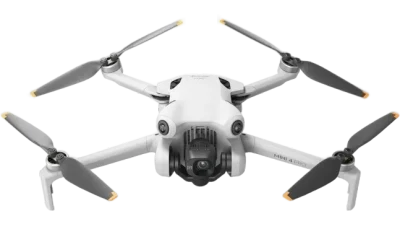
DJI Mini 4 Pro
<249 g · C0 · 1/1.3″ 48MP · omnidirectional · true vertical · 34 min
For two years this was the obvious answer for property work, and it is still a complete tool. The Mini 5 Pro has since made the hundred-pound gap look small.
- Under 249 grams and C0-marked, so it flies in residential areas on registration alone.
- Omnidirectional obstacle sensing — the cheapest drone here that sees in every direction.
- The gimbal rotates for native portrait frames, which is what social listings want.
-
DJI Mini 5 Pro
249.9 g · C0 · 1″ 50MP · 24 mm · omnidirectional + LiDAR · 36 min
A one-inch sensor under the 250-gram line, which for property work is the whole argument in a sentence. Everything else here is either lighter and worse, or better and legally stuck in a field.
- 249.9 grams and C0-marked, so residential flying needs nothing beyond the two registrations.
- A one-inch, 50-megapixel sensor that holds a bright sky and a shaded elevation in one frame.
- 36 minutes on the standard battery. DJI advertises 52, but only with the Plus battery that takes it over 249 grams and out of C0.
-
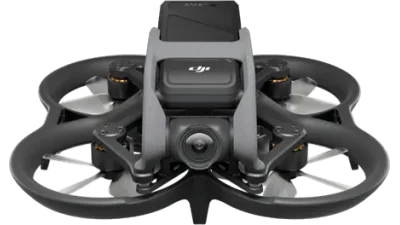
DJI Avata 2 cannot shoot straight down
377 g · C1 · 1/1.3″ 12MP · 12 mm · tilt stops at −85° · JPEG only
Agents see the one-take fly-through videos and want this. It is the wrong purchase twice over: it needs a second person stood beside you every flight, and its gimbal will not reach vertical.
- Flown through goggles, which in UK law requires an observer stood next to you for the whole flight.
- A single-axis gimbal with a controllable range of −85° to 80°, so a true top-down is not available at any price.
- 377 grams and C1-marked. From January 2028 that mark stops counting and it needs the A2 exam to fly near people.
-
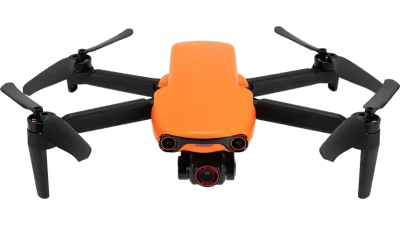
Autel EVO Nano+ no affiliate link — no UK listing I could find
249 g · class mark not published · 1/1.28″ 50MP · 23 mm f/1.9 · 28 min
Here so nobody can call this list a DJI catalogue, and on paper it is a proper 249-gram property drone. I searched Amazon UK this week and found spare propellers for it, but not the drone.
no link- 249 grams with a 1/1.28-inch, 50-megapixel camera — the only credible non-DJI option here.
- Autel publishes a controllable gimbal pitch of −90° to 15°, so the top-down shot is there.
- Autel does not publish a UK or European class mark for it, and I could not find UK stock.
-
DJI Air 3S loses privileges in 2028
724 g · C1 · 1″ 50MP 24 mm + 1/1.3″ 48MP 70 mm · 45 min
The 70 mm tele is the most underrated lens in property photography: it flattens a roofline and picks a chimney out cleanly from thirty metres away. The legal clock on it is the catch.
- Two real focal lengths, 24 mm and 70 mm, which is the difference between one hero shot and four.
- 724 grams with a C1 mark. It flies in residential areas today, but from January 2028 it needs the A2 exam to fly near people at all.
- 45 minutes a battery and omnidirectional sensing, so it handles a full day of instructions.
-
Antigravity A1
249 g · EU C0 · 8K 360° · 55MP sphere · 24 min · forward + downward sensing
It records every direction at once and you choose the framing afterwards, which is exactly what an interactive tour wants and exactly what a set of twelve portal stills does not.
- 249 grams on its standard battery and EU C0, so it flies in residential areas on registration alone.
- An 8K 360 capture at 55 megapixels, which is what an interactive property tour is built from.
- 24 minutes on the standard pack. The 39-minute figure needs the high-capacity battery, which Antigravity’s own page says is not sold in European regions.
-
DJI Mavic 4 Pro A2 exam needed today
1,063 g · C2 · 4/3 100MP 28 mm f/2–f/11 + 70 mm + 168 mm · 51 min
The best flying camera you can put over a house, and the only one here whose aperture actually closes. It is also the one that will keep you thirty metres from anyone who is not on your job.
- Needs the A2 Certificate of Competence before you can fly it near people, and even then you keep 30 metres from anyone uninvolved.
- Three focal lengths — 28 mm, 70 mm and 168 mm — on a 100-megapixel Four Thirds sensor.
- The only drone here with a variable aperture, f/2.0 to f/11, which is what lets you shoot video at a proper shutter speed in daylight.
The list runs cheapest first, so a drone’s position in it is the ranking by price. Check every link before you buy: what a drone costs and which bundles exist both move constantly, and the configuration matters more than the number. Each link points at a bundle that can actually fly. The Avata 2 link is the goggles-inclusive combo, because DJI states the drone on its own “requires a DJI Goggles series product… to operate” — there is a cheaper drone-only listing and it is not a thing you can take off with. The Neo 2 link is the three-battery Fly More Combo rather than the bare drone. Autel and Antigravity specifications come from those manufacturers’ own specification pages.
PART TWO
What an estate agent actually needs delivered
Nobody commissions “drone photography”. They commission a set of images that go on a listing, and the set is smaller and more specific than most people expect. Five frames, sometimes six. Get those and the job is done; miss one and the listing has a hole in it that a hundred extra photographs will not fill.
This is the part that decides which drone you buy, because two of those frames are not available on every machine here. Not “harder”. Not available.
1. The hero elevation
Thirty to forty-five metres up, camera tilted down twenty or thirty degrees, the front of the building filling the middle third with enough garden and street either side to give it context. This is the image that replaces the front-door photograph at the top of the listing, and every drone in this guide can take it.
What separates them is the lens. A 24 mm equivalent is the architectural standard, and it is what the Mini 5 Pro, Mini 4 Pro, Mini 3, Flip and the Air 3S’s wide camera all use. Go wider and the building starts to lean: the DJI Neo 2’s lens is a 16.5 mm equivalent and the Avata 2’s is 12 mm, which is a fisheye by any other name. On a landscape you would never notice. On a house, every vertical line bows outwards and a surveyor-brained buyer will spot it before they read the price.
2. The true top-down
Camera pointing straight down, the whole plot in frame, boundaries visible. This is the single most useful drone image a listing can carry, because it answers questions the floorplan cannot: where the garden actually is, how the parking works, what backs onto the rear fence.
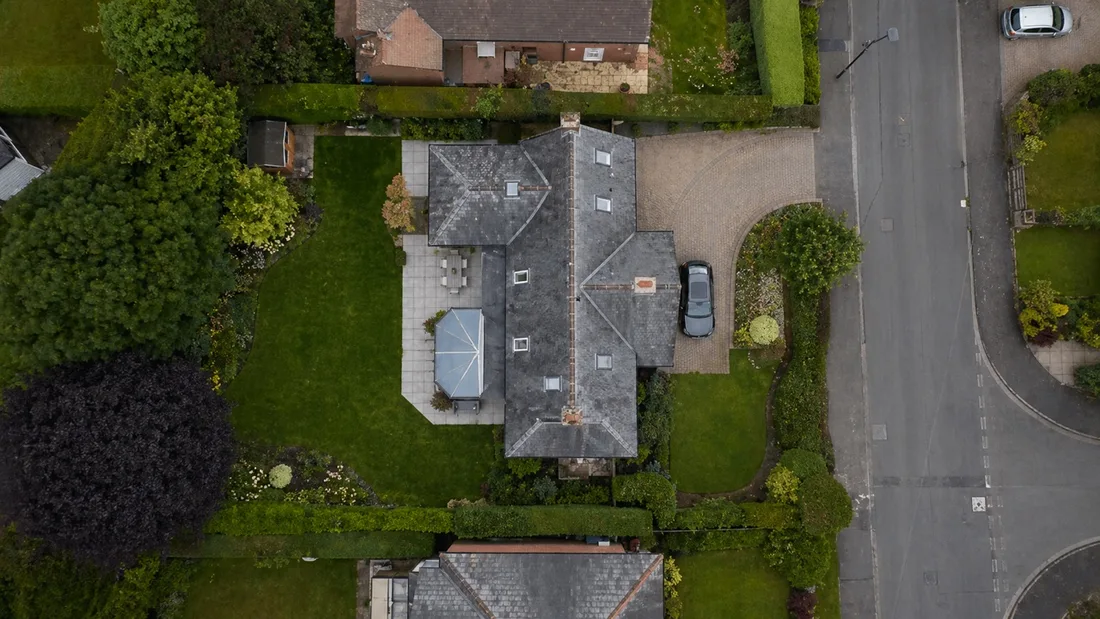
Here is the spec that decides whether you can take it, and I have never seen it in a buying guide. Every gimbal has two published tilt ranges: a mechanical range, which is how far the metal can physically swing, and a controllable range, which is how far you are allowed to drive it. The controllable one is what matters, and it needs to reach −90°.
Most of this field does. DJI publishes a controllable tilt of −90° for the Mini 5 Pro, Mini 4 Pro, Mini 3, Flip, Air 3S and Mavic 4 Pro, and Autel publishes −90° for the EVO Nano+. The exception is the DJI Avata 2, whose single-axis gimbal has a controllable range of −85° to 80°. Five degrees short does not sound like much until you try to square up a rectangular plot and find the far hedge keystoning away from you in every single frame.
3. The boundary and approach
Higher again, camera down forty-five degrees or so, showing where the property sits relative to the road, the neighbours and whatever the vendor is selling as an aspect. For a plot, a paddock or a development site this frame is often the entire instruction.
Nothing exotic is needed. What helps is flight time, because this is the shot you end up circling for, and battery anxiety is what makes people settle for the third-best angle. The Mini 3’s 38 minutes and the Air 3S’s 45 are genuinely useful here; the Neo 2’s 19 are not.
4. The detail pull
A tight frame of the roof, the chimney stack, the render, the state of the flat roof over the extension. Agents use it to head off questions; vendors like it because it looks thorough.
You can crop into a 50-megapixel wide frame and get most of the way there. But a real 70 mm lens does something a crop cannot: it compresses. Stand back thirty metres and shoot at 70 mm and the roof planes stack up flat and readable instead of running away from you. The Air 3S has that lens, and the Mavic 4 Pro has it plus a 168 mm on top. Everything else on this page has one fixed wide lens and a digital zoom, which is a crop with a friendlier name.
5. The vertical clip for social
Fifteen seconds, 9:16, for the agency’s Instagram and TikTok. It is the frame most agents forget to shoot and then wish they had.
Two ways to get it. Crop a landscape 4K frame down and lose two-thirds of your pixels, or use a drone whose gimbal physically rotates so the sensor shoots portrait natively. The Mini 3, Mini 4 Pro and Mini 5 Pro all have a controllable roll axis for exactly this; the Mavic 4 Pro has a gimbal that rotates further still. On the Flip, DJI lists vertical shooting as a cropped mode rather than a rotation, which is fine for social and not fine if anyone wants it printed.
THE LISTING SET, AND WHAT PRODUCES IT
| FRAME | WHAT IT NEEDS | WHICH ONES CAN |
|---|---|---|
| Hero elevation | A 24 mm-ish lens that keeps walls vertical | All except the Neo 2 (16.5 mm) and Avata 2 (12 mm) |
| True top-down | Controllable gimbal tilt reaching −90° | All except the Avata 2, which stops at −85° |
| Boundary and approach | Endurance, so you can circle and choose | Best on the Air 3S (45 min), Mini 3 (38 min), Mini 5 Pro (36 min) |
| Detail pull | A genuine tele lens, not a digital crop | Air 3S (70 mm) and Mavic 4 Pro (70 and 168 mm) only |
| Vertical social clip | A gimbal roll axis you can drive | Mini 3, Mini 4 Pro, Mini 5 Pro, Mavic 4 Pro |
Gimbal ranges, focal lengths and flight times taken from DJI, Autel and Antigravity specification pages, checked 31 July 2026. Flight times are the manufacturer figure for the battery a UK buyer can actually get.
The thing that is not on the list: megapixels
Property portals resize everything you upload. Rightmove and Zoopla will show your image at a couple of thousand pixels wide at most, which a 12-megapixel camera clears without breathing. So the number on the box is not what separates a good property drone from a bad one.
What separates them is dynamic range, and you will meet it on your second job. British houses are photographed under British skies: a white overcast that is four or five stops brighter than a north-facing brick elevation in shadow. A small sensor gives you a choice between a blown-out sky and a black wall. A one-inch sensor gives you both, and a raw file with enough latitude to lift the wall afterwards. That is what the jump from the Flip to the Mini 5 Pro actually buys you, and it shows up on exactly the days you cannot reschedule.
Flying for an agency is work, not a hobby — what changes
If you have never owned a drone, none of the following will be on your radar, and all of it applies from your first flight. It is not complicated. It is just invisible until somebody tells you.
The two registrations everybody needs
A Flyer ID is a free online theory test from the Civil Aviation Authority, valid five years, needed by whoever is holding the controller for any drone of 100 grams or more. An Operator ID costs £12.34 a year, is needed by whoever is responsible for the drone, and the number goes on a label stuck to the airframe.
The part that catches agencies: if the drone belongs to the business rather than to you personally, the business registers as the operator. The CAA expects an organisation to name an accountable manager — a real person answerable for the drones being flown safely and legally — and to ensure that everyone who flies for it holds the right qualification. One Operator ID covers every drone the agency owns.
Insurance is not optional the moment money is involved
The CAA’s wording is that if you fly a drone for any commercial reason, you must have third party insurance as a minimum — and the first example it gives of a commercial reason is getting paid to take pictures or record video. Using a drone for work, such as on an estate, is listed separately and catches the rest.
Read that as an estate agent and it is unambiguous. You do not need to invoice for the photographs. You do not need to be a freelancer. If the flight happens because it is your job, it is not recreation, and hobby cover will not do. The policy has to comply with Assimilated Regulation (EU) 785/2004 — ask the insurer to confirm it does — the duty sits with the operator rather than the pilot, and the policyholder name should match the name on the Operator ID. If you want a sense of the numbers, what commercial drone cover costs is its own conversation.
Why 250 grams decides whether the job is legal at all
This is the one that surprises people, and it is the reason this whole guide leans towards small drones. The Open Category has three sub-categories, and the distances are not similar.
WHERE EACH BRACKET LETS YOU FLY
| SUB-CATEGORY | WHAT FLIES IN IT | NEAR HOUSES? |
|---|---|---|
| Over People (A1) | Under 250 g, or UK0/UK1, or C0 — and C1 until the end of 2027 | Yes. You may fly in residential areas and closer than 50 m to people. Never over a crowd. |
| Near People (A2) | UK2 or C2, with an A2 Certificate of Competence | Yes, but keep 30 m from anyone uninvolved (5 m in low-speed mode) and never fly over them. |
| Far from People (A3) | Everything heavier without that certificate | No. Stay 150 m from residential, recreational, commercial and industrial areas. |
Read the bottom row again. A3 is 150 metres from anything residential. There is no version of photographing a semi-detached house on a normal street that happens 150 metres away from it. So a heavier drone without the A2 certificate is not a compromised property drone — it is not a property drone at all. That is the whole reason the sub-250-gram class dominates this guide, and it is why a manufacturer will fight for every last gram to land at 249.
The A2 Certificate of Competence is the way out if you want the heavier machine. It is a theory test of at least thirty multiple-choice questions taken with a CAA-approved Recognised Assessment Entity, valid five years, with providers setting their own fees. It buys you the middle row: residential flying with a 30-metre bubble around anyone not involved in your job. For a Mavic 4 Pro that is the difference between a working tool and an ornament. If you buy under 250 grams, it buys you nothing you do not already have.
One date to diary. Until 31 December 2027 a European C class mark can be flown as its UK equivalent. From 1 January 2028 that stops, and the drone falls back to plain weight rules. Everything under 250 grams here is unaffected. The two that are not are the DJI Air 3S at 724 grams and the DJI Avata 2 at 377 grams, both C1: today they fly in residential areas with no exam, and from that date both need an A2 Certificate of Competence to fly near people. Buy an Air 3S for property work in 2026 and you are buying about eighteen months of its current legal position, not a permanent one.
Other people’s houses, and the camera
You will be flying over gardens that are not the vendor’s. Two separate things govern that, and neither is aviation law.
First, permission to launch. The CAA is explicit that you need the agreement of whoever owns the land you take off and land from. In practice that means asking the vendor before you use their lawn, and not using the neighbour’s verge because the light is better from there.
Second, the camera. The CAA says that using a camera where people can expect privacy — inside their home or garden — is likely to break data protection laws, and that any photograph or recording in which people can be identified may fall under GDPR and the Data Protection Act 2018 whether you captured them intentionally or not. Recording images for commercial use makes you a data controller with further obligations on top. There is a fuller treatment of how data protection law applies to drone pilots elsewhere on this site.
None of that stops you photographing a house. It shapes how you do it: knock next door before you fly, keep the frame on the instructed property, do not hover over a neighbouring garden waiting for the light, and delete the frames you do not need rather than archiving everything “just in case”. It also explains why the neighbours sometimes come out, and why people ask what they can do about a drone over their garden often enough that we wrote a whole piece on it. Being visible, polite and quick defuses almost all of it.
PART THREE
Buy or hire: how many listings it takes before owning pays
Most guides end at the sticker price. For a business purchase that is the least interesting number, because what you are really deciding is whether to bring a capability in-house or buy it by the job. That question has an arithmetic answer, and for a lot of agents the answer is no.
Start with what year one really contains, because the drone is only the first line of it. The useful way to hold this in your head is not a total in pounds — that goes stale the week after you read it — but a ratio: how many commissioned shoots the whole first-year set-up is worth. That number survives every price change, and it is the one that actually decides this.
Everything year one contains
The drone is the bulk of it, whichever one you choose. On top of that sit the two registrations: a Flyer ID, which is free, and an Operator ID at £12.34 a year. An A2 Certificate of Competence costs you nothing at all if you buy under 250 grams, because you do not need one — which is the first point at which the sub-250-gram argument stops being about regulation and starts being about money.
Then commercial third-party insurance, and this is the line that separates a business purchase from a hobby one. It is a legal requirement rather than a sensible extra, it runs to a low three-figure sum a year for the cover an agency needs, and it moves enormously with cover level, excess and claims history. Get a quote before you budget rather than after: it is the item most likely to surprise you, and the only one on this list you cannot decide to skip.
After that come the things nobody puts on the box. A second standard battery, because one will not see you round a property properly — and on the Mini 5 Pro it has to be the standard pack rather than the Plus, which would push it over 249 grams and out of the legal bracket you bought it for. An ND filter set, without which daylight video runs at roughly twice the shutter speed it ought to. A fast microSD card with room for a day of raw files. And an allowance for the crash you have not had yet — a set of props, a gimbal repair, or the excess on a claim. Individually they are all small. Together with the insurance they add better than half again on top of whatever the drone itself cost, which is why the sticker price is the wrong number to plan around.
Add the lot up and year one, before a single photograph, lands comfortably in four figures for a sub-250-gram set-up — call it five or six commissioned shoots’ worth of money spent before anybody has taken a picture. Hold that ratio; it is the only figure the rest of this section needs.
The per-listing arithmetic
Now divide. Owning is a fixed cost; commissioning is a variable one. Where they cross is the only number that should decide this — so read the middle column in the same unit as everything above it, in commissioned shoots rather than in pounds. One whole shoot per listing means owning has bought you nothing. Half a shoot means it has halved your cost.
| INSTRUCTIONS A YEAR | COST PER LISTING, OWNED | VERDICT |
|---|---|---|
| 3 | Nearly twice a commissioned shoot | Hire. Comfortably. |
| 6 | About one commissioned shoot | Roughly line-ball. |
| 10 | About half a shoot | Owning starts to win. |
| 25 | Around a fifth of one | Buy the drone. |
| 60 | Under a tenth of one | Buy the better drone. |
Set that against what commissioning actually costs. A one-off shoot of aerial photographs for a property listing is typically a couple of hundred pounds, and what that costs moves with travel and turnaround rather than with the drone. So the crossover sits somewhere around six to ten instructions a year.
And the table understates the case for hiring, because three things do not appear in it at all. Your time — an hour on site plus an hour editing, per property. The learning curve, which is real and which you pay for on your first three jobs whether you notice or not. And the liability: a property drone pilot you commission brings their own insurance, their own registration and their own judgement about whether today is flyable, and all three stop being your problem.
My honest read: if you are an individual agent shooting your own instructions a few times a year, commission it. If you are a branch handling a listing a week, or a photographer whose product this is, buy the drone. The middle ground is genuinely a coin toss, and the tiebreaker is usually whether you actually enjoy flying — because the people who do get better photographs, and the people who do not quietly stop bringing it.
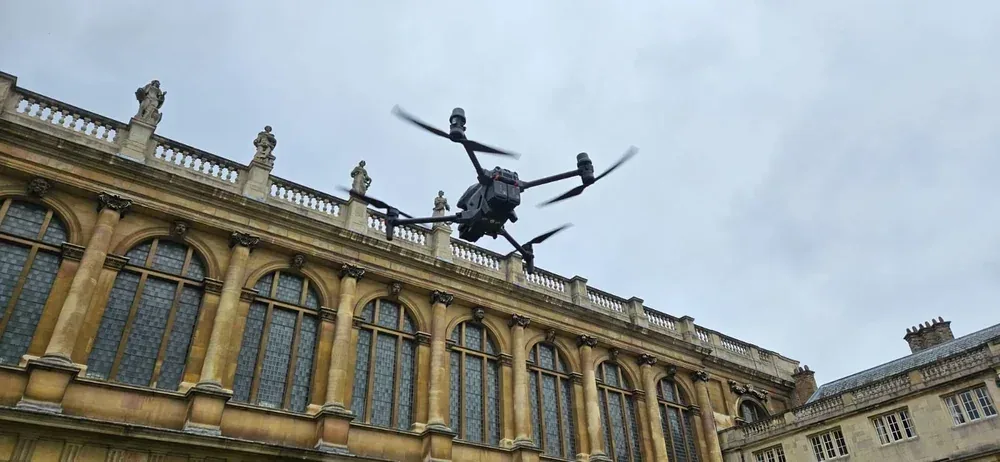
There is a second reason agents commission rather than buy, and it is visible above: some instructions want a machine and a qualification that no 249-gram drone will ever provide. A listed building, a commercial elevation, a site that needs a survey-grade camera. That is a different purchase entirely, and it is not one you make for a semi in a cul-de-sac.
PART FOUR
What I’d buy to shoot a house legally
The DJI Mini 5 Pro, and I would not spend long deciding. It is the only drone I have flown that puts a one-inch sensor underneath the line that decides whether you are allowed to be above a house at all, and it sits in the middle of this field on price rather than at the top of it.
Take the legal argument first, because it is the one that eliminates. At 249.9 grams with a C0 mark it sits in Over People (A1), which is the only Open Category bracket that lets you fly inside a residential area without a further qualification. Everything heavier is either an exam away from that or 150 metres away from the house. There is no clever workaround, and for a business that needs the photographs on a Tuesday, there is no waiting for one.
Then the camera, which is what turns a legal drone into a useful one. The one-inch sensor is the threshold where a British overcast sky and a shadowed elevation stop being mutually exclusive, and the raw files hold enough to fix the rest. The gimbal drives to a true −90° for the site plan and rolls for a native vertical clip. Obstacle sensing works in every direction, which matters more than it sounds when you are threading between a chimney and a beech tree with a client watching. In my hands it is the least stressful drone to fly close to a building, and on a paid job that is worth more than any spec on the page.
Spend less if the photographs are a bonus rather than the product. The DJI Flip costs well under half what the Mini 5 Pro does and has the same 24 mm framing, the same 249-gram legal position and a genuinely good 48-megapixel sensor. What you give up is obstacle sensing to the sides and behind, so you fly it more carefully and further from the gutter. For an agent adding two aerial frames to a listing, it is plenty — and the money you did not spend covers the insurance and the second battery with room to spare.
Spend more for exactly one reason: the second lens. The DJI Air 3S is about half as much again as the Mini 5 Pro and gives you a real 70 mm alongside the 24, and on roofs, chimneys and long elevations that changes the shots you can take rather than merely improving them. Go in knowing that its C1 mark stops counting on 1 January 2028, after which you need the A2 exam to fly it near people. And if photography is your actual trade, the DJI Mavic 4 Pro is the best camera here by a distance, for getting on for three times the money — sit the exam first, then buy it.
The two I’d tell an agent to walk past
The DJI Avata 2. Agents see the one-take fly-through videos estate agencies post and assume that is the drone to buy. It is not, for two reasons that have nothing to do with the price. It is flown through goggles, which in UK law means a second person has to stand next to you watching the drone for the whole flight — so your solo Saturday viewing shoot needs a colleague. And its single-axis gimbal has a controllable range of −85° to 80°, so it physically cannot deliver the top-down site plan. It is a superb toy and I have had a lot of fun with mine. It is not a listing camera.
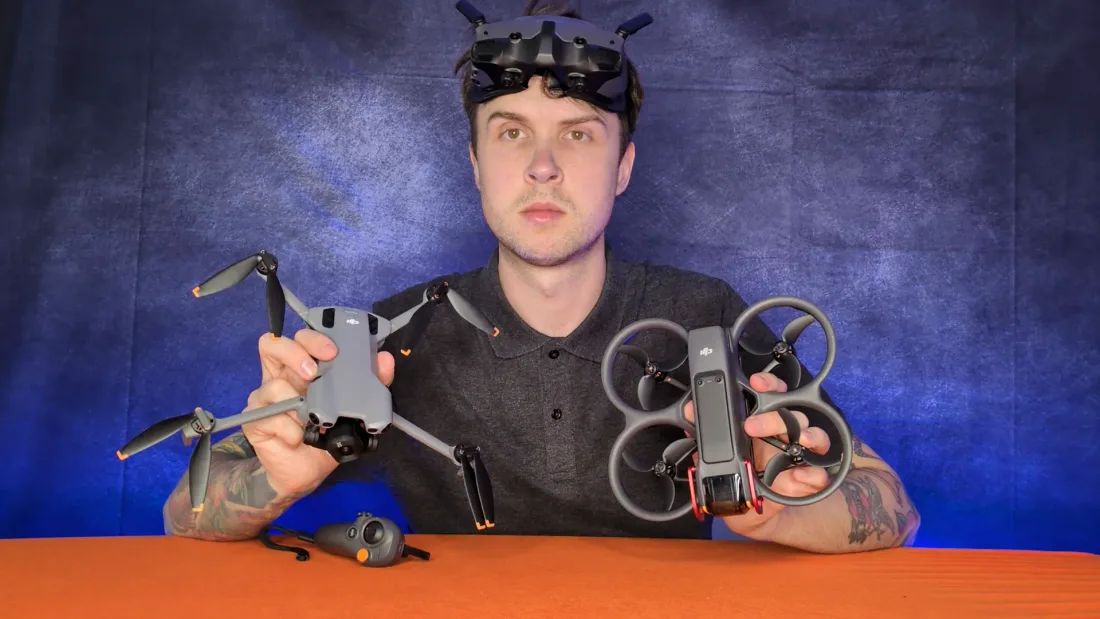
And the DJI Neo 2, which is the cheapest thing here with a DJI badge and therefore the one people reach for first. At 151 grams it is legally unimpeachable. The problem is the 16.5 mm equivalent lens, which is far too wide for a building and bows every vertical it sees, on a 1/2-inch sensor that writes JPEG only. It is a lovely little drone for filming yourself. Put it on a listing and the house looks like it is falling over.
And if you got this far and quietly concluded that you do not want to be a drone pilot — that is a perfectly good answer, and for a handful of instructions a year it is the cheaper one. Somebody else can carry the registration, the insurance and the decision about whether the wind is too strong.
Drones for property listings: the questions I get asked most
What is the best drone for real estate photography in the UK in 2026?
The DJI Mini 5 Pro. It takes off at 249.9 grams, which is what lets it fly in the Over People (A1) sub-category — the only Open Category sub-category that permits flying inside a residential area at all. On top of that it carries a one-inch, 50-megapixel sensor, omnidirectional obstacle sensing and a gimbal that tilts to a true 90 degrees down for the site plan shot. Spend less and the DJI Flip does the same job for well under half the money, with a smaller sensor and much less obstacle sensing. Spend more and the DJI Mavic 4 Pro is better in every way except the one that matters most, because at 1,063 grams it needs an A2 Certificate of Competence before you can fly it near anybody.
Do estate agents need a licence to fly a drone in the UK?
Not a licence, but there are three things you need before the first flight. A Flyer ID for whoever is flying, which is a free CAA theory test valid five years. An Operator ID for whoever is responsible for the drone, which costs £12.34 a year and goes on a label stuck to the airframe — and if the drone belongs to the agency rather than to you personally, the agency registers as the operator and must name an accountable manager. And third-party insurance, which stops being optional the moment the flying is for work. Whether you also need an A2 Certificate of Competence depends entirely on what the drone weighs.
Is drone insurance a legal requirement for property photography?
Yes. The CAA’s position is that if you fly a drone for any commercial reason you must have third party insurance as a minimum, and it lists getting paid to take pictures or record video as exactly that. Photographing a house you are instructed to sell is work, not recreation, even if you are an employee rather than a freelancer and even if nobody invoices separately for the photographs. The policy has to comply with Assimilated Regulation (EU) 785/2004, the responsibility sits with the operator rather than the pilot, and the policyholder name should match the name on the Operator ID.
Can I legally fly a drone over someone else’s house or garden?
Flying over a neighbouring property is not automatically illegal, but two separate things constrain it. First, the CAA requires the landowner’s permission for the spot you take off and land from, so you need the vendor’s agreement even to launch from the garden you are photographing. Second, the camera brings data protection law into it: the CAA says that using a camera where people can expect privacy, such as inside their home or garden, is likely to break data protection laws, and that images in which people can be identified may fall under GDPR and the Data Protection Act 2018 whether you captured them deliberately or not. In practice that means framing the instructed property, not the neighbours’ patio, and deleting frames you do not need.
Which drones can shoot a true top-down photograph of a property?
Any drone whose gimbal has a controllable tilt range reaching 90 degrees down. In this guide that is the DJI Mini 5 Pro, Mini 4 Pro, Mini 3, Flip, Air 3S, Mavic 4 Pro and the Autel EVO Nano+, all of which DJI and Autel publish as controllable to -90 degrees. The one that cannot is the DJI Avata 2: its single-axis gimbal has a controllable tilt range of -85 to 80 degrees, so it stops five degrees short of vertical and you never get a square site plan out of it.
Is it cheaper to buy a drone or hire a drone pilot for property listings?
It depends on how many listings you shoot. Buying a DJI Mini 5 Pro, registering it, insuring it commercially, adding a second battery, filters and a card comes to comfortably four figures in the first year before you have taken a single photograph — five or six commissioned shoots’ worth. Commissioning a pilot for a single property typically runs to a couple of hundred pounds. So the arithmetic turns somewhere around six to ten instructions a year — below that, hiring is simply cheaper and somebody else carries the insurance and the liability. Above it, and especially if you are shooting most weeks, owning wins comfortably.
The short version
Buy the DJI Mini 5 Pro, register it, and get commercial third-party insurance before the first paid flight. It is the only drone here with a one-inch camera that is also light enough to be legally allowed above a residential street. If you shoot fewer than half a dozen instructions a year, commission the photographs instead.
Affiliate links · costs you nothing extra · full disclosure
Drone prices move constantly and bundles change without notice, so this guide does not print them — check the link before you buy, and check which configuration it is for. Weights, gimbal ranges, focal lengths and flight times, checked 31 July 2026, come from DJI, Autel and Antigravity specification pages. Regulatory detail from the UK Civil Aviation Authority. Amazon links are affiliate links. Related reading: the wider case for drone photography, drones chosen for video work and what £500 buys you.