How to Spot Your Drone at Night Under UK Rules

Peter Leslie
12 Sept 2025
Key Takeaways
- From 1 January 2026, any Open Category drone flown at night in the UK must show a green flashing light, and that light is what lets you keep Visual Line of Sight after dark
- UK1, UK2, UK3, UK5 and UK6 class drones ship with a built-in green flashing light; UK0 and UK4 do not and need a retrofit before any night flight
- The remote pilot is legally responsible for making sure the light stays on throughout the flight, and any moment it deactivates the flight is non-compliant
- A co-located observer is the single biggest reliability upgrade on a night flight, and the Drone Code allows an observer to hold Visual Line of Sight on your behalf
- Retrofit green flashing lights add weight, and that weight counts towards the drone's maximum take-off mass and may push it into a different sub-category
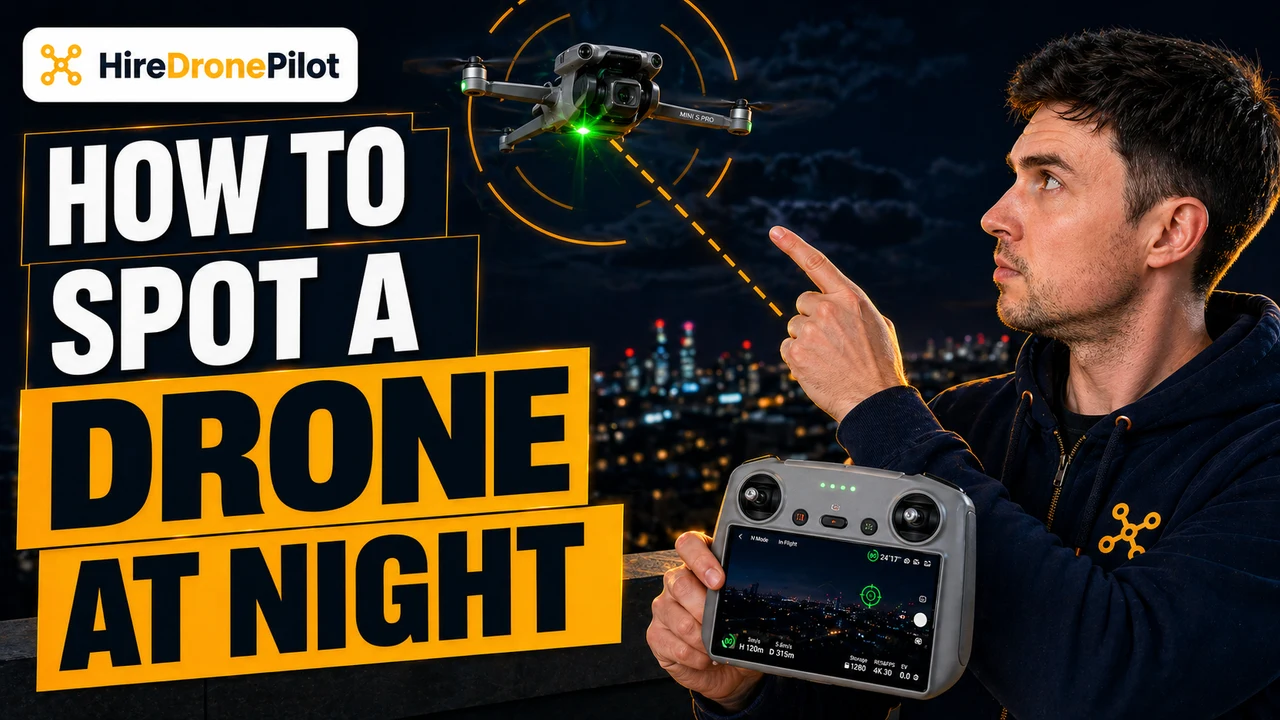
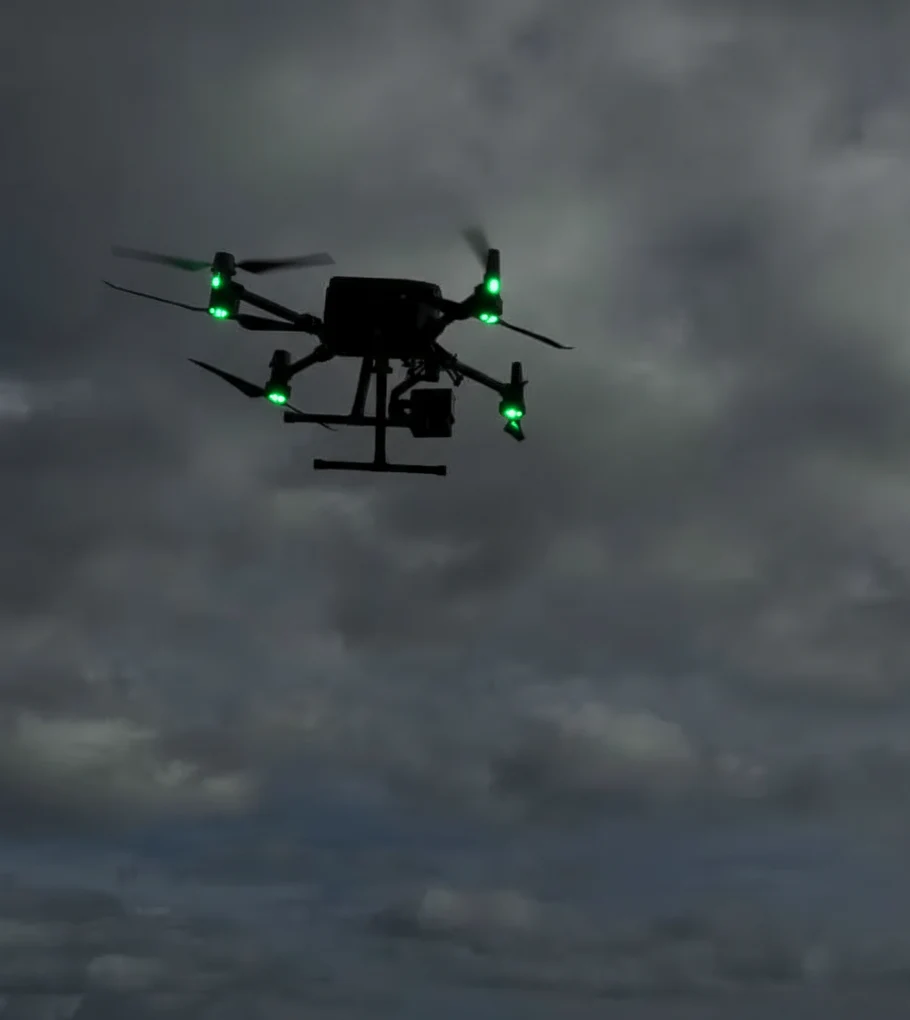
Spotting your own drone at night under UK rules is a solved problem, and the solution is written directly into UK drone law. From 1 January 2026 any Open Category drone flown at night must display a green flashing light throughout the flight, and that light is what turns Visual Line of Sight from a daytime assumption into a night-time reality.
Below is the full picture: what the light actually does, which class of drone ships with one and which does not, how an observer strengthens the setup, and what you as the remote pilot have to do to keep the flight legal after dark. Most of this ties back to the CAA's own flying at night in the Open Category guidance, and the companion piece on flying drones at night in the UK goes deeper on the rules end.
A green flashing light is the UK's legal answer to keeping Visual Line of Sight after dark
The Drone and Model Aircraft Code sets the rule plainly. When you fly at night, your drone must have a green flashing light turned on. The legal basis is UK Regulation (EU) 2019/947 UAS.OPEN.060(2)(g), and it applies to any Open Category night flight from 1 January 2026 onwards.
The reason the light matters is that VLOS gets significantly harder in the dark. You need to be able to see your drone clearly enough to tell which way it is facing and clearly enough to spot other aircraft entering your airspace. In daylight a drone silhouette against the sky gives you orientation cues for free. At night those cues collapse. The green flashing light puts the orientation and position back.
The CAA's own guidance is specific about the purpose. The green flashing light is there to enable a person on the ground to distinguish a drone from a manned aircraft. That framing matters — the light is primarily an anti-collision signal to other drone pilots and airspace users rather than a navigation light for you. Which is why it has to be visible from the ground, and why the regulations do not specify a minimum brightness or flash frequency — it has to be visible enough to do the job.
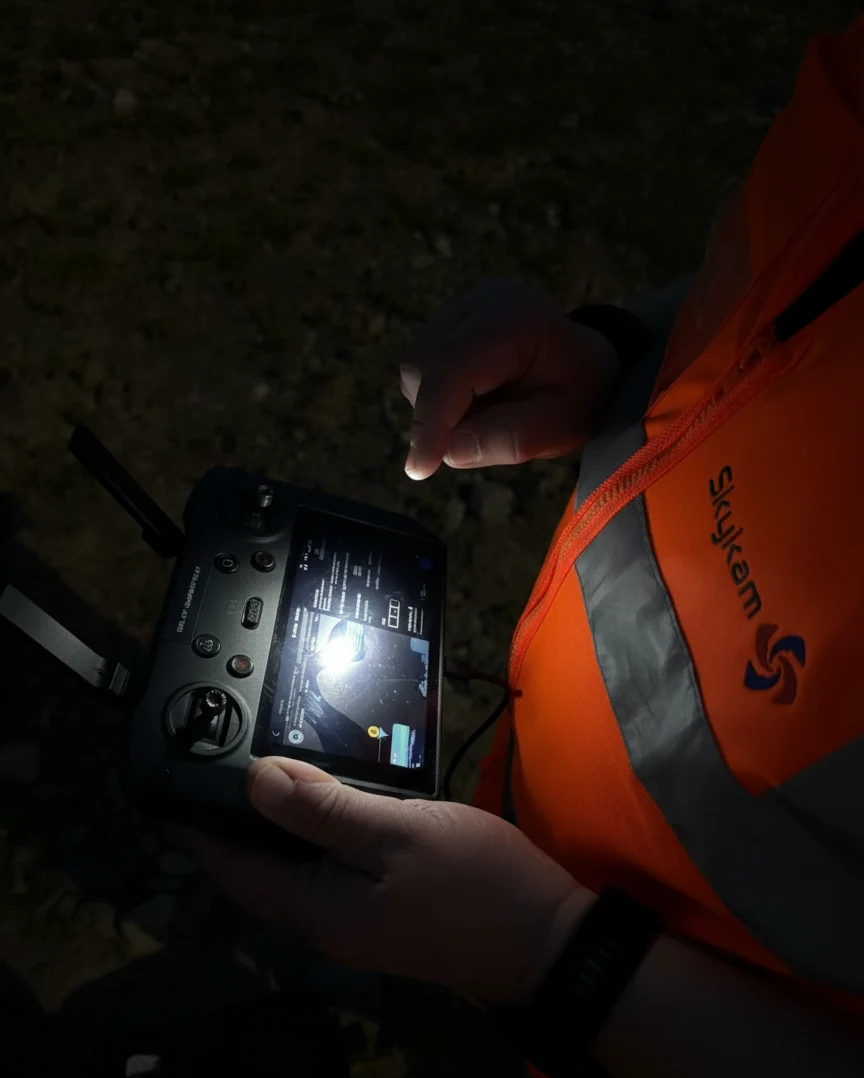
Which class of drone ships with a built-in green flashing light and which does not
This is where the class-mark detail starts to matter. Under UK Regulation 2019/945, only UK1, UK2, UK3, UK5 and UK6 class-marked drones are required by the manufacturer to ship with an in-built green flashing light function. That covers most of the mainstream market — drones like the DJI Matrice series, the larger Mavic variants, and any class-marked drone sold new in the UK from January 2026 in those classes.
The exceptions are UK0 and UK4. UK0 drones are usually very small sub-250g platforms, and UK4 drones are typically fixed-wing model aircraft with simple avionics. Neither class is required to ship with a built-in green flashing light, because the design assumption is that they are unlikely to be flown at night in the Open Category. Legacy drones — that is, drones placed on the UK market before the class-mark system came in — also do not carry the built-in light.
If your drone is UK0, UK4, or a pre-class-mark legacy drone, and you want to fly at night, you must retrofit a specialist green flashing light before the flight. Any competent UK drone retailer sells them. The CAA's guidance is that the light should be securely attached, placed so it is clearly visible from the ground during flight, and should not affect flight safety.
The remote pilot is legally responsible for keeping the light on throughout the flight
This is the detail most people miss. It is not enough to have the green flashing light installed. The light has to remain active at all times during the night flight, and the remote pilot — you — is the person legally responsible for making sure that happens.
Some drones switch off their flashing lights when recording video, because the manufacturer designed the lights to look smooth on the footage. If you hit record and the lights go dark, the flight is no longer compliant. The CAA's own guidance is specific: if the flashing light deactivates for any reason, the remote pilot cannot continue to comply with the operational requirement. You need to check this on your specific drone model before your first night flight, and either disable the lights off during recording setting or avoid recording on night flights entirely.
This is exactly the sort of pre-flight check that makes a night flight either smooth or stressful. Test your lights on the ground before take-off. Verify they stay on when you start recording. Confirm they stay on during a brief high-altitude test. Treat the lights like you treat the battery — an essential piece of safety kit, not a nice-to-have.
A co-located observer is the single biggest reliability upgrade on a night flight
The Drone Code allows you to fly with the help of an observer, and at night that allowance becomes genuinely valuable. The observer has to stand next to you, you have to be in constant verbal communication with each other, and between the two of you one person must keep the drone in direct sight and have a full view of the surrounding airspace at all times. The observer does not need a Flyer ID, but you as the remote pilot remain responsible for the safety of the flight.
In daylight that observer mostly frees you up to spend more time on the controller screen. At night the observer is frequently the primary pair of eyes on the drone, because they are not also watching a dim low-resolution video feed. They are the person who will spot another aircraft entering the area, pick up a deviating bird, or call we have lost visual before you do.
My usual habit on a night flight is to agree specific callouts with the observer before take-off. Eyes on drone. Eyes off drone. Climb. Hold. Return to home. A structured callout pattern makes the job obvious for both of you and removes most of the friction that can otherwise creep in on a dark evening with cold fingers and a bright controller screen.
A retrofit light's weight counts towards the drone's maximum take-off mass
If you are retrofitting a light onto a UK0 or legacy drone, the weight of the light and any mount counts towards the drone's maximum take-off mass. That matters because the Open Category sub-categories — A1, A2, A3 — are defined partly by weight thresholds, and adding even a small light to a borderline drone can push it into a different sub-category with different distance rules.
The classic trap is a sub-250g drone that sits right at the 249g mark out of the box. Strap on a thirty-gram light module and the drone is no longer sub-250g. The people-distance rules change. The ability to fly over uninvolved people evaporates. Which is why the CAA flags this explicitly in its night flying guidance and why any sensible drone pilot weighs the drone with the light fitted before the first night flight, not after.
This is also where the distinction between your own drone and a suspicious drone overhead matters. If you are reading this because you have seen a drone flying near your property at night, the green flashing light you can see from the ground is the legally required anti-collision signal. A drone operating at night without one is not compliant, and that is a fact you can pass to the local police on 101 or to the relevant airport security if the flight is near an airfield.
Night flights still have to clear every other rule in the Drone Code before you launch
The green flashing light is the headline rule, but it is not the only one. A night flight still sits under the rest of the Drone Code. You still have a 120 metre altitude ceiling. You still have a 50 metre distance from uninvolved people in the Open Category, scaling upwards with altitude. You still cannot fly over crowds. You still cannot fly inside a Flight Restriction Zone without permission. And the CAA's own safety advice specifically flags battery derating in cold UK weather as a night-flying consideration.
If you fly commercially at night — event videography, thermal imaging, any paid work — the CAA treats the flight as commercial activity under flying drones for work rules. Third-party liability insurance is required. Competence has to match the operation. In most UK urban or close-range night scenarios, you are likely flying under a Specific Category Operational Authorisation rather than the Open Category.
So to recap. Green flashing light on the drone, active the whole flight, your responsibility as the remote pilot. An observer beside you if the site or flight complexity justifies it. A weight check if you have had to retrofit. And every other Drone Code rule still applies on top of the night-specific light.
If you want the deeper rule set on UK night flying — why the transition period ended, which drone classes ship the light, how the Remote Pilot responsibilities interact with Operator ID and Remote ID — the companion article on flying at night in the UK is the next read.
Got a specific night flight you want covered — an event, a thermal inspection, a dawn-light shoot, an unusual location? Drop a note to peter@hiredronepilot.uk and I will come back to you directly. If you prefer the video version of this explainer, the comments are open on YouTube.
References
Primary source material for this article is the UK Civil Aviation Authority. External links open in a new tab.
- UK CAA — Flying at Night in the Open Category · the green flashing light requirement, class-mark coverage, and remote pilot responsibility
- UK CAA — The Drone and Model Aircraft Code (CAP2320) · Rule 19 (green flashing light), Rule 2 (VLOS and observer rules), altitude and distance rules
- UK CAA — Safety Advice for Drone Operations · winter and night flying, battery performance, collision and human-factor considerations
- UK CAA — Flying Drones for Work · commercial night operations, insurance, Operational Authorisation for Specific Category
Peter Leslie
Founder & GVC Drone Pilot
Peter is the founder of HireDronePilot. With thousands of logged commercial flight hours, he writes about drone technology, commercial surveying tactics, and UK aviation compliance.
Connect on LinkedIn