PDRA01 Explained: Flying Drones in UK Built-Up Areas

Peter Leslie
31 Oct 2025
Key Takeaways
- PDRA01 is the CAA pre-defined Specific Category authorisation for flying drones between 250 g and 25 kg in built-up areas within Visual Line of Sight — if you hold a GVC and an Operational Authorisation, that OA is your PDRA01
- It removes the Open Category A3 rule that keeps you 150 metres from residential, commercial, industrial, and recreational zones
- You must hold a GVC or RPC-L1, maintain a current Operations Manual, and carry third-party insurance
- The authorisation costs £524 per year, lasts twelve months, and requires reapplication before it expires
- Operational limits include 120 metres altitude, 500 metres range, 50 metres from uninvolved people, and no overflight of assemblies
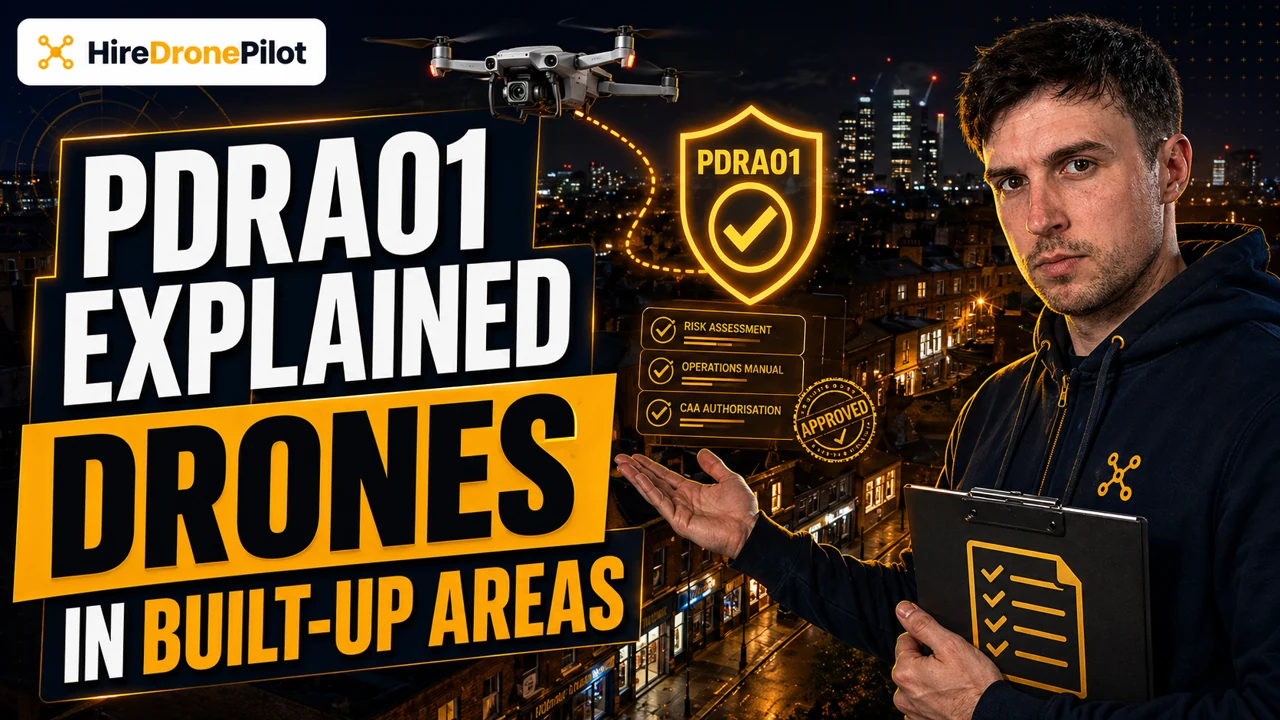
PDRA01 is the authorisation that lets you fly a drone in a residential street, over an industrial estate, or across a commercial district — places the Open Category keeps you 150 metres away from. It is a Pre-Defined Risk Assessment issued by the UK Civil Aviation Authority under the Specific Category, and it is the simplest route to lawful commercial drone operations in built-up areas.
But "simplest" does not mean "easy." The authorisation comes with hard operational limits, qualification requirements, and an ongoing compliance burden that the CAA can audit at any time.
PDRA01 is not a separate thing from your Operational Authorisation — it is your Operational Authorisation
This is a point that trips up a lot of drone pilots, so it is worth clearing up early. A GVC is a qualification — a certificate that proves you are competent to fly. It sits on you as the drone pilot and lasts five years. An Operational Authorisation is a permission from the CAA that lets you conduct a specific type of operation. It sits on you as the operator and lasts twelve months.
PDRA01 is simply the name the CAA gives to the pre-defined Operational Authorisation for VLOS flights in built-up areas. If you hold a GVC and an OA for flying in residential, commercial, or industrial zones — that OA is your PDRA01. They are the same document. Think of the GVC as your driving licence, and PDRA01 as permission to use a restricted road. You need the licence first, but the licence alone does not get you onto the road.
PDRA01 is the CAA's simplest Specific Category authorisation, and it exists because the Open Category locks you out of built-up areas
In the Open Category, the A3 sub-category — "Far from People" — requires you to maintain at least 150 metres of horizontal distance from any residential, commercial, industrial, or recreational area. For many commercial drone pilots, that single rule eliminates most of the work. Roof inspections, building surveys, site photography — the jobs are in towns and cities, and A3 keeps you out.
PDRA01 solves this. It is a pre-defined operational authorisation under the Specific Category that removes the 150-metre restriction and lets you fly inside those congested zones. The "pre-defined" part matters: instead of writing your own bespoke risk assessment from scratch (which is what UK SORA requires), the CAA has already defined the risk profile, the mitigations, and the conditions. You agree to operate within them, and the CAA issues the authorisation.
The authorisation covers any rotary-wing or fixed-wing drone weighing between 250 g and 25 kg. It is valid for work, hobby, or both — though in practice, most PDRA01 holders are commercial drone operators who need access to built-up areas for paying clients.
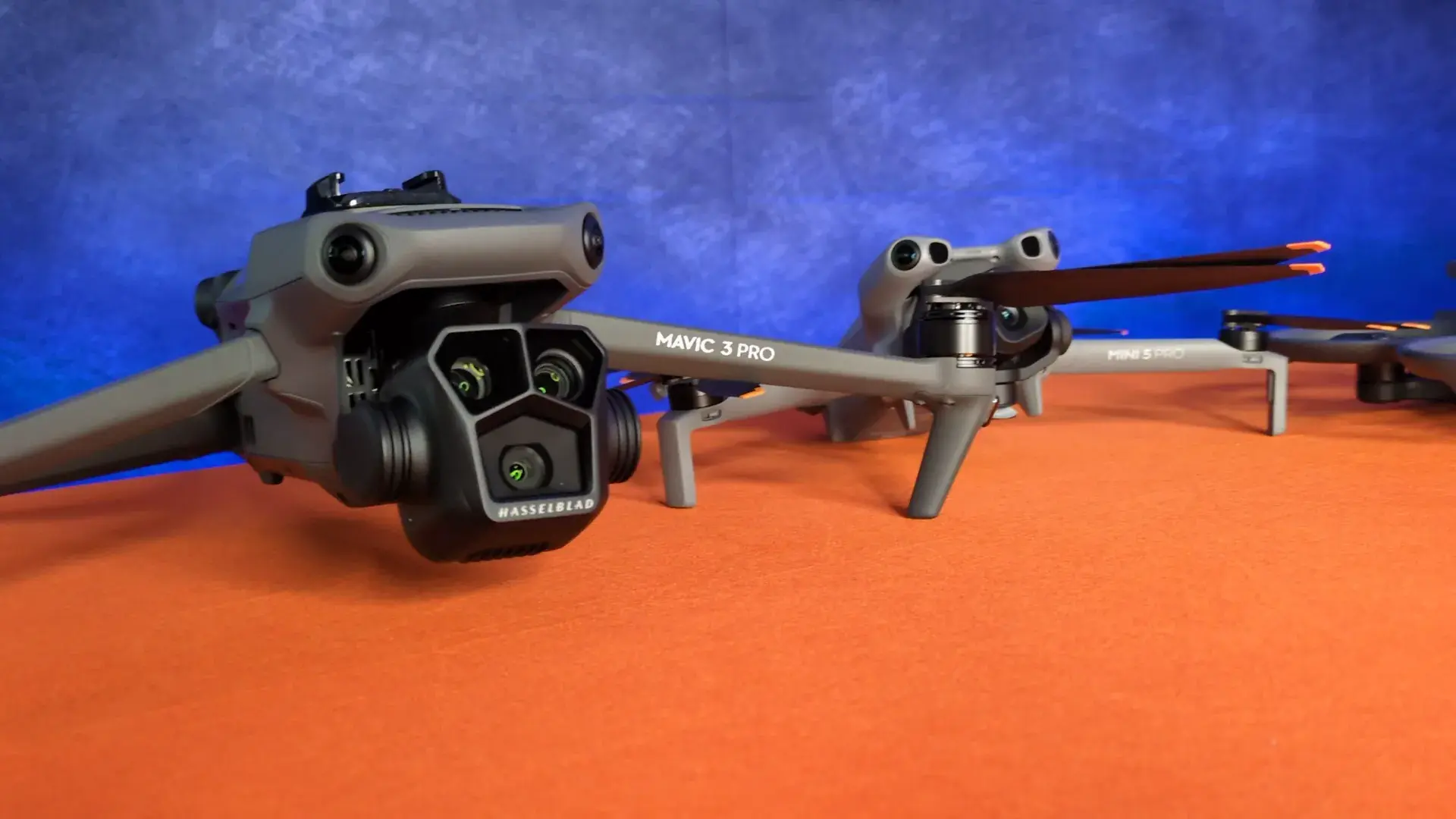
The authorisation removes the 150-metre restriction from residential and commercial zones, but it does not remove the 50-metre people buffer
The headline privilege of PDRA01 is access to congested areas. You can fly in residential streets, commercial high streets, industrial estates, and recreational parks — all the zones that A3 bans you from.
What PDRA01 does not do is let you fly close to people. You must maintain a minimum horizontal separation of 50 metres from any uninvolved person at all times during flight. That buffer reduces to 30 metres only during take-off and landing, and only during those phases.
Assemblies of people — crowds, queues, outdoor events — get an even harder rule. You must maintain at least 50 metres of horizontal separation from any assembly, and you must never overfly an assembly at any height. On top of that, the CAA applies the 1-to-1 rule: your horizontal separation from an assembly must not be less than the height of your drone. Fly at 80 metres and the buffer becomes 80 metres.
You are permitted to overfly uninvolved individuals, but the CAA requires you to keep this to the absolute minimum necessary for your operation. This is not a blanket permission to loiter over people.
PDRA01 also permits 24-hour operations, including night flying, provided you follow the approved night procedures set out in your Operations Manual.
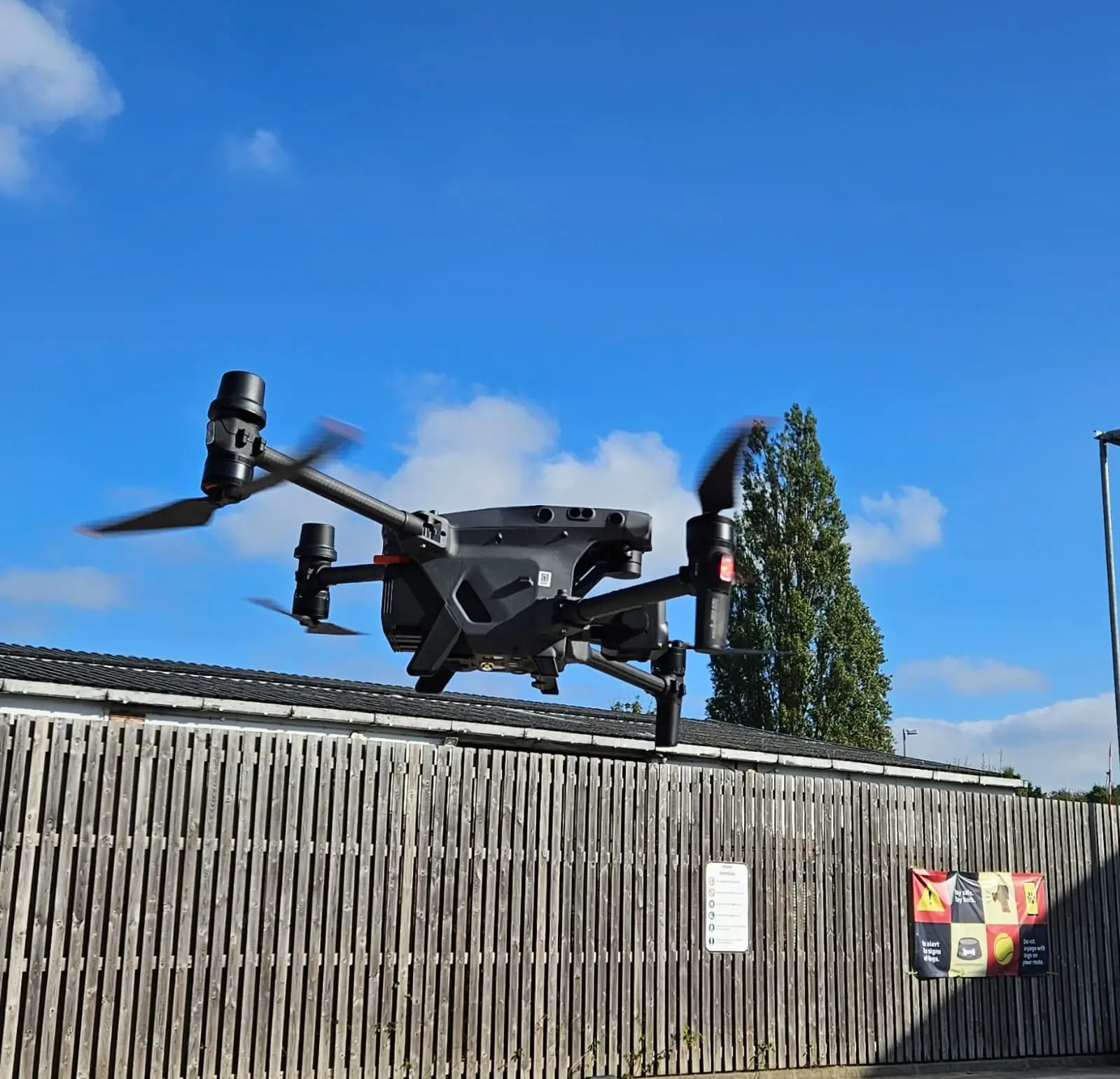
Your operational ceiling is 120 metres, your range is 500 metres, and you must maintain Visual Line of Sight at all times
The altitude ceiling under PDRA01 is 120 metres (400 feet) above the closest point of the earth's surface — the same limit as the Open Category. There is one narrow exception: if a structure is taller than 105 metres and the person in charge of that structure requests an inspection, you may overfly it by up to 15 metres, provided your drone stays within 50 metres horizontally of the structure.
Your maximum operating range is 500 metres from you as the Remote Pilot, measured horizontally. This is not a suggestion — it is written into UK Regulation (EU) 2019/947.
Throughout every flight, you must maintain Visual Line of Sight with your drone. That means direct, unaided eyesight — no binoculars, no telephoto lens, no screen-only flying. You may use a competent observer who is co-located with you and who maintains VLOS on your behalf, but the observer does not extend your range beyond 500 metres. You are also permitted to change your position during a flight, as long as you maintain control and situational awareness throughout the move.
Two final hard limits: you must not drop any article from the drone, and you must not carry dangerous goods.
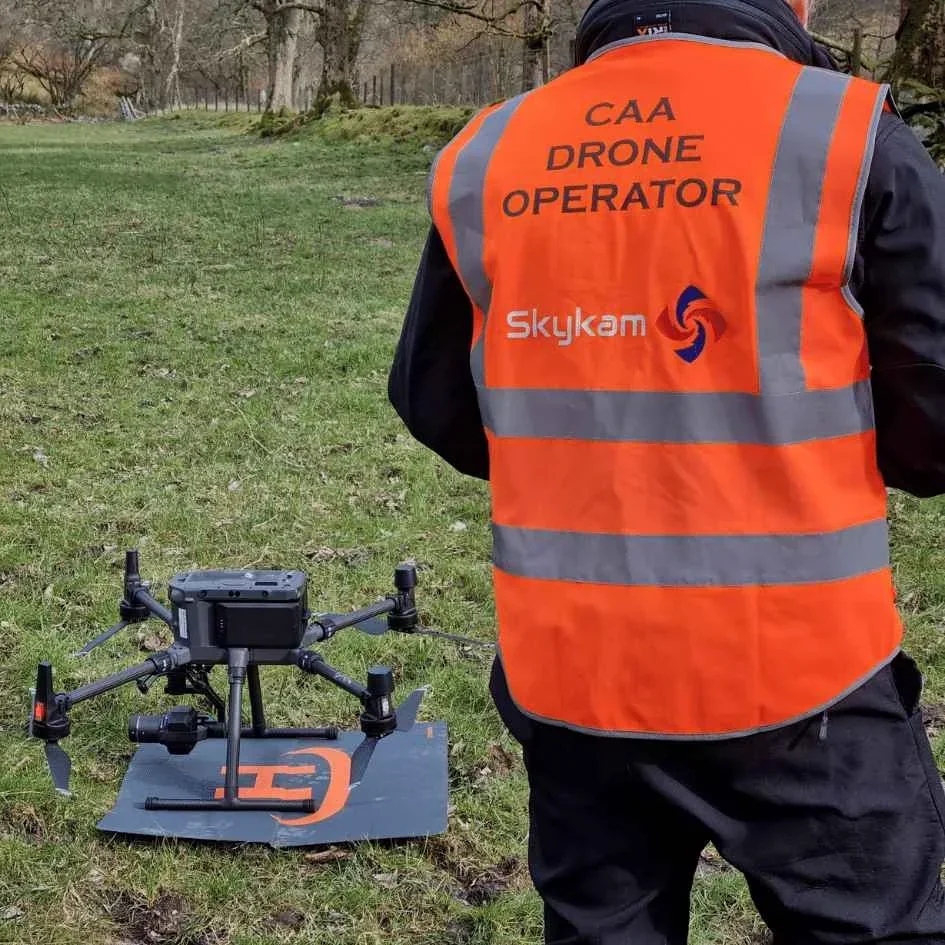
You need a GVC or RPC-L1, a Flyer ID, an Operations Manual, and £524 per year to hold a PDRA01
The qualification barrier is the first gate. Every Remote Pilot operating under your PDRA01 must hold a valid Flyer ID and either a GVC (General Visual Line of Sight Certificate) or an RPC-L1 (Level 1 Remote Pilot Certificate). Both are VLOS-only qualifications valid for five years. On top of the certificate, each drone pilot must have logged at least two hours of flying experience in the three months before any PDRA01 flight — currency time that can be gained in either the Open or Specific Category.
The Operations Manual is the second gate. The CAA requires every PDRA01 holder to develop and maintain a manual that covers site surveys, pre-flight checks, in-flight procedures, emergency response, maintenance schedules, and flight logging. The CAA strongly recommends using the CAP 2606 template, and in practice most drone operators do — it is the easiest path to a compliant manual.
You must also carry third-party insurance that meets the requirements of UK Regulation (EU) 785/2004, and you must display your Operator ID on every drone you fly under the authorisation.
The cost is £524 per year with no VAT. The authorisation lasts twelve months. You can reapply from 28 days before expiry, and the CAA aims to issue within 24 hours of a complete application. The application itself takes roughly 15 minutes. If you submit in error, a refund is available within 30 days minus a £25 administrative fee.
The CAA can audit you at any time, and a Level 1 finding means instant suspension of your authorisation
Holding a PDRA01 is not a one-off approval. The CAA operates an ongoing compliance regime and can select you for audit at any time. When they do, you receive a notification at the email address registered to your Operator ID, and you have 28 calendar days to respond with a full evidence pack.
That pack includes your Operations Manual, the qualifications and currency details for every Remote Pilot who flew the last three flights, your Flyer ID and Operator ID, site surveys for those three flights (each on a different date), flight logs, and maintenance records for every drone used. All documentation must match the operator name on the authorisation — a mismatch triggers suspension.
The CAA grades its findings on two levels. Level 2 findings are concerns that do not pose an immediate safety risk; you must address them by a target date. Level 1 findings are immediate safety concerns, and they result in instant suspension of your authorisation. If the Level 1 issue is resolved by the target date, the CAA moves your authorisation toward reactivation. If it is not, the suspension holds until your authorisation expires.
You are required to retain all flight safety documents, Remote Pilot qualifications, and maintenance records for a minimum of three years.
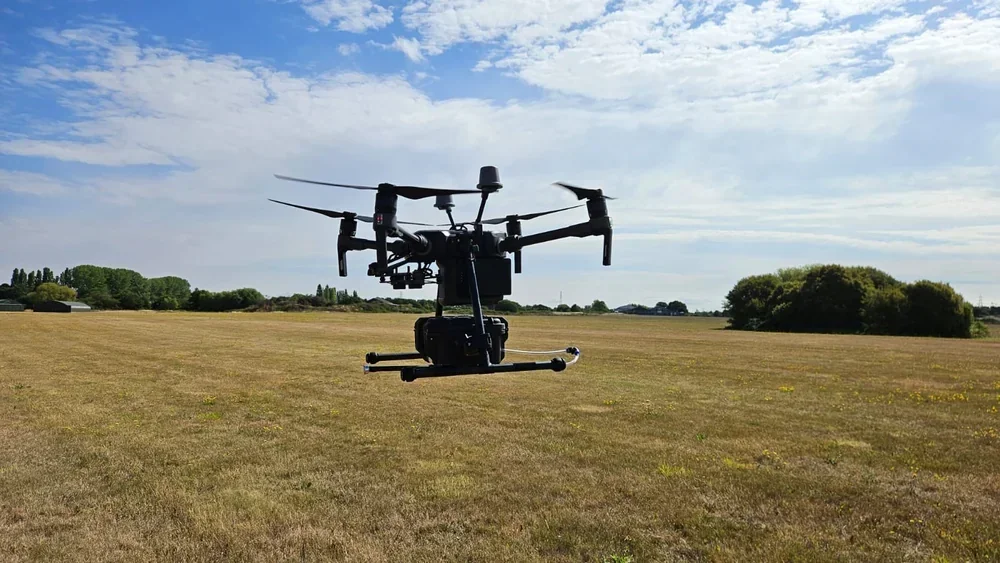
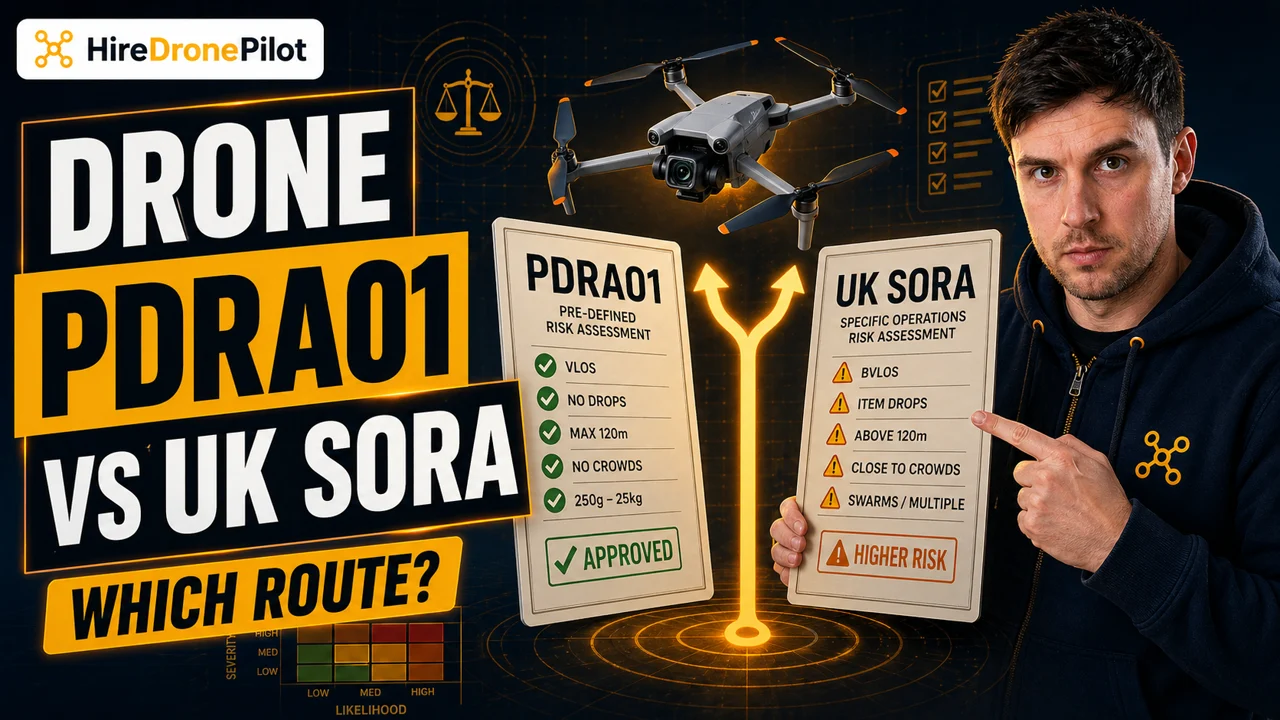
If your operation needs BVLOS, item drops, or flights closer than 50 metres to people, PDRA01 does not cover it and you need UK SORA
PDRA01 has clear boundaries. It covers VLOS flights, drones up to 25 kg, altitudes up to 120 metres, and a 50-metre minimum separation from uninvolved people. If your operation falls outside any of those limits, PDRA01 is not the right authorisation.
The next step up is UK SORA (Specific Operations Risk Assessment), which replaced the older Operating Safety Case from 23 April 2025. UK SORA covers Beyond Visual Line of Sight operations, item drops, flights close to or over crowds with drones weighing 500 g or more, increased altitudes above 120 metres, and swarm operations. It requires you to write your own risk assessment from scratch rather than using a pre-defined one, and the qualification pathway moves to RPC-L2 and RPC-L3 for progressively more complex operations.
For most commercial drone pilots, PDRA01 is the authorisation that unlocks the majority of paying work. Roof inspections, building photography, site surveys, and urban mapping all sit comfortably inside its conditions. The key is knowing where those conditions end — and PDRA01 makes the boundaries explicit enough that you should never be in doubt.
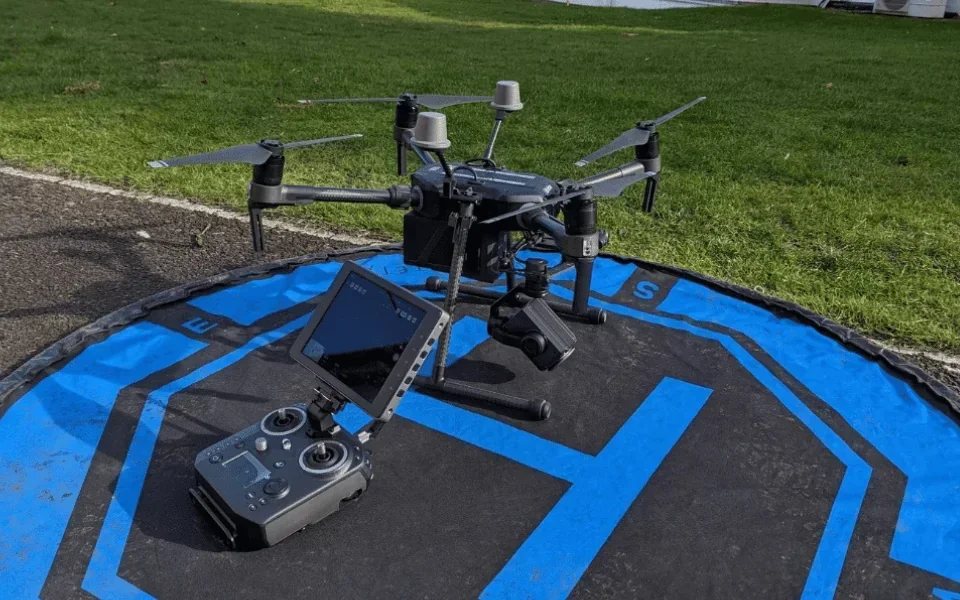
PDRA01 is the single most useful authorisation for commercial drone operators in the UK, and it is deliberately straightforward — provided you stay inside its conditions, maintain your paperwork, and keep your currency hours current. The CAA designed it to be the entry point into the Specific Category, and for VLOS work in built-up areas, it is all you need.
Got a PDRA01 question — maybe a borderline site or an ops manual query? Drop a note to peter@hiredronepilot.uk and I will come back to you directly. If you prefer the video version of this explainer, the comments are open on YouTube.
References
Primary source material for this article is the UK Civil Aviation Authority. External links open in a new tab.
- UK CAA — PDRA01 Overview · operational conditions, altitude and range limits, people-buffer rules, 1-to-1 rule
- UK CAA — Apply for a PDRA01 Operational Authorisation · £524 annual cost, 24-hour processing target, application steps
- UK CAA — PDRA01 Operations Manual · Operations Manual requirements, CAP 2606 template
- UK CAA — PDRA01 Oversight and Enforcement · audit process, evidence pack, Level 1 and Level 2 findings
- UK CAA — Where You Can Fly (A1, A2, A3 Sub-categories) · Open Category A3 150-metre restriction from congested areas
- UK CAA — Specific Category Overview · PDRA01 vs UK SORA scope, Specific Category definition
Peter Leslie
Founder & GVC Drone Pilot
Peter is the founder of HireDronePilot. With thousands of logged commercial flight hours, he writes about drone technology, commercial surveying tactics, and UK aviation compliance.
Connect on LinkedIn