PDRA01 vs UK SORA: When You Need Each

Peter Leslie
27 Apr 2026
Key Takeaways
- PDRA01 is the simpler, pre-defined Specific Category route — 250g to 25kg, VLOS, anywhere in the UK subject to airspace, including residential, commercial, industrial and recreational areas
- PDRA01 costs £524 per year with a 24-hour CAA processing turnaround once the application is complete
- UK SORA is the bespoke route for any operation PDRA01 does not cover — BVLOS, item drops, flights above 120 metres, swarms, and flights close to crowds or close to people with a 500g-plus drone
- If your planned operation sits inside the PDRA01 limits, PDRA01 is almost always the right choice — SORA only earns its keep when you actually need the extra scope
- Both routes are CAA Operational Authorisations under the Specific Category — one is pre-baked, the other is risk-assessed from scratch
If your planned drone operation needs more than the Open Category allows, you have exactly two routes into the Specific Category: PDRA01 or UK SORA. Most commercial drone operators only ever need the first one. A small but growing minority — BVLOS specialists, delivery drone operators, swarm shows, infrastructure inspections that climb above 120 metres — need the second.
This guide draws the line between them. The pillar piece on what UK SORA actually is covers how SORA works as a framework. This article is the decision aid — which route do you need, and exactly what tips an operation from one side to the other.
PDRA01 is the pre-defined route that covers most commercial drone work in the UK
PDRA01 stands for Pre-Defined Risk Assessment 01, and it is the only PDRA the UK CAA currently issues. The CAA has done the safety case for you in advance, set the limits, and pre-approved the operation against those limits. You apply, you accept the conditions, and you fly.
The headline scope is wide. PDRA01 authorises any drone between 250g and 25kg in flight, within Visual Line of Sight, at any UK location subject to airspace restrictions. That includes residential streets, commercial estates, industrial yards, and recreational sites — the four area types the Open A3 sub-category keeps you 150 metres clear of by default. PDRA01 unlocks the same airspace for the same drones, on the back of a one-page CAA authorisation rather than a bespoke risk assessment.
The standard PDRA01 conditions are easy to keep in your head: a 120-metre altitude ceiling, a 50-metre buffer from uninvolved people that drops to 30 metres only during take-off and landing, a 500-metre maximum range from the Remote Pilot, no item drops, no flights over assemblies of people, and 24-hour-a-day operating provided your operations manual covers night flying. The qualifying licence is a GVC (or an RPC-L1), held by every Remote Pilot operating under the authorisation.
For the price, the maths is straightforward: £524 per year with no VAT, valid for 12 months, and the CAA aims to turn the application around in 24 hours once everything is correct. For most inspection, photography, and survey work, PDRA01 is the right tool and the right cost.
UK SORA is the bespoke route for any operation PDRA01 does not cover
UK SORA stands for Specific Operations Risk Assessment. Where PDRA01 hands you a pre-baked envelope, SORA expects you to draw the envelope yourself, justify it with evidence, and let the CAA approve it as a one-off. There is no list of pre-set limits — the limits are whatever you can prove are safe.
SORA replaced the older OSC (Operating Safety Case) route on 23 April 2025. From that date the OSC application service closed to new submissions, and every fresh non-PDRA01 authorisation has been written under SORA. The application turns on calculating a SAIL (Specific Assurance and Integrity Level) rating for the operation and demonstrating the containment levels needed to keep the drone inside its planned operational volume.
SORA is more work to apply for than PDRA01, and the licensing usually steps up as well — many SORA operations expect an RPC-L2 or RPC-L3 qualification rather than a basic GVC, depending on the SAIL rating the application lands at. The pay-off is scope. A SORA authorisation can cover operations that PDRA01 has zero capacity for, and a single SORA authorisation can cover multiple operating locations and multiple drone models at once where the older OSC framework usually forced one application per site or model.
Six specific operations push you from PDRA01 into UK SORA
The CAA publishes the line plainly. If your planned operation hits any of the following, PDRA01 cannot authorise it and you need UK SORA:
- Flying Beyond Visual Line of Sight (BVLOS)
- Dropping items from a drone — lift-and-deliver designs, agricultural payloads, or any sort of release in flight
- Flying close to crowds or assemblies of people
- Flying close to uninvolved people with a drone weighing 500g or more
- Flying above the 120-metre altitude ceiling the rest of UK drone law uses as a hard cap
- Swarm operations — multiple drones flown simultaneously by one or coordinated drone operators
Each one of these is a hard switch, not a sliding scale. The moment your operation touches any of the six, PDRA01 is off the table and the application has to go through SORA. There is no half-step in between — PDRA01 has no "with extras" version that lets you do a single low-altitude item drop or a single short BVLOS leg under the simpler authorisation.
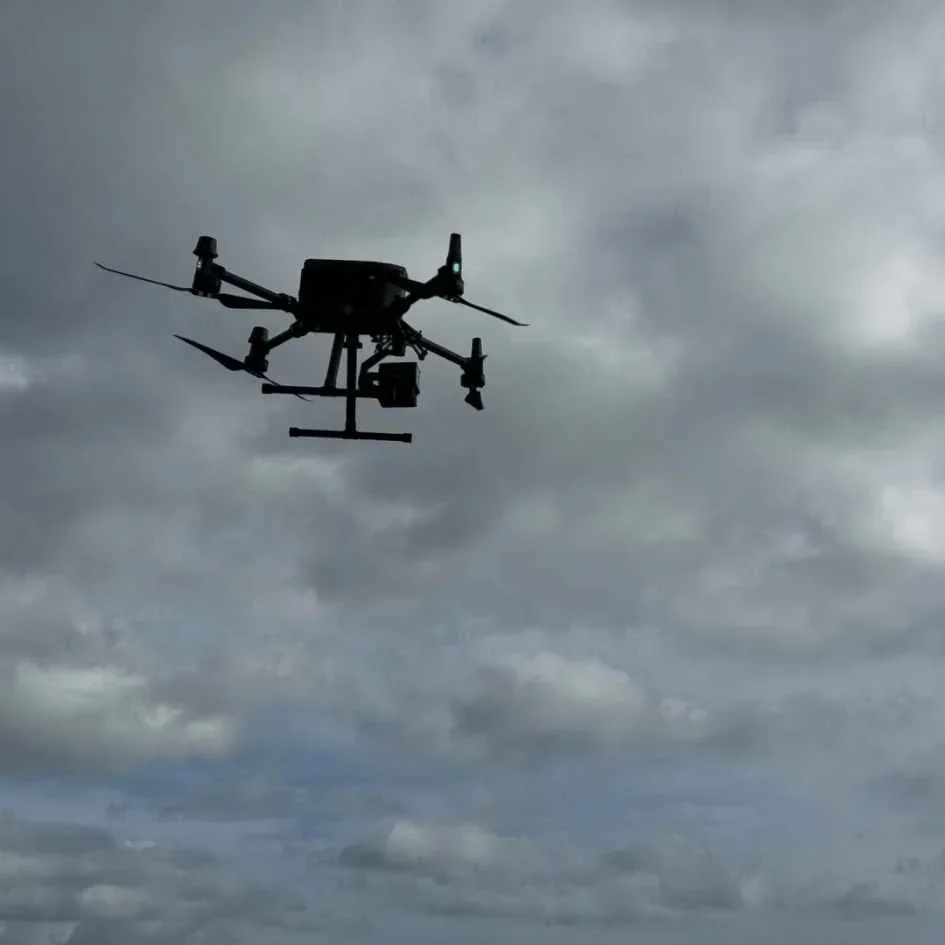
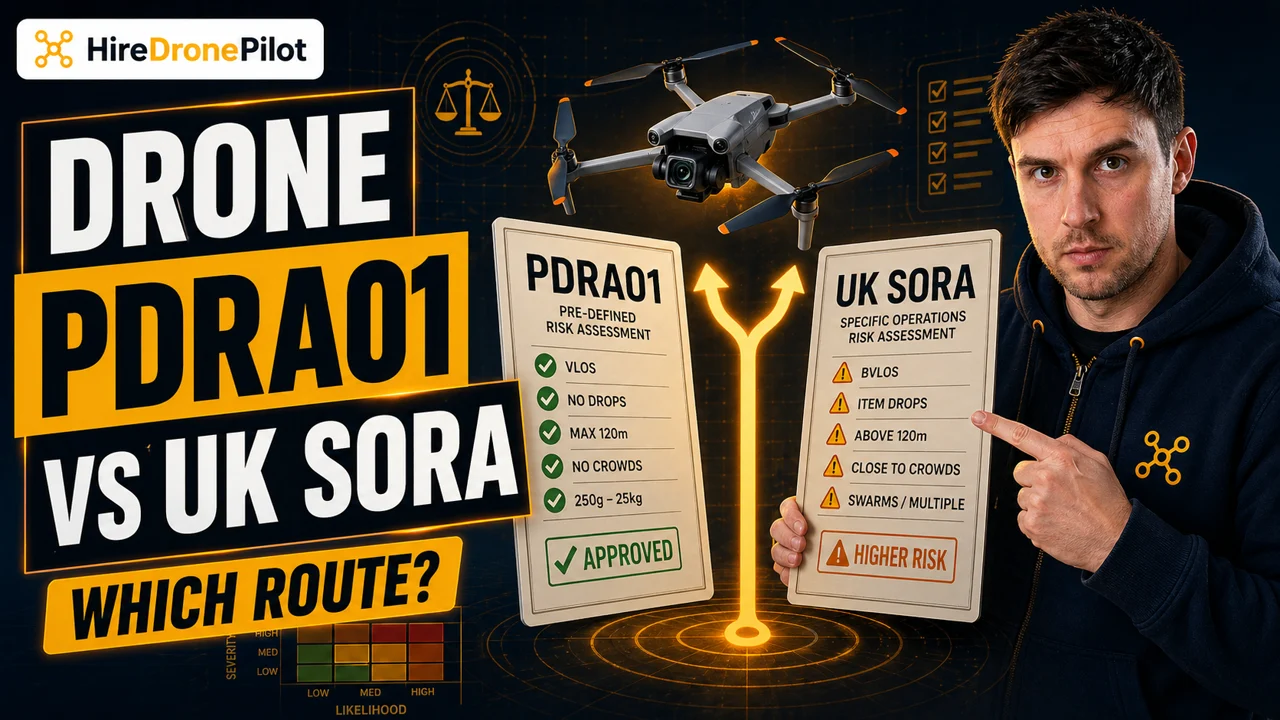
A side-by-side comparison of PDRA01 and UK SORA
The cleanest way to see the line is to put both authorisations next to each other on the conditions that actually drive the choice.
| Condition | PDRA01 | UK SORA |
|---|---|---|
| Risk assessment | Pre-defined by the CAA | Bespoke, applicant-built, SAIL-rated |
| Drone weight | 250g to 25kg MTOM | Defined by the application |
| Visual line of sight | VLOS only | VLOS or BVLOS |
| Maximum altitude | 120 metres (400ft) AGL | Above 120 metres if justified |
| Maximum range from Remote Pilot | 500 metres | Defined by the application |
| Item drops | Not permitted | Permitted if justified |
| Operating areas | Residential, commercial, industrial, recreational | Defined by the application, multiple locations supported |
| Crowds and assemblies | No overflight, 50m horizontal minimum | Permitted if justified |
| Swarm operations | Not covered | Covered if justified |
| Multiple drone models | Yes, within the weight band | Yes, explicitly supported under one authorisation |
| Pilot qualification | GVC or RPC-L1 | RPC-L2 or RPC-L3 typically, depending on SAIL |
| Annual fee | £524 per year | Variable, set per application |
| Processing time | 24 hours after a complete application | Significantly longer; bespoke review |
| Authorisation duration | 12 months | Defined by the application |
A simple decision flow for picking the right route
If you sketch the choice as a series of checkpoints, the picture clears quickly. Walk down the list and stop at the first answer that lands on SORA — if you reach the end without one, PDRA01 is your authorisation.
- Will the drone fly Beyond Visual Line of Sight at any point? → SORA
- Will anything be dropped or released from the drone in flight? → SORA
- Will the drone fly above 120 metres above ground level? → SORA
- Will the drone fly close to crowds or assemblies of people? → SORA
- Will the drone weigh 500g or more and fly close to uninvolved people? → SORA
- Will multiple drones fly simultaneously as a swarm? → SORA
- None of the above → PDRA01
A worked example helps. A roof inspection over a residential street, with a 900g drone at 45 metres of altitude, 70 metres horizontal from the nearest uninvolved person, no drops, VLOS held the whole time — that is squarely PDRA01. A delivery flight from a fixed base, on a 1.5km route, BVLOS, releasing a parcel at the destination — that is squarely SORA. A construction site survey at 100 metres of altitude with a 2kg survey drone, fully VLOS, all on private land — PDRA01 again.
The most common edge case is drone-in-a-box. The autonomous fixed-base systems used for security patrols and infrastructure monitoring are almost always BVLOS, which is the moment the choice forces SORA. Our drone-in-a-box UK regulations guide walks through how those systems land inside the SORA framework, including the SAIL and containment story.
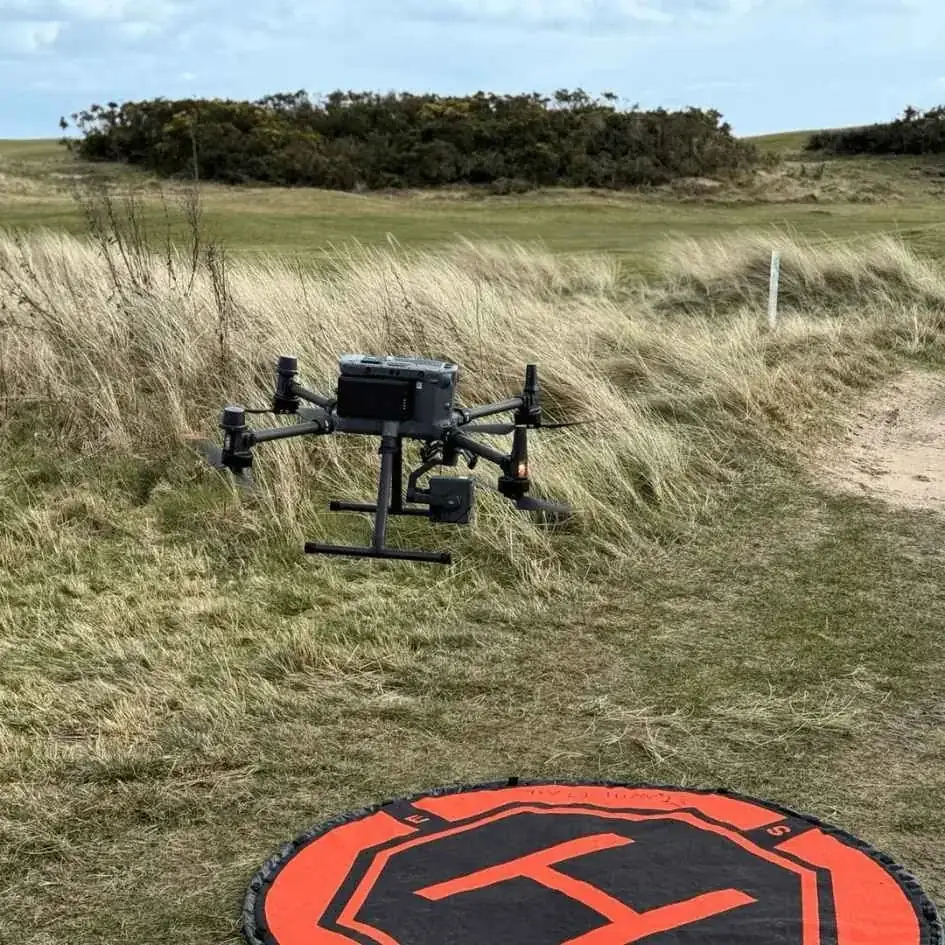
If PDRA01 will cover the operation, take it — SORA only earns its keep when you genuinely need the extra scope
It is tempting, especially for a new commercial drone operator, to assume the more advanced authorisation is the more impressive choice. In practice, the opposite is true. PDRA01 is the right tool for the work it covers, the application is fast, the cost is fixed, and the conditions are well understood. SORA is the right tool when the work genuinely sits outside PDRA01 — not when you are reaching for the heavier framework on principle.
If you are not sure which side of the line your operation falls on, walk it through the how to obtain Operational Authorisation guide and the what is an Operational Authorisation explainer before you commit. The legal frame underneath both routes is the same — the wider UK drone laws picture stitches it together — and the choice between PDRA01 and SORA is genuinely the choice of which lane fits the operation, not which lane is more prestigious.
For the working drone pilots on this site, the rough split is roughly nine PDRA01 authorisations to every one SORA. That ratio is not laziness — it is the genuine shape of UK commercial drone work. Most jobs are VLOS, daylight, sub-25kg, no drops, no crowd overflight. PDRA01 was designed around that shape.
The decision is a small one once you frame it correctly. Run the operation through the six SORA triggers. If none hit, PDRA01 is your authorisation, your GVC qualifies you, and the application is a 24-hour piece of work. If any hit, SORA is the only legal route, your GVC alone may not be enough, and the work shifts into a longer application cycle and a more demanding licensing chain.
Got a borderline operation you want sense-checked — an inspection that climbs near 120 metres, a job near a music festival, a delivery prototype you are scoping? Drop a note to peter@hiredronepilot.uk and I will come back to you directly. If you prefer the video version of this explainer, the comments are open on YouTube.
References
Primary source material for this article is the UK Civil Aviation Authority. External links open in a new tab.
- UK CAA — PDRA01 Operational Authorisation Overview · PDRA01 conditions, weight band, £524 fee, 12-month duration, 120m altitude, 50m people-buffer
- UK CAA — Specific Category Overview · PDRA vs UK SORA application routes, list of operations that require UK SORA
- UK CAA — UK SORA-based Operational Authorisations · SAIL rating, containment levels, multi-location and multi-model support
- UK CAA — Beyond Visual Line of Sight (BVLOS) · BVLOS as a typical UK SORA trigger
- UK CAA — UK Regulatory Framework for Drones · UK Regulations (EU) 2019/947 governing the Specific Category
Peter Leslie
Founder & GVC Drone Pilot
Peter is the founder of HireDronePilot. With thousands of logged commercial flight hours, he writes about drone technology, commercial surveying tactics, and UK aviation compliance.
Connect on LinkedIn