Best Follow Me Drone UK 2026: What I’d Buy, and Where It Would Lose Me

Peter Leslie
31 July 2026 · 21 min read
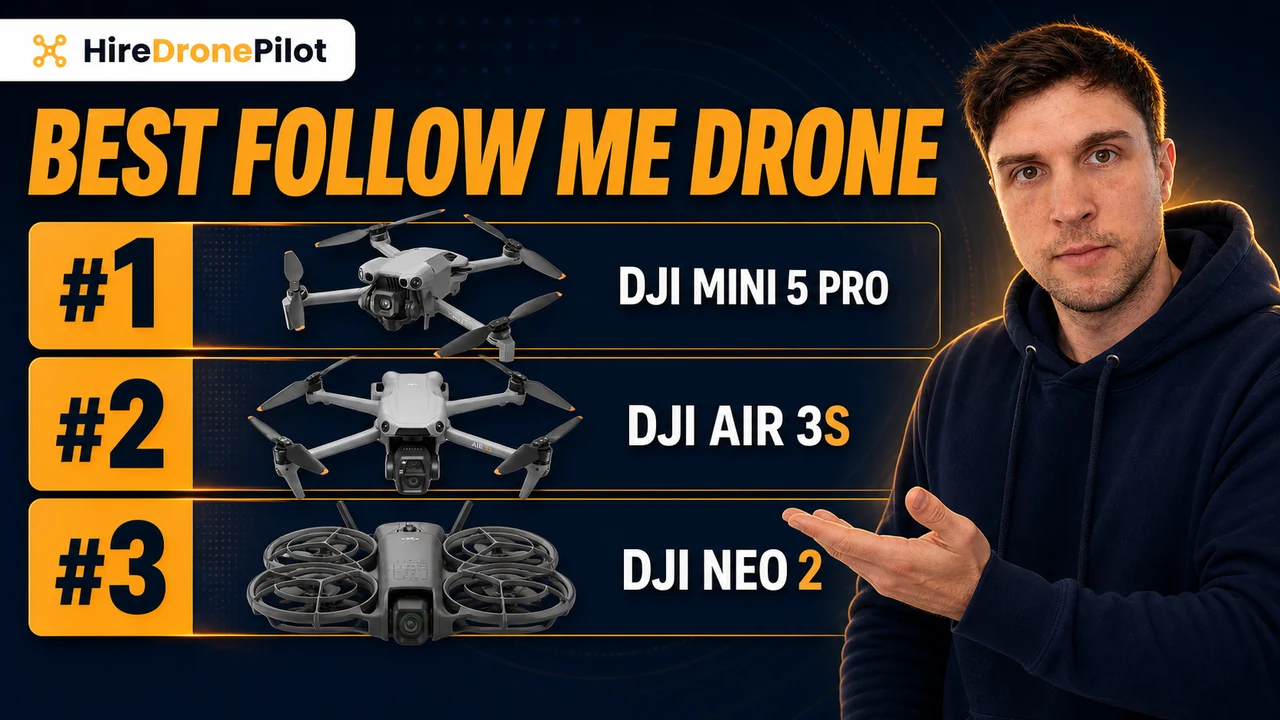
In the advert, somebody throws a small grey object off their palm, rides away down a fire road, and it comes with them. Around the corner. Under the branches. Over the bridge. Then it drops back into their hand at the bottom, and they have a film of their own morning that nobody had to stand there and shoot.
Everything in that clip is real, and everything in it is also the good take. What the advert never shows is the run before it, where the drone came around the same corner, lost the rider behind a hawthorn hedge, and stopped dead in the air. That is not a fault. It is how this works: the drone is not tracking you. It is tracking a shape in a camera frame that it believes is still you, and the instant that belief breaks, so does the shot.
So two things decide this purchase, and neither is the megapixel count. The first is how fast you move and what is beside you while you do it — open moorland and a wooded singletrack are entirely different problems. The second is how much you are willing to be a pilot at all, because some of these hand you a controller and some of these have no controller to hand you.
Which is why the best follow me drone in 2026 is not the one with the biggest number on the box. It is the one that is still behind you at the end of the ride.
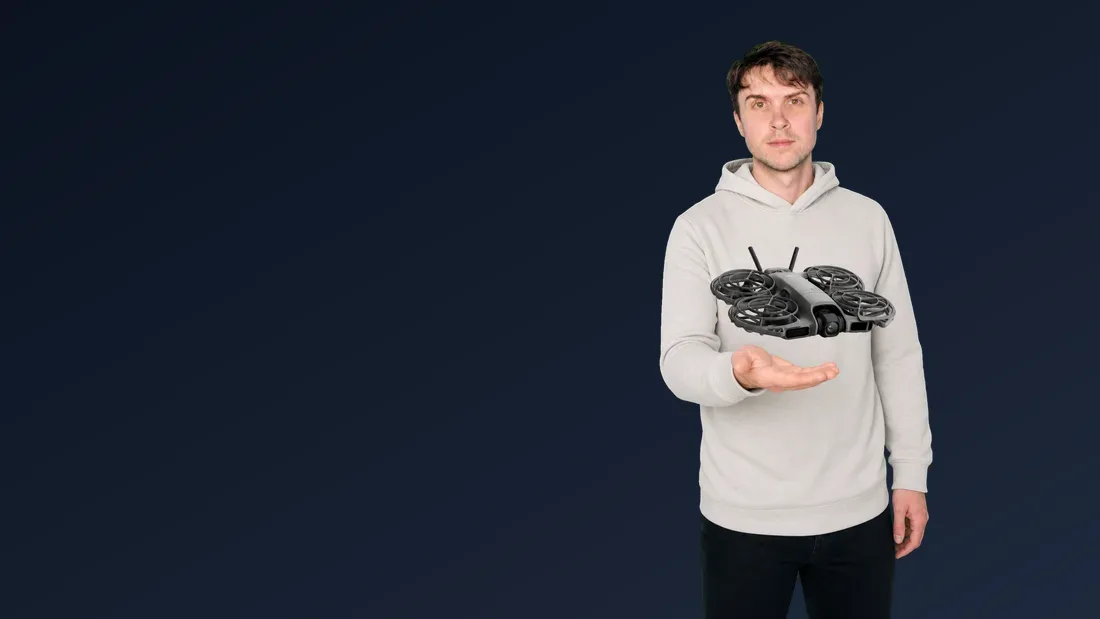
This guide does three things. It asks four questions about how and where you actually move, and narrows eleven drones to the one that fits — including one I have left in purely so you can see why it is the wrong buy, and one you cannot buy at all. Then it takes tracking apart properly: what the drone is really locked on to, how far it is allowed to get from you, and the specific moments it drops you, using the manufacturers’ own published limits rather than the marketing. Then it walks through one flight from palm to landing, so you know what the day feels like before you spend anything.
How I get paid: the Amazon links below are affiliate links, so if you buy through one I earn a small commission at no extra cost to you. It does not change what I recommend — the cheapest drone in this guide is one I actively argue against, it has a buy link and I would still rather you did not click it.
The Best Follow Me Drone in 2026 Is the DJI Mini 5 Pro
The only drone here that can see in every direction, keep the shape of you in frame at running and riding speed, and still weigh less than a tin of soup.
- Omnidirectional obstacle sensing plus a forward-facing laser scanner that still reaches 25 metres in the dark, so it brakes for the tree instead of finding it.
- 249.9 grams and C0-marked — the easiest bracket in UK law, with nothing further to sit or pass.
- A dedicated skiing tracking scene that locks the drone behind you and takes the framing choices away deliberately, with a subject-speed ceiling of 12 m/s. Above that it will not hold you.
- 36 minutes on the standard battery. DJI advertises 52, but only on the bigger battery that pushes it over 249 g and out of that easy bracket.
- It needs a controller. If what you wanted was to throw something off your hand and forget it, this is not that.
Affiliate link · costs you nothing extra · full disclosure
PART ONE
Here are the five that win their categories. Each one carries what is wrong with it, because every drone on this page fails at something and the failures are the part you need before you spend the money.
Best Cheap Follow Me Drone: DJI Neo 2
The cheapest drone in Britain that can follow you and also see what it is about to fly into.
- 151 grams and C0-marked, so nothing changes for it in 2028 and no exam is ever needed.
- Omnidirectional vision plus a forward laser scanner — at this price nothing else has it.
- The catch, from DJI’s own numbers: it will track at 12 m/s but its sensing only works up to 8 m/s.
Best Hands-Free Follow Me Camera: HOVERAir X1 PRO
No controller, no phone, no pairing. Press a button, hold out your hand, and go back to what you were doing.
- 191.5 grams with the battery, under the 250-gram line, and it folds to 105×149×34 mm.
- HOVERAir quotes 42 km/h maximum auto-follow and 60 km/h instantaneous tracking speed, measured in a windless test.
- Rear proximity sensors only, and 16 minutes per battery — both worth knowing before you plan a long ride around it.
Best Follow Me Drone for Cycling and Skiing: HOVERAir X1 PROMAX
The one kit designed around the fact that your hands are busy. Handlebar mount, wrist Beacon, and the best sensor of any hands-free camera here.
- 192.5 grams, a 1/1.3-inch sensor, 8K at 30fps and 4K at 120fps for slow motion.
- The Beacon adds a wrist screen and, per HOVERAir, feeds its signal into the visual tracking to help it hold you.
- Rear proximity and vision sensors only, and the same 16 minutes per battery as the X1 PRO.
Best Follow Me Drone for Filming at a Distance: DJI Air 3S
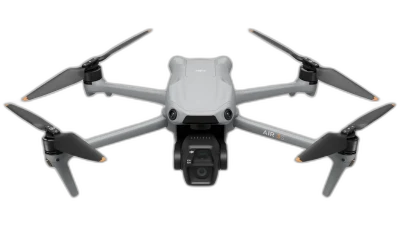
When you want the shot to look like a film crew was there: two cameras, 45 minutes, and the muscle to sit out at the end of its legal leash.
- Its manual states that tracking exits automatically past 50 metres of horizontal distance in the EU — the rule written into the firmware.
- 45 minutes per battery, a 1-inch main camera and a 70 mm tele, so you get two very different looks of the same run.
- 724 grams and C1-marked, so from January 2028 it becomes a legacy drone and needs the A2 test to fly near people.
Best Follow Me Drone for Surfing and Paddling: HOVERAir AQUA
The only one here that can take off from the water, land back on it, and be dropped in the sea without the day ending.
- 249 grams, rated IP67 and positively buoyant — HOVERAir supports taking off from and landing on water.
- Dedicated SUP, Kayak and Foil modes, 55 km/h top speed and Level 7 wind resistance, which is what a beach actually asks of a drone.
- 23 minutes per battery, half as long again as the X1 PRO manages.
- Rear sensing only, nothing looking forward, and no controller in the system — so its framing is whatever its preset modes decide. Buy it for water and nothing else.
Affiliate links · costs you nothing extra · full disclosure
Take the quiz: find the drone that will keep up with you
Four questions about how you move, because that is what decides this.
- Built around speed and surroundings, which is what actually breaks tracking.
- Eleven drones, from a hundred-pound palm-launch camera to a waterproof one that floats.
- Will tell you when the honest answer costs more than you hoped.
- About 20 seconds, and no email needed.
STEP 1 OF 4
11 of 11 still fit
All eleven, and where each one drops you
-
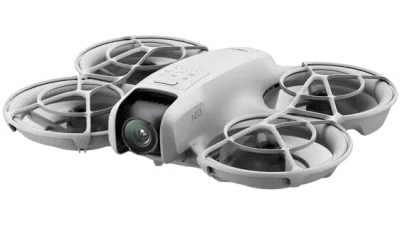
DJI Neo no obstacle sensing
135 g · C0 · downward sensing only · 18 min · palm takeoff, no controller needed
The cheapest way to find out whether you actually like being filmed. It takes off your hand, follows you from behind, lands back on your hand, and it will fly straight into the first thing you lead it under.
- 135 grams with a C0 mark, so no test and no certificate beyond the £12.34 registration.
- DJI says plainly that the Neo does not support obstacle avoidance — its only sensor points at the ground.
- Its manual describes the failure honestly: on a sharp turn, or when something gets between you, it loses you and hovers.
-
DJI Neo 2 sensing slower than its own tracking
151 g · C0 · omnidirectional sensing · 19 min · ActiveTrack, palm takeoff
The cheapest drone in Britain that can both track you properly and see what it is about to hit. For most people asking this question, this is where the sensible answer starts.
- 151 grams and C0-marked, so nothing changes for it in 2028 and no exam is ever needed.
- Omnidirectional vision plus a forward laser scanner — at this price nothing else has it.
- The catch, from DJI’s own numbers: it will track at 12 m/s but its sensing only works up to 8 m/s.
-
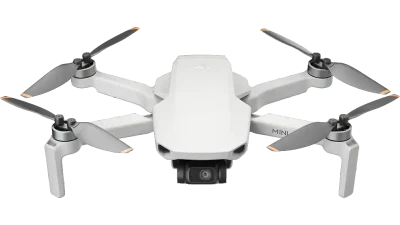
DJI Mini 4K cannot follow you at all
under 249 g · no class mark · downward sensing only · 31 min · QuickShots only
Here as a warning, because it is the drone people buy by mistake. It is a perfectly good cheap camera drone and it has no subject tracking whatsoever — the manual’s entire intelligent-flight chapter is five preset stunts.
- No ActiveTrack and no follow mode — only QuickShots, which fly one preset move and return.
- DJI’s own QuickShots warning is a preview of every tracking limit in this guide: not past 50 metres, not if you match the background, not if you are moving fast.
- DJI UK no longer lists it for sale, so what you find is third-party stock.
-
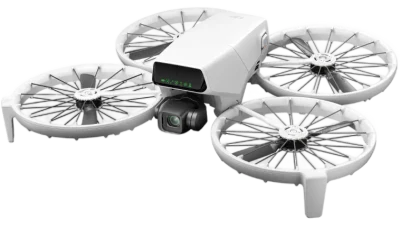
DJI Flip tracks on a very short leash
under 249 g · C0 · forward + downward sensing · 31 min · tracks 2–10 m away
Full propeller cages, a 48-megapixel camera and half an hour in the air, and it will follow you around a garden or a beach beautifully. Read the tracking distances before you plan anything bigger.
- Propeller cages moulded in, so a clipped twig usually ends the take rather than the drone.
- DJI supports tracking a person at 2–10 m horizontally and 0.5–10 m up, with 2–7 m quoted as optimal.
- 31 minutes per battery, which is double what any of the palm-sized cameras here manage.
-
HOVERAir X1 PRO rear sensors only
191.5 g · rear proximity sensors · 16 min · 42 km/h follow · no controller at all
The purest version of the idea: a folding camera with a mesh cage that lives in a jersey pocket, launches off your palm and needs no controller, no phone and no pairing. I would buy it for open ground and nothing else.
- 191.5 grams with the battery, under the 250-gram line, and it folds to 105×149×34 mm.
- HOVERAir quotes 42 km/h maximum auto-follow and 60 km/h instantaneous tracking speed, measured in a windless test.
- Rear proximity sensors only, and 16 minutes per battery — both worth knowing before you plan a long ride around it.
-
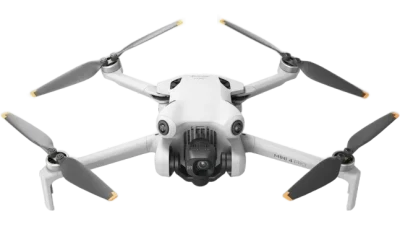
DJI Mini 4 Pro superseded by the Mini 5 Pro
under 249 g · C0 · omnidirectional sensing · 34 min · ActiveTrack 360°
Still an excellent tracking drone and now the previous generation, which is exactly why it is worth a look. Everything the Mini 5 Pro does for following a person, it did first.
- Omnidirectional binocular vision, so it will route around a tree rather than into it.
- ActiveTrack 360° supports a person at 4–20 m horizontally, with 4–15 m as DJI’s optimal range.
- 34 minutes per battery, and a C0 mark under 249 grams, so nothing changes for it in 2028.
-
DJI Mini 5 Pro needs a controller
249.9 g · C0 · omnidirectional + forward LiDAR · 36 min · ActiveTrack 360°
The best tracking I have flown under the 250-gram line, and the only one here with a laser scanner looking forward, which is what lets it hold a line through thin branches that stop everything else.
- Omnidirectional sensing plus a forward-facing laser scanner that reaches 25 metres in the dark.
- A dedicated skiing tracking scene, which locks the drone behind you and takes the framing choices away deliberately.
- 36 minutes on the standard battery. DJI advertises 52, but only on the bigger battery that pushes it over 249 g.
-
HOVERAir X1 PROMAX rear sensors only
192.5 g · rear proximity + vision · 16 min · 8K · Beacon to 1 km
The cycling kit is the one that changes the argument: a wrist Beacon that feeds its own signal into the tracking, a handlebar mount so you can launch mid-ride, and a 1/1.3-inch sensor shooting 8K. On a wide open trail it is the most competent hands-free camera made.
- 192.5 grams, a 1/1.3-inch sensor, 8K at 30fps and 4K at 120fps for slow motion.
- The Beacon adds a wrist screen and, per HOVERAir, feeds its signal into the visual tracking to help it hold you.
- Rear proximity and vision sensors only, and the same 16 minutes per battery as the X1 PRO.
-
DJI Air 3S 724 g · loses privileges in 2028
724 g · C1 · omnidirectional + forward LiDAR · 45 min · tracking stops past 50 m
The one that can sit properly far away and still hold you, with two cameras so you can choose how compressed the background looks. It is also nearly three times the weight of everything else here, and its class mark expires as a UK equivalent.
- Its manual states that tracking exits automatically past 50 metres of horizontal distance in the EU — the rule written into the firmware.
- 45 minutes per battery, a 1-inch main camera and a 70 mm tele, so you get two very different looks of the same run.
- 724 grams and C1-marked, so from January 2028 it becomes a legacy drone and needs the A2 test to fly near people.
-
HOVERAir AQUA only if you are on water
249 g · IP67 · floats · 23 min · 55 km/h · Level 7 wind
Rated IP67, positively buoyant so it can take off and land on the water, and stiff enough in wind to sit off a beach. If you surf, paddle or foil, nothing else on this page is even in the conversation.
- 249 grams, IP67 and positively buoyant — HOVERAir supports taking off from and landing on water.
- Dedicated SUP, Kayak and Foil modes, plus 55 km/h top speed and Level 7 wind resistance.
- 23 minutes per battery, which is half as long again as the X1 PRO manages.
-
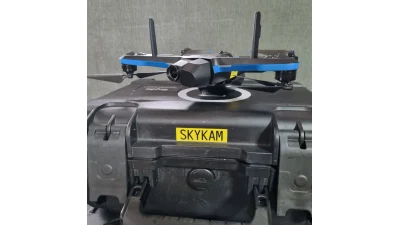
Skydio 2+ no affiliate link — you cannot buy one
no manufacturer page · no UK listing I could find · discontinued
For years this was the answer to this question, and it is in the list so you stop searching for it. Skydio’s product page for it now returns a 404 and the company sells to police, defence and utilities. There is no consumer machine to buy.
no link- Skydio’s own product page for the 2+ returns HTTP 404, and its site now sells only enterprise and public-safety drones.
- An Amazon UK search returns only third-party spare parts for its enterprise gimbals, so there is no listing worth pointing you at.
- Listed here so you know why every three-year-old recommendation article sends you somewhere that does not exist.
The eleven are listed cheapest first, so the ordering is the cost ordering. I do not print the figures: they move week to week, and the only one worth trusting is the one on the retailer’s page at the moment you buy. Weights, flight times, sensing and tracking limits are the manufacturers’ own published figures — DJI UK for the DJI drones, HOVERAir’s UK store for the HOVERAir ones — checked 31 July 2026. DJI UK no longer lists the Mini 4K, so its weight and specification come from DroneCompare, CC BY 4.0.
PART TWO
How tracking works, and the moment it loses you
Every other guide to this category will tell you a drone “follows you”. That phrase does an enormous amount of hiding. Nothing on this page is following you. Each of them is following a rectangle it drew around some pixels a few seconds ago, and re-drawing that rectangle twenty or thirty times a second by asking: does this bit of the picture still look like the bit I was watching? When the answer is no, the flight changes character instantly.
Once you have that in your head, every specification on this page reads differently, and you stop being surprised by the things these drones do.
The drone has no idea who you are
Start with what it is not. There is no tracker in your pocket that the drone homes in on. You point at yourself on a screen, or you stand in front of it and press a button, and it takes a snapshot of your appearance from that angle, in that light, against that background. Everything afterwards is that comparison repeated.
Which is why DJI restricts what it will even attempt. Its manuals say the supported subjects are moving vehicles, boats and people — and the Mini 5 Pro’s manual adds a line that stops you short the first time you read it: it recommends tracking vehicles, boats and people but not children. Small, fast, unpredictably shaped subjects are exactly the case the recogniser was not built for. If you bought this to film your six-year-old learning to ride a bike, the manufacturer has quietly told you it is not designed for that.
HOVERAir does the same job with its own recogniser, which it calls ShadowTrack, and then does something the DJI drones do not. On the cycling kits you wear a small screen on your wrist called a Beacon, and HOVERAir states that the drone uses signals from the Beacon to augment its visual tracking. It is not GPS following; it is a second opinion feeding the same camera system, so that when the picture gets ambiguous the drone still has a rough idea where you went. That is a real advantage on an open trail, and it is why the cycling bundle exists.
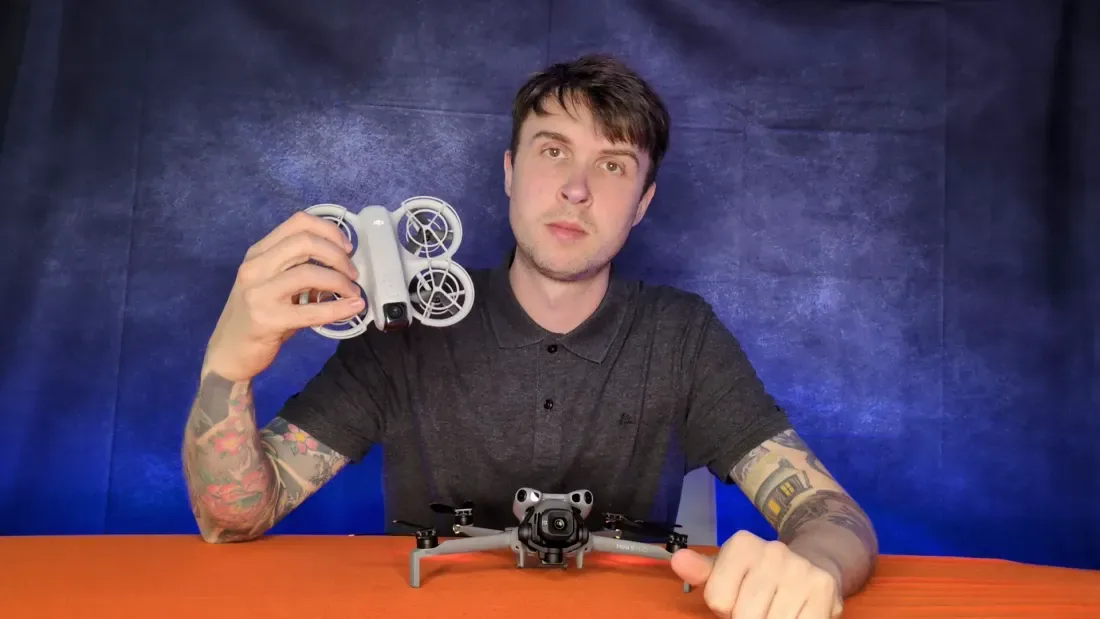
The five moments it loses you
You do not have to take my word for any of this, which is the good news. DJI publishes the failure conditions in the same manual that comes in the box, and the list is nearly identical across the Neo 2, the Flip, the Mini 4 Pro, the Mini 5 Pro and the Air 3S. Here it is in plain English, with the situations you will actually meet.
WHEN TRACKING DROPS YOU, PER DJI
-
Something gets between you.
A hedge on the inside of a bend, a barn, a lorry, a single overhanging branch. DJI’s phrasing is that the subject is out of sight for an extended period — but on a sharp turn, “extended” can be under a second.
-
You match your background.
DJI names two cases explicitly: a subject with a similar colour or pattern to its surroundings, and a subject in a large monochrome area — snow-covered ground or desert. A skier in a white jacket in flat light is the textbook failure.
-
You change shape.
Standing up out of the saddle, tucking, crouching, throwing an arm out. DJI asks you to be extra vigilant when the subject changes shape drastically while moving, and when the subject is not moving on a level plane — which is another way of writing “downhill”.
-
The light is wrong.
The Mini 5 Pro manual puts numbers on it: below about 300 lux or above about 10,000 lux, be extra careful. That is dusk under trees at one end, and bright snow or sand at the other.
-
Somebody else walks past.
The Air 3S manual says it outright: the tracked subject may be swapped for another if they pass close to each other. On a busy towpath the drone can quietly change its mind about who you are, and follow a stranger home.
Read that list again as a shopping list and it tells you where to spend. Nothing on it is fixed by a bigger sensor. Some of it is helped by better recognition, some by the Beacon, and quite a lot of it by simply choosing a background you do not blend into — which costs nothing.
What actually happens at the moment it loses you
Manufacturers behave differently here, and it is worth knowing which one you have bought before it happens rather than after.
The DJI Neo is the most conservative and the most honest about it. Its manual says that when you are not in the camera’s field of view — it gives a sharp turn and an obstacle as the two examples — the drone loses you and hovers, and you have to come back into frame for it to pick you up again. So it stops, in the air, wherever it was. If you carry on riding, it is now a small grey object sitting alone over a field behind you.
The Air 3S gambles instead. Its manual describes the drone continuing at its current speed and heading, trying to re-identify you, and only hovering and dropping out of tracking once that fails. That is the better behaviour when the thing blocking you is a single tree you both pass, and the worse behaviour when it is a wall.
Neither of them is trying to come and find you. That is the fundamental difference between what these do and what people imagine they do, and the whole reason the next section exists.
The leash: how far away it will go
Everyone reads the transmission range on the box. Almost nobody reads the tracking range, which is far smaller, and it is the number that decides what your shots look like. These are DJI’s published limits for tracking a person, from the user manuals.
HOW FAR IT WILL TRACK A PERSON
| DRONE | HORIZONTAL | HEIGHT |
|---|---|---|
| DJI Flip | 2–10 m2–7 m optimal | 0.5–10 m |
| DJI Neo 2 | 4–20 m | 0.5–15 m |
| DJI Mini 4 Pro | 4–20 m4–15 m optimal | 0.5–20 m |
| DJI Mini 5 Pro | 4–20 m | 0.5–50 m |
| DJI Air 3S | 20 mtracking exits past 50 m in the EU | 20 m |
Twenty metres. That is the working distance for almost all of them, and it is much closer than the footage in the adverts suggests, because a very wide lens twenty metres up looks like a hundred metres away. It also means the drone is genuinely near you: near enough to hear over a bike, near enough to worry a horse, near enough that where you take off matters.
The Air 3S line is the interesting one, and it is not a coincidence. DJI has written a hard 50-metre limit into its European firmware, so that tracking simply switches itself off if the drone gets further than that from you. That number comes straight out of the rulebook, which is the next section.
Speed: the number two manufacturers publish twice
Here is where the specification sheet and the manual disagree, and the manual is the one telling the truth.
DJI’s specification page for the Mini 5 Pro lists a maximum horizontal speed of 15 m/s in tracking status, which is 54 km/h and sounds like plenty for anything you are likely to do. Open the user manual for the same drone and it says it is recommended that the speed of the moving subject should not exceed 12 m/s, or it will not track properly. That is 43 km/h. The first number is what the machine can do; the second is what the software can follow. They are not the same claim, and only one of them is on the shop page.
The Neo 2 has a sharper version of the same problem, and this one is a safety point rather than a filming point. Its published tracking speed is 12 m/s. Its obstacle sensing is rated effective up to 8 m/s forwards, backwards and sideways — and only 3 m/s up and down. So there is a band between about 29 and 43 km/h where DJI says it will still be chasing you and also says its ability to notice a tree has stopped being reliable. On a fire road that band is most of a descent.
HOVERAir publishes one figure, 42 km/h maximum auto-follow speed, with a 60 km/h instantaneous tracking speed for short bursts, and footnotes it as measured in a windless test environment climbing to 1.5 metres above the ground. That is an honest footnote and it should read as a warning: a headwind is speed you no longer have.
The practical translation. Walking, running and trail riding are inside every one of these. A steady road-bike pace of 30 km/h is fine. A fast descent, on skis or on tarmac, is at or beyond the published limit of every drone on this page — and the drone will not tell you it has given up until you watch the footage.
Sensing is not tracking, and the cheap ones only have one
Two different systems get muddled together in the marketing, and separating them is most of what you need to shop well.
Tracking is the camera keeping you in frame. Obstacle sensing is a separate set of sensors keeping the drone out of things. A drone can be excellent at one and have none of the other, and the DJI Neo is exactly that: it will follow you happily and DJI states plainly that it does not support obstacle avoidance. Its only sensor looks at the ground, for hovering. Lead it under a washing line and the washing line wins.
The HOVERAir cameras are a subtler version of the same gap. Both the X1 PRO and the X1 PROMAX have what HOVERAir calls rear active collision detection — proximity sensors on the PRO, proximity and vision sensors on the PROMAX. That is genuinely useful, because when a drone is filming you from the front it is flying backwards, and backwards is where its blind spot would otherwise be. But there is nothing looking forward or sideways. In a wood, that matters.
And even omnidirectional sensing has a caveat that people miss. DJI is explicit that its drones cannot avoid moving subjects such as people, animals or vehicles, and that you should not use tracking modes around small or fine objects — it names tree branches and power lines. Twigs and cables are the two things a vision system is worst at seeing and the two things most likely to be at drone height on a British trail.
Read all of that as a buying rule
Buy for your worst background, not your best day. If most of your riding, running or walking happens with things beside you — trees, walls, hedges, lampposts — then obstacle sensing all round is not a luxury feature, it is the whole purchase, and it costs far less than you would guess: the cheapest drone here that has it is the second-cheapest drone on the page, and under a third of the price of my overall pick. If you genuinely spend your time on open ground, a hands-free camera with rear sensors will give you better footage for less faff, and you can stop reading the specification sheets.
The UK rules for a drone that follows you, in plain words
Assume you have never registered anything, because most people reading this have not. There is one rule here that is specific to follow-me flying and genuinely good news, and two registrations that catch almost everybody.
Follow-me is the one legal exception to watching your drone
The normal UK rule is unforgiving: you must keep your drone in direct sight at all times, clearly enough to tell which way it is facing, and with a full view of the airspace around it. No binoculars, no screens, no goggles.
Follow-me mode is one of only two carve-outs from that, and the CAA’s Drone Code states it in a single sentence: “You do not have to keep the drone in direct sight when follow-me mode is active and set to follow within 50m of you.” The Code immediately adds: “All other points still apply.”
That is a much bigger permission than it looks, because it is the thing you were going to do anyway. You are on a bike, at speed, looking at a trail. You cannot also be watching a drone. The law has already decided that is acceptable — on the condition that the drone is genuinely following you, and genuinely within fifty metres.
Read the conditions carefully, though, because they are where people fall out of it:
- Fifty metres, not five hundred. Set the follow distance and height so it cannot exceed that. This is why DJI made the Air 3S drop out of tracking past 50 m in Europe.
- It only covers follow-me. The second you take the sticks to reframe a shot, you are flying manually and the direct-sight rule is back, immediately.
- Everything else is unchanged. 120 metres maximum height, restricted airspace, landowner’s permission to take off and land, and the distance rules for the drone you are flying.
- You are still responsible. The Code opens by saying you are responsible for flying safely whenever you fly. Nothing in follow-me mode moves that.
I will add a practical note of my own on top of the law: I still look. Not because I have to, but because the drone that has quietly lost you and hovered is a drone you want to notice before it is a mile behind and out of battery.
You will need two registrations, whatever the box says
A Flyer ID is a free theory test you sit online. It lasts five years and anyone flying a drone of 100 grams or more needs one. An Operator ID costs £12.34 a year, you must be 18 to register for it, and it goes on a label stuck to the outside of the drone. Every drone of 100 grams or more with a camera needs one.
Every single drone in this guide is over 100 grams and has a camera. The lightest is the DJI Neo at 135 grams. So both apply to all of them, every time, with no exceptions.
This is worth labouring because the marketing actively works against it. HOVERAir’s UK product page for the X1 PRO and PROMAX carries the line “No forms, no fuss”, and states that at 192 g the drones are C0-class in the EU with “no license required”. The class point is fair and the weight is right. The conclusion is not the UK position: a 192-gram camera drone needs a Flyer ID and an Operator ID here, and “no forms” is precisely the wrong thing to have in your head when you land at a beach car park.
Weight decides everything else
Under 250 grams, or carrying a C0 or C1 mark, you are in Over People (A1) — the easy category. You may fly over people who are not involved in what you are doing, and closer than 50 metres to them, and in built-up areas. You may not fly over crowds, ever, whatever the drone weighs. That covers everything here except the Air 3S by weight, and the Air 3S gets there today via its C1 mark.
Go heavier with no class mark and it changes fast: an A2 Certificate of Competence — a theory exam of at least 30 questions taken with a CAA-approved provider — before you can fly near people at all. Without it you are in Far from People (A3): 50 metres from anyone not involved, 50 metres from individual buildings and 150 metres from anything residential, commercial, industrial or recreational. Which, for a drone whose entire job is to circle a moving person along a public trail, is close to unusable.
And then there is 1 January 2028
Until 31 December 2027, a drone carrying a European C class mark may be flown as though it held the equivalent UK class. From 1 January 2028 that stops. A C-marked drone becomes a legacy drone and falls back to plain weight rules: under 250 g flies A1, under 2 kg needs an A2 CofC, under 25 kg is A3.
For nearly everything here, nothing happens. The Neo, Neo 2, Flip, Mini 4 Pro and Mini 5 Pro are all under 250 grams and stay exactly where they are, and so are the HOVERAir cameras at 191.5 and 192.5 grams. One drone on this page moves:
WHAT CHANGES ON 1 JAN 2028
| DRONE | TODAY | FROM 2028 |
|---|---|---|
| DJI Air 3S 724 g, C1 | Over People (A1), no qualification | Near People (A2), A2 CofC required |
| Everything else here 119–249.9 g | Over People (A1) | Unchanged — still A1 |
Two last ones that catch people, and both are relevant to filming yourself. If you fly at night your drone must have a green flashing light switched on — that has been compulsory since 1 January 2026, and a sunset ride is a night flight. And third-party insurance is optional for recreation and a legal requirement the moment anybody pays you for the footage, which includes the sponsored post you had not thought of as work. The full set of UK drone rules is written up separately if you want them all in one place.
PART THREE
One flight, palm to landing: what the day actually looks like
Specifications are one thing. What decides whether the drone gets used is whether the sequence below is pleasant enough to repeat on a wet Tuesday. So here is the whole thing, in order, with the parts nobody mentions.
Minute zero: where you are standing
This is the decision that determines the shot, and you make it before anything is switched on. Remember the tracking distance: about twenty metres. The drone will be that close, so look at what is within twenty metres of your first hundred paces — the gate post, the low branch over the track, the telegraph wire crossing the lane. On the palm-launched cameras there is no obstacle sensing in front of the drone at all, so that survey is the only thing standing between the drone and the wire.
You also need permission to take off and land from whoever owns the ground. On a car park, that is a real conversation and not a technicality.
The first thirty seconds: acquisition
On a HOVERAir or a DJI Neo, you press a button on the drone, hold it flat on your palm, and it goes. There is no phone, no pairing screen and no controller — and having flown both, the first time it lifts off your hand is genuinely delightful in a way that reading about it does not convey. On the Mini 5 Pro or the Air 3S you power up the controller, wait for satellites, launch, then drag a box around yourself on the screen.
Either way, the next thirty seconds are the ones that matter. Stand still. Face it. Let it get a clean, well-lit look at you against a background you do not match. A poor acquisition is the single biggest cause of a flight that drops you two minutes later, and it is entirely free to fix by waiting.
The middle: the corner where it goes wrong
Everything is lovely for a while, and then you take a bend with something on the inside of it. The geometry is against you and it is worth understanding once. You are turning on a tight radius. The drone, sitting behind and above, has to fly a longer arc than you do to stay in the same relative position, so it needs to accelerate through the exact moment your body is briefly hidden by the hedge on the apex.
That is where a Neo hovers and a Mini 5 Pro usually does not, and it is most of what the extra money buys. The habits that help are unglamorous: take the wide line, run a follow angle that is offset rather than directly behind, and if you know a blind corner is coming, be boring through it.
Minute sixteen: the battery, and why it is the real spec
This is the number that reshapes the day. The HOVERAir cameras give 16 minutes per battery. The DJI Neo gives 18, the Neo 2 gives 19, the Flip 31, the Mini 5 Pro 36 and the Air 3S 45 — and every one of those is a wind-tunnel figure measured flying gently in a straight line, not chasing a moving person.
Sixteen minutes is not sixteen minutes of your ride, either. It is perhaps five separate take-offs of two to three minutes each, because you are not filming continuously; you are filming the bits worth filming. Which is a perfectly good way to use one, as long as you knew. It is also why the cycling bundles ship with two spare batteries and a charging hub instead of one spare, and why the first accessory anybody buys for a DJI is another battery — which is a real line on the bill rather than a rounding error, and worth pricing before you commit to the drone rather than after.
The landing, and the bit you will not have planned
The palm cameras come back to your hand, which never stops being satisfying. The DJI drones with controllers land where you tell them, or return to the take-off point on their own.
The bit nobody warns you about is the fifteen minutes afterwards. The footage lives on the drone — 32 GB internal on the X1 PRO, 64 GB on the PROMAX, a card in the DJI drones — and it has to come off over Wi-Fi to a phone before you can do anything with it. An 8K clip is a large file. If your plan is to post something before you have taken your shoes off, budget for that transfer, and buy the card speed the manufacturer asks for rather than the cheapest one.
None of this is an argument against buying one. It is an argument for knowing that a follow-me drone is a small ritual rather than a magic wand: five minutes of thought before, two minutes of patience at the start, and a quarter of an hour of file wrangling after. Do that and it produces footage nothing else can. Skip it and you will own an expensive object that lives in a drawer.
PART FOUR
What I’d buy, and where it would lose me
The DJI Mini 5 Pro is the drone I would take if I could only own one, and I would go in expecting to lose it on exactly two things: a hard descent above about 43 km/h, and a properly wooded singletrack where the branches close over the line. Those are the honest edges, and no drone sold in Britain today does better on either.
It wins because of what happens when tracking is about to fail. Omnidirectional vision means it can route around the tree rather than stop at it, the forward-facing laser scanner sees thin things that a camera struggles with and works at 25 metres in the dark, and the tracking envelope is the most generous here — four to twenty metres out and up to fifty metres above you. It is also 249.9 grams, which keeps you in the simplest bracket of UK law permanently.
Budget past the drone, because the drone is not the bill. On top of whatever the Mini 5 Pro costs on the day, there is the Operator ID at £12.34, which you renew every year and which is the only part of this you pay for twice. Then the second battery, which you will want by the third weekend and which is the single biggest add-on DJI sells. Then a fast microSD card, bought to the speed DJI asks for rather than the cheapest one on the shelf. And then, if you are being honest with yourself, a quiet allowance for the day you clip something. Reckon on the first year costing meaningfully more than the ticket price — call it a fifth again on top by the time all four are done. The Flyer ID test, at least, is free.
The thing I did not expect, having flown it, is how much of the pleasure is in the skiing scene mode — DJI deliberately removes your framing choices, locks the drone behind you and just gets on with it. Fewer decisions, better footage. That is the whole argument for this category in one setting.
Spend less and lose very little. The DJI Neo 2 is the best value in this guide by a distance. It has obstacle sensing all the way round, ActiveTrack, palm launch and a C0 mark at 151 grams, and it costs less than a third of the winner. Its ceiling is real — sensing effective only to 8 m/s, and 19 minutes in the air — but for walking, running and everyday filming it does the same job.
Spend more only for a specific reason. If your hands are on handlebars and your ground is open, the HOVERAir X1 PROMAX cycling kit, which costs comfortably more than my overall pick, solves a problem the DJI drones do not even attempt: a handlebar mount so you can launch mid-ride, a wrist Beacon that feeds the tracking, and 8K from a 1/1.3-inch sensor. Buy it for moorland, coast road and piste. Do not buy it for the woods.
If you never want to touch a controller
Then the HOVERAir X1 PRO sits in the middle of the pack on price and nowhere near the middle of it on ambition — and be honest with yourself about the trade. You are getting the best version of “press it, throw it, forget it” that exists, at 191.5 grams and 42 km/h, and you are giving up all forward obstacle sensing and more than half the flight time of a Mini 5 Pro. On open ground that is a bargain. Under trees it is a countdown.
And if you are on water — surfing, paddling, foiling — the HOVERAir AQUA — the dearest thing on this page — is not a luxury version of the others, it is the only one that survives the day. IP67, positively buoyant, Level 7 wind resistance and 23 minutes. Nothing else here can take off from a board.
The two I’d tell you to walk away from
The DJI Mini 4K, and I want to be very specific about why, because it is a good little drone being sold into the wrong search. It has no subject tracking at all. Its entire intelligent-flight chapter is QuickShots — five preset moves that fly a fixed pattern around you and come back — and DJI’s own instructions say not to use them when the subject is more than 50 metres away, similar in colour to the surroundings, or moving fast. If you want a cheap camera drone to fly, it is fine. If you want something that comes with you, it cannot, and the price is the only reason anybody buys it by mistake.
And the Skydio 2+, which I have left in the list without a buy link because it is still the answer half the internet gives to this question. It was superb at exactly this. It is also gone: Skydio’s own product page for it returns a 404, the company now sells to police, defence and utilities, and an Amazon UK search turns up nothing but spare parts for its enterprise gimbals. Stop looking for one.
And if what you actually need is one particular piece of footage rather than a new hobby — a tracking shot of a race, an event, a launch — then owning any of this is the expensive way to get it. You can hire a qualified drone pilot who already has the drone, the qualification and the insurance, and what a shoot costs is often less than the drone you were about to buy for one weekend.
Best follow me drone UK: the questions I get asked most
What is the best follow me drone in the UK in 2026?
The DJI Mini 5 Pro. It is the only drone here that combines omnidirectional obstacle sensing with a forward-facing laser scanner, ActiveTrack 360°, 36 minutes of flight and a take-off weight of 249.9 g, which keeps it in the easiest UK weight bracket. Spend a good deal less and the DJI Neo 2 gives you the same style of tracking with obstacle sensing all round, for under a third of the money. If you want a camera that needs no controller at all and follows you at road-cycling speed, the HOVERAir X1 PRO is the honest alternative, and it sits between the two.
Do you have to keep a follow me drone in sight in the UK?
Not while it is genuinely following you within 50 metres. The CAA’s Drone Code says you do not have to keep the drone in direct sight when follow-me mode is active and set to follow within 50 m of you, and adds that all other points still apply. That is the only exception besides using an observer. Past 50 metres, or the moment you take manual control, the normal rule returns and you must be able to see the drone clearly enough to tell which way it is facing. You are still responsible for the flight throughout.
Why does my drone stop following me?
Because tracking is a camera recognising a shape, not a signal locking on to you. DJI’s own manuals list the conditions: the subject is blocked or out of sight for a while, the subject is a similar colour or pattern to the background, the subject is in a large monochrome area such as snow, the subject changes shape a lot while moving, or the light is very dark or very bright. The DJI Neo’s manual is blunt about it: on a sharp turn, or when an obstacle gets between you, it loses you and hovers until you are back in frame.
How fast can a follow me drone actually follow you?
Slower than the box says. DJI’s specification for the Mini 5 Pro is 15 m/s in tracking status, about 54 km/h, but the same drone’s user manual recommends that the speed of the subject should not exceed 12 m/s, about 43 km/h, or it will not track properly. HOVERAir publishes 42 km/h as the maximum auto-follow speed for the X1 PRO and X1 PROMAX, measured in a windless test. Realistically, running and mountain biking are comfortable; a fast descent on skis or a road bike at 45 km/h is at or past the limit.
Do I need a licence to fly a follow me drone in the UK?
Not a licence, but almost certainly two registrations. Every drone here has a camera and weighs more than 100 g, so you need a Flyer ID, which is a free online theory test valid for five years, and an Operator ID, which costs £12.34 a year and goes on a label stuck to the outside of the drone. HOVERAir’s own UK page says “no license required” next to the weight. That is not the UK position for a 192 g camera drone, and it is the single most common thing buyers of these get wrong.
Can a follow me drone follow you through trees?
Only some of them, and none of them reliably. DJI states plainly that you should not use its tracking modes in areas with small or fine objects such as tree branches or power lines. A drone with omnidirectional sensing, like the Mini 5 Pro or the Neo 2, will usually brake rather than hit a trunk. A drone with sensors only underneath, like the DJI Neo, has nothing to stop it. And even the best of them loses you the moment a branch comes between the camera and your body, because the tracking is visual.
The short version
Buy the DJI Mini 5 Pro if you move through places that have things beside you, and accept that you are carrying a controller. Buy the HOVERAir X1 PRO if your ground is open and you want a camera that needs nothing from you at all. Then register before the first flight, because both of them need a Flyer ID and an Operator ID.
Affiliate links · costs you nothing extra · full disclosure
Specifications checked 31 July 2026 against the DJI UK store, DJI’s user manuals and HOVERAir’s UK store. This guide carries no prices on purpose: they move constantly, and the only figure worth acting on is the one on the retailer’s own page at the moment you buy. Regulatory detail from the UK Civil Aviation Authority and its Drone Code. Tracking distances, subject-speed limits and failure conditions from the manufacturers’ own user manuals and specification pages; DJI Mini 4K comparison figures from DroneCompare, licensed under CC BY 4.0. Amazon links are affiliate links. Related reading: filming yourself talking to camera, what a drone weighs after twelve miles, how far £500 goes and the wider camera-drone comparison.