Drone-in-a-Box Operations: UK Regulations Explained

Peter Leslie
27 Apr 2026
Key Takeaways
- Drone-in-a-box systems are autonomous, fixed-base drone platforms that launch, fly a mission, and dock back into a weatherproof base without a drone pilot on site
- UK drone-in-a-box operations are almost always Beyond Visual Line of Sight by design, which puts them outside PDRA01 and into UK SORA territory
- A UK SORA application for a drone-in-a-box system has to evidence containment, geo-fencing, automatic return-to-home, command-and-control link redundancy, and remote override procedures
- One UK SORA authorisation can cover multiple base locations and multiple drone models, which is the framework drone-in-a-box operators design around
- Real-world UK use cases sit in security patrols, energy site monitoring, agriculture scouting, and telecoms tower inspection — all built on repeat autonomous sorties from a fixed base
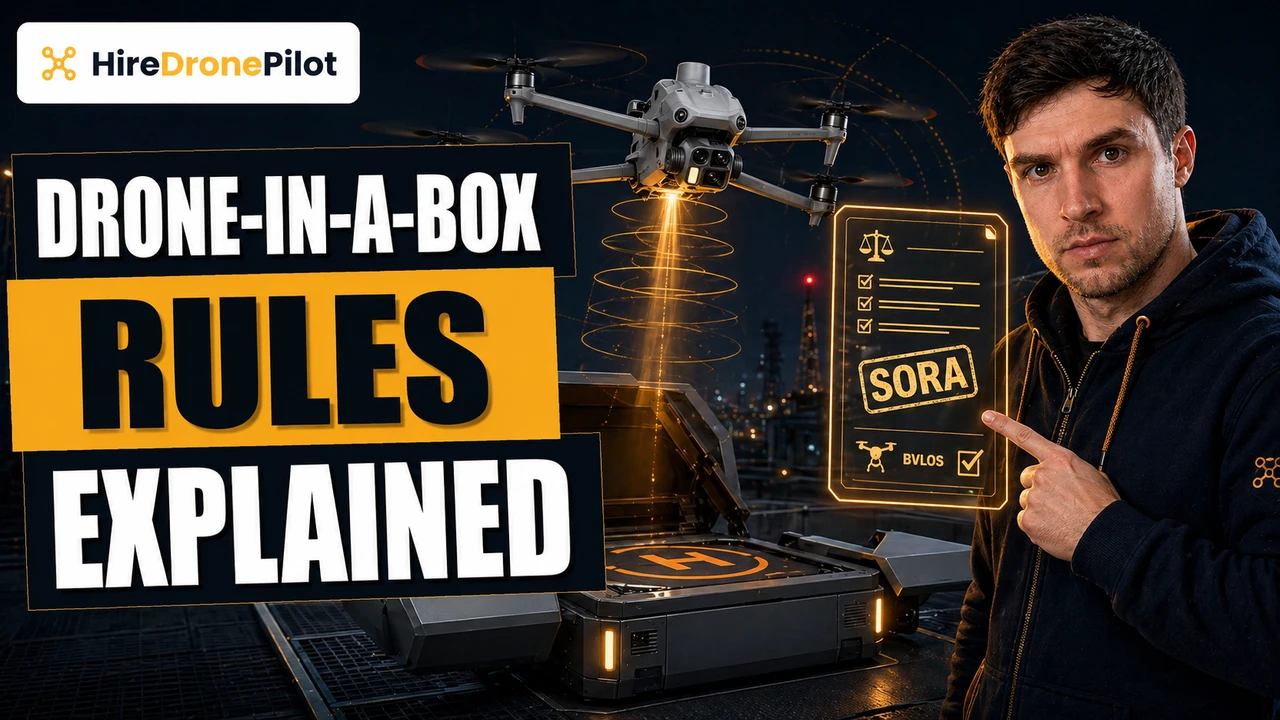
A drone-in-a-box system is an autonomous, fixed-base drone platform: a weatherproof docking station that houses the drone, charges its battery, and launches it on demand or on schedule to fly a pre-programmed mission before docking itself back inside. There is no human walking the drone out of a kit case. There is no drone pilot watching it climb. The whole point of the system is that it works without one. That design choice puts drone-in-a-box squarely inside the UK SORA authorisation route — not PDRA01 — and the UK regulatory framework expects a specific set of evidence before it will let you fly one.
This article walks through what a drone-in-a-box system actually is, why almost every UK deployment needs a SORA authorisation rather than a PDRA01, what the SORA application has to evidence to clear the CAA's bar, and where in UK industry these systems are getting commercial use. The pillar SORA explainer covers SAIL ratings and containment levels in detail; this article focuses on the bits that are specific to fixed-base autonomous flying.
A drone-in-a-box system is an autonomous fixed-base platform that flies missions without a drone pilot on site
The hardware is a weatherproof enclosure, usually the size of a large garden shed or a small cabinet, fitted to a roof, a yard, or a perimeter point on a site. Inside sits the drone on a precision landing pad, with charging contacts, environmental sensors, and a connection back to a remote operations centre. The lid opens, the drone takes off, completes its mission, returns to the precision pad, and the lid closes. The whole sequence runs without a drone pilot physically present at the base.
The flight modes split into two patterns. Scheduled missions run on a clock — a perimeter sweep at fixed intervals, an agricultural scouting circuit on a daily cadence, a telecoms tower check after every storm. On-demand missions are triggered by an external signal — a perimeter alarm, a thermal hotspot detected on a fixed camera, an inspection request raised by a control-room operator. In both cases the drone is the responder, not the principal asset, and the human supervising the operation sits at a remote workstation.
The drone itself is normally a sub-25kg multirotor with redundant systems — dual GNSS, redundant IMU packages, an obstacle-sensing suite, and a robust return-to-home behaviour. The base provides power, weather protection, and the precision-landing infrastructure that lets the drone dock reliably in wind and rain. The supervising drone operator sees a live video feed, telemetry, and a kill switch, but the routine flight is autonomous.
Drone-in-a-box operations are BVLOS by design, which lifts them out of PDRA01 and into UK SORA
The reason a drone-in-a-box deployment cannot live inside PDRA01 is structural, not procedural. PDRA01 requires Visual Line of Sight — a competent observer keeping the drone in unaided sight throughout the flight. A drone-in-a-box base point is, by definition, unattended: the drone takes off from a roof on the far side of an industrial estate while the supervising operator watches from a control room a hundred miles away. That is Beyond Visual Line of Sight in the strictest sense, and BVLOS is one of the operations the CAA explicitly lists as outside PDRA01.
Even where a drone-in-a-box deployment posts a local visual observer at the base, the autonomous flight envelope tends to push past PDRA01 in other ways: routes that pass close to people working on adjacent sites, sorties that cross over property the drone operator does not control, and repeat flights at densities PDRA01 was not written for. Once any one of those triggers fires, the route is UK SORA. The full breakdown of where the boundary sits between PDRA01 and SORA is in the PDRA01 vs UK SORA comparison, and the wider Specific Category framing sits in the Specific Category hub.
There is no realistic UK route to a fully autonomous drone-in-a-box deployment that avoids the SORA application. The framework is designed for exactly the kind of operations a drone-in-a-box is built to run, and the CAA's transition timeline — sketched out in the UK SORA release date guide — assumes operators of these systems engage with SORA from day one.
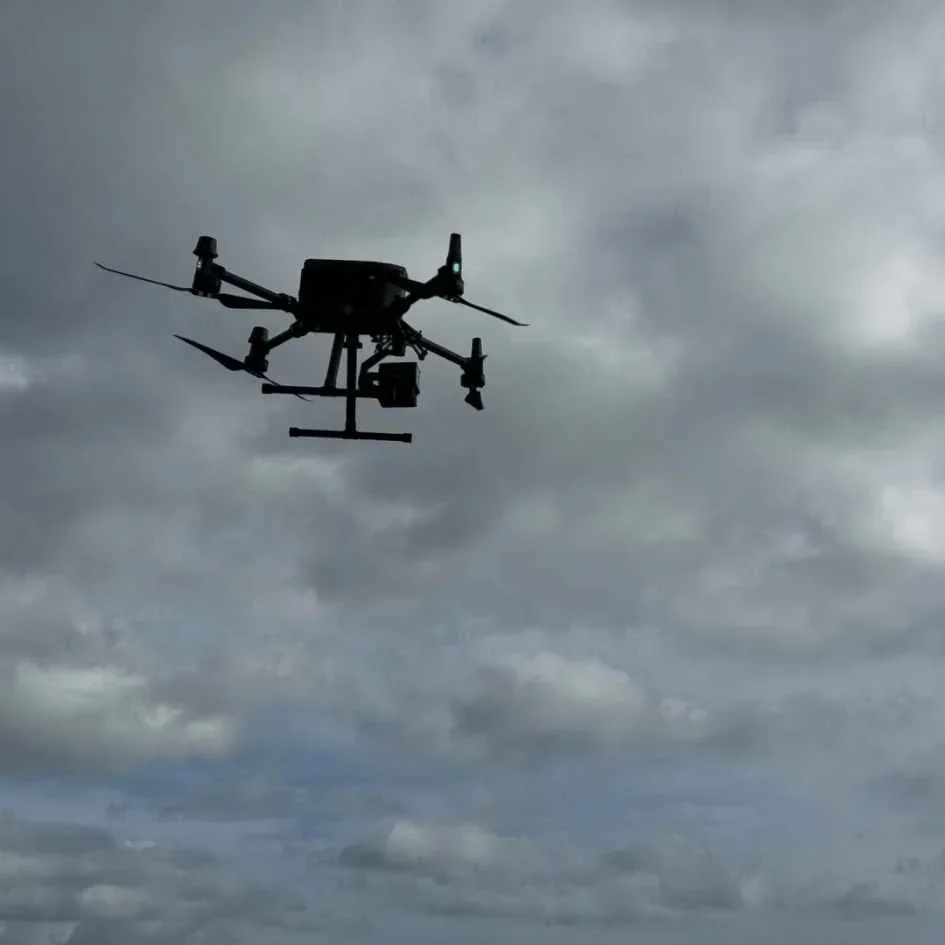
A SORA application for a drone-in-a-box has to evidence containment, geo-fencing, link redundancy, automatic return-to-home, and override procedures
The pillar article covers the SAIL rating and containment level mechanics in general terms. For a drone-in-a-box system, those generic requirements crystallise into a specific list of system features the CAA expects to see documented and tested in the application:
- Containment evidence — proof the drone stays inside the operational volume you defined, including the ground risk buffer and the adjacent area, across every mission profile the base is configured to fly
- Geo-fencing — hard software boundaries that stop the drone leaving its authorised airspace volume, with documented behaviour for what happens when the boundary is hit
- Automatic return-to-home — a tested RTH behaviour for low battery, lost link, weather triggers, and manual abort, with a published flight path back to the base that the application has accounted for
- Command-and-control link redundancy — at least one fallback for the control link (typically 4G/5G primary, RF backup, or vice versa) so a single network outage does not strand the drone in flight
- Remote override and kill-switch procedures — documented steps for the supervising drone operator to take direct control, abort the flight, or trigger an emergency landing, plus the qualifications and currency requirements of the people authorised to do it
- Signal-loss behaviour — what the drone does the instant the control link drops, how long it waits before initiating RTH, and how the supervising operator is notified
- Operations manual coverage — written procedures for pre-flight self-checks, post-flight diagnostics, weather decisioning, and incident reporting, all routed through the supervising operator rather than an on-site drone pilot
- Flight logs — automatic logging for every sortie, retained and producible on request, because there is no on-site drone pilot keeping a paper logbook
The application also has to address the human side. Even though the routine flight is autonomous, the CAA still wants competent drone pilots in the loop — typically RPC-L2 or RPC-L3 holders supervising remotely, with currency requirements and ongoing training documented in the operations manual. The drone may fly itself, but the legal Remote Pilot does not vanish from the picture.
A practical aside on identification: every drone in a drone-in-a-box deployment has to broadcast Remote ID on the same timeline as any other UK Specific Category drone. The autonomy of the operation does not exempt it — if anything, it makes Remote ID more important, because it is the mechanism that lets the police, the CAA, and other airspace users see what the unattended box is actually flying at any given moment.
UK SORA's multi-location and multi-drone flexibility is exactly what drone-in-a-box operators need
A drone-in-a-box deployment is rarely a single base. A national security contract might run a network of twenty bases across a portfolio of sites; an energy operator might position bases at every substation in a region; a telecoms operator might fit one to every major tower. Writing a separate Operational Authorisation for each base would be unworkable, and under the older OSC framework the paperwork was a serious problem.
UK SORA explicitly supports multiple operating locations under a single authorisation, which maps cleanly onto a drone-in-a-box network. The application has to evidence each base — the operational volume around it, the ground risk profile, the adjacent area — but the resulting authorisation covers the whole portfolio. As new bases come online, the route is a SORA modification rather than a fresh authorisation.
The framework also allows different drone models under one authorisation. A site that uses a smaller drone for routine perimeter sweeps and a larger payload-capable drone for occasional inspection sorties can cover both inside the same SORA authorisation, provided each model is evidenced in the application. For a drone-in-a-box network with mixed hardware, that consolidation is meaningful operationally.
The fit between SORA's flexibility and the drone-in-a-box business model is not accidental. The framework was designed knowing that the next decade of UK Specific Category operations would be dominated by repeat autonomous flying from fixed bases — and the multi-location, multi-model architecture is the part of SORA that makes that scale economically.
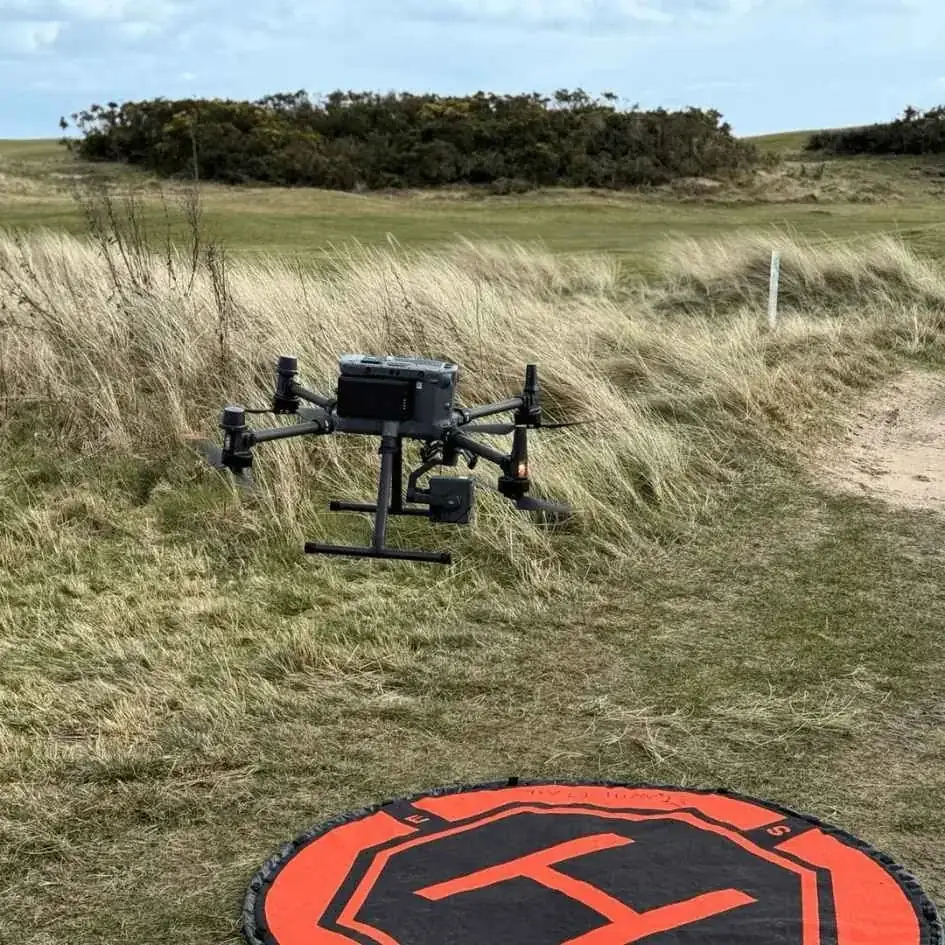
Real-world UK use cases sit in security, energy, agriculture, and telecoms
The four sectors that have moved fastest on drone-in-a-box deployments in the UK share a common shape: large physical sites, repeat inspection or surveillance needs, and a cost-of-attendance high enough that an autonomous drone wins on the economics.
Security and perimeter patrol. Large industrial estates, logistics hubs, and high-value compounds use drone-in-a-box systems for scheduled perimeter sweeps and on-demand response to ground-based sensor triggers. The drone reaches a perimeter break in seconds rather than the minutes a security guard takes on foot, and it does it overnight without a shift rota.
Energy site monitoring. Substations, solar farms, and offshore-adjacent infrastructure use fixed-base drones for thermal inspection, fault location, and storm-damage assessment. The drone replaces a contractor van trip for routine checks, and it can launch within minutes when an alarm fires.
Agriculture. Large farms and estates use drone-in-a-box systems for crop scouting, livestock checks, and post-spray verification on a daily cadence. The base sits at the farm office; the drone flies a programmed circuit at first light and lands before breakfast.
Telecoms tower inspection. Mobile-network operators use fixed-base drones at tower sites to run scheduled visual and thermal checks of antenna arrays and structural elements. The traditional alternative is a rope-access team or a cherry-picker; the drone-in-a-box does the routine inspection and only triggers a physical visit when it finds something worth investigating.
Across all four sectors the regulatory shape is identical: a UK SORA authorisation written around the operational volume, the containment story, the link-redundancy architecture, and the remote-supervision procedures. The use case dictates the mission profile; the framework underneath stays the same. For the broader UK regulatory context this article sits inside, the UK drone laws hub is the place to start.
Drone-in-a-box is the format that finally makes routine, scheduled, autonomous drone flying viable at industrial scale in the UK. The regulatory route is more work than a PDRA01 application — but it is the route, it is well-defined, and the framework is built for exactly this shape of operation.
Got a specific drone-in-a-box scenario you want covered — a network design you are scoping, a SORA application you are about to submit, or a sector-specific use case you want a view on? Drop a note to peter@hiredronepilot.uk and I will come back to you directly. If you prefer the video version of this explainer, the comments are open on YouTube.
References
Primary source material for this article is the UK Civil Aviation Authority. External links open in a new tab.
- UK CAA — UK SORA-based Operational Authorisations · SAIL rating, containment levels, multiple locations, multiple drone models
- UK CAA — Specific Category Overview · PDRA01 vs UK SORA application routes, BVLOS triggers
- UK CAA — Beyond Visual Line of Sight (BVLOS) · BVLOS as a SORA trigger, Operational Authorisation requirement
- UK CAA — Remote ID (RID) · Remote ID broadcast obligations applicable to drone-in-a-box deployments
- UK CAA — UK SORA Multiple Locations · Multi-location authorisation pathway used by drone-in-a-box networks
- UK CAA — UK SORA Using Different Models of Unmanned Aircraft · Multi-model authorisation pathway used by mixed-fleet operators
Peter Leslie
Founder & GVC Drone Pilot
Peter is the founder of HireDronePilot. With thousands of logged commercial flight hours, he writes about drone technology, commercial surveying tactics, and UK aviation compliance.
Connect on LinkedIn