What Is Drone Signal Loss? Causes, Failsafes, and UK Responsibilities

Peter Leslie
31 Oct 2025
Key Takeaways
- Signal loss is the interruption of the radio link between the controller and the drone — it takes down your stick input, telemetry, and live video feed at the same time
- Common causes are flying past the transmission range, physical obstructions, electromagnetic interference, and extreme weather
- Modern drones trigger a Return to Home failsafe on signal loss, but only if a home point has been locked before takeoff
- UK Drone Code Rule 10 makes it your legal responsibility to know how your drone behaves on signal loss, and Rule 11 makes firmware and RTH settings part of fit-to-fly
- Breaking Visual Line of Sight because the signal drops is not a defence — the flight is still a criminal offence under the Air Navigation Order 2016
Signal loss is one of those things that sounds rare until the first time it happens to you. The stick stops doing anything. The live video feed freezes. The telemetry readout on your controller goes quiet. For a second or two you are not flying a drone — you are watching a drone do something without you. What happens in the next thirty seconds depends on whether the drone's failsafe is correctly configured, and whether the drone's failsafe has enough information to do its job.
This piece walks through what signal loss actually is, the common causes, what modern drones do about it, and the UK responsibilities that still apply regardless of how the drone behaves. It sits alongside the other sensor and system explainers — the drone GPS, drone IMU, drone compass, and Return to Home posts are the natural next reads.
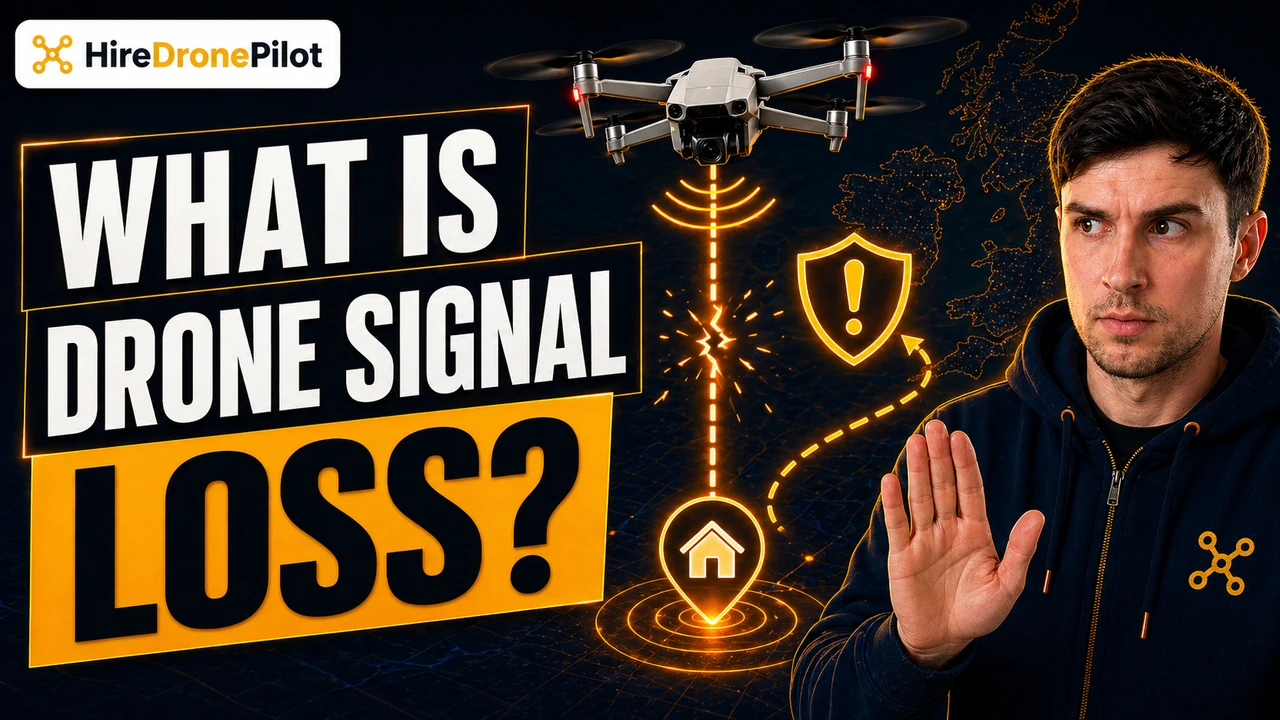
Signal loss is an interruption of the radio link between the controller and the drone
Your drone is connected to your controller by a two-way radio-frequency link, usually on the 2.4 GHz or 5.8 GHz band. The controller pushes stick inputs and commands up. The drone pushes telemetry and a live video feed back down. Signal loss is what we call it when that two-way connection is broken — your inputs stop reaching the drone, and the drone's broadcast stops reaching you.
Three things go quiet at the same moment. Your ability to steer the drone. The live preview feed on your controller's screen. The telemetry readout showing battery, altitude, speed, and GPS status. You are, for the duration of the drop, flying blind.
The drone is not stranded — it still has its own GPS, its IMU, and its flight controller. It can hold a hover, it can fly a programmed return, it can land itself. What it cannot do is take new instructions from you. So the question becomes what the drone does next, and whether you set it up to do the right thing before takeoff.
The common causes of signal loss are distance, obstructions, interference, and weather
Signal loss is not usually a mystery. It is nearly always one of four things.
Distance. Every transmission system has a published range — often measured in kilometres — but published ranges are ideal-condition numbers. Real-world distance before signal strength falls off is shorter, and in practice it will almost always be longer than your Visual Line of Sight. If you have lost signal because you flew too far, you are also flying Beyond Visual Line of Sight without an authorisation, which is a separate and more serious problem — and any triggered Return to Home does not retroactively fix it.
Physical obstructions. Radio waves are blocked and reflected by solid structures. Buildings, metal bridges, hills, dense tree canopy, and water surfaces all degrade or interrupt the link. A drone that flies behind a building is briefly invisible to the controller's radio, even if the drone is only a couple of hundred metres away.
Electromagnetic interference. High-voltage power lines, substations, broadcast masts, and dense urban Wi-Fi all leak radio-frequency noise into the 2.4 and 5.8 GHz bands. If your drone starts losing signal in a specific spot on every flight, interference from a nearby source is the usual explanation.
Weather. Heavy rain, fog, and high humidity all absorb and scatter radio signals, shortening effective range. You will rarely lose signal in light drizzle, but a proper downpour can meaningfully compress your working distance. For the broader picture of flying in difficult conditions, see flying drones in rain and flying drones in windy weather.
On top of these, a flat battery in the controller, an antenna misaligned with the drone, or a transmission system on a firmware version that is out of sync with the drone can all produce what looks like classic signal loss.
Modern drones trigger Return to Home on signal loss — but only if a home point is locked before takeoff
The good news is that every modern consumer drone is designed for this moment. If the radio link stays broken for more than a couple of seconds, the flight controller triggers the Return to Home failsafe. The drone ascends to its configured RTH altitude, flies to the recorded home point, and lands there.
This only works if a few things are true, and all of them are your responsibility as a drone pilot:
- A home point was recorded before takeoff. The home point is not automatic — it is locked when the GPS has a strong enough fix at the launch location. If you took off before the home-point icon appeared in your flight app, RTH has nowhere to fly to.
- The RTH altitude is set above any obstacles between the drone and the home point. The default is often 30 m or 100 m depending on the drone. If your flight is in an environment with trees or buildings taller than that, the drone can fly straight into them on the way home.
- The GPS signal is still strong at the drone's current position. A drone that lost signal behind a large building may also have lost some satellite signal. Sensor fusion handles a brief drop, but a prolonged GPS gap and a radio gap at the same time is a genuinely difficult situation.
- Battery is sufficient for the return. Low-battery RTH will trigger earlier, and even then the drone estimates the flight time. If the estimate is wrong — because of wind, a long detour around obstacles, or a cold battery — the drone can land short.
DJI drones add a layer of behaviour. Within 50 m of the home point they typically just land in place. Further out, they fly back along the recorded outbound path for the first 50 m before switching to a straight line home. The specifics vary by product line, and the DJI UK support portal is the authoritative source for your specific drone's RTH behaviour.
UK Drone Code rules put the drone pilot on the hook for knowing RTH behaviour
The regulatory side of signal loss is often overlooked. The Drone and Model Aircraft Code is explicit about your responsibilities here, and two rules matter most.
Rule 10 — know what your drone can and cannot do. The Code spells this out directly. You need to know how far it can fly before losing signal, how long it can fly before running low on power, and how to set and update features like the maximum flying height and the lost-connection or Return to Home mode. If you cannot describe what your drone will do on signal loss, you are not compliant with Rule 10.
Rule 11 — make sure your drone is fit to fly. The Code is specific that firmware must be up to date because firmware updates can control power, position, emergency landings, and airspace-restriction data. A drone running out-of-date firmware is not fit to fly, regardless of how cleanly it hovers.
Practical implication: running a flight without checking RTH altitude, without confirming the home point is locked, or without knowing the drone's signal-loss behaviour is not a technical oversight — it is a regulatory gap. If something goes wrong, the CAA will be looking for evidence that you followed these rules.
Breaking VLOS because the signal dropped is not a defence
This is the legal point that gets overlooked most often. If your drone flies itself back on Return to Home, the flight may still have breached Visual Line of Sight for the duration of the automatic leg. You were not in direct control of the drone during that time, and if you could not see it through the return, you were flying BVLOS.
The Air Navigation Order 2016 treats this as a criminal offence. Endangering an aircraft in flight carries up to five years in prison. A triggered failsafe does not create a legal exemption for what the drone was doing before it triggered.
This is the underlying reason professional drone pilots treat signal loss as a planning problem rather than a flying problem. The right moment to deal with signal loss is in the pre-flight — by choosing a route where the drone stays within both VLOS and comfortable transmission range, by confirming the home point and RTH altitude, and by knowing in advance which direction to move the controller to re-establish the link if it flickers.
A short pre-flight routine dramatically reduces the probability of a real signal-loss incident
The routine I run before any serious flight is short and boring, which is exactly the point:
- Wait for at least ten to twelve satellites before takeoff, and confirm the home-point icon is showing.
- Set the RTH altitude above the tallest obstacle within the operational area — trees, masts, roofs.
- Visually identify the flight path between the drone and the home point. If there is a tall obstruction in the RTH line, move the takeoff point or raise the RTH altitude.
- Check the controller battery and the antenna orientation. Point the antennas broadly at the drone; perpendicular is best if you are using dual antennas.
- Keep the drone well inside VLOS. If it is becoming a dot, pull it back — the signal is probably still fine but VLOS has gone first.
- Have a plan for the direction you will walk or face if the signal flickers. Usually the quickest fix is to line up an unobstructed sky line-of-sight between you and the drone.
Those six checks make the vast majority of signal-loss events into non-events. A momentary drop triggers a two-second pause, the drone reacquires, and the flight continues. That is the outcome to design for.
So the short version. Signal loss is the interruption of the radio link between controller and drone. It has four common causes. Modern drones handle it with Return to Home, which only works if you set it up. The UK rules make its handling explicitly your job. And breaking VLOS during a failsafe is not a defence, which is why the professional habit is to prevent the situation rather than respond to it.
Got a specific signal-loss story you want me to unpick — a spot on your regular flight path that drops, an RTH that did something unexpected, a site with known interference? Drop a note to peter@hiredronepilot.uk and I will come back to you directly. If you prefer the video version of this explainer, the comments are open on YouTube.
References
Primary source material for this article is the UK Civil Aviation Authority. External links open in a new tab.
- UK CAA — The Drone and Model Aircraft Code (CAP2320) · Rule 2 (VLOS), Rule 10 (know your drone including RTH), Rule 11 (fit to fly, firmware)
- UK CAA — Safety advice for drone operators · human factors, technical-failure prevention, and collision avoidance
- UK CAA — UK Regulatory Framework for Drones · Air Navigation Order 2016; five-year maximum for endangering an aircraft
- DJI — UK support portal · product-specific Return to Home behaviour and transmission-system documentation
Peter Leslie
Founder & GVC Drone Pilot
Peter is the founder of HireDronePilot. With thousands of logged commercial flight hours, he writes about drone technology, commercial surveying tactics, and UK aviation compliance.
Connect on LinkedIn