How to Fly the DJI Neo 2 at Night in the UK

Peter Leslie
22 May 2026
Key Takeaways
- The DJI Neo 2 is legal to fly at night in the UK Open Category, but you must fit a green flashing anti-collision light from take-off to landing
- The Neo 2 ships at 151 grams with a maximum take-off mass of 160 grams under its C0 declaration, so the retrofit light must not push it over that ceiling
- The vision system needs at least 5 lux of ambient light to position reliably, and the forward LiDAR and obstacle avoidance both degrade in darkness
- Visual Line of Sight does not relax after dark, and on a 151-gram drone that realistically halves the daytime range you should plan around
- All the usual Open Category limits stay in force, including the 50 metre people buffer, the 120 metre altitude ceiling, and any flight restriction zone
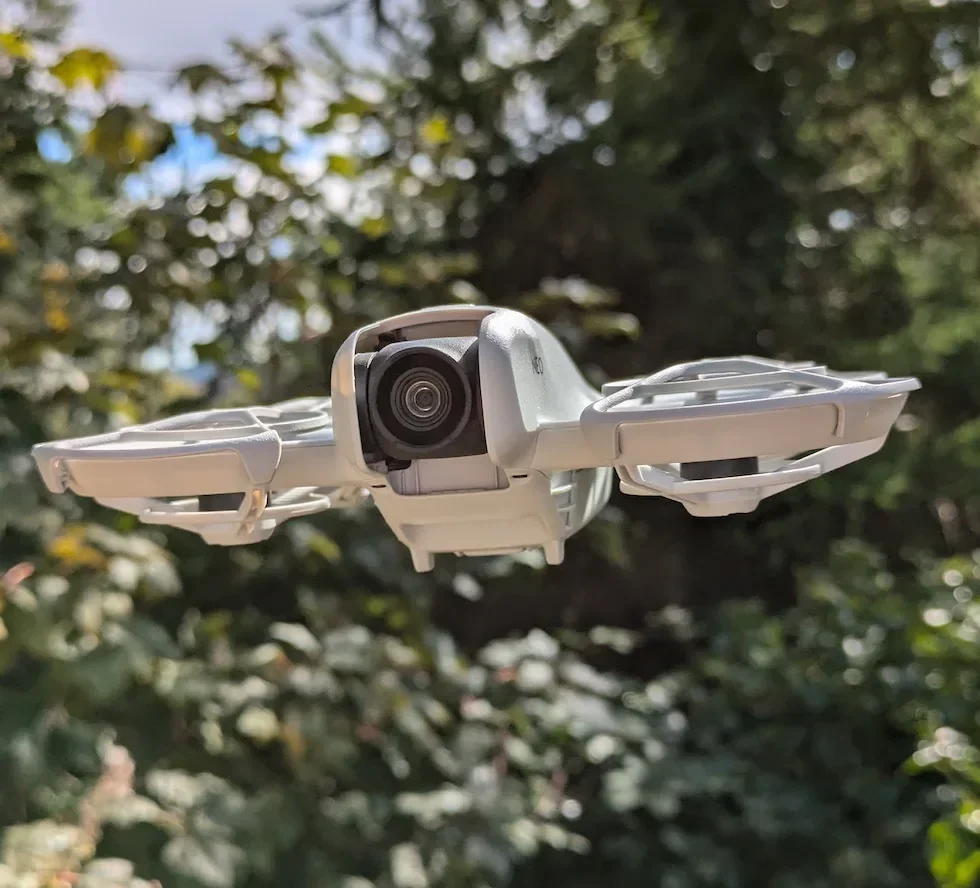
The DJI Neo 2 is the second generation of the lightest serious drone DJI sells in the UK, and the most common question I get from new owners is whether it is legal to fly it after sunset. The short answer is yes — night flying is permitted in the Open Category, the Neo 2 qualifies, and the new forward LiDAR makes it more capable in low light than the original Neo ever was.
The longer answer is that the Neo 2 was built around a daylight workflow, and treating it as a night drone takes a green flashing light retrofit, a halved mental range, and an honest reading of where the 5 lux floor on its vision system actually sits in real-world lighting.
The DJI Neo 2 is legal to fly at night in the UK Open Category, with one new lighting requirement
There is no time-of-day prohibition anywhere in the Drone and Model Aircraft Code. The Open Category sets its limits on weight, altitude, distance from people, and airspace — never on whether the sun is up. The DJI Neo 2 at 151 grams sits comfortably inside the rules that govern recreational drone operators flying after sunset, and a walk through night flying in the UK covers the legal picture in detail.
What does change after dark is the lighting rule. From 1 January 2026, every drone flown at night in the UK must carry a green flashing anti-collision light, active for the whole flight. The legal basis is UK Regulation (EU) 2019/947 UAS.OPEN.060(2)(g), sitting alongside the wider UK regulatory framework. The Neo 2 also carries a camera and sits in the 100-gram to under-250-gram bracket, so both a Flyer ID and an Operator ID are mandatory — DJI Neo 2 registration with the CAA is a hard prerequisite of any night flight.
The DJI Neo 2 does not ship with a green flashing light, so the retrofit is the first thing to buy
This is the part that catches most new Neo 2 owners. UK Regulation (EU) 2019/945 only requires UK1, UK2, UK3, UK5 and UK6 class drones to ship with a factory-fitted green flashing light. UK0 and UK4 class drones are exempt, and the Neo 2 carries a C0 declaration that sits in the UK0 equivalent bracket. It does not come with a green flashing light out of the box.
Practically, that means you cannot legally fly the Neo 2 at night straight out of the box. You have to fit a small clip-on or stick-on green flashing light first. Lume Cube, Ulanzi and Firehouse make the most popular versions for sub-250-gram drones, and the better ones add three to six grams.
On the Neo 2 the maths matters. The drone ships at 151 grams and its C0 declaration sets a maximum take-off mass of 160 grams. That leaves nine grams of headroom, and going beyond it invalidates the C0 declaration the drone relies on for the friendliest Open Category sub-category rules. Pick a light inside that nine-gram window and the Neo 2 keeps every legal advantage it had by day. Mount it on the top of the body, away from the gimbal and the downward infrared sensors.
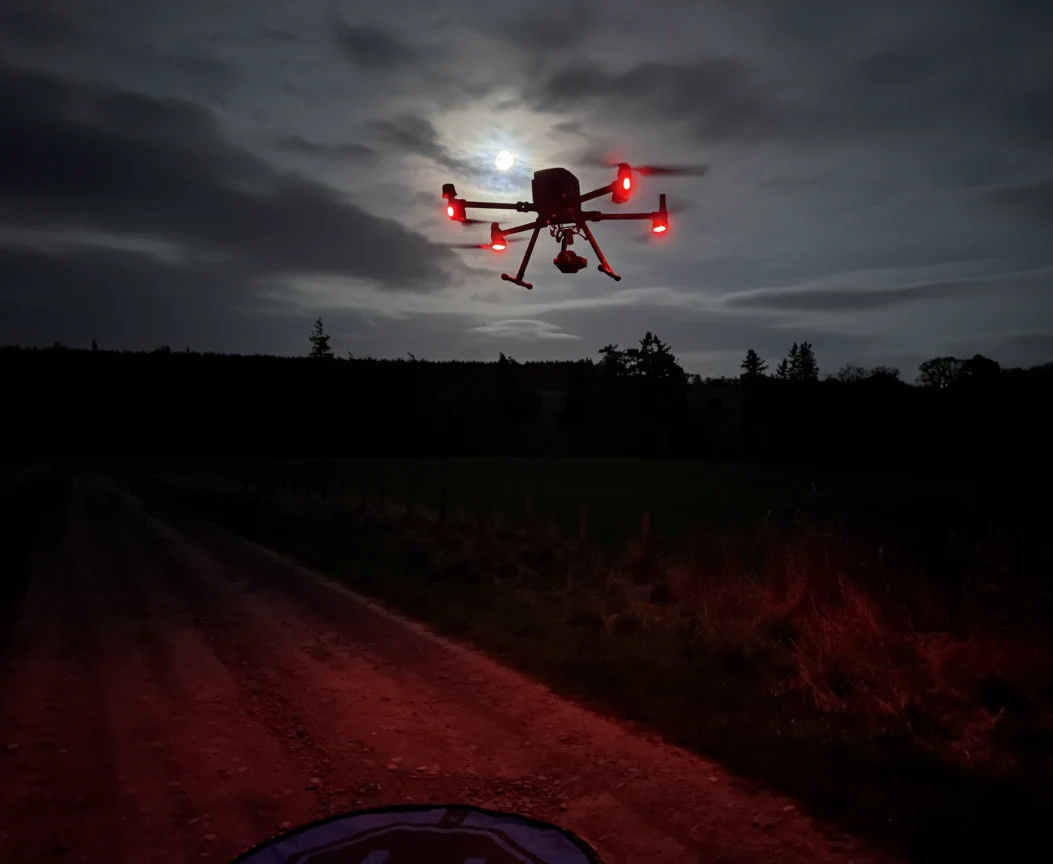
The DJI Neo 2 vision system needs at least 5 lux of ambient light, and below that the drone is on GNSS alone
The DJI Neo 2 manual is direct on this point. The sensing stack — the forward LiDAR, the omnidirectional monocular vision system, and the downward infrared sensors — is rated to work between 5 lux and 100,000 lux. Below that 5 lux floor the vision system cannot work properly, and the Neo 2 falls back onto GNSS positioning alone.
For night flying, that single number is the most important one in the manual. A lit residential street, a town square, a floodlit car park — all comfortably above 5 lux. A field at the edge of a village under ambient sky glow, a coastal path with no street lighting, a back garden lit only by spill from a kitchen window — all well below it. In a dark site the Neo 2 will still take off, but GNSS hold loosens, the visual hover wanders, the forward LiDAR obstacle avoidance system degrades, and a sudden gust will push the drone several metres before it corrects.
| Site | Approximate light level | Neo 2 sensing |
|---|---|---|
| Lit residential street | 15 to 30 lux | Reliable |
| Town square or floodlit car park | 30 to 100 lux | Reliable |
| Edge of village, ambient glow only | 2 to 5 lux | Marginal — vision likely to drop |
| Unlit countryside or coast | Below 1 lux | Vision system off, GNSS only |
Visual Line of Sight does not relax after dark, and on a 151-gram drone that halves your realistic daytime range
Visual Line of Sight is the absolute rule of the Open Category, and it does not get a night exemption. You still have to see the Neo 2 directly, with your own eyes, clearly enough to tell which way it is facing and to spot other aircraft. The CAA accepts no binoculars, no telephoto, and no goggles unless you are flying with a co-located observer.
The Neo 2 is small. By day it disappears for most drone pilots at around 200 metres — by night it disappears far sooner, and what you are actually tracking is the green pulse of the anti-collision light against a black background. A green flash picked out by an experienced eye in clear conditions is comfortable to maintain at perhaps 80 to 120 metres. Beyond that it gets ambiguous quickly.
My own habit on the Neo 2 at night is to halve the daytime range and slow every stick input down. A site I would push to 200 metres in daylight I will keep inside 100 at night, and the 1-to-1 rule matters even more after dark — the horizontal offset is what preserves the viewing angle that tells you which way the drone is facing. All the standard Open Category distances still apply: the 50 metre people buffer, the 120 metre altitude ceiling, and any flight restriction zone, all active twenty-four hours a day.
A few practical habits make the difference between a clean Neo 2 night flight and a costly one
Walk the site in daylight first. The single biggest cause of broken Neo 2s at night is a power line, fence post, or tree branch the drone pilot did not see during the take-off check. Drone Code Rule 17 is the legal backstop, but a daytime walk-around is what stops you needing to invoke it.
Keep the home point set somewhere lit. The Neo 2 return-to-home uses GNSS to come back, but the final landing relies on the downward vision and infrared system. A home point on dark grass is a recipe for a hard landing — a lit pavement, a torch-marked landing pad, or even a piece of white card on the ground is what gets you a clean touchdown. Listen for manned aircraft too. Air ambulances, police helicopters, and emergency medical flights do a lot of their work after dark, often low and without a published route. If you hear or see one, reduce height or land immediately.
Finally, mind the temperature. The Neo 2 operating range is minus 10 to plus 40 degrees Celsius, and a cold-soaked battery will lose noticeable runtime on a winter evening. Keep the spare batteries in an inside pocket until just before flight and watch the in-app battery temperature on the first flight of the night.
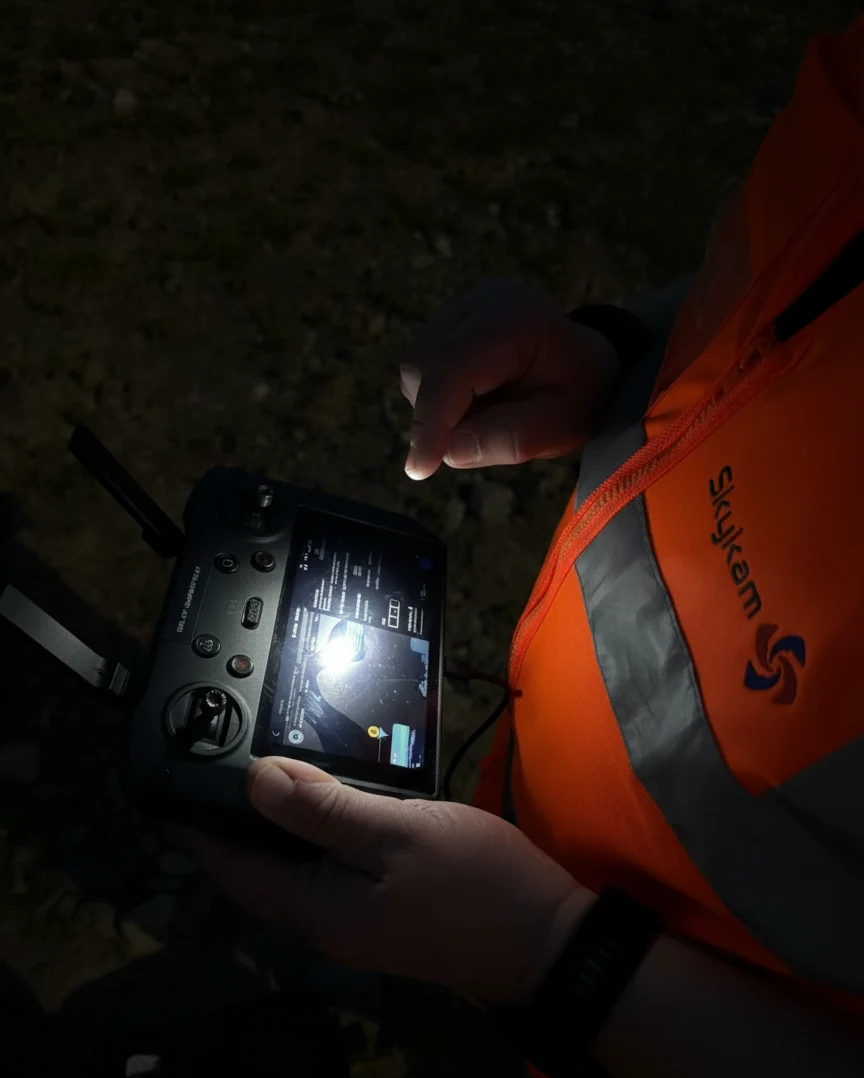
The DJI Neo 2 at night is a different drone than it is by day. The rules say yes — with a green flashing light fitted, with VLOS held, and with the standard Open Category distances respected. The Neo 2 says yes too, but only above the 5 lux ambient floor and only inside a halved range. If your night plan steps outside any of that — a fully dark site, an overflight of a residential area, a longer-range job — the Specific Category with an Operational Authorisation takes over.
Got a specific Neo 2 night scenario you want covered — a coastal site, a residential overflight, a venue lit by a single flood light? Drop a note to peter@hiredronepilot.uk and I will come back to you directly. If you prefer the video version of this explainer, the comments are open on YouTube.
References
Primary source material for this article is the UK Civil Aviation Authority and the DJI Neo 2 user manual. External links open in a new tab.
- UK CAA — Flying at Night in the Open Category · green flashing light rule, mandatory from 1 January 2026, UK0/UK4 retrofit requirement
- UK CAA — The Drone and Model Aircraft Code (CAP2320) · Rule 19 night lighting, Rule 17 manned aircraft, Rule 4 people buffer, VLOS rule
- UK CAA — UK Regulatory Framework for Drones · UK Regulations (EU) 2019/945 and 2019/947 including UAS.OPEN.060(2)(g)
- UK CAA — Where You Can Fly (A1, A2, A3 sub-categories) · Open Category distance and area rules including the 50m people buffer
- DJI — Neo 2 User Manual · 151g take-off weight, 160g C0 MTOM, 5 to 100,000 lux vision system range, forward LiDAR and downward infrared sensors, minus 10 to plus 40 Celsius operating range
Peter Leslie
Founder & GVC Drone Pilot
Peter is the founder of HireDronePilot. With thousands of logged commercial flight hours, he writes about drone technology, commercial surveying tactics, and UK aviation compliance.
Connect on LinkedIn