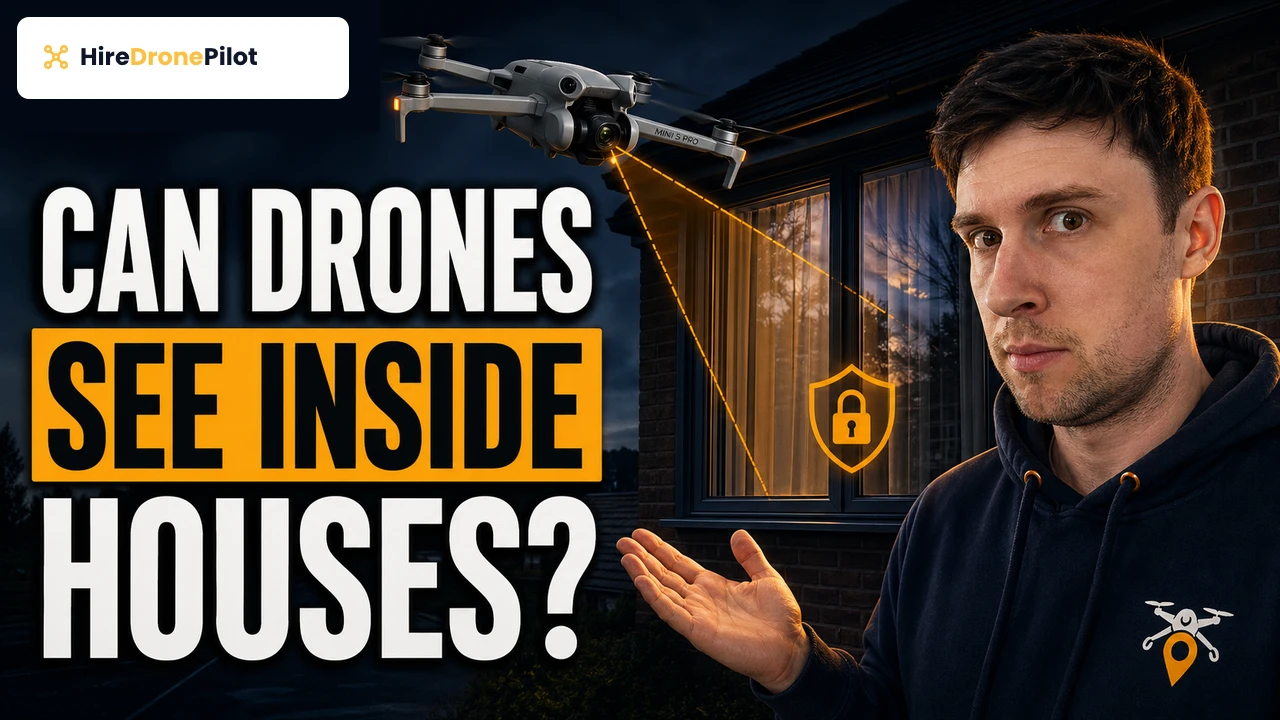
Can Drones See Inside Houses? The Honest, Physics-Backed Answer

Peter Leslie
16 Apr 2026
Key Takeaways
- A consumer 4K drone camera flying at the legal altitude ceiling of 120 metres cannot read a face or a phone screen through an unobstructed window
- Ground Sample Distance scales linearly with altitude, so the resolution of anything inside a window drops off fast as the drone climbs
- Net curtains, blinds, tinted glass and daytime reflections block almost everything a drone camera wants to see through a window
- Thermal cameras can detect that somebody is inside a room through a wall or curtain, but they cannot produce a recognisable face through glass
- Recording inside a home or garden almost always breaches UK GDPR and the Data Protection Act 2018, and the Information Commissioner's Office is the regulator
- The real-world risk profile is nothing like the spy-drone headlines, and the laws that exist are aimed squarely at the handful of drone operators who genuinely try to cross the line
The spy-drone headline keeps coming back. A drone hovers outside a window, peers in with a magical zoom lens, reads your laptop screen, and watches you through the walls with a thermal camera. The short answer is that almost none of that is possible with a consumer drone flown legally — and the bits that sound plausible are a lot less impressive in practice than the headlines suggest.
What consumer drones can do is much more ordinary, and the rules that govern it — UK drone laws, UK GDPR, the Data Protection Act 2018 and old-fashioned nuisance — are much stricter than most drone owners realise. This article walks through what the physics allows, what the law forbids, and where the honest middle ground sits for a homeowner who is worried about privacy.
A consumer 4K drone camera at legal altitude cannot read a face or a phone screen through your window
Start with the physics. Every digital image has a resolution, and aerial photographers measure it using Ground Sample Distance — the size of the real-world square that a single pixel represents. A typical consumer drone with a 6.4 millimetre sensor, a 24 millimetre-equivalent focal length and a 4000-pixel-wide image sits at about 1.3 centimetres per pixel when flown at the Open Category floor of 20 metres, and at roughly 6.7 centimetres per pixel at an altitude of 100 metres.
Those numbers sound small until you ask what they actually render. A human eye is about three centimetres wide. At 20 metres you have two or three pixels on the whole eye, which is enough to see it but nowhere near enough to read it. At 100 metres the eye is half a pixel across — gone. The CAA-legal ceiling is 120 metres altitude above the surface, and at that height each pixel covers about eight centimetres. A phone screen is smaller than that.
This is the linear relationship that kills the spy-drone fantasy. Double your altitude and you halve your effective resolution. A drone hovering safely above a street has nothing like the resolving power a still camera on the ground would give you at the same distance.
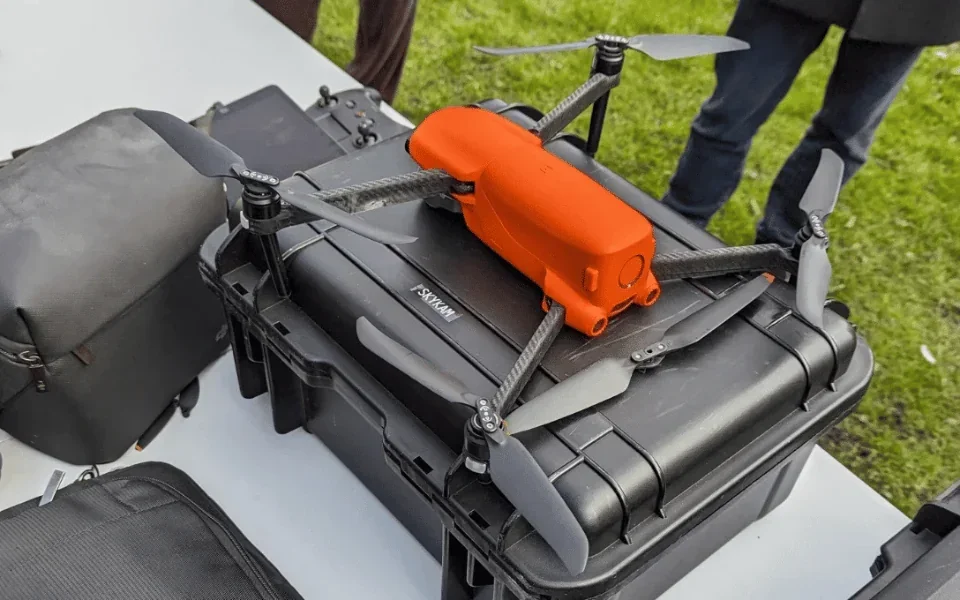
A clean unobstructed window gives up maybe thirty percent of what a ground-level observer would see, and a net curtain kills the rest
Even if you ignore the altitude penalty and imagine a drone hovering at fifteen metres outside a second-storey window, the glass itself is the next problem. Daylight glare, double-glazing reflections and the viewing angle at a horizontal hover make modern windows behave like mirrors far more often than they behave like lenses.
From the drone pilot's side of the controller, a sunlit window at thirty degrees off the horizon is a flat silver panel. An overcast day flattens the reflection, but the interior of the room drops into near-black on any exposure that keeps the outside of the house correctly exposed. You can see the window is there. You cannot see what is behind it.
A net curtain pushes that number toward zero. So does a roller blind, a vertical blind, a Venetian blind, a patterned film, tinted glass, or the double-reflection off secondary glazing. These are all dirt-cheap privacy countermeasures, and they are overwhelmingly effective against any consumer drone camera, because the drone cannot compensate for a barrier the light has already been stopped by.
The only time a window really betrays you is the reverse case that nearly everyone forgets. On a dark winter evening with the interior lights on and no curtains drawn, a lit room acts like a television set seen from outside. That is a general privacy problem, not a drone problem — any passer-by with a phone can film it — but it is the one case where a drone adds meaningful reach.
Thermal cameras can tell that somebody is in a room, but they cannot produce a recognisable image of them through glass
The second spy-drone myth is that thermal imaging gives the drone operator X-ray vision. It does not. Long-wave infrared — the band that a drone thermal camera uses — is stopped almost completely by ordinary window glass. The camera sees the glass itself, not the warm body behind it. Ask any firefighter who has tried to use a thermal imager through a window: the window lights up, the person does not.
What thermal can do is detect the indirect signature of warmth. A recently occupied sofa radiates a different temperature from the rest of a cold wall. A person standing behind a thin curtain puts a faint human-shaped smudge on the curtain. A lit bulb glows. None of that adds up to a recognisable image, and none of it lets the drone operator identify anybody.
Where thermal does matter is at industrial inspection distances on the exterior of a building, where you are mapping heat loss through walls, spotting a hot electrical panel on a rooftop, or tracing missing loft insulation. Those jobs are the legitimate use case, they are priced per flight because the sensor is expensive, and nobody is pointing them through a bedroom window.
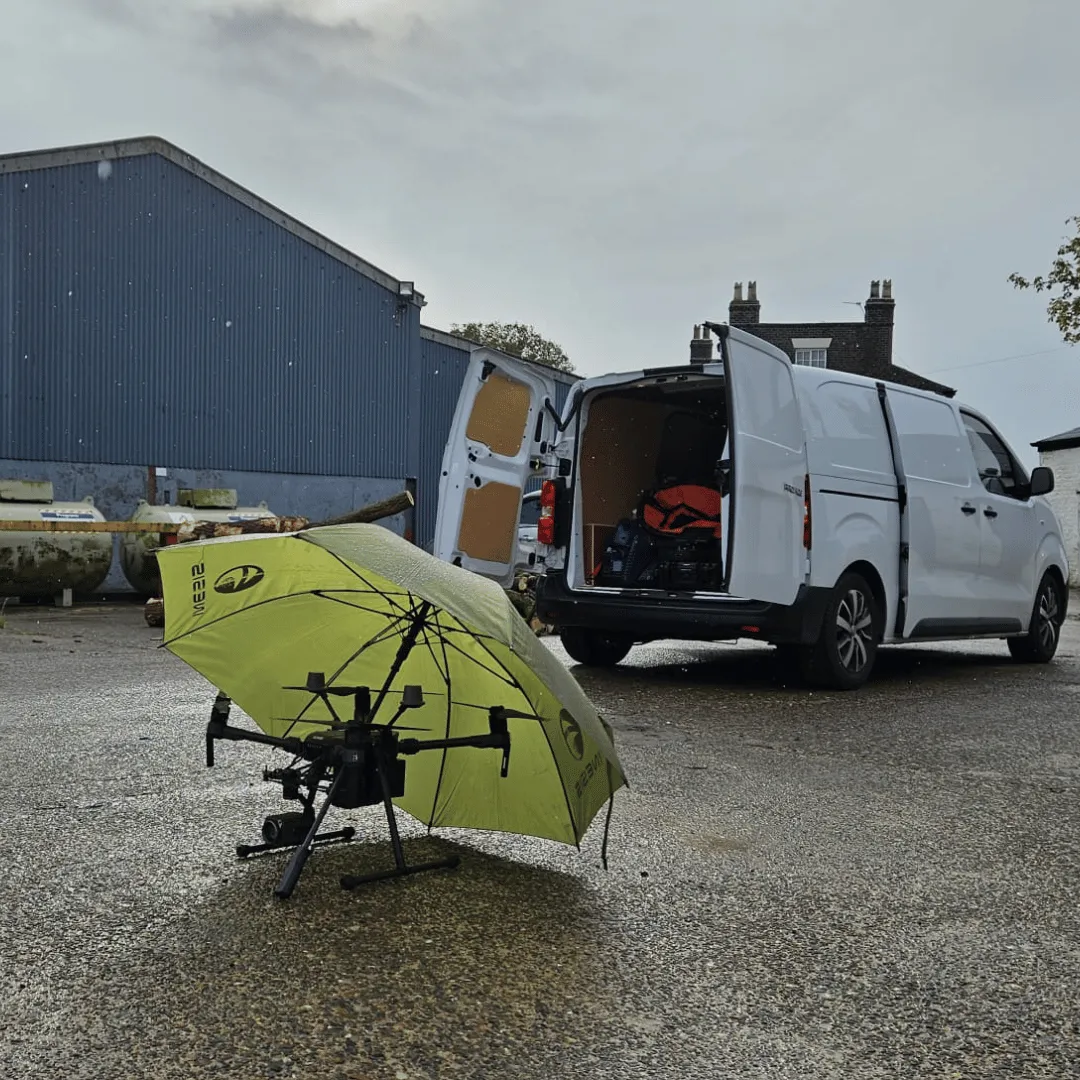
Night-vision mode on a consumer drone is a low-light colour mode, not a military starlight sensor
A lot of the anxiety around drones seeing into houses comes from the night-vision marketing on newer consumer models. Read the spec sheet and the capability collapses fast. Most night mode settings on a consumer drone are a software pipeline — higher ISO, longer exposure, more aggressive noise reduction — applied to the same colour sensor the drone uses in the day.
That is useful for navigating at dusk, for producing a usable city shot after sunset, and for the sort of ambient low-light photography the drone is sold to do. It is not useful for seeing through a dark window into a dark room. The sensor still needs photons, and a curtain-shrouded interior is not giving it any.
Under the Drone Code, flying at night in the Open Category also requires a green flashing light on the drone from the first of January 2026. That is a hard rule — the drone is not stealthy at night, and the light is specifically there to make it visible to people on the ground.
Recording inside a house or garden is a data protection breach before it is anything else
Set the camera physics aside for a moment. Even in the scenarios where a drone could see something — the lit-at-night room, the overflown garden, the close-range shot of a balcony — UK law treats that footage as personal data the instant it is captured.
The Drone and Model Aircraft Code is explicit: using a drone camera or listening device where people can expect privacy — inside their home or garden — is likely to break data protection law. That is not advice. That is the regulator telling a drone operator in plain words that UK GDPR and the Data Protection Act 2018 apply, whether the capture was on purpose or by accident.
There is a clean legal line here that does not depend on what the camera could technically resolve. If a recognisable person appears in a frame — a face, a tattoo, a numberplate, a unique outfit — personal data has been processed, and the drone operator becomes a data controller. A commercial flight needs a lawful basis under Article 6, a retention plan, and transparency to the people affected. A hobbyist uploading the clip to a public channel loses the household exemption and picks up the same duties. The full commercial picture is in the GDPR guide for drone operators.
Alongside UK GDPR there is nuisance — the civil law of persistent or unreasonable interference with the enjoyment of your own property — and there is the Protection from Harassment Act 1997 if the flights are repeated and targeted. A one-off flight past a window is rarely harassment; a pattern of flights aimed at the same house, at the same time of day, over several weeks, is.
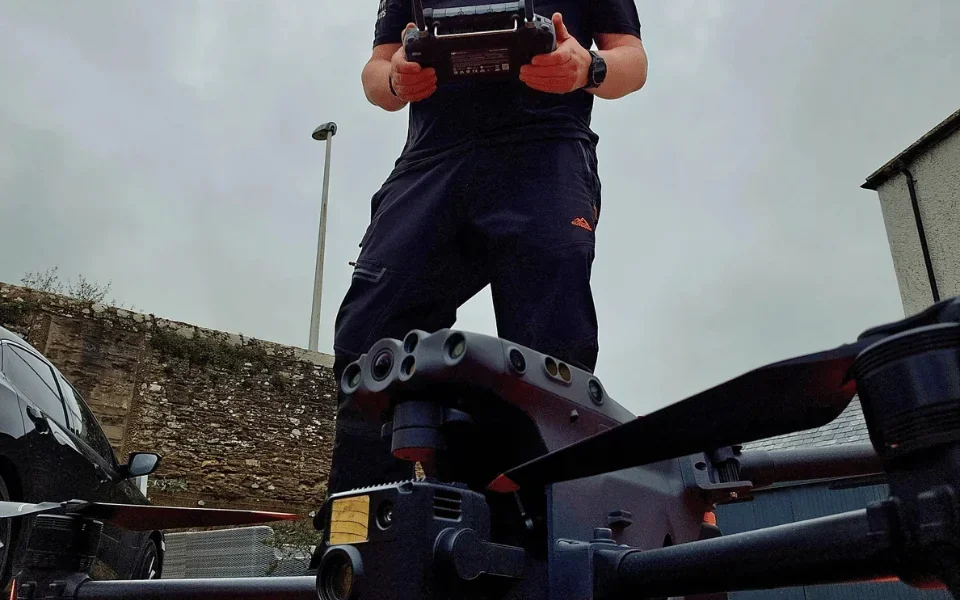
The regulator is the Information Commissioner's Office, not the Civil Aviation Authority
A point that trips up most homeowners: the CAA does not police the privacy side of drone operations. The CAA polices the airspace. The ICO polices the data. Those are two different regulators, with two different powers, and a complaint about a drone camera has to reach the right one.
In practice that means a privacy complaint about a drone goes to two places. You call 101 for the police if the flight looks dangerous, illegal, or targeted at people. You contact the ICO if the complaint is about capture or retention of personal data. If the flight happened over your own property in particular, the route to identify the drone operator starts with the police, because Operator ID lookups are not public.
The ICO's enforcement toolkit is graduated — information notices, reprimands, enforcement notices and, at the top end, monetary penalties. Most complaints end in a reprimand and a corrective order rather than a headline-grade fine, but a reprimand on file is a real problem for anyone trying to run a commercial drone business. Serious deliberate voyeurism sits in criminal law and is handled by the police.
What to do if you think a specific drone is watching your house
Most drone sightings over a residential street are not surveillance. Professional drone pilots doing roof inspections a few houses down, a neighbour learning on a new model, a wedding videographer pulling a hero shot over the road — these are the usual explanations, and they look the same from a living-room window as a hostile flight.
A short checklist will usually sort the innocent cases from the ones that need reporting. Note the time, the direction of travel, and how long the drone stayed. Check whether it came back the next day, or the same day of the week the following week — the pattern is what separates a one-off from targeted surveillance. If the flight breaches a hard rule — very close to the house, persistently hovering over the garden, at night without a visible light, or in a restricted zone — call 101 and log the sighting. If the concern is about footage of you or your family, contact the ICO in parallel.
If the drone keeps coming back, the neighbour-drone-over-the-garden guide covers the civil route, and the stopping drones flying over your property guide covers the physical and legal countermeasures you can actually use without breaking the law yourself. If you believe a single drone is specifically tracking you rather than your house, the drone-following-me guide is the right starting point.
The best countermeasure is the same one it has always been: close the curtains
If you step back from the camera specifications and the legislation, the practical privacy picture is much less dramatic than the headlines. Consumer drones at legal altitudes simply do not resolve detail inside a house. The glass, the curtains and the reflections defeat the camera long before the law has to. Thermal imaging does not do what people think it does. Night-vision modes are low-light colour, not starlight, and the drone has to fly with a flashing light on.
Where real risk does exist, it sits in three places: the lit-at-night uncurtained window, the deliberate targeted flight, and the published clip that turns an incidental capture into searchable personal data. All three are covered by rules that are already on the books — UK GDPR, the Data Protection Act 2018, nuisance, harassment, and the Drone Code itself — and the practical defence against all three is the curtain rail. Most homeowners already have one.
Got a specific scenario you want covered — a drone that keeps appearing over your garden, a lit-up office block you can see from the street, a wedding videographer pulling a hover right past your bedroom? Drop a note to peter@hiredronepilot.uk and I will come back to you directly. If you prefer the video version of this explainer, the comments are open on YouTube.
References
Primary source material for this article is the UK Civil Aviation Authority and the Information Commissioner's Office. External links open in a new tab.
- UK CAA — The Drone and Model Aircraft Code (CAP2320) · 120m altitude ceiling, recording inside home/garden breaches data protection, night-flight light rule
- UK CAA — Privacy Rules When Flying Drones · GDPR applies to intentional and unintentional capture, know what your camera can do
- UK CAA — Concerns About Privacy and Illegal Use of Drones · 101 for police, CAA and ICO split of responsibility
- ICO — Drones and Your Privacy · Information Commissioner's Office guidance for the public
- UK CAA — UK Regulatory Framework for Drones · Air Navigation Order 2016 and UK Regulations (EU) 2019/945 and 2019/947
- UK Legislation — Data Protection Act 2018 · statutory basis sitting alongside UK GDPR
Peter Leslie
Founder & GVC Drone Pilot
Peter is the founder of HireDronePilot. With thousands of logged commercial flight hours, he writes about drone technology, commercial surveying tactics, and UK aviation compliance.
Connect on LinkedIn