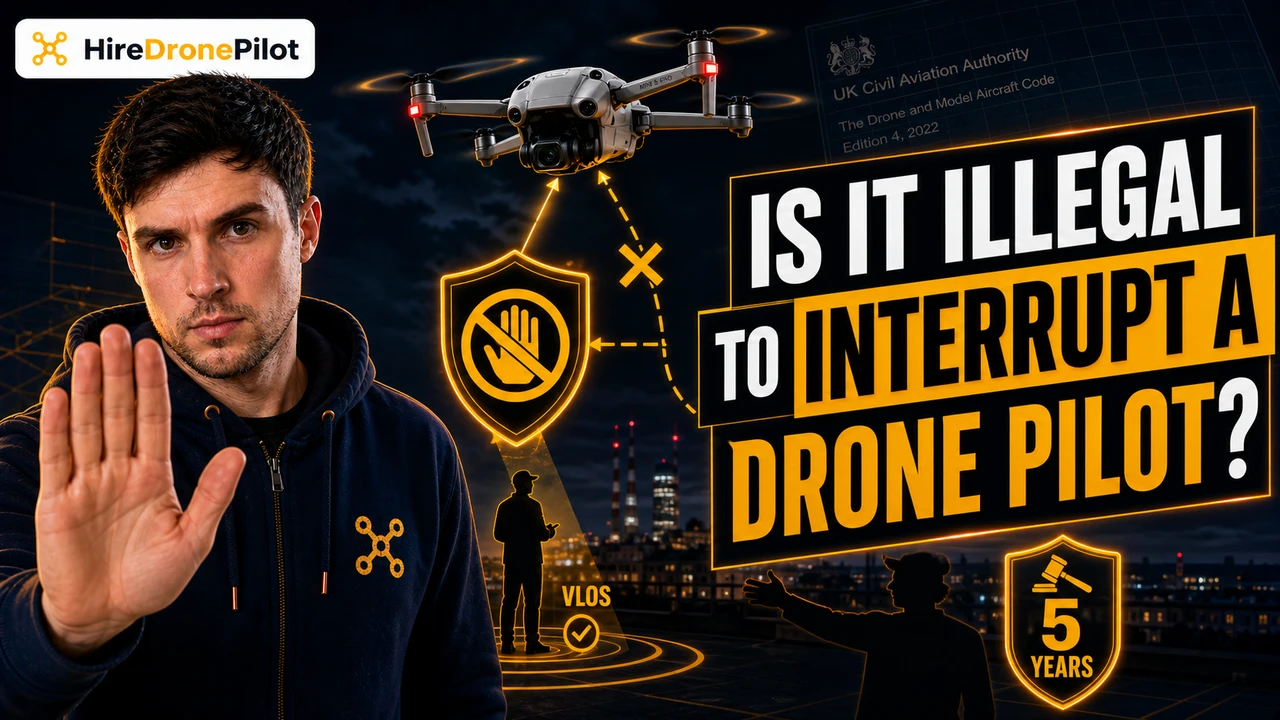
Is It Illegal to Interrupt a Drone Pilot in the UK?

Peter Leslie
8 May 2026
Key Takeaways
- There is no single offence called “interrupting a drone operator” in UK law, but the conduct can trigger several existing offences at once
- Physically interfering with a drone in flight is treated as endangering an aircraft, which carries a maximum sentence of five years under the Air Navigation Order 2016
- Shouting at, threatening, or repeatedly confronting a drone pilot can fall inside the Public Order Act 1986 and the Protection from Harassment Act 1997
- The Drone Code makes a remote pilot’s concentration a legal duty, so removing their line of sight or attention is what turns rudeness into endangerment
- If a drone is genuinely bothering you, the lawful path is to document, call 101, and use the Information Commissioner’s Office — not to interrupt the flight
It is one of the most common questions I get asked at sites where neighbours have wandered over for a chat. Yes — depending on what you do, interrupting a drone pilot in mid-flight can be a criminal offence in the UK, and one route through it carries up to five years in prison under the Air Navigation Order 2016.
There is no single statute called “interrupting a drone operator” on the books. What there is, is an offence ladder: distraction, endangerment, criminal damage, public order, harassment, and common assault. This article walks each rung in plain English, then points to the lawful alternatives if a flight is genuinely upsetting you. The full picture sits inside the wider UK drone laws framework, which is worth keeping open in another tab.
Yes, interrupting a drone pilot in flight can be a criminal offence in the UK, and the law cares more about your conduct than your intent
Most people picture the criminal law as a single button: did you mean to do harm, yes or no. Aviation law is built differently. The Air Navigation Order 2016 makes it an offence to recklessly or negligently act in a manner likely to endanger an aircraft, and a drone in flight counts as an aircraft for that purpose. There is no requirement to prove you wanted the flight to fail. Acting in a way an ordinary person would call reckless is enough.
That single phrase — reckless or negligent — is what turns interrupting a drone pilot from rude into criminal. Most professional drone pilots are happy to talk to you on the ground after they land. None of them are happy to be grabbed, shouted at, or stepped in front of while their drone is one hundred metres up.
Above and beyond the aviation rules, the everyday criminal law still applies. Threats become public order offences. Repeated targeting becomes harassment. A push becomes common assault. The drone in their hands does not put a force field around them and it does not put a force field around you either.
Physically interfering with a drone in flight is treated as endangering an aircraft, with a five-year ceiling, before any criminal damage charge is added
Grabbing the drone, swatting it, throwing an object at it, or stepping in to block the remote pilot’s view of it sits at the top end of this ladder. The criminal damage charge is the smallest piece. The bigger one is the same charge that lands when somebody points a laser at a passing helicopter: endangering an aircraft, maximum sentence five years. The same offence-stack logic applies to shooting down drones, and the courts treat all of these as variations on the same theme.
There is a second layer most people miss. The remote pilot is not the only person at risk. The 50 m from people rule works because the drone pilot is the one keeping the drone away from bystanders. The moment you remove them from the loop — by knocking the drone down, by panicking them, by ripping the controller from their hands — the risk transfers straight to whoever is standing nearby. If a falling drone hits a passer-by, that endangerment charge is now yours, not the operator’s.
From a drone pilot’s perspective, this is the bit that catches well-meaning people out. They imagine a confrontation as a one-on-one moment between them and the operator. The legal reality is that the airspace, the public on the ground, and the drone’s flight path are all in the room with you.
Shouting at, threatening, or persistently confronting a drone operator can sit inside public-order and harassment offences even before any aviation rule comes in
Drop the physical contact and you are still well inside the criminal law. The Public Order Act 1986 turns threatening, abusive, or insulting words into an offence the moment they cause alarm or distress to another person. Section 4 covers threatening behaviour likely to make somebody fear immediate violence. Section 4A and section 5 cover abusive language with intent or recklessness as to causing harassment, alarm, or distress. You do not need to throw a punch to be charged; raising your voice, getting in someone’s face, and refusing to back off can be enough.
Repeat the encounter and the law shifts up a gear. The Protection from Harassment Act 1997 needs only a course of conduct — two or more occasions — that a reasonable person would call harassment. If the same drone pilot keeps turning up at a roof inspection two doors down and you keep walking out to confront them, you are in PHA territory regardless of whether you were in the right about the flight itself.
Cross the line into a push, a grab, or a swing, and that is common assault under the Criminal Justice Act 1988. The drone in their hands often costs more than a phone, but the law does not soften because the equipment looks like a toy — the protection on the operator is exactly the same as it would be on any other member of the public.
The Drone Code makes a drone pilot’s concentration load-bearing, and removing it is what turns interruption into endangerment
The reason interrupting a drone pilot is treated more seriously than interrupting, say, a photographer with a tripod, is that the law has already decided their attention is doing safety-critical work. The Drone and Model Aircraft Code lays this out across three rules that stack on top of each other.
Rule 2 is the headline. The remote pilot must keep Visual Line of Sight on the drone — direct sight, with their own eyes, clearly enough to tell which way the drone is facing and clearly enough to spot any other aircraft entering the airspace. Block their view, even for a few seconds, and you have personally caused a breach of that rule. Rule 16 forbids flying while distracted. Rule 17 requires the drone pilot to act quickly and safely if the situation in the air or on the ground changes — the very reaction that interruption is designed to remove.
When somebody asks me whether shouting at a drone operator is really endangerment, this is the answer. The Drone Code does not allow the operator to relax their attention even briefly. Anything that strips their concentration is, by definition, creating the hazard the law is trying to keep closed.
If a drone is genuinely bothering you, the lawful path is to document, call 101, and use ICO or police powers, not to interrupt the flight
There is almost always a legal route that does not put you on the wrong end of a charge. Start by documenting: write down the time, take a photo of the drone, look on the body of the drone for the operator ID label that every UK operator is legally required to display. If it is on the ground or low enough to read, that label tells the police exactly who the drone belongs to. There is a dedicated guide on the site for stopping drones over your own property that walks the full evidence-gathering routine.
For non-emergency complaints, call 101 for your local police; for genuine danger, 999. For privacy concerns where identifiable footage may have been captured, the UK GDPR route runs through the Information Commissioner’s Office. The article on police powers over drones covers what officers can and cannot do, and the piece on what happens when somebody is caught flying a drone illegally walks through the typical enforcement outcomes.
If the concern is overflight rather than confrontation, the explainer on flying over private property sets out the airspace-ownership rules. And before you assume the drone is filming you through the window, the piece on whether drones can see inside houses is worth a quick read — the spy-drone headlines almost never match what the camera can actually do.
So the short answer is yes, interrupting a drone pilot can be illegal — not under one bespoke law, but under whichever of half a dozen existing laws fits your conduct on the day. The further you go from a calm question on the ground, the heavier the offence-stack gets, and the easier the prosecution becomes.
Got a specific scenario — a confrontation that already happened, or a borderline case where you are not sure who was in the wrong? Drop a note to peter@hiredronepilot.uk and I will come back to you directly. If you prefer the video version of this explainer, the comments are open on YouTube.
References
Primary source material for this article is the UK Civil Aviation Authority. External links open in a new tab.
- UK CAA — The Drone and Model Aircraft Code (CAP2320) · Rules 2, 16 and 17 on VLOS, distraction, and reacting to changing conditions
- UK CAA — UK Regulatory Framework for Drones (Air Navigation Order 2016) · the reckless-or-negligent endangerment offence and the five-year ceiling
- UK CAA — Where You Can Fly · the 50 m people-buffer that interruption transfers risk into
- UK CAA — Contact and reporting routes · how the CAA wants suspicious activity and incidents reported
Peter Leslie
Founder & GVC Drone Pilot
Peter is the founder of HireDronePilot. With thousands of logged commercial flight hours, he writes about drone technology, commercial surveying tactics, and UK aviation compliance.
Connect on LinkedIn