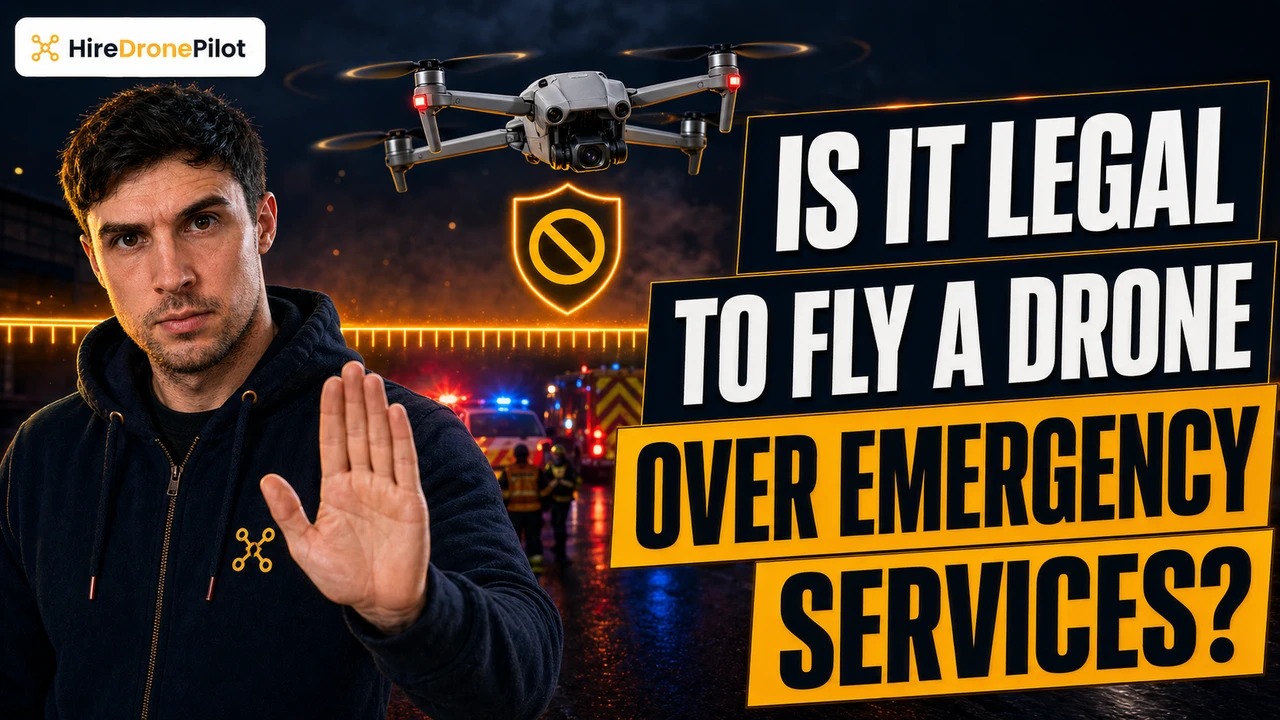
Is It Legal To Fly a Drone Over Emergency Services in the UK?

Peter Leslie
17 Apr 2026
Key Takeaways
- CAP 722 section 5.2.2.3 names emergency response efforts — including police, fire, ambulance, rescue, and a crime in progress — as areas the Remote Pilot must not fly near, unless the responsible emergency response personnel have given permission
- CAP 722 is guidance, not law — but breaching it usually breaches the Air Navigation Order 2016, with Article 241 (endangering persons or property) and Article 240 (endangering a manned aircraft) doing the heavy lifting
- A police officer can require the drone to be grounded on the spot, and refusing or delaying compliance is itself a criminal offence
- A police helicopter or air ambulance at the scene turns the flight into a five-year-prison endangerment risk the moment it lifts off
- The crowd rule, the congested-areas rule, and the 1-to-1 rule stack on top of the CAP 722 duty — every active scene tends to meet at least one of them
- Identifiable people in the footage bring UK GDPR and the Data Protection Act 2018 into scope, and recording for a criminal or terrorist purpose is a standalone offence
- Press or hobby status is no shield, and an incident at the scene itself triggers mandatory occurrence reporting to the AAIB and the CAA
You are out flying, and a street away you spot a police cordon, a burning building, or an ambulance crew working an accident. The question lands in your lap. Can I legally bring the drone overhead for a better look? The short answer is no, and the longer answer is that you need to step away even faster than most drone pilots realise.
UK drone law does not have a standalone rule that reads "no flying over emergency services", but it does something cleaner — it names emergency response efforts as areas you stay away from, and then the wider UK drone laws stack half a dozen other offences on top. The result is the same. Fly anyway and you have stacked rules before the drone has even turned to face the scene.
CAP 722 names emergency response efforts — including a crime in progress — as areas you do not fly near, and the duty binds the Remote Pilot
The specific clause lives inside CAP 722, the CAA's guidance document for unmanned aircraft operations in UK airspace. It sits in Section 5.2.2.3, the list of Remote Pilot In-flight Responsibilities, right alongside the duty to avoid collisions with other aircraft and the duty to comply with Flight Restriction Zones. Verbatim:
Ensure that the UA is not flown close to or inside any areas where an emergency response effort is ongoing, unless they have permission to do so from the responsible emergency response personnel. The term emergency response effort covers any activities by police, fire, ambulance, coastguard or other similar services where action is ongoing in order to preserve life, protect the public or respond to a crime in progress. This includes activities such as road traffic collisions, fires, rescue operations and firearms incidents, although this list is not exhaustive.
Two things matter about where that clause sits. First, it is a Remote Pilot duty, which means it binds the person at the sticks on every flight, not just the operator on paper. Second, the list is not exhaustive, so a crime scene that does not tidy itself into the named categories still counts if the responders are on site doing active work.
The permission carve-out is real. If the senior officer on the scene tells you to fly — for example because the force has asked you in to capture footage they cannot get themselves — the duty is satisfied. In practice the permission needs to come from someone with authority over the scene, and a nod from a bystander does not count.
CAP 722 is guidance, not law — but the Air Navigation Order offences sitting underneath it are what actually bite
CAP 722 is Guidance Material, not legislation. You are not prosecuted for breaching CAP 722 itself. You are prosecuted for breaching the law it describes, and in this case there are two underlying offences that do the heavy lifting.
Air Navigation Order 2016 Article 241 states plainly that no person may recklessly or negligently cause or permit an aircraft to endanger any person or property. Your drone is the aircraft in that sentence, and a crime scene is densely populated with persons and property the rule exists to protect.
Article 240 points the other way: a person must not recklessly or negligently act in a manner likely to endanger an aircraft, or any person in an aircraft. That covers a police helicopter or air ambulance flying into the same airspace. We will come back to that one.
If you fly commercially and hold an Operational Authorisation, the CAP 722 emergency-response duty is usually wrapped into its conditions. Breaching it is then a condition breach the CAA can act on administratively, without a prosecution.
Police can require the drone to land the moment they see it, and refusing is itself a criminal offence
The second a constable reasonably suspects a drone-related offence, their powers over the drone switch on. A constable can require you to bring the drone down and stop the flight, can inspect your Flyer ID and Operator ID, and can seize the drone where an offence is suspected. Refusing or deliberately delaying compliance is a separate criminal offence on top of whatever triggered the stop.
A quiet detail worth knowing. Police drones themselves sit outside UK Regulation (EU) 2019/947 because police unmanned aircraft operations are specifically excluded. That means a police drone can be in the air above the scene lawfully at the same moment yours cannot. If you see a police drone over the cordon, do not read it as a licence to join it. Read it as a clearer signal the airspace is exactly where you should not be.
The practical behaviour is simple. Land as soon as it is safe, cut the rotors, have your Flyer ID and Operator ID ready, and do not argue the flight geometry while the drone is still in the sky. The officer's job is easier, and your stop stays short.
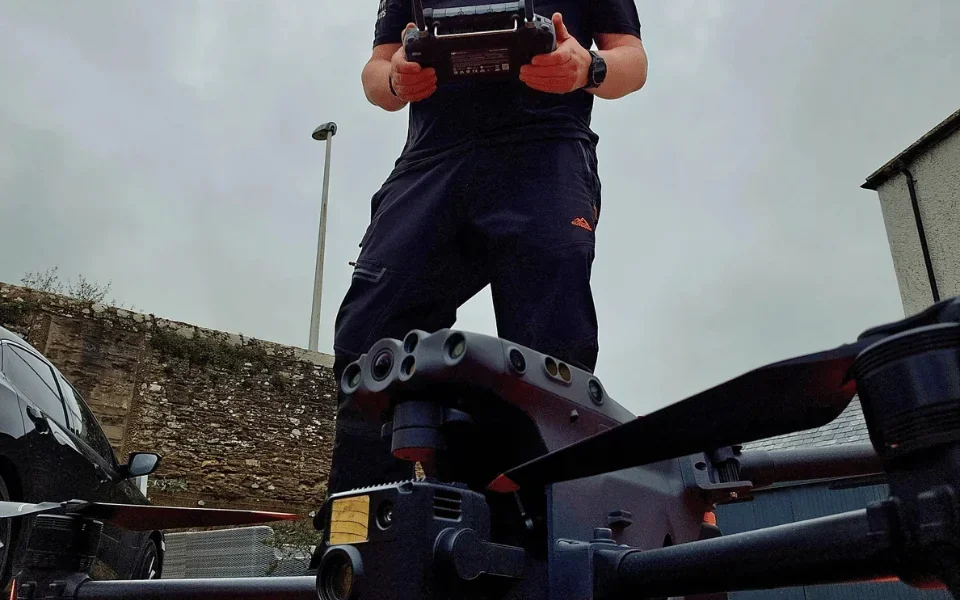
A police helicopter or air ambulance at the scene turns the flight into an Article 240 endangerment risk the moment it lifts off
This is the line that catches drone pilots who thought they were the lowest-risk object in the sky. CAP 722 warns specifically that many unlicensed helicopter landing sites also exist, including hospital helipads, and that such aircraft may loiter at low-level or land and take off unexpectedly. An active incident is exactly the sort of place a helicopter arrives without a flight plan in the public domain.
A police helicopter, the force's own surveillance drone, or an air ambulance lifting a patient out of the cordon puts manned-aircraft into your operating volume in an instant. From that moment Article 240 of the ANO is in play, and endangering an aircraft in flight carries a maximum sentence of five years in prison. Fly at seventy grams or fly at twenty five kilograms — the offence is the same.
The safe assumption for any active scene is that an air ambulance or police helicopter either is already on the way or will be. Stand your drone down before the first blue light arrives, not after.
The crowd rule, the congested-areas rule, and the 1-to-1 rule stack on top of the CAP 722 duty
Even if there were no CAP 722 emergency-response clause at all, an active emergency scene tends to trigger at least one of the rules that govern normal flight. Active incidents pull in onlookers, press and responders, and it does not take many of them to turn the cordon into what CAP 722 defines as an assembly of people — gatherings where persons are unable to move away due to the density of the people present. Overflying an assembly is banned at every drone weight, including the sub-250g bracket.
Most scenes also sit inside a congested area — residential, commercial, industrial or recreational land, as CAP 722 defines it — where additional operational limitations apply to every flight. That is before you get to the 50-metre distance-from-people rule and the 120-metre altitude ceiling, both of which still apply regardless of what is going on underneath you.
CAP 722 also names the 1-to-1 rule in print: the horizontal separation between the UA and uninvolved people should not be less than the height of the aircraft. At a cordon full of uninvolved people, the arithmetic is brutal. Climb to a hundred metres to get a better angle and you need to be a hundred metres off to the side. Pull back thirty metres and your ceiling drops to match.
Identifiable people in the footage bring UK GDPR and the Data Protection Act 2018 into scope, and recording for a criminal purpose is a standalone offence
A crime scene is a setting where identifiable people are almost guaranteed to end up in the frame — officers, witnesses, victims, forensic teams, and the families who have just arrived. The UK GDPR and the Data Protection Act 2018 apply to any capture of identifiable individuals, intentional or not.
The CAA adds a second rule that is sharper than most hobby flyers realise. It is against the law to take photographs or record video or sound for criminal or terrorist purposes. That is not a reference to filming the wrong neighbour's garden — it is a standalone criminal offence, and capturing footage that assists a live investigation for the wrong side of the cordon is exactly the sort of flight it is designed to bite.
The ripple effects extend beyond the flight itself. If the case ends up in court, unregulated drone footage of the scene can prejudice the trial and touch the edges of contempt of court. Obstructing a police officer in the execution of their duty is a separate criminal offence under general UK law, and it does not need to be a drone-specific statute to apply to a drone pilot.
Press or hobby status is no shield, and an incident at the scene itself triggers mandatory occurrence reporting
A press logo on the drone does not change any of the above. The Flyer ID and Operator ID requirements do not dissolve for journalism, the ANO 2016 endangerment offences apply the same way, and the CAP 722 emergency-response duty binds every remote pilot regardless of the intent behind the flight. The CAA treats the flight on its safety merits, not its editorial purpose.
If the flight itself produces an accident, a serious incident, or any involvement with a manned aircraft, CAP 722 Section 2.7 kicks in and mandatory occurrence reporting to both the Air Accidents Investigation Branch and the CAA is required. An Open Category flight that clips a responder, loses control near an air ambulance, or lands outside its designated area at an incident all meet the bar. Those reports run in parallel with any police investigation — they do not replace it.
Third-party insurance is the other thread worth flagging. Flying outside the rules invalidates most third-party drone insurance the same way breaching a Flight Restriction Zone does. An accident at an emergency scene stops being an insurance claim and becomes a direct personal liability, which is usually the part that ends careers.
The wider consequence ladder — warning, seizure, magistrates' court, and the quiet damage a conviction does to your CAA register entry and future paperwork — is walked through in the separate guide on what happens if you get caught flying a drone illegally in the UK.
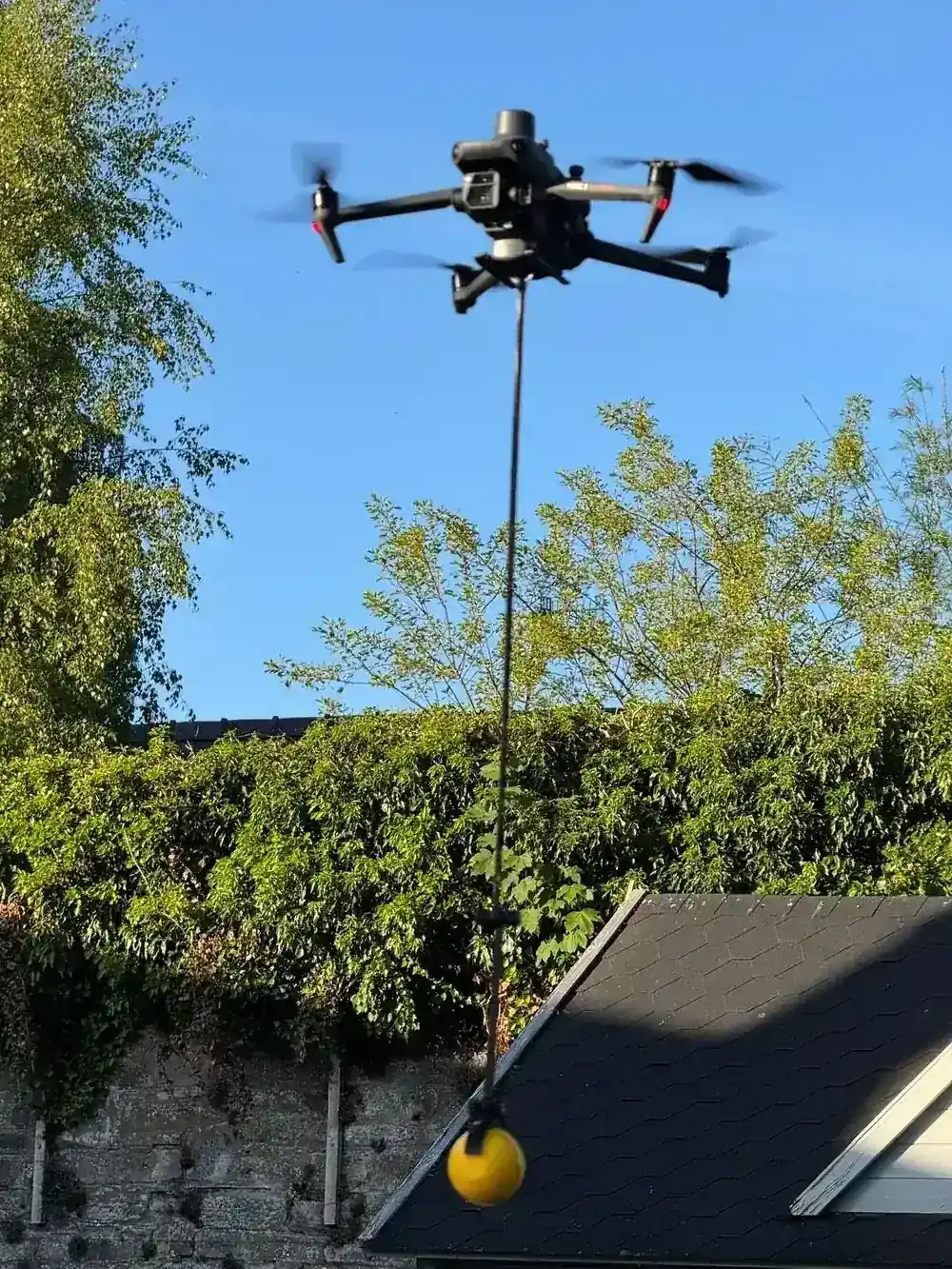
So there is no single emergency-services clause in UK drone law, but there does not need to be. CAP 722 names it in the remote-pilot duties, the ANO backs it with criminal offences, the police can ground you on the spot, and the everyday rules on crowds, congested areas and manned aircraft all turn in the same direction. If you spot an active emergency response from the controller, land the drone and walk.
Got an edge case you want covered — an RTC across the river, a police drone already in the air, a press commission that claims it has permission? Drop a note to peter@hiredronepilot.uk and I will come back to you directly. If you prefer the video version of this explainer, the comments are open on YouTube.
References
Primary source material for this article is the UK Civil Aviation Authority. External links open in a new tab.
- UK CAA — CAP 722 Ninth Edition Amendment 2 (April 2024) · Section 5.2.2.3 In-flight Responsibilities, p.117 — the emergency-response-effort clause
- UK CAA — Drone regulations for police forces · police UAS exemption, enforcement responsibility, 101/999 reporting
- UK CAA — Concerns about privacy and illegal use of drones · crowd rule, restricted airspace, recording for criminal purposes is illegal
- UK CAA — Privacy rules when flying drones · UK GDPR and DPA 2018 apply to identifiable people, intentional or not
- UK CAA — The Drone and Model Aircraft Code (CAP2320) · people-buffer rule, crowd rule, VLOS requirement, 120m altitude ceiling
- UK CAA — UK Regulatory Framework for Drones · Air Navigation Order 2016, Articles 240 and 241, and UAS Regulations
- UK CAA — CAP 722 §2.7 UAS Occurrence Reporting · mandatory AAIB and CAA reporting for accidents, serious incidents, manned-aircraft involvement
Peter Leslie
Founder & GVC Drone Pilot
Peter is the founder of HireDronePilot. With thousands of logged commercial flight hours, he writes about drone technology, commercial surveying tactics, and UK aviation compliance.
Connect on LinkedIn