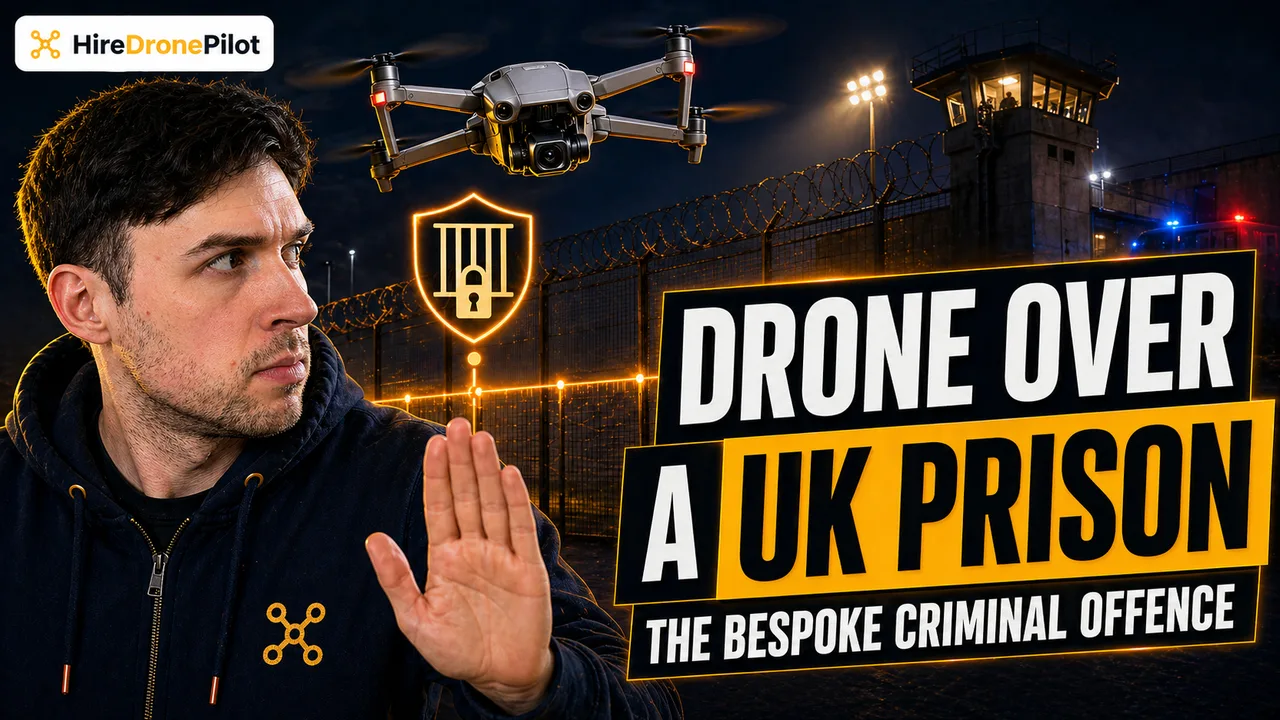
Drone Over a UK Prison: The Bespoke Criminal Offence

Peter Leslie
16 Apr 2026
Key Takeaways
- UK prisons sit under a bespoke no-fly regime that goes far beyond the general Drone Code, created by section 40F of the Prison Act 1952
- Flying a drone over or into a prison is a stand-alone criminal offence carrying up to two years in prison, a fine, or both
- The Drone Code, the Air Navigation Order 2016 and the Open Category rules still apply on top — a prison overflight breaks multiple laws at once
- Prisons in England and Wales operate active counter-drone detection and response, and police treat any drone activity near the wall as suspected contraband delivery
- A lawful commercial flight at a prison requires written permission from the Governor and the Ministry of Justice, with the full Specific Category paperwork that goes with it
A prison is not a regular no-fly zone. It sits under a bespoke criminal regime that police stations, stadiums and power stations do not have, and that changes the calculation entirely before you unfold the sticks. Any flight over a UK prison wall is a specific statutory offence in its own right, and it is one of the rare places where a drone breach can land you directly in a custodial sentence under legislation that has nothing to do with the Drone and Model Aircraft Code.
This guide walks through the prison-specific law, how it stacks on top of general UK drone laws, what the counter-drone response at a typical HMP actually looks like, and the narrow route under which a legitimate commercial flight over a prison can be authorised.
Prisons have their own bespoke criminal offence that no other sensitive site carries
The single most important fact about prisons, and the one most drone pilots get wrong, is that prisons are governed by a dedicated criminal statute aimed specifically at drone flights. That statute is section 40F of the Prison Act 1952, inserted by the Serious Crime Act 2015 and later strengthened. It makes it an offence to land a drone or fly a drone over a prison in England and Wales without authorisation.
This is the point that distinguishes prisons from police stations, hospitals, military establishments and every other category of sensitive site in the UK. A police station is protected only by the general Drone Code, trespass law and whatever airspace restriction happens to overlap it. A prison has its own line in primary legislation written specifically about drones.
The maximum penalty under section 40F is two years imprisonment, an unlimited fine, or both, on conviction on indictment. You do not have to drop anything, make contact with the ground, or interfere with any person to commit the offence — the flight over the wall is the offence. That is the bit that genuinely shocks people when I explain it on site.
The Drone Code and the Air Navigation Order 2016 still stack on top of the prison offence
Nothing about section 40F turns off the rest of UK drone law. Every general rule you normally operate under is still in force at a prison, and a single overflight typically breaks several of them at once. The legal backbone remains the Air Navigation Order 2016 and the UK Regulations (EU) 2019/945 and 2019/947.
A prison site is almost always inside a residential or commercial area, which means the Open Category A3 sub-category — the one most recreational flights default into — already keeps you 150 metres clear of its boundary unless your drone carries the right class mark. Overflying uninvolved people inside the prison, whether staff or prisoners, also breaks the people-buffer rules every drone pilot holds above fifty metres and the 50-metre distance-from-people rule below it.
On top of the Drone Code breach sits the ANO itself. Endangering an aircraft in flight carries up to five years in prison — relevant because many prisons sit inside or beneath controlled airspace, and helicopters routinely use prison landing sites for escorted movements. The Crown Prosecution Service has every reason to layer charges in a prison case, so a drone pilot who flies over an HMP can realistically face both the bespoke Prison Act offence and generic aviation offences from the same short flight.
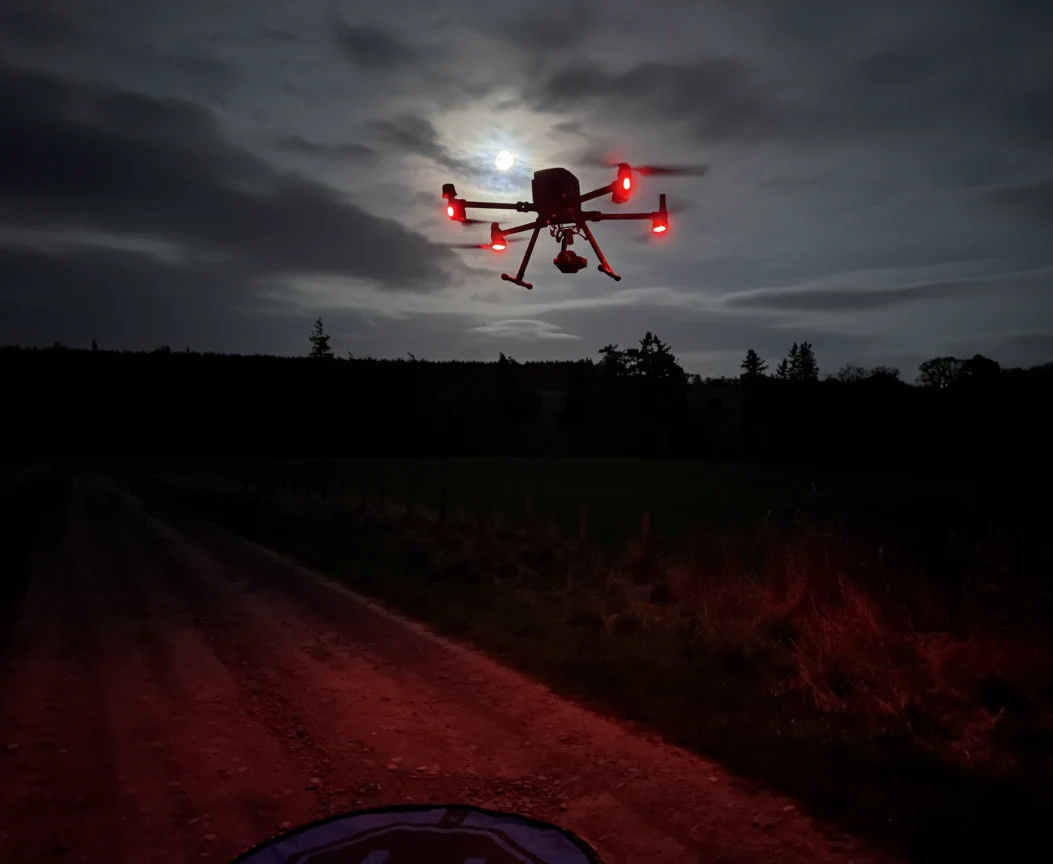
Contraband delivery by drone is what drove the law, and it shapes how police respond
The reason the legal regime is so aggressive is that contraband delivery by drone has been a persistent problem across the English and Welsh estate. His Majesty's Prison and Probation Service publishes annual figures showing drone-related incidents running into the hundreds each year, with the payload mix dominated by mobile phones, SIM cards, drugs, and occasionally weapons. That risk profile is why the offence sits where it does in primary legislation.
From a policing point of view, any unexplained drone near a prison wall is treated as attempted conveyance of prohibited articles into a custodial facility until proven otherwise. That is a distinct, separately-charged offence carrying a maximum sentence of ten years, under the same Prison Act. Police are not going to assume a hobbyist has wandered off course — they are going to investigate as though the flight was deliberate. You do not want to be explaining a fly-by from the inside of a custody interview room.
The Ministry of Justice also funds a national counter-drone capability across the prison estate. That capability combines radio-frequency detection, directional antennas, and coordinated response with the relevant territorial police force. You do not see most of it from the outside, which is the point.
Counter-drone kit at HMPs is real, but the enforcement still comes from the police
There is a common misconception that prison staff can simply knock your drone out of the sky. They cannot. The use of signal jamming equipment in the United Kingdom is itself restricted, and private drone jammers are generally illegal under the Wireless Telegraphy Act 2006, even for a prison. The Ministry of Justice operates counter-drone kit under specific government authority that the rest of the estate does not enjoy, and the operational detail of what they do and do not deploy is deliberately not public.
What actually happens in practice is that the prison detects the drone, logs the signature, and calls the police. The police then use the wider toolkit available to them — including geolocation of the pilot, airspace data, and in some forces their own counter-drone assets — to identify the operator on the ground. The question of shooting a drone down is separate again, and it is not something a prison officer will do. What is very likely is that your drone, your controller, your phone and your SD cards are all going to leave the site in a police evidence bag.
This is also why Remote ID matters to the prison problem. As Remote ID rollout continues through 2026 and beyond, broadcasting your Operator ID in real time makes an anonymous contraband flight radically harder. That is a feature, not a bug, for everyone involved in legitimate drone work.
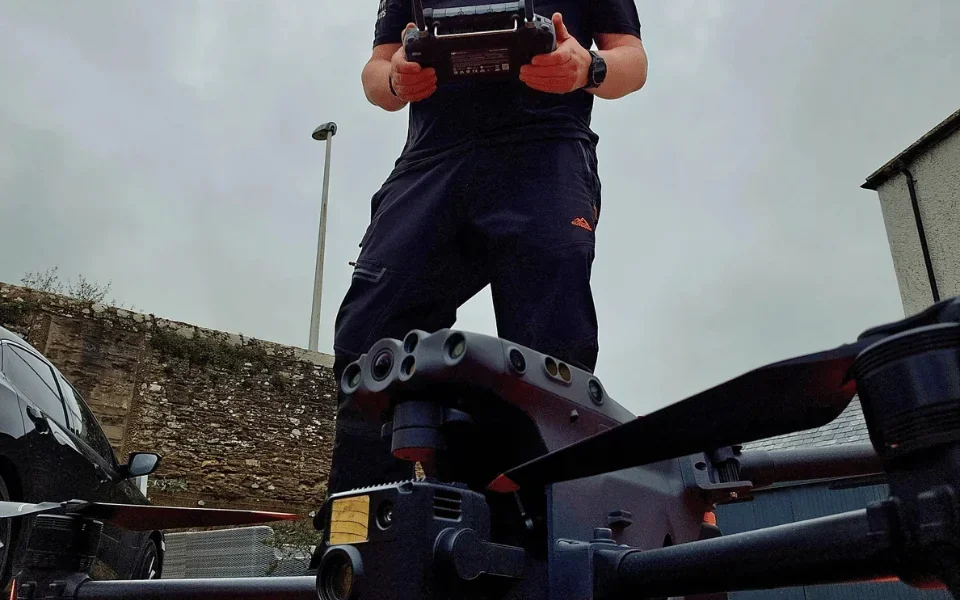
Lawful commercial work at a prison runs through the Governor, the Ministry of Justice and the Specific Category
Legitimate drone work at a prison is not impossible. It is infrequent, tightly controlled, and always commissioned by the prison itself or by a contractor working on its estate. The route involves three overlapping approvals and none of them are quick.
First, written authorisation for the section 40F offence has to come from the person in lawful authority — the Governor of the specific prison, usually through the Ministry of Justice. That permission is specific to the date, the operator, the drone and the purpose. Without it, no other paperwork you hold makes the flight legal.
Second, the flight itself has to sit inside a valid CAA authorisation. In the Specific Category that usually means a bespoke Operational Authorisation, not off-the-shelf PDRA01, because the airspace, the people on site, and the security requirements are all unusual enough to justify a site-specific safety case.
Third, there is the on-the-day reality: a full site survey, a detailed RAMS, documented commercial drone insurance, a briefed escort, security clearance for every person in the ground crew, and a cleared flight window coordinated with prison operations. The qualified drone pilots who do this kind of work typically hold a GVC as a minimum and bring a years-deep compliance history to the conversation. Prisons do not hand permission to drone operators who turned up last week.
If you accidentally stray over a prison, land immediately and self-report
Accidental incursions happen, especially in urban areas where an HMP sits alongside other buildings you might legitimately be filming. The right response is a short one. Recover the drone by the shortest safe route, land as soon as you are clear, and stop flying. Do not loiter to check whether anyone noticed — the counter-drone system already has.
Once on the ground, self-report to the police on 101 before anyone has to come looking for you. Keep your flight logs, your controller data, your camera cards and any planning screenshots intact — drone flight logs are one of the most persuasive pieces of evidence a drone pilot can hand a police officer to show the overflight was unintentional.
Candour matters. The section 40F offence hinges on whether the flight was deliberate and unauthorised. A drone operator who self-reports, cooperates, and can evidence a genuine navigational error is in a fundamentally different position from one who is tracked down by police intelligence days later.
The short version: a UK prison is not just another sensitive building marked on Drone Scene. It is one of the few places in civilian life where primary legislation specifically criminalises the flight of a drone, and the criminal penalty sits on top of every other aviation rule you already know. For recreational drone pilots the answer is simple — do not fly anywhere near the wall. For commercial operators, the only route is the slow, paperwork-heavy one, and it starts with a letter to a Governor, not a firmware update.
Got a specific scenario you want covered — a commercial job near a sensitive site, an accidental overflight you are unsure how to report, or a Specific Category question? Drop a note to peter@hiredronepilot.uk and I will come back to you directly. If you prefer the video version of this explainer, the comments are open on YouTube.
References
Primary source material for this article is UK primary legislation and the UK Civil Aviation Authority. External links open in a new tab.
- Prison Act 1952 — Section 40F (unauthorised use of a drone near or over a prison) · bespoke offence, two-year maximum custodial sentence
- Prison Act 1952 — Section 40C (conveyance of List A / B / C articles into prison) · ten-year maximum for contraband delivery
- UK CAA — The Drone and Model Aircraft Code (CAP2320) · people buffer, 150m A3 separation, Open Category baseline
- UK CAA — UK Regulatory Framework for Drones · Air Navigation Order 2016, UK Regulations (EU) 2019/945 and 2019/947
- Serious Crime Act 2015 — Explanatory Notes · origin of the drone-specific prison offence
- HM Prison and Probation Service · operational authority, Governor-level permissions, counter-drone policy
Peter Leslie
Founder & GVC Drone Pilot
Peter is the founder of HireDronePilot. With thousands of logged commercial flight hours, he writes about drone technology, commercial surveying tactics, and UK aviation compliance.
Connect on LinkedIn