Best Long Range Drone UK 2026: What I’d Buy, and How Far You Can Legally Fly It

Peter Leslie
31 July 2026 · 20 min read
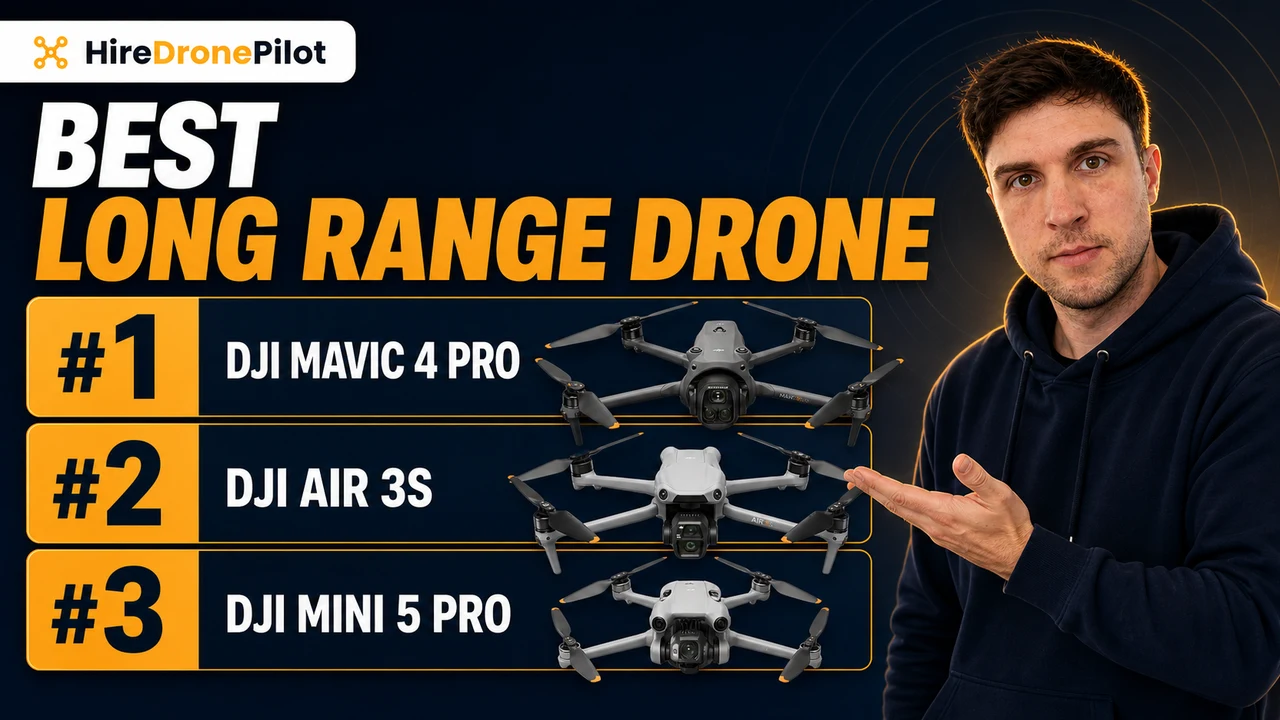
Twenty kilometres. It is printed on the box, it is in the Amazon listing title, and it is the reason a great many people end up on a page like this one. Twenty kilometres is Edinburgh to Livingston. It is further than you can see from the top of a Munro on the clearest day of the year.
And you will never fly it. Not because your drone cannot — it genuinely can, in the right field, in the right country. You will never fly it because in Britain the law does not measure your range in kilometres. It measures it in whether you can still see the thing. Lose sight of your drone and you have stopped flying legally, at whatever distance that happens, and on a grey afternoon over a hedge that can be two hundred metres.
So two things decide this purchase, and the big number is only half of one of them. The first is how much radio margin you want between the specification and the moment the picture starts tearing, because that gap is where the number actually earns its money. The second is weight, because weight decides where in Britain you are allowed to stand and press take-off at all.
Which is why the best long range drone in 2026 is not the one with the largest figure on the box. It is the one that still holds a clean picture at the far end of what your eyes can honestly manage, and that you are allowed to fly from the places you actually want to fly from.
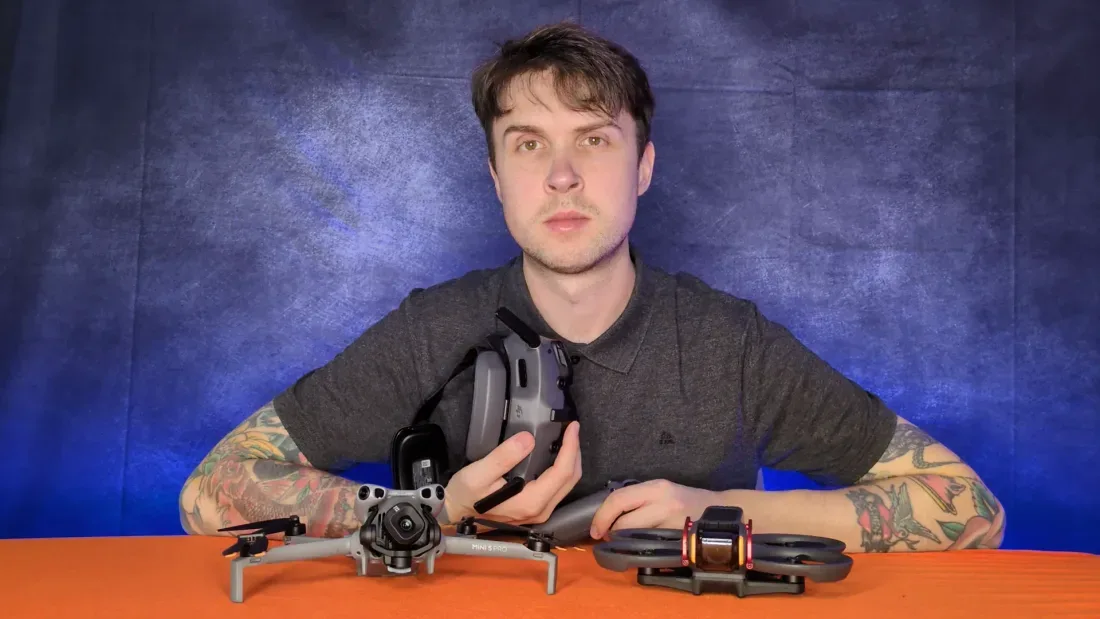
This guide does three things. It asks four questions about how and where you will really fly, and narrows eleven drones to one — and for a fair number of readers the honest answer is a drone with a smaller number on the box than the one they arrived wanting. Then it takes transmission range apart properly: what those figures are measured under, why the same drone is sold with two different ranges, and where Visual Line of Sight actually stops you. Then it goes through the four things that take your range away long before the radio gives up.
How I get paid: the Amazon links below are affiliate links, so if you buy through one I earn a small commission at no extra cost to you. It does not change what I recommend — two of the eleven drones here have no buy link at all because I could not find a UK listing worth pointing you at, and the drone I have picked is not the one with the longest range on this page.
The Best Long Range Drone in 2026 Is the DJI Mini 5 Pro
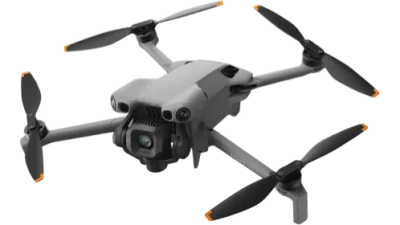
The most transmission you can buy without the weight that starts closing places off to you. It holds a picture as far out as you can honestly see it, and it weighs less than a can of drink.
- DJI’s O4+ link, published as 20 km under the American FCC standard and 10 km under the European CE one, with a 21 km maximum flight distance on the standard battery.
- 249.9 grams and C0-marked in the standard combo, so you can fly it in a village or a park without a certificate.
- 36 minutes on the standard battery. The 52-minute figure needs the Plus battery, which DJI itself warns takes the drone past the C0 limit, so it can no longer be flown as a C0 drone.
- None of that changes the law: you may fly it only as far as you can see it, which is a few hundred metres.
Affiliate link · costs you nothing extra · full disclosure
PART ONE
Here are the four that win their categories. The Mini 5 Pro above already has the page, so it does not appear again below — these are the four that beat it at one specific job, on price, on time in the air, or on a flight somebody is paying for. Each one carries what is wrong with it, because none of them is perfect — and because the honest negative on a long-range drone is usually the thing that decides it.
Best Budget Long Range Drone: DJI Flip
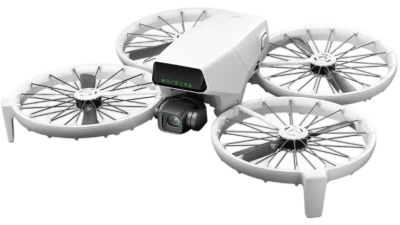
The current-generation radio at the old price, wrapped in cages, so your first long flight out and back is survivable.
- Under 249 grams and C0-marked, so no A2 test and nothing changes for it in 2028.
- O4 transmission at 13 km FCC and 8 km CE, with a 14 km maximum flight distance.
- Full propeller cages built in, so the inevitable first contact with a branch is survivable.
Best Long Range Drone for the Money: DJI Mini 4 Pro
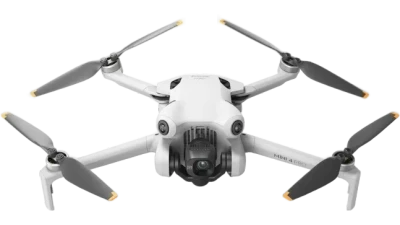
The cheapest way into the 20 km headline, and the cheapest drone here that watches in every direction while it uses it.
- Under 249 grams and C0-marked, so the built-up-area restrictions never apply to it.
- O4 transmission at 20 km FCC and 10 km CE, with omnidirectional obstacle sensing.
- 34 minutes on the standard battery, or 45 on the Plus — which takes it over the 250-gram line.
Best Long Range Drone for Time in the Air: DJI Air 3S
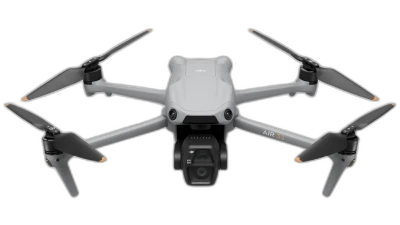
Distance is time, not kilometres. This is the one that is still up when the mini has landed to swap batteries.
- 45 minutes a battery and a 32 km maximum flight distance — the longest legs of anything here short of a Mavic.
- A one-inch main camera and a 70 mm telephoto, so you can reach into a scene instead of flying at it.
- 724 grams and C1-marked: fine near people today, but from January 2028 it becomes a legacy drone and needs the A2 test.
Best Long Range Drone for Professional Work: DJI Mavic 4 Pro
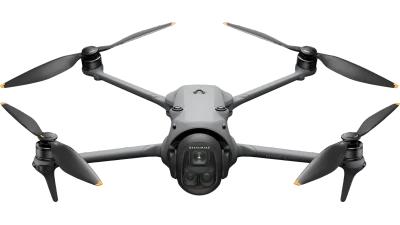
When the flight has to work first time, in the wrong weather, with somebody paying for the result.
- O4+ at 30 km FCC and 15 km CE, and a 41 km maximum flight distance — the biggest radio margin you can buy.
- 51 minutes a battery, and a 100-megapixel Hasselblad camera on a 4/3 sensor.
- 1,063 grams and C2-marked, so the A2 Certificate of Competence is required before you fly it near people.
Affiliate links · costs you nothing extra · full disclosure
Take the quiz: find the right long range drone for you
Four questions, starting with the one that decides whether you need range at all.
- Built around where you will stand, because that is what UK law actually limits.
- Eleven drones, from the cheapest palm-launcher DJI sells to a 51-minute Hasselblad.
- Will tell you when a smaller number on the box is the better buy.
- About 20 seconds, and no email needed.
STEP 1 OF 4
11 of 11 still fit
All eleven, with the range figure that actually applies
-
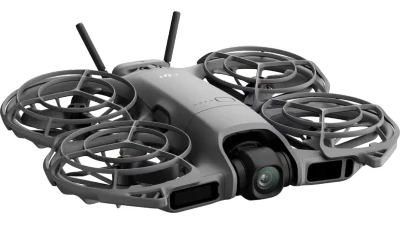
DJI Neo 2 Wi-Fi unless you buy the transceiver
151 g · C0 · 10 km FCC / 6 km CE · 19 min
The cheapest way to find out whether you enjoy this at all. Its published range comes with a footnote most listings skip: DJI measured it using the controller or the goggles, and the drone on its own talks to your phone over Wi-Fi.
- 151 grams and C0-marked, so you can fly it over people and in built-up areas with no test beyond registration.
- DJI’s 10 km FCC and 6 km CE figures are footnoted “using the remote controller or goggles”. The digital transceiver that enables that link is a paid add-on.
- 19 minutes a battery, 17 with the propeller guards fitted, and a 7 km maximum flight distance — the shortest legs on this page.
-
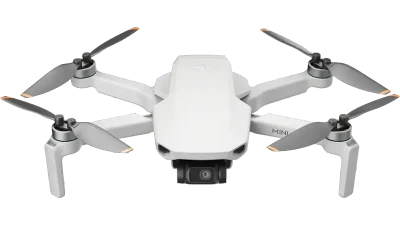
DJI Mini 4K DJI UK no longer lists it
246 g · 10 km FCC · 31 min · 3-axis gimbal
The cheapest drone here whose Amazon listing sells you a range figure — “10km Video Transmission” is in the title. It is also, for what it costs, a genuinely sensible first drone with a proper stabilised camera.
- 246 grams, so it sits under the 250-gram line and you can fly it in residential areas.
- DJI UK now shows every configuration as unavailable, so this is an Amazon-only purchase at a street price.
- 31 minutes a battery on a three-axis mechanical gimbal, which is a lot of drone for the money.
-
DJI Flip
249 g · C0 · 13 km FCC / 8 km CE · 31 min
The cheapest drone here with DJI’s current O4 radio in it, which is the part of the specification that actually matters when you are 300 metres out with a hedge between you. Propeller cages included, which is why I keep handing it to first-timers.
- Under 249 grams and C0-marked, so no A2 test and nothing changes for it in 2028.
- O4 transmission at 13 km FCC and 8 km CE, with a 14 km maximum flight distance.
- Full propeller cages built in, so the inevitable first contact with a branch is survivable.
-
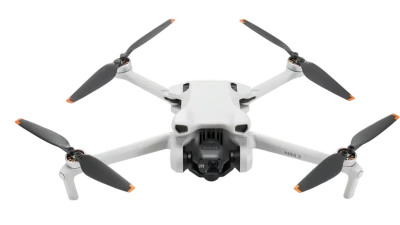
DJI Mini 3 the same radio as a far cheaper drone
248 g · C0 · 10 km FCC / 6 km CE · 38 min
Here as the clearest proof that money does not buy range. It comes with the DJI RC screen controller and carries exactly the same O2 link and exactly the same 10 km FCC figure as the far cheaper Mini 4K.
- 248 grams and C0-marked, with 38 minutes on the standard battery — genuinely long legs for the size.
- DJI’s older O2 link: 10 km FCC, 6 km CE, and a 720p live view where the newer drones give you 1080p.
- The version linked here is the one with the DJI RC screen controller, which is where most of the extra money goes.
-
DJI Mini 4 Pro
<249 g · C0 · 20 km FCC / 10 km CE · 34 min
The cheapest way into the 20 km headline, and the cheapest drone here that watches in every direction while it does it. If the Mini 5 Pro were not so close in price it would be the pick.
- Under 249 grams and C0-marked, so the built-up-area restrictions never apply to it.
- O4 transmission at 20 km FCC and 10 km CE, with omnidirectional obstacle sensing.
- 34 minutes on the standard battery, or 45 on the Plus — which takes it over the 250-gram line.
-
DJI Mini 5 Pro
249.9 g · C0 · 20 km FCC / 10 km CE · 36 min
O4+, a one-inch sensor and a take-off weight that keeps every door open. In my hands it is the drone that stopped me reaching for anything bigger, because the bigger ones buy you distance you are not allowed to use.
- O4+ at 20 km FCC and 10 km CE, and a 21 km maximum flight distance on the standard battery.
- 249.9 grams and C0 in the standard combo. DJI warns that fitting the Plus battery takes it past the C0 limit, so it can no longer be flown as a C0 drone.
- 36 minutes standard, 52 on that Plus battery — a figure you can only use by giving up the class mark.
-
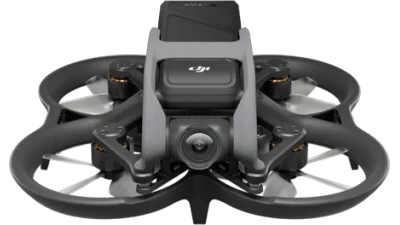
DJI Avata 2 needs a second person, every flight
377 g · C1 · 13 km FCC / 10 km CE · 23 min
The drone with the longest advertised reach that you will use the least of. Flown through goggles, which in UK law means somebody has to stand next to you watching it the whole time — so its usable range is the shortest here, not the longest.
- Goggles 3 and the RC Motion 3 are in the box — the drone on its own will not fly at all.
- UK rules require an observer stood beside you whenever you fly through goggles, and the goggles can never count as seeing the drone.
- 377 grams and C1-marked, so from January 2028 it needs the A2 test to fly near people.
-
DJI Air 3S
724 g · C1 · 20 km FCC / 10 km CE · 45 min
Forty-five minutes and two cameras, and the drone I would take if the flying involved a long walk out and a long look around. The weight is what you pay for it: it weighs nearly three Mini 5 Pros, and in 2028 that starts to matter.
- 45 minutes a battery and a 32 km maximum flight distance — the longest legs of anything here short of a Mavic.
- A one-inch main camera and a 70 mm telephoto, so you can reach into a scene instead of flying at it.
- 724 grams and C1-marked: fine near people today, but from January 2028 it becomes a legacy drone and needs the A2 test.
-
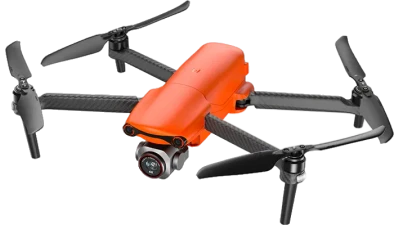
Autel EVO Lite+ no affiliate link — I could not find UK stock
835 g · no class mark · 12 km FCC / 6 km CE · 40 min
The non-DJI answer people ask about, and the clearest illustration of the whole problem. Autel advertises “7.4 miles” and then, in its own specification table, halves it for Europe. I searched Amazon UK and found spare arms and propellers, not drones.
no link- No UK listing I could find worth pointing you at, so there is no buy link on this row.
- Autel publishes 12 km FCC and 6 km CE alongside the transmit power that causes the gap: 30 dBm against 20 dBm.
- 835 grams with no class mark, so it is governed by weight: the A2 Certificate of Competence before you fly it anywhere near people.
-
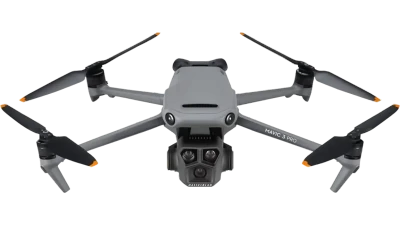
DJI Mavic 3 Pro no affiliate link — out of stock at DJI UK
958 g · C2 · 15 km FCC / 8 km CE · 43 min
A superb camera on the wrong side of a generation change. Every configuration is out of stock at DJI UK, and the older O3+ radio it carries reaches less far than a Mini 4 Pro costing far less. I would not chase one.
no link- DJI UK lists every configuration as out of stock, so there is no link here.
- The O3+ link gives 15 km FCC and 8 km CE, which is less than the current O4 drones below half the price.
- 958 grams and C2-marked, which needs the A2 Certificate of Competence today, not in 2028.
-
DJI Mavic 4 Pro
1,063 g · C2 · 30 km FCC / 15 km CE · 51 min
The longest link and the longest endurance on this page by a distance, and the only one that will still be showing you a clean picture when everything else has given up. It also needs a certificate before you can fly it near anybody.
- O4+ at 30 km FCC and 15 km CE, and a 41 km maximum flight distance — the biggest radio margin you can buy.
- 51 minutes a battery, and a 100-megapixel Hasselblad camera on a 4/3 sensor.
- 1,063 grams and C2-marked, so the A2 Certificate of Competence is required before you fly it near people.
Rows run cheapest to dearest, and every link points at the cheapest configuration that actually flies. I do not print prices here: they move week to week, and a stale number beside a buy button is worse than no number at all — the link shows you what each one costs right now. Specifications checked against manufacturer pages on 31 July 2026. Transmission figures are the manufacturers’ own, measured unobstructed and free of interference — FCC first, CE second. DJI Mini 4K weight and flight time from DroneCompare, CC BY 4.0.
PART TWO
Transmission range and legal range are different things
There are two numbers in this category and almost every guide conflates them. One is a radio specification: how far the drone and the controller can still hear each other. The other is a permission: how far away the drone is allowed to be. They have nothing to do with each other, they are out by a factor of about fifty, and only one of them is printed on the box.
What the 20 km actually measures
Start with the specification, because it is more interesting than it looks once you read the small print underneath it. Here is DJI’s wording for the Mini 5 Pro, and it is the same wording on every DJI specification page: the figure is measured in an unobstructed outdoor environment free of interference, and it shows the farthest communication range for one-way, non-return flights.
Read that again. One-way. Non-return. The number describes a flight in which the drone travels away from you until the link breaks, and it is not measured in a place that exists in Britain — no buildings, no trees, no neighbours’ Wi-Fi, no wind. It is a laboratory ceiling, and everything real subtracts from it.
Which DJI knows perfectly well, because on the same page it publishes what happens when you put the drone somewhere real. These figures for the Mini 5 Pro are worth more than the headline:
THE SAME DRONE, FOUR ENVIRONMENTS — DJI’S OWN FIGURES
| WHERE | RANGE |
|---|---|
| Laboratory, no interference the number on the box | 20 km |
| Suburb or seaside low interference | 10–20 km |
| Urban landscape strong interference | 1.5–4 km |
| Obstructed by buildings low interference, no line of sight | 0–0.7 km |
A 20 km drone, behind a row of houses, is a 700-metre drone. DJI prints that itself, in the same table as the headline, and I have never seen it in an advert.
The same drone is sold with two different ranges
Now the part that genuinely surprises people. Look at any DJI or Autel specification page and you will find not one range but four, one per radio standard:
DJI Mini 5 Pro, max transmission distance: FCC 20 km · CE 10 km · SRRC 10 km · MIC 10 km.
Those are four different regulatory regimes — American, European, Chinese and Japanese — and the reason the American figure is double is on the same page, one row up. DJI lists the transmitter power it is allowed to use in each: on the 2.4 GHz band, under 33 dBm under FCC, under 20 dBm under CE. Decibels are a logarithmic scale, so those thirteen decibels are not a small difference. They are roughly twenty times the power.
Autel spells the same thing out even more plainly on the EVO Lite series page: transmission power “FCC: ≤30dBm; CE: ≤20dBm”, and max transmission distance “FCC: 12km; CE: 6km”. Autel’s marketing copy, three scrolls up the same page, offers “a transmission range of 7.4 miles” and does not mention that the European number is half of it.
So when a listing title advertises 20 km, understand what you are reading: the largest of four numbers, measured in the friendliest of four environments, for a flight that never comes back.
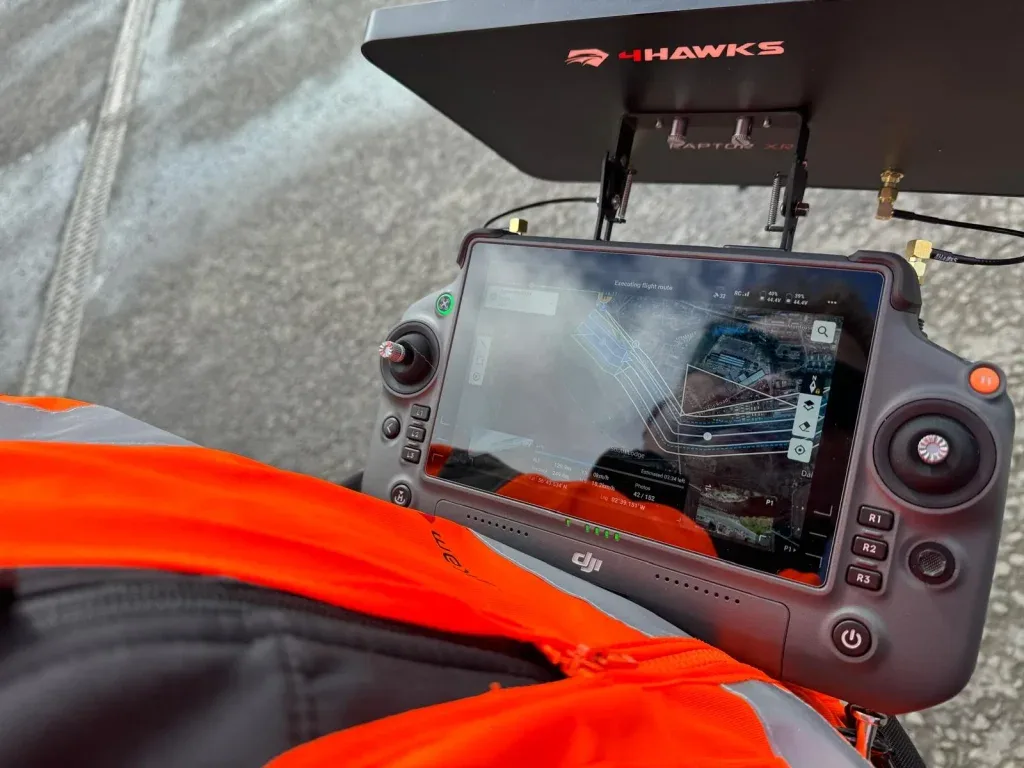
Aftermarket antennas like this one genuinely do improve a link. They do not change a single word of what follows, which is the point of this section.
The legal range is your eyesight, and it has no number
Here is the rule that actually decides how far you can fly, and it is worth reading in the CAA’s own words rather than a summary of them. You must always keep your drone in direct sight and make sure you have a full view of the surrounding airspace. And direct sight is defined by what it excludes: you must be able to see the drone without binoculars, without a telephoto lens, and without “electronic viewing equipment, such as a smart phone, tablet or video goggles”. Normal glasses and contact lenses are fine.
There is a second half that people skip, and it is the harder one: you must be able to see it clearly enough that you can tell which way it is facing. Not “can see a dot”. Can tell the front from the back.
Notice what is missing: a distance. There is no number in the Open Category rules, no 500-metre limit, nothing you can measure with the app. The limit is a capability, and it moves with the light, the sky behind the drone, the size of the drone and your own eyes on the day.
So how far can you actually see one?
Let us do the arithmetic instead of guessing, because it is more sobering than the guess. A DJI Mini 5 Pro measures 380 mm across, propellers unfolded — DJI publishes the dimensions. Hold your arm out and that is 600 mm from your eye, so the apparent width of the drone at any distance is simply 380 divided by that distance, times 600.
A DJI MINI 5 PRO, HELD AT ARM’S LENGTH
| DISTANCE | LOOKS THIS WIDE | WHAT THAT IS |
|---|---|---|
| 50 m | 4.6 mm | A grain of rice. Orientation obvious. |
| 100 m | 2.3 mm | A match head. Still easy. |
| 200 m | 1.1 mm | A pin head. Orientation is getting hard. |
| 300 m | 0.8 mm | A bank card seen edge-on. Most people are guessing by here. |
| 500 m | 0.5 mm | A pencil line. You know where it is because the app told you. |
That is against a bright sky on a clear day. Against trees, against a hillside, in haze, or with the sun behind it, halve it. And the honest answer to “how far can I fly” falls out of the table: most people, most days, are working somewhere between 300 and 400 metres, and the point where you stop being able to call the drone’s heading is your real limit, not a number in the app.
Buying a bigger drone helps less than you would hope, and I could not give you a clean comparison even if I wanted to: DJI publishes the Mini 5 Pro’s unfolded size with the propellers on and the Air 3S’s with them off, so the two figures — 380 mm and 325 mm — are not measuring the same thing. What I can tell you from standing in fields with both is that the difference between a mini and a Mavic at 300 metres is the difference between a small dot and a slightly less small dot.
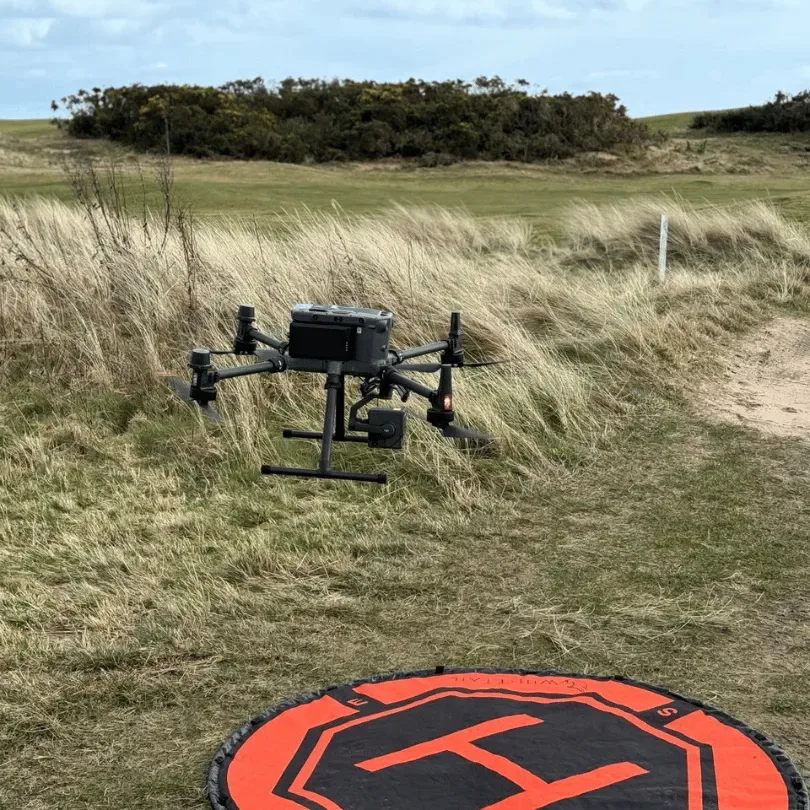
This is what a site that genuinely supports distance looks like: nothing between you and the horizon, and nothing behind you either.
The three exits, and why none of them is yours
People reasonably ask whether there is a way round it, because they have heard of pilots flying kilometres out. There are three doors, and they are all locked from the recreational side.
BVLOS — flying beyond visual line of sight — is exactly what it sounds like, and the CAA is unambiguous: you must never do it unless you hold an Operational Authorisation that specifically authorises BVLOS operations. That is a Specific Category authorisation. Recreational flying happens in the Open Category, and BVLOS is not permitted there at all.
FPV does not help either, and this is the mistake I see most. Flying by watching a live picture needs an observer stood next to you, and the CAA states it flatly: using FPV equipment does not mean you can fly beyond visual line of sight in the Open Category. The observer lets you wear goggles. They do not let the drone go further — somebody still has to be able to see it, so the limit is still eyesight, just somebody else’s. If you want that argument in full, it is the subject of the guide to FPV drones and the observer rule.
Follow-me mode is the one genuine relaxation, and it is small. The Drone Code says that when follow-me is active and the drone is set to follow within fifty metres of you, you do not have to keep it in direct sight. Fifty metres. It is a rule about filming yourself on a bike, not a door to distance flying, and everything else in the Code still applies.
You will also see “500 metres” quoted as a UK VLOS limit. It is not one. That figure comes from a Specific Category authorisation used by commercial operators, and it does not appear in the rules recreational flyers fly under. The full working is in how far a drone can legally fly in the UK.
How to get the most legal range you can
None of this means you are stuck at fifty metres. The gap between a bad day and a good one is surprisingly large, and it is almost all about the site and the setup rather than the drone. Five things make a real difference, and every one of them is free.
Pick your background before you pick your direction. A grey drone against a bright sky is visible a long way out. The same drone against a hillside, a treeline or a town disappears at a third of the distance, because there is no contrast left to see it against. If you want reach, fly it up and out over open ground rather than along a valley side.
Height buys you visibility, up to a point. Getting the drone off the background and into clear sky is the single biggest improvement you can make to how far you can track it — and it improves the radio link at the same time, because you have removed the obstruction. The ceiling is 120 metres from the closest point of the ground, and that is absolute.
Turn the lights on and leave them on. Every drone here has orientation lights, and most people never think about them in daylight. They are what turns a dot into something you can read the heading of, and they are the difference between 250 metres and 350.
Ask somebody to stand with you. Not to extend your range — an observer does not do that, and cannot — but because two people lose sight of a drone far less often than one, and the moment you lose it you are outside the rules until you find it again. It also means somebody is watching the sky while you are watching the drone.
Set a distance limit in the app and use it as a fence, not a target. Every DJI drone here will let you cap maximum distance and maximum altitude. Set the distance one to a number you have actually proved you can see the drone at from that site, on that day, and let the drone enforce it while you concentrate on flying.
Do all five and you will be flying at the far end of what the law allows rather than the near end. That is the honest version of “more range”, and it costs nothing.
So what is a long range drone actually for?
You are not buying distance. You are buying margin. A 20 km link is not a permit to fly 20 km; it is the reason the picture is still clean at 300 metres with a hedge in the way, in a town full of routers, on a day when you turned the controller the wrong way. Range is the gap between the specification and the conditions — and the conditions, as DJI’s own table shows, take between eighty and ninety-six per cent of it.
That reframing is the single most useful thing in this article, and it changes what you should buy. You are not shopping for the biggest number. You are shopping for enough headroom that the drone never becomes the reason you cut a flight short — and then buying the lightest thing that gives you it, because weight is what decides where you are allowed to stand.
The UK rules that decide where you can stand, in plain words
Assume you have never registered anything, because most people reading this have not. There are two registrations, and then weight takes over — and on a long-range drone weight is the expensive part.
A Flyer ID is a free theory test you sit online. It lasts five years, and anyone flying a drone of 100 grams or more needs one. An Operator ID costs £12.34 a year, you must be 18 to register for it, and it goes on a label stuck to the outside of the drone. Every drone of 100 grams or more with a camera needs one. Every drone on this page needs both.
Then weight and class mark decide where you may fly. Under 250 grams, or carrying a C0 or C1 mark, and you are in Over People (A1): you can fly closer than 50 metres to people, over them, and in residential, recreational, commercial and industrial areas. That is the Neo 2, the Mini 4K, the Flip, the Mini 3, both Minis Pro, the Avata 2 and — today — the 724-gram Air 3S.
Go heavier without that and it changes completely. A C2 drone like the Mavic 4 Pro or the Mavic 3 Pro, or an unclassed 835-gram Autel, needs an A2 Certificate of Competence — a theory exam of at least 30 questions with a CAA-approved provider — before you may fly near people at all. Without it you are in Far from People (A3): 50 metres from anyone, 50 metres from individual buildings and 150 metres from anything residential, recreational, commercial or industrial. Which, if you live in a town, means driving somewhere before you can take off — and that restriction costs you far more flying than any transmission figure ever will.
Two ceilings that apply to everything here regardless of range: you may not fly above 120 metres (400 feet) from the closest point of the ground, and if you fly higher than 50 metres you are told to grow your horizontal distance from people to match. Height does not scale with range either.
And then there is 1 January 2028
This is the part nobody selling you an Air 3S will mention. Until 31 December 2027, a drone carrying a European C class mark may be flown as though it held the equivalent UK class. From 1 January 2028 that stops. A C-marked drone becomes legacy and falls back to plain weight rules: under 250 g flies A1, under 2 kg needs an A2 CofC, under 25 kg is A3.
For the small ones nothing changes — the Neo 2, Mini 4K, Flip, Mini 3, Mini 4 Pro and Mini 5 Pro are all under 250 grams and stay exactly where they are. Two drones on this page do change:
WHAT CHANGES ON 1 JAN 2028
| DRONE | TODAY | FROM 2028 |
|---|---|---|
| DJI Air 3S 724 g, C1 | Over People (A1), no qualification | Near People (A2), A2 CofC required |
| DJI Avata 2 377 g, C1 | Over People (A1), no qualification | Near People (A2), A2 CofC required |
Nothing gets confiscated and nothing becomes illegal to own. But if part of the appeal of an Air 3S in 2026 is that it needs no qualification, understand that you are buying roughly eighteen months of that. Either accept you will sit the A2 CofC in 2027, or stay under 250 grams — where the whole sub-250-gram category never has to think about it again. The two Mavics are already on the far side of it: C2 means the A2 certificate today.
Two more that catch people out on long flights. You need the landowner’s permission to take off and land, which is a conversation rather than a technicality and does not extend to wherever the drone happens to be a kilometre later. And third-party insurance is optional for recreation and a legal requirement the moment anybody pays you for the footage.
PART THREE
The four things that take your range before the radio does
Assume the law is settled and you are flying inside it. There is still a gap between the distance you are allowed and the distance you will actually get, and it is not the radio that closes it. Four things do, roughly in this order.
1. Anything solid between you and it
Radio at these frequencies wants a clear line between the two antennas. Put a house in the way and DJI’s own figure for its best mini drone drops to 0–0.7 km. Put trees in the way and it is 0.7–4.5 km. Those are DJI’s numbers for a 20 km drone, published on the same page as the 20 km.
In practice this means the thing that breaks your link is almost never distance. It is the moment the drone goes behind the barn, drops below a ridge, or comes back at low level with a hedge in the way. If you have ever had a perfect signal at 400 metres and a stuttering one at 150, this is why, and buying a longer-range drone fixes it far better than flying closer does.
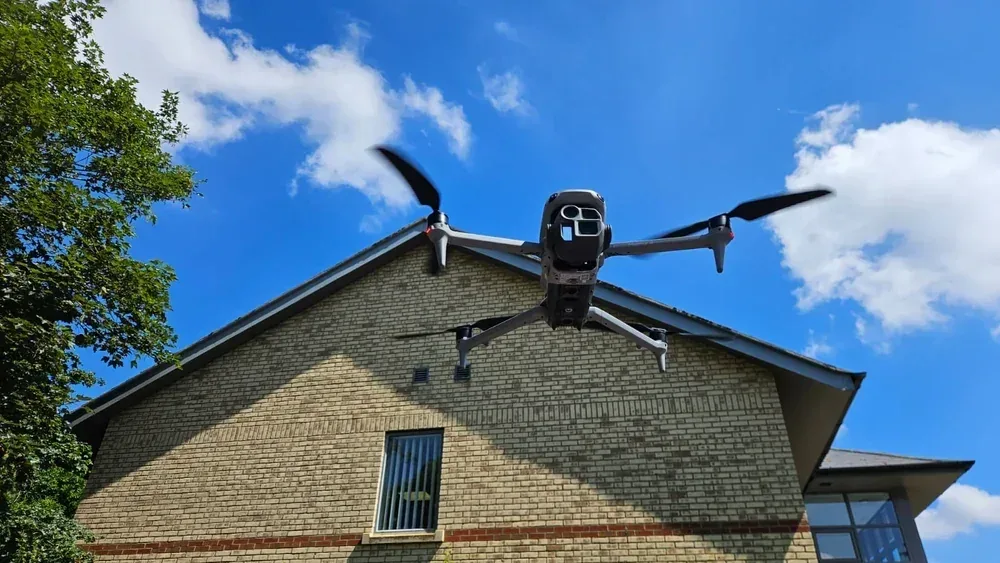
2. Everybody else’s radio
Both bands these drones use are shared with domestic Wi-Fi, and that is what DJI means by “urban landscape, approx. 1.5–4 km”. It is not the buildings in that figure, it is the routers inside them. A housing estate on a Saturday afternoon is a genuinely hostile radio environment, and it is the reason the same drone that behaves impeccably on a beach feels twitchy over a town.
Two things help and neither costs anything. Stand somewhere the controller can see the drone directly, because the antennas are directional and the pattern is worst straight above you and straight behind. And hold the controller so the antennas face the drone edge-on rather than pointing at it — the strongest part of the pattern comes off the flat of the antenna, not the tip.
3. The battery, and the trip home
Now the limit almost nobody accounts for. Every “max flight distance” on this page — 21 km for a Mini 5 Pro, 32 km for an Air 3S, 41 km for a Mavic 4 Pro — is published with the same footnote: measured in a controlled wind tunnel, at sea level, in conditions equivalent to windless, flying forward at a constant speed, until a forced landing due to battery depletion.
That is a one-way trip that ends with the drone on the ground wherever it happened to be. A flight you fly is out and back, so halve it. Then take the reserve you need to trigger return to home with something in hand, so halve what is left again. A 21 km drone is comfortably a five-kilometre drone in the field — which is still ten times further than the law lets you go, and that is rather the point.
Endurance is the honest way to think about range, and it is why the Air 3S wins its award here. Forty-five minutes is not further than 36 minutes. It is more time at the far end deciding whether the shot is any good.
4. Wind, which is never symmetrical
A drone flying out with a tailwind is a drone flying home into a headwind, on a battery it has already half spent, and this is the classic way a long flight turns into a walk. Every drone here is rated to somewhere between 10.7 and 12 metres per second of wind — roughly 24 to 27 miles an hour — and that rating is about staying upright, not about making progress.
The habit worth building is simple: fly out into the wind, come home with it. It feels backwards, because flying out downwind is easy and fast. That is exactly the trap. If you are not sure which way it is blowing at height, watch how much the drone crabs to hold position in a hover before you commit to a direction.
And if the link does drop
It is not a crisis, and it is worth knowing what happens before it happens rather than after. Every drone here climbs to its set return altitude and flies back to its home point when it loses the controller. Which makes two settings worth checking before a long flight: the return altitude must clear the tallest thing between you and the drone, and the home point must be where you are now rather than where you were twenty minutes ago. The full sequence, and what to do while it is happening, is in what actually happens when a drone goes out of range.
One thing not to do: chase it. Walking towards a drone that is already flying home only moves the home point further from where you will end up standing.
PART FOUR
What I’d buy, and how far you can legally fly it
The DJI Mini 5 Pro, flown to somewhere between three and four hundred metres and no further. That is the honest answer to both halves of the question in the headline, and I would not spend long on either. It is not the cheapest drone on this page and it is not the dearest; it is the one where the money stops buying you anything the law will let you use.
The Mini 5 Pro wins because it puts the current-generation radio — O4+, 20 km FCC and 10 km CE — inside a 249.9-gram airframe. That combination is the whole argument of this page. The radio gives you enough margin that the picture holds together at the far end of what you can legally see, in a town, behind a hedge. The weight keeps every take-off site in Britain available to you without a certificate. I have flown it a great deal, and the thing I did not expect was how completely it ended my interest in bigger drones: the extra reach they sell you is reach you are not permitted to use.
Its honest flaw is the battery. DJI advertises 52 minutes, and that figure needs the Plus battery, which DJI itself warns takes the drone past the C0 limit so that it can no longer be operated as a C0 drone. Plan around 36 minutes and treat the 52 as a number for somebody who has decided the class mark does not matter to them.
Spend less and lose surprisingly little. The DJI Flip costs well under half what the Mini 5 Pro does and has the same generation of radio at 13 km FCC and 8 km CE, 31 minutes, propeller cages and the same C0 mark. At the 300 metres you will actually be flying, you would struggle to tell the two apart on link quality. What you lose is the camera and the sensing, not the range — which is the whole point of this page, arriving as a saving rather than an argument.
Spend more for time, not distance. The DJI Air 3S costs appreciably more than the Mini 5 Pro and buys you 45 minutes, a second camera and a 32 km flight distance. It does not buy you a metre of extra legal range. Buy it if the flying involves a walk out to somewhere good and you want to be up there properly when you arrive — and buy it knowing that in January 2028 it starts needing the A2 certificate, which is a cost of its own on top of the drone.
If somebody is paying for the footage
Then the DJI Mavic 4 Pro — and sit the A2 Certificate of Competence before it arrives, because at 1,063 grams and C2 you will need it. It is comfortably the most expensive thing on this page, several times the price of the Mini 5 Pro, and I would not spend that on range alone. Thirty kilometres FCC and fifteen CE is not about flying thirty kilometres; it is about the link never being the reason a paid flight failed. Fifty-one minutes is the same argument in the battery. Both are things you buy once and are grateful for on the one day a job goes sideways — which is why this is the only drone here I would recommend on money somebody else is paying.
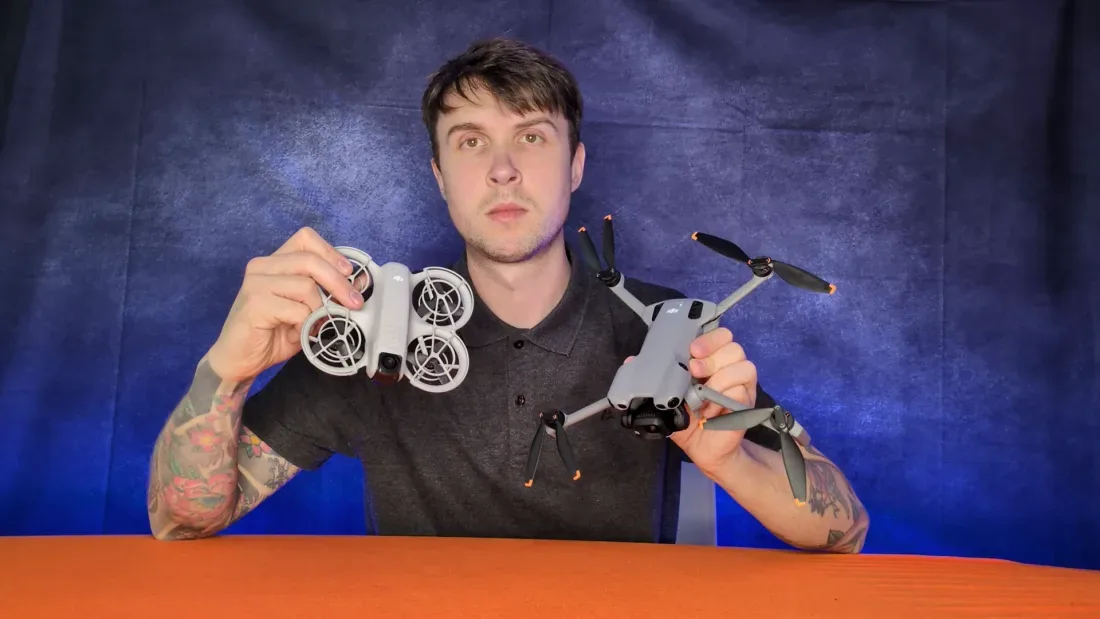
The two I’d tell you to walk away from
The DJI Mavic 3 Pro. It is a wonderful camera and it was the drone of its generation, but DJI UK lists every configuration out of stock, from the cheapest to the dearest, and its O3+ radio manages 15 km FCC and 8 km CE — less than the Mini 4 Pro manages for a fraction of the money. You would be paying Mavic money for a shorter link and a certificate requirement, and paying it to a third-party seller, because DJI itself cannot take the order. There is no buy link on its row for exactly that reason.
And the Autel EVO Lite+, which I have left in the list without a link because I could not find one worth giving you. It is a genuinely interesting drone — a one-inch sensor with an adjustable aperture, 40 minutes, 835 grams — and searching Amazon UK for it returns replacement motor arms and propellers rather than drones. It is also the clearest example in this guide of the thing Part Two is about: Autel sells it on “7.4 miles” and then prints “CE: 6km” in its own specification table. I would not buy on a number that the manufacturer halves further down the same page.
And if what you actually need is one shot from somewhere you cannot legally get to — a coastline, a large estate, a site that needs covering properly — then owning any of this is the expensive way round. You can hire a qualified drone pilot who already holds the certificate, the insurance and, where the job genuinely needs it, the authorisation to fly further than you may; and what that costs is usually less than the drone.
Best long range drone UK: the questions I get asked most
What is the best long range drone in the UK in 2026?
The DJI Mini 5 Pro. It carries DJI’s O4+ transmission, published as 20 km under the FCC standard and 10 km under the CE one, it flies for 36 minutes on its standard battery, and at 249.9 grams it stays in the easiest weight bracket in UK law. Spend roughly half as much and the DJI Flip gives you 13 km FCC and 31 minutes, on the same generation of radio and the same C0 mark. Spend several times as much and the DJI Mavic 4 Pro publishes 30 km FCC and 51 minutes, though at 1,063 grams and C2 it needs an A2 Certificate of Competence before you can fly it near people. None of the three may legally be flown further than you can see it.
How far can you legally fly a drone in the UK?
As far as you can see it with your own eyes, and no further. The rule is Visual Line of Sight: you must keep the drone in direct sight, clearly enough to tell which way it is facing, and have a full view of the surrounding airspace. Direct sight excludes binoculars, telephoto lenses and screens of any kind. There is no distance written into the Open Category rules, but in practice that puts most people between 300 and 400 metres horizontally, and often much less. The 500-metre figure quoted online comes from a Specific Category authorisation, not from the rules recreational flyers fly under.
Why does my drone say 20 km transmission when I cannot fly that far?
Because transmission range is a radio specification, not a permission. DJI measures it in an unobstructed, interference-free environment, one way, with no return flight, and publishes a different figure for each radio standard: 20 km under FCC, 10 km under CE, on the same drone. On the same specification page DJI also publishes what happens in the real world — roughly 1.5 to 4 km in a city, and 0 to 0.7 km once buildings are in the way. None of those numbers is a legal distance. The legal distance is what you can see.
Do I need a licence to fly a long range drone in the UK?
Not a licence, but you almost certainly need to register. Anyone flying a drone of 100 grams or more needs a Flyer ID, a free online theory test valid for five years. Every drone of 100 grams or more with a camera needs an Operator ID, which costs £12.34 a year and goes on a label stuck to the drone. After that it is weight and class mark that decide where you can fly. Sub-250-gram drones and C0 or C1 drones can be flown in built-up areas today. A C2 drone like the DJI Mavic 4 Pro needs an A2 Certificate of Competence before you can fly it near people at all.
Is a longer transmission range worth paying for?
Yes, but not for distance. A stronger link buys you margin: the picture holds together at 300 metres behind a hedge, in a town full of Wi-Fi, or with the controller pointed the wrong way. DJI’s own figures show a 20 km drone dropping to between 1.5 and 4 km in a city and to under 700 metres behind buildings, so the headline number is the ceiling from which the real world subtracts. Buying more range means buying a bigger gap between the specification and the distance at which the picture starts to break up.
Can I fly beyond visual line of sight if I have an observer or FPV goggles?
No. Flying beyond visual line of sight needs an Operational Authorisation from the CAA that specifically permits BVLOS, and that sits in the Specific Category, not the Open Category all recreational flying happens in. The CAA states plainly that using FPV equipment does not mean you can fly beyond visual line of sight. An observer lets you fly through goggles while they keep the drone in sight — it does not extend how far away the drone may be. The only relaxation in the Drone Code is follow-me mode, and only while the drone is set to follow within 50 metres of you.
The short version
Buy the DJI Mini 5 Pro. It has the strongest link you can get under 250 grams, which means margin where you need it and no paperwork where you do not. Then fly it to three or four hundred metres, which is as far as the law lets your eyes take you — and treat the number on the box as headroom rather than a destination.
Affiliate links · costs you nothing extra · full disclosure
Specifications checked 31 July 2026 against manufacturer sources. I do not print prices anywhere in this guide: they change from week to week, so the only figure worth trusting is the one on the listing when you click through. Transmission, weight, class and flight-time figures come from the manufacturers’ own specification pages; regulatory detail from the UK Civil Aviation Authority and its Drone Code. DJI Mini 4K weight and flight time from DroneCompare, licensed under CC BY 4.0. Amazon links are affiliate links. Related reading: how the camera drones compare, what you can take on a plane and what signal loss actually is.