Sub-250g Drones Over Crowds: The Rule Every Drone Pilot Gets Wrong

Peter Leslie
10 Sept 2025
Key Takeaways
- A sub-250g drone in the A1 sub-category can legally fly closer than 50 metres to uninvolved people, and can legally overfly them
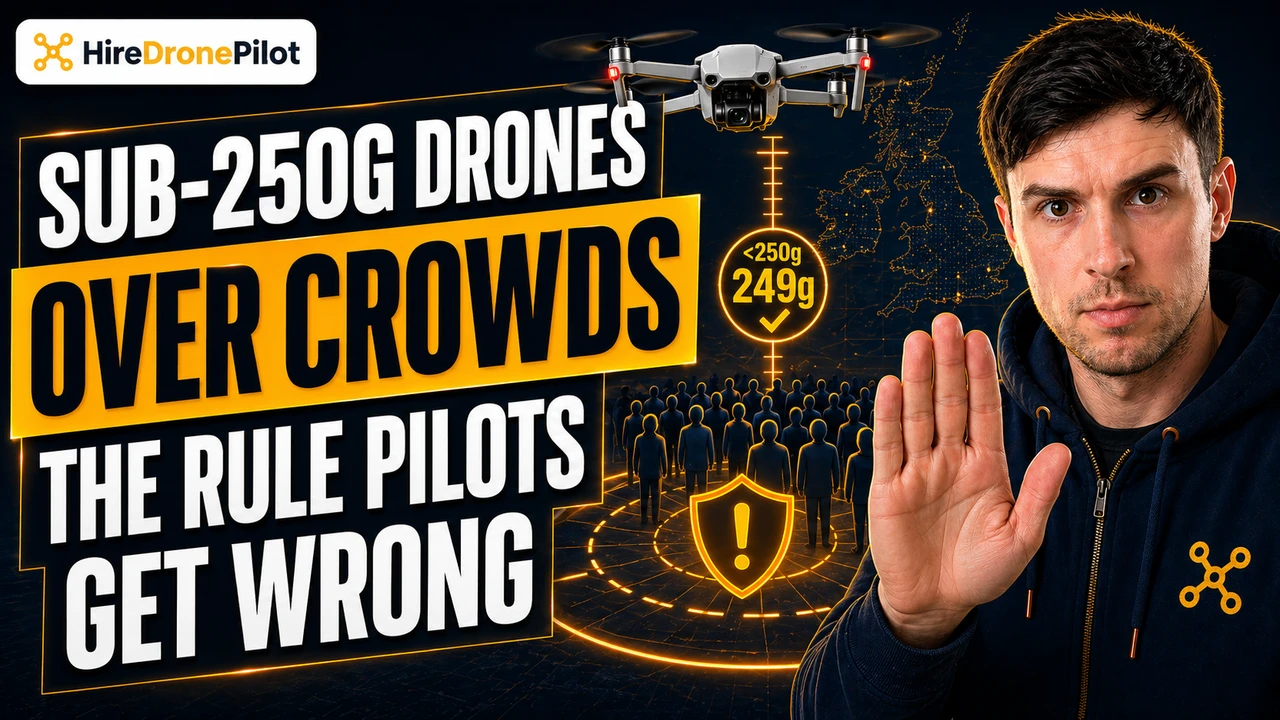
- That same drone still cannot fly over a crowd, at any height, under any circumstance allowed in the Open Category
- The Drone Code defines a crowd as any group of people who cannot move away quickly because of the density around them
- Typical crowds named in the Code are sports events, music festivals, shopping areas, rallies, parties, and crowded beaches or parks
- Flying close to or over crowds requires the Specific Category and a UK SORA-based Operational Authorisation, not a PDRA01
- Getting it wrong is a criminal offence under the Air Navigation Order 2016, and endangering an aircraft carries up to five years in prison
The most common misconception I hear from newer drone pilots goes something like this: my drone is under 250 grams, so I can fly it anywhere, including over a crowd. Half of that sentence is true. The other half is a criminal offence under UK drone law.
A sub-250g drone does unlock things a heavier drone cannot do in the Open Category. It is allowed inside the fifty-metre people-buffer, and it is allowed to overfly uninvolved people. But the ban on flying over a crowd applies to every drone in the UK, regardless of weight, and the Drone and Model Aircraft Code defines a crowd far more broadly than most drone pilots think.
A sub-250g drone unlocks A1 access to people, but not a free pass over everyone
The sub-250g weight threshold is the line that separates the two permissive sub-categories inside the Open Category. In the Drone Code’s wording, a legacy drone under 250 grams, or anything carrying a UK0, UK1, C0 or C1 class mark, flies in the Over People (A1) sub-category. A drone above that threshold, without an A2 CofC, drops into the far-stricter Far from People (A3) rules.
What A1 access actually grants you is two specific relaxations of the fifty-metre people rule. First, you can fly closer than fifty metres horizontally to uninvolved people. Second, you can fly over those uninvolved people. A heavier drone in A3 can do neither without the A2 CofC, and even the A2 route only closes the gap to thirty metres in most conditions. If you want the list of drones that actually fit inside A1 on weight alone, see my best sub-250g drones for 2026 guide.
The CAA is very deliberate about the language. A1 relaxes the rules for uninvolved people, not for people who are crowded together. Those are two different categories in the Code, and the rules that apply to them are not the same.
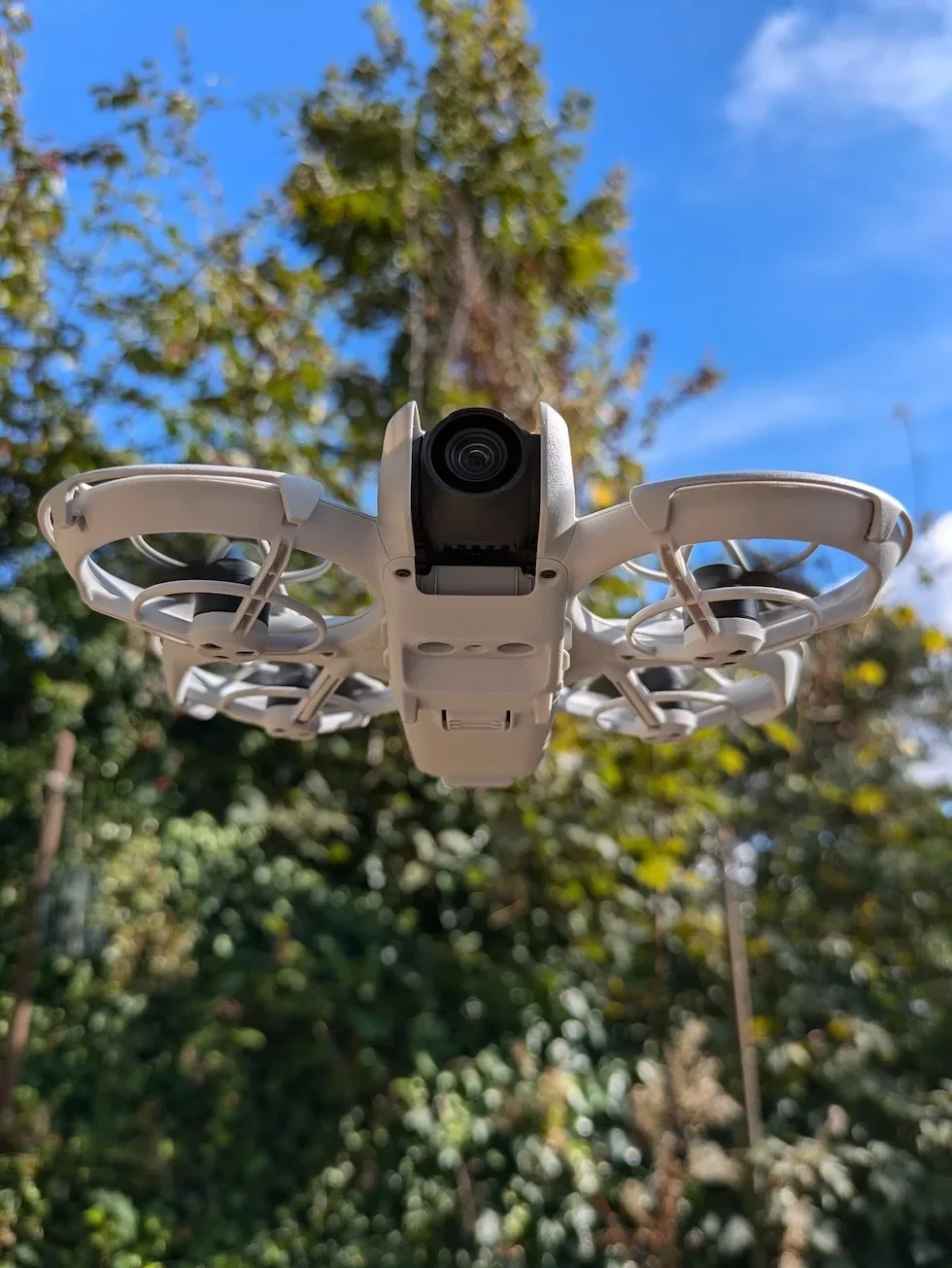
The Drone Code bans overflying crowds with every drone in the UK, no matter how light
Rule 5 of the Drone Code is explicit. Never fly over crowds, no matter what size of drone you have. The wording is not accidental. The CAA drafted the A1 relaxations knowing this ban would sit alongside them, and the two rules are designed to be read together.
This is also baked into the A1 sub-category description on the CAA’s Where You Can Fly page. Under the A1 Do not list, the first line is do not fly over crowds. The second is the 120-metre altitude ceiling, which you can read more about in our drone height limit guide. The first one is the line that catches almost everybody out.
The Drone Code’s own list of authorisations you would need to step outside the Code puts flying over crowds in the same category as flying above 120 metres or closer than 150 metres to residential areas. It is Specific Category territory, not Open Category territory.
A crowd is any group of people who cannot move away quickly — and that is a wider definition than it sounds
The definition inside Rule 5 is the one every drone pilot should be able to quote. A crowd is any group of people who cannot move away quickly because of the number of other people around them. The test is density and mobility, not headcount.
The Code then lists worked examples of places where people are typically crowded together. Every one of them is a standard drone commission request, which is why this list matters in practice:
- Shopping areas — a busy high street or a pedestrianised shopping district.
- Sports events — spectators around a football pitch, a rugby ground, a running event.
- Religious and political gatherings — congregations, demonstrations, civic ceremonies.
- Music festivals and concerts — any ticketed or open-access live-music event.
- Marches and rallies — parades, protests, processions.
- Crowded beaches and parks — on a peak weekend, even a public park becomes a crowd.
- Parties, carnivals, and fêtes — weddings, street parties, town-centre seasonal events.
Notice what is not on the list. A busy pavement at lunchtime, a line of people at a bus stop, a couple of families on a beach on a quiet morning — those are uninvolved people, not a crowd. Rule 4 governs them, and a sub-250g drone can legally overfly them. The practical test I use on site is the one the CAA gives you for free: if the group below could scatter in a second if something went wrong overhead, they are not a crowd. If the packing is tight enough that scattering is physically impossible, they are.
Two practical sub-250g examples show where the line sits on real jobs
The abstract test becomes much easier with side-by-side examples. Both of these pairs come straight out of my own commercial diary.
Wedding ceremony vs wedding reception. A wedding ceremony on a manicured lawn, where forty guests are seated in rows watching the couple, is a crowd. Packed seating, narrow aisles, no way to scatter if a drone fails overhead. Overflying that with any drone is illegal, sub-250g included. A wedding reception on the same lawn two hours later, with guests spread out in small clusters holding drinks, is not a crowd — and a sub-250g drone can fly over the dispersed guests, provided you are still flying safely and respecting the venue’s rules. For client-facing coverage, wedding aerial work usually plans the overhead shots around the reception layout, not the ceremony.
Outdoor market vs city-centre shopping. A farmers’ market with fifteen stalls and browsers walking between them is normally not a crowd, unless the aisles are shoulder-to-shoulder. You can fly a sub-250g drone above the stalls at a sensible altitude without breaching Rule 5. A Saturday afternoon on Oxford Street, Carnaby Street, or the pedestrian zone of any major city centre at peak hours is a crowd for Rule 5 purposes — the density and mobility test is obvious on sight. The London drone rules guide covers the airspace and bylaw layers that stack on top of this one.
The hard cases sit in the middle. A slightly busy seaside promenade on a bank holiday, a half-full town square during a Christmas market, a crowded park bandstand. My default on those is to treat the group as a crowd, plan around it, and not rely on a borderline interpretation. If your flight can be reframed so the drone is overhead of the space around the group rather than the group itself, take that reframe every time. Our public park and beach guides work through the location-specific sides of this.
PDRA01 does not fix this — the Specific Category route for crowds is a UK SORA
There is a second misconception that follows hard on the first. Drone pilots who have gone through the GVC and hold a PDRA01 Operational Authorisation sometimes assume that authorisation lets them fly over crowds. It does not.
PDRA01 is the pre-defined route into the Specific Category for the large majority of commercial UK drone work. It authorises flight inside residential, commercial, industrial and recreational areas, with drones between 250 grams and 25 kilograms. It names the 1-to-1 rule for horizontal separation from assemblies of people — see the 1-to-1 rule explainer for the detail — and it lets you fly within fifty metres of uninvolved people.
What PDRA01 does not do is permit overflight of assemblies of people. The PDRA01 conditions state it in black and white: any overflight of assemblies of people must not be conducted, and horizontal separation must stay at least fifty metres. So a PDRA01-holding drone pilot, flying a 900-gram camera drone, is in exactly the same legal position as a hobbyist with a sub-250g drone when a crowd is underneath: overflight is off the table.
If the flight genuinely needs to be close to or over a crowd, the CAA’s own Specific Category overview lists flying close to crowds as an operation that requires a UK SORA-based Operational Authorisation, not a PDRA01.
UK SORA replaced the old OSC process from 23 April 2025 as the method for bespoke Operational Authorisations. It is the right tool for things a PDRA01 does not cover: crowd overflight, BVLOS, flights above 120 metres, drops, and swarm operations. A UK SORA application is its own piece of work — see our explainer on CAP 722 for the broader framework — and it is not a weekend exercise. It is, however, the only legitimate route if the brief really does require a drone over a crowd.
Breaking Rule 5 is a criminal offence, and the sub-250g weight does not soften the penalty
The Drone Code is not an etiquette document. It is the operational face of the Air Navigation Order 2016 and the UK Regulations (EU) 2019/945 and 2019/947. Breaching Rule 5 by flying over a crowd is a criminal offence regardless of drone weight.
Routine breaches can result in a fine. Endangering an aircraft in flight carries a maximum sentence of five years in prison. Flying outside the Code also invalidates your third-party drone insurance, which turns any incident from an insurance claim into direct personal liability. If you are working commercially, the policy cancellation ends the job and ends the client relationship at the same time.
There is also the second-order problem that crowds tend to contain cameras. Social media does the CAA’s enforcement work for them more often than drone pilots realise. A sub-250g drone buzzing over a festival gets filmed by a hundred phones, posted to TikTok by evening, and flagged to the CAA by morning. The weight class is irrelevant to the complaint, and the police powers to stop-and-seize follow the same path whatever the drone on the evidence clip weighs.
So the sub-250g rule in the UK is genuinely permissive — more so than a lot of drone pilots give it credit for. It lets you fly within fifty metres of uninvolved people, and it lets you overfly them, which is a real advantage for the kind of low-risk aerial work most drones get used for. The line it does not cross is the crowd line, and that line sits exactly where Rule 5 puts it: any group of people too tightly packed to scatter.
If the brief genuinely demands a drone over a crowd, the honest answer is the Specific Category and a UK SORA-based Operational Authorisation — not a sub-250g workaround. For the wider picture on weight thresholds and class marks, the Operator ID guide and the hub page both fill in the surrounding rules.
Got a specific scenario you want covered — a borderline event site, a wedding brief, a city-centre shoot where the crowd test is unclear? Drop a note to peter@hiredronepilot.uk and I will come back to you directly. If you prefer the video version of this explainer, the comments are open on YouTube.
References
Primary source material for this article is the UK Civil Aviation Authority. External links open in a new tab.
- UK CAA — The Drone and Model Aircraft Code (CAP2320) · Rule 4 (sub-250g A1 relaxations), Rule 5 (crowd ban and crowd definition), Rule 9 (authorisation needed to step outside A1/A3)
- UK CAA — Where You Can Fly (A1, A2, A3 sub-categories) · A1 Over People rules for UK0/UK1/C0/C1 and sub-250g drones, including the “do not fly over crowds” instruction
- UK CAA — PDRA01 Operational Authorisation Overview · 50m separation from assemblies of people, no overflight of assemblies, the named 1:1 rule
- UK CAA — Specific Category Overview · UK SORA replaced OSC on 23 April 2025; flying close to crowds requires a UK SORA-based Operational Authorisation
- UK CAA — Class Marks · UK0/UK1 and C0/C1 weight boundaries, legacy sub-250g category, January 2026 class-mark requirement
- UK CAA — UK Regulatory Framework for Drones · Air Navigation Order 2016 and the UK Regulations (EU) 2019/945 and 2019/947 penalties
Peter Leslie
Founder & GVC Drone Pilot
Peter is the founder of HireDronePilot. With thousands of logged commercial flight hours, he writes about drone technology, commercial surveying tactics, and UK aviation compliance.
Connect on LinkedIn