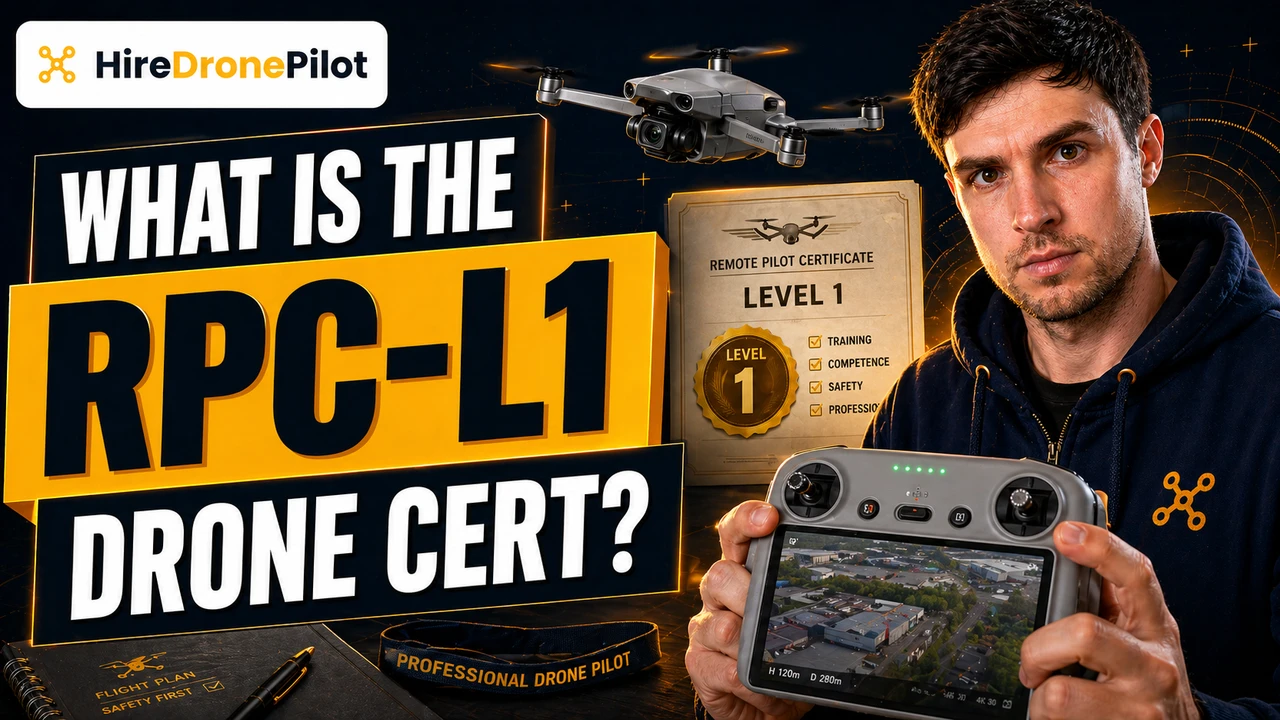
What Is the RPC-L1? UK Remote Pilot Certificate Level 1 Explained

Peter Leslie
16 Apr 2026
Key Takeaways
- The RPC-L1 is the UK entry-level Remote Pilot Certificate for Specific Category Visual Line of Sight operations
- An RPC-L1 satisfies the Remote Pilot requirement for PDRA01, the standard authorisation for commercial VLOS work in built-up areas
- It is the first rung of the RPC progression ladder that leads through RPC-L2 and RPC-L3 to Beyond Visual Line of Sight work
- The certificate is valid for five years, has no minimum age, and is issued separately for rotorcraft or fixed-wing drones
- Drone pilots already holding a GVC are exempt from the RPC-L1 theory test and only need to complete the practical flight assessment
The Level 1 Remote Pilot Certificate — RPC-L1 — is the entry-level qualification inside the UK Remote Pilot Certificate framework. It sits in the Specific Category alongside the GVC and authorises Visual Line of Sight operations only.
In practice it does two jobs. It qualifies you as a Remote Pilot under PDRA01 for day-to-day commercial work, and it is the only starting point on the progression ladder that eventually leads to Beyond Visual Line of Sight flying.
The RPC-L1 is the first rung of the UK Specific Category qualification ladder
The UK Civil Aviation Authority recognises five Specific Category qualifications: the GVC, and RPC-L1 through RPC-L4. Of those five, only two — the GVC and the RPC-L1 — are entry-level. Both authorise the same VLOS work. The RPC-L1 is the one that sits formally inside the RPC framework and opens a structured progression route.
The L1 in the name is not decorative. It is a deliberate signal that this is the starting point of a ladder. Above it sit the RPC-L2 for BVLOS work in ARC-a airspace, the RPC-L3 for BVLOS up to ARC-c, and the RPC-L4 for expert operations. Each level builds on the one below, and you cannot skip rungs.
For any drone operator whose future includes advanced work — long-range inspection corridors, linear asset surveys, first-responder deployment — the RPC-L1 is the entry ticket. No RPC-L1, no RPC-L2.
The RPC-L1 authorises Specific Category VLOS operations under PDRA01
On its own, an RPC-L1 is a competency certificate, not a flight permission. To actually fly commercially in built-up areas you pair it with an Operational Authorisation — most commonly PDRA01, the pre-defined authorisation the CAA issues for standard VLOS work.
PDRA01 explicitly lists the Remote Pilot requirement as RPC-L1 (either aeroplane or rotorcraft) or GVC (either fixed wing or multirotor). Holding an RPC-L1 satisfies that requirement in full. Inside PDRA01 the operating envelope is the one most commercial drone pilots work inside every day.
| PDRA01 condition | Limit |
|---|---|
| Drone mass | 250g to 25kg |
| Altitude ceiling | 120m (400ft) above the closest point of the surface |
| Maximum range from Remote Pilot | 500m, within VLOS |
| Separation from uninvolved people | 50m, reducing to 30m for take-off and landing only |
| Assemblies of people | 50m horizontal separation, 1-to-1 rule, no overflight at any height |
| Annual cost | £524 per year, no VAT |
Inside those limits, an RPC-L1 drone pilot can legally take on roof inspections, building photography, site surveys, and the rest of the standard PDRA01 caseload. BVLOS sits outside the envelope entirely and requires the RPC-L2 or higher.
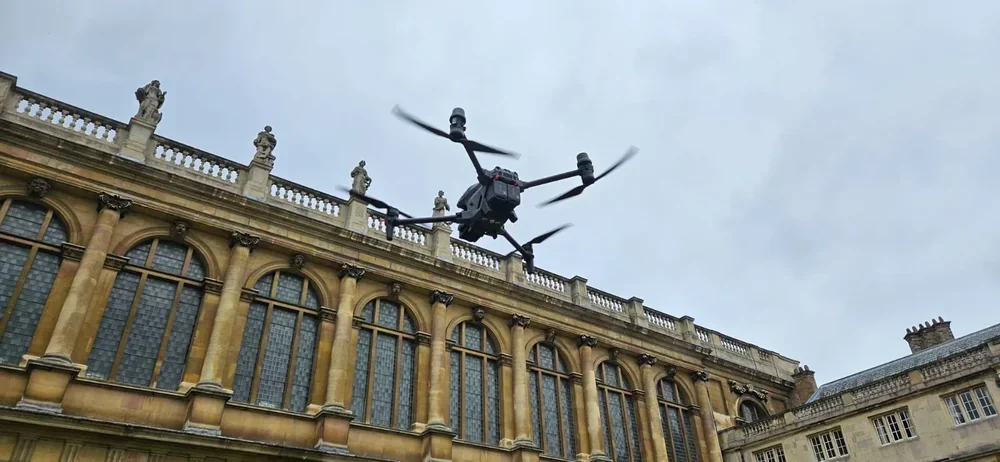
An RPC-L1 and a GVC unlock the same day-to-day work, but only the RPC-L1 leads anywhere else
The GVC is the older, standalone VLOS certificate. For PDRA01 flying the two are functionally identical — the authorisation treats them interchangeably. We covered the head-to-head in detail in RPC-L1 vs GVC. The short version is worth repeating here.
The difference is the road after PDRA01. The GVC is a dead-end certificate — it qualifies you for VLOS work and that is where the syllabus stops. There is no GVC Level Two. The RPC-L1 is explicitly designed as the first step on a progression path that continues through RPC-L2 to BVLOS, and onward to RPC-L3 and RPC-L4 for integrated airspace and expert operations.
There is also a categorisation difference. The GVC is issued once and covers both multirotor and fixed-wing drones. The RPC-L1 is issued per drone type — RPC-L1(R) for rotorcraft, a separate certificate for fixed wing — so drone operators flying both types through the RPC framework need both variants.
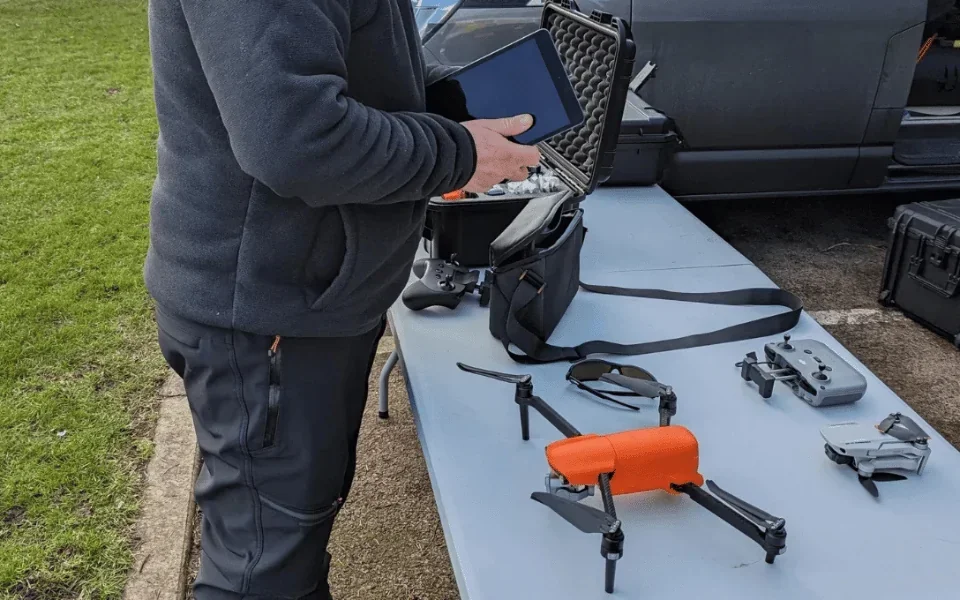
The training path is a theory exam and a practical flight assessment at a CAA-approved RAE
The RPC-L1 is awarded by Recognised Assessment Entities (RAEs) — the CAA-approved training providers that run the course and the exams. A valid Flyer ID is the entry condition, and there is no minimum age. Training providers may set their own age policies, so confirm directly with your chosen RAE before booking.
Assessment has two components. A theory examination covering air law, operational procedures, human factors, meteorology, navigation, and the principles behind Specific Category risk assessment. A practical flight assessment demonstrating controlled VLOS operations, pre-flight planning, in-flight handling, and emergency procedures — flown on the drone type the certificate will be issued for.
Drone pilots who already hold a valid GVC get a useful shortcut: a GVC exempts you from the RPC-L1 theory test, leaving only the practical flight assessment. That is deliberate on the CAA side — it lowers the bar for existing GVC holders who want to move onto the RPC progression pathway without restudying material they have already proved. The final certificate is valid for five years.
The RPC-L1 pairs with an Operational Authorisation, drone operator registration, and insurance
Holding an RPC-L1 is one piece of a larger compliance stack. To actually take on commercial work you need four things in place. A qualified Remote Pilot — the RPC-L1 satisfies that. An Operational Authorisation — usually PDRA01, applied for by the drone operator. An Operator ID displayed on every drone. And drone insurance compliant with UK Regulation (EU) 785/2004 for any flight conducted with commercial intent.
The Operational Authorisation is the document that actually grants the flight permission. The RPC-L1 is the Remote Pilot qualification that makes you eligible to be named on it. Separate things, both required. PDRA01 is the default starting Operational Authorisation for most new Specific Category drone operators, and the RPC-L1 is built to satisfy its Remote Pilot requirement on day one.
Choose the RPC-L1 over an A2 CofC or GVC when progression to BVLOS is on the table
The three certificates drone pilots usually weigh up are the A2 CofC, the GVC, and the RPC-L1. They sit at different points on the regulatory map, and only one of them leads to BVLOS.
The A2 CofC is an Open Category qualification. It covers the Near People (A2) sub-category — flying closer to uninvolved people within the Open Category's weight and behaviour limits — and is the right call for recreational drone pilots or for small commercial operations that genuinely fit inside the Open Category. It does not touch PDRA01 and it does not unlock Specific Category work.
The GVC and the RPC-L1 are both Specific Category VLOS certificates. Pick the GVC if you fly both multirotor and fixed-wing drones routinely and want one certificate to cover both, and if BVLOS is genuinely not on your roadmap. Pick the RPC-L1 in every other case — especially if you are starting fresh with no Specific Category qualification, because it covers everything the GVC does and adds the progression ladder on top. For existing GVC holders who now want a BVLOS route, the theory exemption makes adding the RPC-L1 practical the fastest and cheapest way to get onto the RPC ladder without starting again.
The RPC-L1 is the right entry certificate for any drone pilot serious about a long-term Specific Category career, because it is the only entry point that keeps the door open to advanced work. Day to day, it looks identical to a GVC. Year to year, it is the one that can grow with you.
For the wider picture of drone pilot qualifications in the UK, the overview stitches every Open and Specific Category certificate together.
Got a specific qualification question — a training provider decision, a transition from GVC, a BVLOS roadmap? Drop a note to peter@hiredronepilot.uk and I will come back to you directly. If you prefer the video version of this explainer, the comments are open on YouTube.
References
Primary source material for this article is the UK Civil Aviation Authority. External links open in a new tab.
- UK CAA — Level 1, 2 and 3 Remote Pilot Certificates and GVC · RPC-L1 entry conditions, UA category variants, five-year validity, GVC theory exemption
- UK CAA — Remote Pilot Qualifications Overview · list of the five Specific Category qualifications, Flyer ID prerequisite
- UK CAA — PDRA01 Operational Authorisation Overview · Remote Pilot requirement (RPC-L1 or GVC), 50m/30m separation, 500m range, 120m ceiling, £524/year
- UK CAA — Beyond Visual Line of Sight (BVLOS) · BVLOS requires Specific Category and Operational Authorisation; RPC-L2 minimum
- UK CAA — UK Regulatory Framework for Drones · Air Navigation Order 2016 and UK Regulations (EU) 2019/945 and 2019/947
Peter Leslie
Founder & GVC Drone Pilot
Peter is the founder of HireDronePilot. With thousands of logged commercial flight hours, he writes about drone technology, commercial surveying tactics, and UK aviation compliance.
Connect on LinkedIn